
The Z is for zombie.
What sets World War Z apart from other zombie pictures is its massive scope. It literally is a World War against the undead.
First Impressions
This trailer starts with Brad Pitt, his wife, and his children stuck in a traffic jam in New York City. A police officer warns them to stay in their car when a garbage truck smashes into the man, along wth dozens of cars, knocking them out of the way. Everyone runs. The family manages to make it onto a helicopter while some crazy looking people follow. The world is being overrun by something that causes people to go rabid and attack others. A shot of a mound of individuals climbing a wall, like a group of ants trying to reach over the top, gives some perspective as to what these creatures are capable of. It’s the start of World War Z, and you’ll never look at zombies the same again.
Presented below is the trailer for the film.


World War Z title card.
The Fiction of The Film
In Philadelphia, Gerry and Karin Lane (Brad Pitt & Mireille Enos) are awoken by their two daughters, Rachel (Abigail Hargrove) and Connie (Sterling Jerins). They are heading out of town on vacation, but get stuck in a traffic jam in downtown as chaos erupts all around them. Mass panic and explosions are a precursor to a wave of hyper-fast zombies storming through the streets. They escape town by stealing an abandoned RV, having to stop in Newark and hide in an apartment building with an Hispanic family. Gerry, a retired U.N. investigator, is contacted by his friend Thierry (Fana Mokoena), the Under-Secretary-General of the U.N., who wants Gerry to help them.
Gerry readies his family to head to the roof the next morning as zombies storm the building. He stabs one, getting some of its blood in his mouth. On the roof, he steps to the edge, slowly counting to twelve to see if he turns or not. The young boy they stayed with, Tommy (Fabrizio Guido), comes with him, his parents having been killed by the monsters. They are taken to the USS Argus, an aircraft carrier in the Atlantic Ocean, where Thierry greets them, letting Gerry know that the whole world is infected.
Thierry recruits Gerry to travel with Doctor Fassbach (Elyes Gabel) to South Korea in search of the origin point of the outbreak. An accident kills Fassbach on the ground, but Gerry continues to investigate, hearing from a detained CIA operative (David Morse) that he needs to talk with Jurgen Warmbrunn in Jerusalem, which coincidentally sealed their city days before the outbreak. In Israel, Gerry asks how they were able to know an outbreak was coming. Jürgen tells him that they intercepted an Indian message that mentioned “zombies” and took the necessary precautions.

Gerry spends one last moment with Tommy and his daughters before departing on his mission.
A P.A. system inside the walled city is too loud and draws the zombies like ants to a picnic. They breach the walls, causing immediate chaos. Gerry is led to the airport by Segen (Daniella Kertesz), a female Israeli soldier, but his plane has left without him. A zombie bites her hand, so Gerry immediately amputates it, saving her life. They hop aboard a commercial flight where he directs pilots to the airport nearest a W.H.O. facility, which happens to be Cardiff, Wales. Gerry has an epiphany on the plane, realizing he’s seen zombies avoid three people who are ill or injured and believes that’s the ticket to surviving.
As the plane comes in for a landing, a zombie hidden in a compartment breaks out and immediately starts turning people into the undead. To protect themselves, Gerry detonates a grenade, which causes the plane to crash, injuring him. Unable to raise the plane, and believing Gerry is dead, Thierry is forced to release Karin and the children as non-essential personnel to a safe-camp in Nova Scotia. Segen helps him to the W.H.O. facility, where he awakens three days later. The doctor in charge, Javier (Pierfrancesco Favino), demands to know what he’s doing there, and he explains that camouflaging themselves by injecting a deadly pathogen into their blood may stop the zombies from “seeing” them.
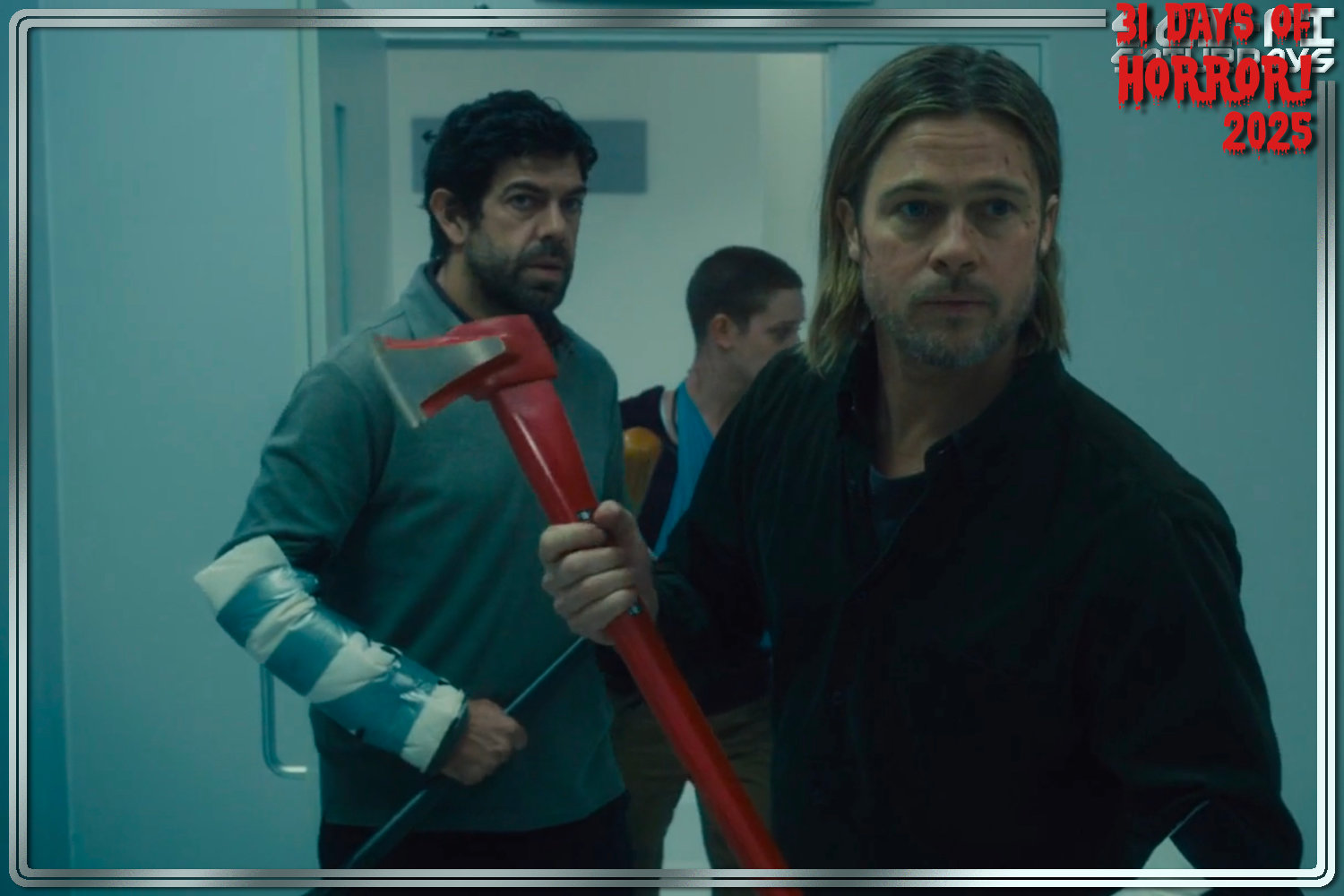
The other doctors all think this may work, but the necessary pathogens are locked in B-Wing, behind a horde of zombies. Gerry, Segen, and Javier take weapons and sneak through the infected hallways, being quiet to avoid rousing the dormant zombies. They get most of the way through undetected until Javier accidentally bangs a metal cart. Gerry leads the zombies away from Segen and Javier, but they can’t make it into the lab and narrowly make it back to safety. Gerry gets into the lab and grabs dozens of various vials, but is blocked from leaving by a zombie. He injects himself with a dose of a pathogen, which allows him to walk past all the zombies to safety. The film ends with Gerry and Segen landing in Nova Scotia to be with his family (and Tommy), while new reports and vaccines are sent worldwide to help the survivors clean up their world.
“Every human being we save is one less zombie to fight.” – Jürgen Warmbrunn

Rather than let the virus spread, soldiers torch the room with the infected.
History in the Making
Looking back over 10 years at World War Z shows a film that has made a huge impact in the horror genre and one that continues to resonate with fans. It’s an atypical zombie movie, which is why it’s being featured this week on the Sci-Fi Saturdays crossover with 31 Days of Horror. It’s a film derived from the zombie genre, but one that also includes a scope beyond the standard reanimated dead story. Unlike the majority of other zombie films, this film is an adaptation of the novel World War Z: An Oral History of the Zombie War, written by Max Brooks (son of actors Anne Bancroft and Mel Brooks). And adaptation is an interesting term, since the book is an oral history of the zombie apocalypse told by various characters in an abbreviated style. Many felt that the story was unfilmable as-is, but writer J. Michael Straczynski discovered a way to put it all together. He created the character of Gerry Lane and outlined his travels around the world looking for the origin of the plague. The story was re-worked by writer Matthew Michael Carnahan, and was eventually turned into a screenplay by Carnahan and the writing duo of Drew Goddard and Damon Lindelof.
The zombie film has enjoyed various periods of popularity, from its inception with George Romero’s Night of the Living Dead in 1968 through his final, original sequel, Day of the Dead, in 1985, to its renewed popularity in the 21st Century, which has only recently started to wane. With very few exceptions, Night of the Living Dead became the template for all modern zombie films, whether they are straight remakes (Night of the Living Dead – 1990), teen-centered (Night of the Comet), or comedies (Shaun of the Dead). Yet, there have been outliers. Resident Evil and 28 Days Later (both 2002) are the films that kicked off the modern popularity with zombies, with the former being based on a 1996 video game series. I Am Legend (2007), which is a cross between an apocalyptic zombie story with heavy notes of vampires, was based on a story by Richard Matheson. And then World War Z, of course. Since its release, at least three other zombie films have been based on literary sources, including Warm Bodies (2013), Pride and Prejudice and Zombies, and The Girl with All the Gifts (both 2016).
However, the biggest difference between World War Z and other zombie films is its global reach and strong scientific component, following the guidelines for tracking viral outbreaks and developing vaccines. Historically, zombie films take place in a specific locale with a small group of (often) diverse characters. Night of the Living Dead took place at a farmhouse. Dawn of the Dead took over a shopping mall. Shaun of the Dead and 28 Days Later both took place in London. World War Z is massive in comparison, as the film visits six global locations, features a large list of supporting characters, and most importantly, creates a humongous zombie outbreak. There are more zombies than you can shake a stick at, and definitely more than could be hired on as extras.

Like ants, the zombies are able to use their sheer numbers to accomplish things they would never be able to do alone.
Genre-fication
Some may argue the inclusion of World War Z as a science-fiction film, which is their prerogative. While it’s non-existent in the futurism aspects of the genre, it completely makes up for that with its apocalyptic setting and the strong scientific thread that runs through the film. If Resident Evil can be considered a zombie film with sci-fi elements, and I Am Legend can be considered a zombie film with sci-fi elements, then so too can World War Z exist in this vein. The motivation for Gerry to undertake his mission is driven by the short-lived Doctor Fassbach, who believes that if the virus is to have a cure, its point of origin must be sought out. He counsels Gerry that Mother Nature is a serial killer who hides her weaknesses as strengths. The clues to unraveling this mystery must be located in following the breadcrumbs and understanding the disease. And that’s just what he does for the first half of the film. Using the scientific method, characters create well-thought-out plans instead of random ideas of what may work. Gerry follows the trail back to Patient Zero, but eventually falls short. That’s when the film switches to a methodology of proving a scientific hypothesis and creating a vaccine instead of a cure. World War Z becomes one of the most hopeful apocalyptic films since Children of Men (2006), as it offers an upbeat ending for zombie fiction, something that is rarely ever seen.
In the realm of horror fiction, World War Z continued the popularity of the relatively new idea of the fast-moving zombie. Historically, zombies have been slower, shambling undead. The rotting corpses of the original zombie films were missing feet or legs and were unable to move as easily as humans, making the biggest fear of them about being overcome by too many zombies to fend off. Beginning in 2002 with 28 Days Later, the idea of “fast zombies” was introduced. This changed the genre immediately, instigating a whole new level of adrenaline-laced fear. We used to be able to outrun zombies and hide. Now, they run as fast as we can, limiting the options for survival. 28 Weeks Later and the remake of Dawn of the Dead expanded on this idea. World War Z took this idea to extremes. The ability to utilize CGI character models for the undead allowed for tidal waves of zombies to flood areas faster than people could escape. Gerry even utilizes a water metaphor in discussing zombies, saying they move around sick people like “a river around a rock.” Their speed and overwhelming numbers make them a force to be reckoned with, elevating the terror of an already scary genre. Three years later, Train to Busan would continue the frightening idea of fast zombies on a fast train, adding yet another reason to avoid crowds.

Gerry and Segen (which means Lieutenant in Hebrew) work their way towards the WHO campus and a potential cure.
Societal Commentary
Zombie films, by their very nature, are about societal issues. The impetus is a viral outbreak that turns normal members of society into cannibalistic creatures, breaking normal social interactions. World War Z takes the interpersonal relations in the classic zombie film (classism, fear of the other, racial tensions) and elevates it to a global level. No longer is the blame placed on an individual member of the group who is unable to work with the others (the subplot of nearly every zombie film to date). Instead, the failure falls to the city or country for being shortsighted. The book gets into some of these details more than the film, with the governments of the world being more to blame than specific characters. Much of the civilized world shown falls quickly to the viral outbreak, demonstrating a lack of proper protocols for dealing with a global contagion, especially one spread as quickly as this one. Only two countries show promise, each with very different methodologies. Israel receives advanced notice of the spreading zombie outbreak and is immediately able to close off its borders, isolating and protecting itself. It does not become isolationist, however. The country allows refugees who are uninfected to enter without stipulation, deciding that anyone who is not a zombie benefits society. North Korea falls on the flip side. Already a nation with closed borders, its government reportedly had the 23 million citizens’ teeth extracted within days to prevent the spread of the disease. As the CIA agent mentions, no teeth, no bite, no spread.
Every character that Gerry meets is eager to help him in one way or another. And those who throw roadblocks up, or act as minor antagonists to his story, do so for the right reasons. The commander of the USS Argus relegates Gerry’s family to non-essential personnel, but not as the action of some malicious military leader (like in Day of the Dead). He’s concerned with the greater good and needs only people contributing to the survival of the species on his boat. The W.H.O. doctors tie up Gerry when he arrives unconscious. They have no beef with him specifically, but are worried about strange people who show up uninvited at their doorstep. Suspicion is a normal reaction. The film says multiple times that humans are only following their nature, as the zombies are only following theirs. Jürgen states, “The problem with most people is that they don’t believe something can happen until it already has. It’s not stupidity or weakness. It’s just human nature.” It’s something Gerry has had to unlearn in his time with the United Nations. He tells Tommy’s family that “movement is life,” which becomes the truth of the film. They decide to stay in their apartment, getting turned, while Gerry’s movement is what keeps him alive throughout the film. It’s a contradiction to our instincts. Locking ourselves into a location feels safer, but not in this case.

Gerry explains to one of the WHO doctors why he is there, and what his plan is.
The Science in The Fiction
When Gerry joins the group of survivors on the boat, Thierry tells him that the airlines were the perfect delivery system for the virus. A global pandemic was created before anyone knew what was happening. This is the same idea of viral propagation as shown in Terry Gilliam’s film 12 Monkeys. A virus boards a small metal cylinder on a host. Hundreds of other people share the same air for hours, allowing plenty of time for infection. Then the individuals go their own way, taking the virus to a multitude of different locations. World War Z namechecks the Spanish Flu as a comparison. The film notes that the virus was unknown in 1918 but had killed 3% of the world’s population in three years. This may have been a difficult concept to wrap your brain around in 2013. But within 7 years, and the death tolls from the COVID-19 pandemic, the magnitude and speed of the infection feel much more real.
Gerry has the idea that a body infected by a pathogen will be ignored by the zombies, who are perfect vectors for spreading their deadly virus. The hypothesis sounds like it might work, but there’s no scientific proof, only Gerry’s anecdotal evidence. None of the scientists is ready to test something like this because it’s untried. However, they are willing to investigate the possibility that such an idea might work. This commitment to portraying scientists as people who follow the scientific method instead of cowboys who take unnecessary risks just for the sake of the plot is refreshing. Gerry gets to be the cowboy in this case (hey, it’s Brad Pitt!), injecting himself with an unknown pathogen. It might be one that kills him, according to Dr. Ryan, depending on which vial he chooses. Luckily, his hypothesis was sound and yielded the necessary information to allow for further testing and the release of a vaccine to inoculate the population against the vicious attacks of the undead. Another win for science and vaccines!

A poignant message to Gerry’s family is shared, just before he injects himself with a potential lethal virus.
The Final Frontier
Not directly related to the release of World War Z, but there was a mobile fitness game that came out around this time called Zombies, Run! It was designed as an immersive exercise program in which the player is out for a jog when zombies suddenly show up, necessitating a change in speed. Playing on the popularity of the zombie genre to get people more interested in exercise is an interesting decision, and one that can only help prepare for any ensuing global apocalypse. No word on whether you could train to outrun “fast zombies.” I would also be remiss if I forgot to mention the clever wordplay in the credits for actor Peter Capaldi. World War Z was filmed in 2012 and released in 2013. At some point in this time frame, Peter Capaldi found out that he was chosen as the Twelfth iteration of the character Doctor Who. Is it only a coincidence that he is credited as “WHO Doctor” in the credits of this film? Surely not.
Talk of a sequel to World War Z has been underway for the better part of a decade. Different directors and production companies have been attached as plans have changed and evolved. Just two months ago, in August 2025, Paramount announced a sequel was coming but provided no further details. If, and when, a sequel ever does arrive, there have been many real-world examples of pandemic, vaccine, and health-related news to include as further backstory for the film. Until then, World War Z stands as the most singularly optimistic zombie film, which presents a global story as seen through the lens of a family man.
Coming Next


Having grown up on comics, television and film, “Jovial” Jay feels destined to host podcasts and write blogs related to the union of these nerdy pursuits. Among his other pursuits he administrates and edits stories at the two largest Star Wars fan sites on the ‘net (Rebelscum.com, TheForce.net), and co-hosts the Jedi Journals podcast over at the ForceCast network.