
And you think traffic in your city is bad!
Valerian and the City of a Thousand Planets is a mouthful of a title for a film that is just as long. It’s a space opera released at a time when sci-fi films were trending toward the more real and gritty, rather than the fantastical. Adapting a popular French comic series from the late 1960s, the film might be asking too much of short-attention spanned audiences, as it creates a bizarre and fun galactic romp.
First Impressions
The trailer creates an epic vision that feels like a cross between Star Wars and Avatar. Directed by the man who also directed The Fifth Element and based on a graphic novel, the preview gives little away in terms of planet, focusing instead on the grandeur and scale of the film. Giant spaceships and creatures. Fantastic technology. Weird alien beings. And, something slightly sinister.
Presented below is the trailer for the film.


Valerian and the City of a Thousand Planets title card.
The Fiction of The Film
Footage of the first meeting between United States astronauts and Soviet Union cosmonauts in orbit leads into a montage of a space station in Earth orbit slowly getting bigger over time as more groups join the space-faring nations. In 2150, the first alien beings are met as the space station continues to grow in size. Eventually, the Alpha Intergalactic Space Station, as it has become known, becomes so large that it must be pushed out into deep space. Four hundred years later, on the planet Mül, the peaceful Pearl aliens are decimated by the crash of space vessels on their planet. The Emperor and his wife are trapped in a crashed spaceship, while their daughter, Princess Lihö, is stuck on the surface as the planet explodes. Elsewhere, Major Valerian (Dane DeHaan) and Sergeant Laureline (Cara Delevingne) arrive at the planet Kyrian to recover the converter, an alien creature, and return it to Alpha.
Valerian enters the Big Market, a transdimensional trading post, where he mingles with tourists until he can find the location of the converter. A pair of hooded aliens is attempting to purchase the creature from Igon Siruss (John Goodman), a large intergalactic mobster. The mission has some complications, but Valerian manages to escape with their ops team and Laureline’s help in their spaceship, named Alex. Onboard, Valerian asks Laureline to marry him, which she scoffs at. They return to Alpha with the creature, which is capable of replicating any object placed within its mouth. Valerian and Laureline report to General Okto-Bar (Sam Spruell), who informs them of a radioactive zone, the Red Zone, in the middle of Alpha. Commander Arun Filitt (Clive Owen) wants the zone destroyed, lest it kill off Alpha. Valerian is tasked with protecting the Commander during a Security Council meeting while Laureline keeps watch of the converter.
During the meeting, a dozen aliens storm into the room and kidnap the Commander. Valerian pursues them in his spaceship as they fly through the superstructures of the space station. When the passages become too narrow, the Major ejects in his SkyJet and disappears into the Red Zone. Laureline is confined to quarters due to the kidnapping, but escapes and, with the help of three bird-like aliens, the Doghan Daguis, meets with a submarine driver named Bob (Alain Chabat). In order to find Valerian, Laureline must procure a jellyfish from an underwater bromasaur. She places the sea creature on her head, like a hat, and uses its telepathy to locate Valerian. Laureline finds Valerian stuck on a cliffside, but is soon caught by the Boulan-Bathor, a primitive group of large aliens living in the “Restricted Area.”

An example of some of the highly stylized imagery in the film, based on panels from the original comic.
Valerian navigates the vice and lowlifes of the Paradise Alley pleasure area and meets Jolly (Ethan Hawke), a pimp, for Bubble (Rihanna), a shape-shifting glamopod. He convinces Bubble to help him sneak into the Boulan-Bathor region and save Laureline. Meanwhile, Laureline is dressed up in a fancy white dress and used as a server for the King of the tribe. He is less interested in the food platter she holds, but does fancy snacking on her head. Luckily, Valerian enters to save her, disguised as one of the tribespeople by Bubble. A fight ensues where the heroes kill many of the tribe before escaping. They land in a garbage pit where Bubble dies from her wounds. Valerian reveals that the Pearl princess Lihö is somehow communicating with him and guiding their adventure.
The duo enters the radiation zone but finds that there is actually no radiation present. They discover a tribe of Pearls, the sole survivors of the massacre on Mül. They are looking to secure the last living converter so they can power up their spaceship and seek out a new homeworld. The Pearl Emperor, Haban Limaï (Elizabeth Debicki), reveals that a war fought above their planet was the cause of its destruction, specifically the firing of fusion missiles by Commander Filitt. They have captured him to trade for the converter. Laureline feels pity for them and hands over the converter and the last remaining power pearl. Arun awakens and demands that Valerian and Laureline follow his orders and stop these “savages.” Valerian punches him out instead.
Outside the zone, soldiers have gathered to stage a rescue of the Commander, along with Arun’s cadre of K-Tron battle robots. Valerian manages to get word to Okto-Bar to hold off the attack, but the K-Tron robots following Arun’s orders begin attacking everyone. After a large battle and the detonation of a Federation bomb, the K-Trons are destroyed, the Pearls escape in their newly powered space-zeppelin, and Arun is captured by Valerian and Laureline, who survive in a 21st-century space capsule. Valerian repeats his offer to marry Laureline, who kisses him and replies, “Maybe.”
“You are your own worst enemy, Commander. Unless you make up with your past, you won’t have a future.” – Emperor Haban-Limaï

Laureline examines the Mül converter.
History in the Making
Valerian and the City of a Thousand Planets is a light-hearted space-opera based on a popular French bande dessinée and adapted to the big screen. It is a sprawling space-epic, similar to dozens of other films from the previous 40 years, yet it was released to much aggression and disdain. There certainly are elements of the movie that are throwbacks to a different time of filmmaking, which the audience may have resisted or thought inappropriate. But overall, this film is fun and goofy, based so much on its inspirational source.
Between 1967 and 1985, writer Pierre Christin and artist Jean-Claude Mézières serialized the adventures of Valerian and Laureline in the French anthology magazine Pilote, first weekly and then monthly. Pilote was best known for the comedic Asterix, but also featured the western Blueberry (by Jean “Mœbius” Giraud) and the comic strip Achille Talon. As a publication, it provided a modicum of serialized science-fiction stories and would inspire other titles, such as Métal Hurlant and its American counterpart, Heavy Metal. The Valerian and Laureline stories were popular enough to be collected in Albums, and continued being published from 1988 to 2019, even after Pilote ceased publication. Twenty-three separate adventure storylines were published over the 50 years of publication. Director Luc Besson chose to adapt the seventh storyline, “Ambassador of the Shadows,” for this particular film.
Besson is no stranger to sci-fi films or the styles associated with French bande dessinée. He created The Fifth Element twenty years prior, which features early ideas that he would flesh out in Valerian. Jean-Claude Mézières and Mœbius were two of the artists that Besson sought out during pre-production for The Fifth Element, and many of the aliens and background designs seem reminiscent of their artwork. For Valerian, Besson took direct inspiration from the four-part story originally published in Pilote, using some of Mézières’ frames verbatim. The plot was adapted from the story, with many elements remaining the same, but also some additional material was inserted to flesh out the characters and situations. Both the original comics and this film appear to be influenced by pop culture films and stories that have influenced the later 20th Century resurgence of sci-fi and fantasy.

Valerian is a wanted man for disobeying the orders of his commander (but for good reason).
Genre-fication
The films John Carter, Flash Gordon, and Star Wars all have one major thing in common with Valerian and the City of a Thousand Planets. These stories were all inspired by the pulp heroes and film serials of the early 20th Century. The characters of John Carter and Flash Gordon were both early action heroes and men out of their element, Carter being introduced in 1911 as an earthling transported to Mars, and Gordon in 1934 as an earthman in another galaxy. They both inspired other space fantasy tales in books and comics, and created franchises based on their premises. Star Wars was the first breakout film that drew inspiration from these types of stories, infusing elements of myth and global culture on top of the pulp origins. Having been created in the late 60s and through the 70s, the Valerian and Laureline bande dessinée was also inspired by these same tales. Readers can see elements of Buck Rogers, Flash Gordon, John Carter, and other non-sci-fi related elements. Once Star Wars was released in 1977, one can’t help but see inspiration from that film series on everything that has come since, for good or for ill.
The elements of the space opera, present in Star Wars (and dozens of other films), are part of the comic book pedigree for Valerian and should not be seen as a direct ripoff of Lucas’ storyline. Yet, it’s also difficult to see space-opera films post-Star Wars and not be reminded of these types of similarities. Valerian provides several examples that will make fans point excitedly at their screens as they spot similarities. See how many of these elements seem familiar to you. Valerian and Laureline’s adventures begin on a desert planet where they must escape from a overly sized crime lord. Laureline takes an underwater submersible and narrowly avoids being eaten by a giant aquatic monster. While looking for a way into the alien territory, Valerian steps into the seedy district populated with hundreds of alien species, making his way into a bar/club. When escaping the Boulan-Bathor area, Valerian blasts through a grate, and he and Laureline end up in a garbage pile. These are just a few of the sequences that stood out, but there are still more to find. There is perhaps one homage to the stories of yesteryear that audiences may find puts a bad taste in their mouth. The Boulan-Bathor are presented as non-English speaking savages, brutish and not necessarily smart. They kidnap Laureline and dress her up in a beautiful dress, presenting her as presumed eye-candy for their king. The twist is that he only wants to eat her brain from her head. This harkens back to pulp stories with the savage African stereotype, as seen in Tarzan or Allan Quatermain stories. It may not have been the best homage to include in this modern film, but one that certainly fits within the oeuvre of the source material.

An almost unrecognizable Ethan Hawke, in his minor role as Jolly the Pimp.
Societal Commentary
Thematically, Valerian and the City of a Thousand Planets focuses on action and adventure like many other space-opera films. It has good guys doing good things and bad guys doing bad things. And while it doesn’t delve into the mythic quality that Star Wars has, there’s still plenty of grey area for it to inhabit. Firstly, amidst the space missions and action, there are elements of young love. Valerian and Laureline are definitely attracted to one another, even if Laureline plays hard to get. Valerian plays the headstrong, and sometimes clueless, man who is attracted to the female lead (in a sort of young adult style of story). Laureline, who may be the more competent of the two protagonists (and maybe the real hero), gives Valerian a hard time about his attraction, though she feels a connection as well. It lends a lightheartedness to the film under some of the more intense themes.
Valerian and Laureline work for the questionably named United Human Federation, a militaristic government that controls Alpha. Their missions seem to be human-centric, as their orders seem to benefit humans over other species. But the two, especially Laureline, are more thoughtful than that. They seem to have respect for all species and only follow their orders when they are morally appropriate. Laureline refuses to provide Commander Filitt with the converter when he demands it because she senses something is off about him. This makes her an empathetic character, but a horrible soldier/operative. It’s hard to run a government with agents who don’t follow orders. But in her defense, she’s absolutely correct to ignore him, as he displays immoral traits and a lack of conscience regarding his genocide of the Pearls.
Arun Filitt is probably a war criminal and is left to get his comeuppance at the conclusion of the film, but no tears are shed over this character. The filmmakers create a situation that makes it appear as if he is a sympathetic character, having been captured by “terrorists.” People paying attention probably recognize these aliens as the Pearls from the opening of the film. When awoken at the end of the movie, Filitt is exposed for being the Commander who ordered the use of fusion missiles, which caused the destruction of the Pearl homeworld, Mül. He rants about doing the right thing and keeping the government from being exposed to outside intervention, rather than taking ownership of his mistake and accepting the punishment. He attempts to confuse the issue by calling those who don’t agree with him “the enemy” and that Valerian and Laureline have been “brainwashed” by their lies. In terms of subtlety, it’s not, as it paints a picture of a man who has been accustomed to wielding power, suddenly being exposed for the villain he truly is, and doubling down on his lies. If only it were that easy to take down the bad guys in real life.

Valerian and Laureline prepare to escape from the Boulan-Bathor feast.
The Science in The Fiction
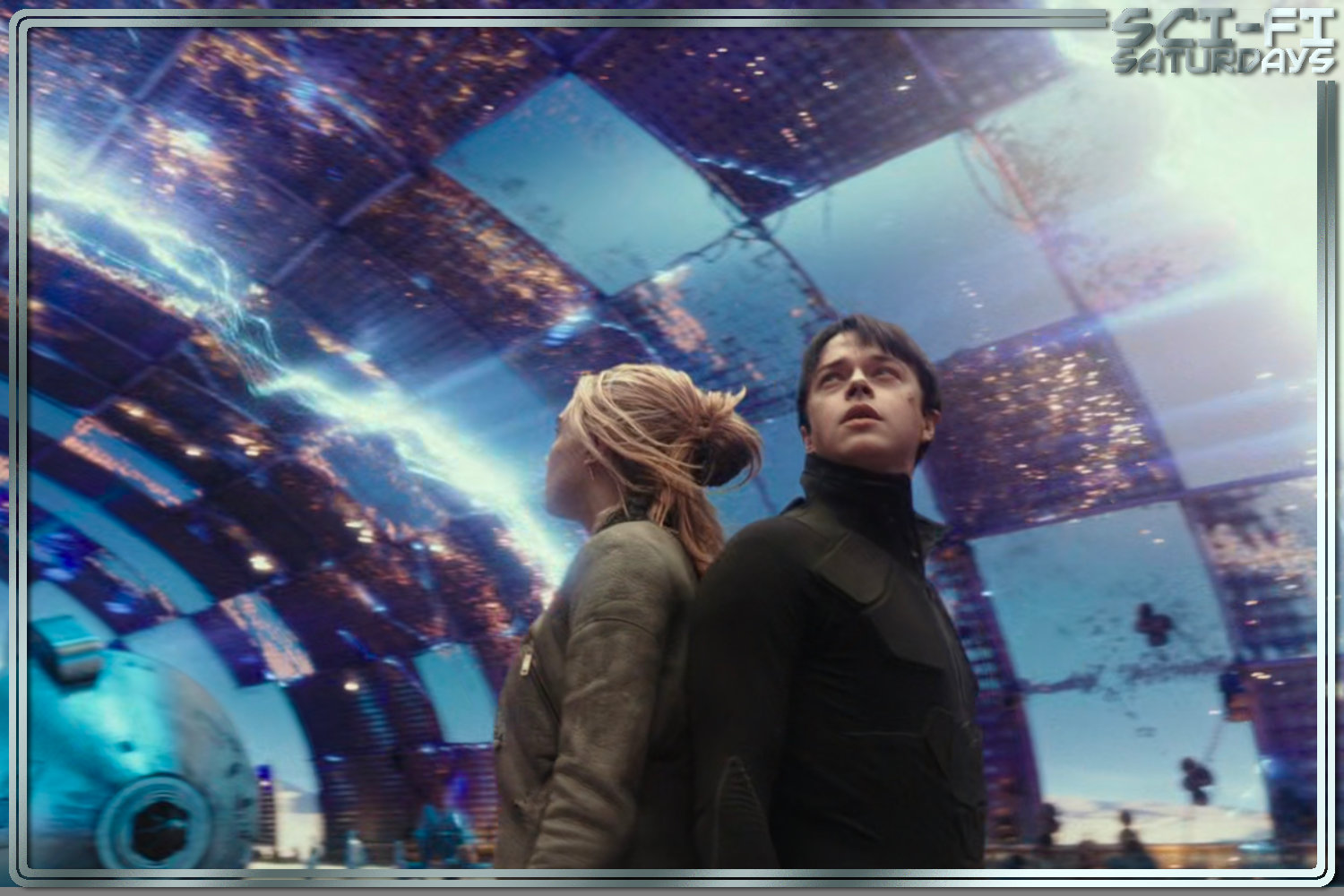
Unlike many space fantasy films, Valerian is derived from our own space-faring history. The impetus for the Alpha space station is based on a real event, depicted at the beginning of the film, the 1975 Apollo-Soyuz Test Project. It occurred on July 17, 1975, and was the first joint US-Soviet space mission, featuring the historic docking of an American Apollo and a Soviet Soyuz capsule. From here, the fantastical world is built as the International Space Station becomes the hub for humanity’s meeting with aliens. That’s where any real-world similarities end, however. The rest of the film concerns interdimensional marketplaces, alien creatures, space ships, and killer robots. It’s just the sort of thing that one would expect to find in a space opera story. Two of the most visually interesting aspects are the depiction of the Mül converter and the Kyrian marketplace, which exists in another dimension. The converter is a small lizard-like creature that can instantly multiply small objects given to it. In the original comic, Laureline uses it to create enough money to pay the Doghan Daguis for providing information. The Pearls use the creatures to generate quantities of their power pearls, used to power the Mül technology. It’s a strange visual effect since the replicated objects pour out from under the creature, which is usually held in someone’s hand, and there’s no discernible orifice for them to come from. The interdimensional market is even more interesting, as nothing like it has been seen, at least in any films reviewed in this series. To anyone without the proper helmet (which has a visor tuned to the correct frequency to see the market), it appears that people are just wandering through the barren sandy wasteland of the planet. But in the augmented reality of the visor, visitors can see a busy and thriving marketplace. Objects bought in the marketplace must be taken through a converter, which transfers them from that dimension into our own. A cool idea, and one that is visually interesting.

The operatives confront the ethically challenged Commander Filitt, surrounded by the Pearls.
The Final Frontier
Valerian and the City of a Thousand Planets didn’t perform well at the box office. It was hampered by both poor reviews and a long running time of over two hours and fifteen minutes (its title is also too long to be easily remembered by those unfamiliar with the series). In the landscape of sci-fi movies from the mid-2010s, the film was neither an element of an expanding franchise nor a more gritty and nuanced adult-oriented film. It was Luc Besson’s love letter to a favorite childhood comic book series. It was full of big swings, weird imagery, and even weirder situations (psychic jellyfish, for instance). It probably caught many off guard. It was certainly long, longer than it needed to be, but that extra time sets up the world-building, which, for space operas, is most of the challenge. Audiences may also not have been drawn to the leads, Dane DeHaan and Cara Delevingne, younger actors with not much popularity between them. DeHaan, who had worked on numerous projects, might have been best known as the angsty Harry Osborne in The Amazing Spider-Man 2, while Delevingne was known for the teen drama Paper Towns and the superhero film Suicide Squad. Together, they are not as engaging as they might have been, and audiences may have been put off by their lack of chemistry. However, their roles do adhere to the style of the original Valerian and Laureline comics, for what it’s worth. In the hurried marketing of films, where a project has to find an audience immediately to survive, Valerian and the City of a Thousand Planets failed to do so. It’s difficult to market a film such as this, which is part nostalgia, part pet-project, and part space-fantasy in a world where things that are different are shunned and derided. Yet there’s still plenty of time to discover the film, which surely appeals to fans of swashbuckling space operas, with aliens, action, and positive moral ideals.
Coming Next


Having grown up on comics, television and film, “Jovial” Jay feels destined to host podcasts and write blogs related to the union of these nerdy pursuits. Among his other pursuits he administrates and edits stories at the two largest Star Wars fan sites on the ‘net (Rebelscum.com, TheForce.net), and co-hosts the Jedi Journals podcast over at the ForceCast network.