
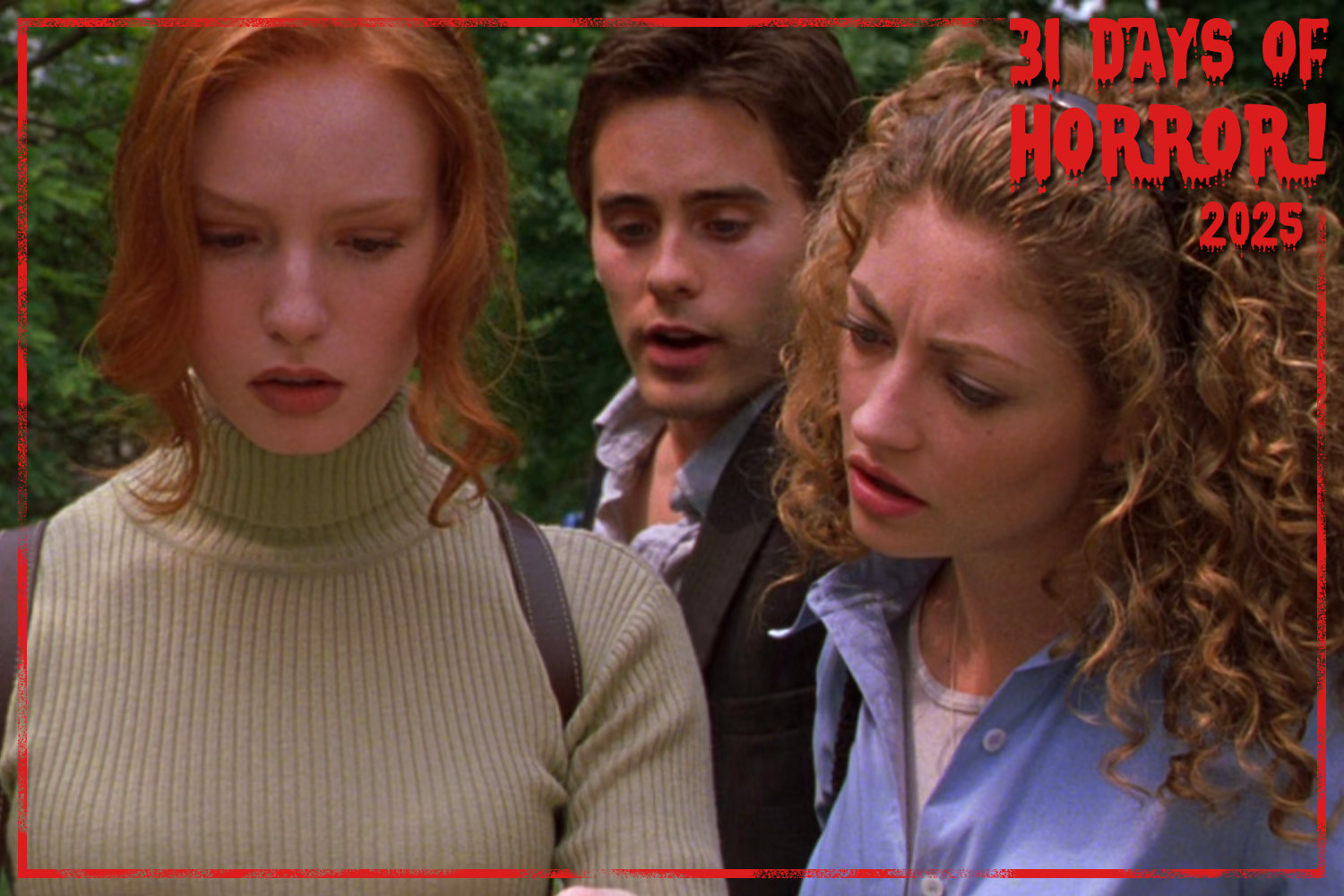
Here at Urban Legend Outfitters, we have all the right tools for all your urban legend needs.
It’s difficult to come up with a new conceit for horror franchises, but Urban Legend manages to do just that. Building on the late 90s horror resurgence, it creates a premise that leaves audiences guessing while providing the necessary tropes of the American slasher film.
Before Viewing
The trailer for this horror film starts with a group of college students taking a class on folklore, where their professor is discussing urban legends. They put the Pop Rocks and soda myth to the test, and one of the students falls to the ground dead, before winking and sitting back up. Classic urban myths are mentioned, including flashing headlights at a stranger and the killer in the back seat of the dark car. Suddenly, the students start experiencing these legends for real as an axe killer comes for them. Did you ever hear the Urban Legend about the film that scared someone so much they died?
Presented below is the trailer for the film.


Urban Legend title card.
After Viewing
College student Michelle Mancini (Natasha Gregson Wagner) pulls over to get some gas during a rainstorm. An awkward and stuttering attendant (Brad Dourif) tries to warn her that there’s someone in her back seat, but she drives away thinking she’s in danger from this man. A figure in a parka rises from the backseat and swings a double-bit ax, decapitating her. At Pendleton University, in New Hampshire, Parker (Michael Rosenbaum) tells the 25-year-old story of a murder in Stanley Hall. None of his friends believes him, including journalism student Paul (Jared Leto), who calls it an urban legend. In Professor Wexler’s (Robert Englund) folklore class, he discusses urban legends as modern cultural admonitions before having Brenda (Rebecca Gayheart) and Damon (Joshua Jackson) demonstrate the Pop Rocks and soda myth.
Despite having said she didn’t know Michelle, it’s revealed that Natalie (Alicia Witt) and she were friends in High School. Damon takes Natalie out to a remote location to console her, but she turns down his advances. He is strangled by the killer when he gets out of the car to pee and hanged above the car. When Natalie returns to the murder location with the campus officer, Reese (Loretta Devine), nothing seems amiss. Returning to her dorm room, Natalie is not surprised to hear her goth roommate Tosh (Danielle Harris) having sex again. Except this time, she’s actually being murdered by the killer who leaves a note on the wall, “Good thing you didn’t turn on the lights.”
Both Dean Adams (John Neville) and Resse believe Tosh’s death to have been suicide. Paul gets a tip from the janitor (Julian Richings) to investigate Wexler, who has a parka like the one Natalie saw on the killer. Paul and Natalie are brought before the Dean, who warns Natalie about her probation and delivers word that Paul has been fired from the school paper. Natalie admits to Brenda that she did know Natalie. They were playing a prank on a random driver called the “gang high-beam initiation,” which goes horribly wrong, killing the other driver. Paul discovers a newspaper from 1973 listing Wexler as the only survivor of the Stanley Hall massacre, proving it is not an urban legend.

Professor Wexler offers Brenda some soda to go with her Pop Rocks.
The Dean doesn’t want to raise a fuss on campus and orders Reese not to contact any authorities without his permission just before he gets his Achilles tendon sliced and crushed by a runaway car. Paul shares his knowledge with Natalie, and they kiss, which pisses Brenda off due to her crush on Paul. Reese slips on a puddle of blood in Wexler’s office, but finds no body. The annual frat party, celebrating the supposed Stanley Hall massacre, is in full swing when Parker receives a call from “inside the house” that his dog is in the microwave. He searches for the killer and is murdered on the toilet, having Pop Rocks and Drano poured into his throat.
The killer then shows up at the radio station, kills the show producer, and then Parker’s girlfriend, Sasha (Tara Reid). Natalie witnesses the murder and goes to find Paul, whom she’s suspicious of. They head off campus, picking up Brenda on their way, to find a phone to call the police. While Paul is talking to a gas station owner, the girls find Wexler’s body in the back of Paul’s truck. Scared, they take off through the woods but become separated. Natalie is picked up by the janitor, who takes her back to school. He has a parka in his car that looks just like the killer’s. Before she can get out, a car with no headlights drives past. When the janitor flashes his lights at them, the car turns and chases them, causing an accident.
Natalie limps back to campus, hearing screams from the abandoned Stanley Hall. Inside, she finds the dead bodies of most everyone killed so far, and a seemingly unconscious Brenda. It’s a trick, and Brenda knocks Natalie out, revealing that the boy she and Michelle accidentally killed was her boyfriend. Reese arrives to help, but is shot by Brenda. Before Brenda can complete her urban legend killing spree, Paul comes around the corner, distracting her long enough for Reese to shoot Brenda. Natalie grabs a spare gun and blows Brenda out the window. She and Paul drive away to find the police, but Brenda pops up in the backseat with an ax. She’s not dead! Paul crashes the car on a bridge, sending Brenda out the front window into a river, where she floats away. Later, at another college, a student finishes relating the story of the Pendleton murders when Brenda, now looking different, tells him that’s not the way it happened at all. She’s still not dead!!
“I’ll take advantage of my homicidal instincts and I’ll start killing people in a trendy, attention-getting, cover-story kind of way.” – Parker, mocking Paul

Damon tries to hit on Natalie in her time of sorrow. He’ll get the swing of it.
The horror film Urban Legend is interesting in that it’s a film actually about multiple urban legends which, surprisingly, hadn’t been created before this time. That’s not to say that there weren’t films that involved oft-told stories, tall tales, or old wives’ tales. One of the earliest films dealing with the friend-of-a-friend type story was Black Christmas. That film was derived from The Babysitter legend, where a babysitter receives a call to check on the children, with the call originating from inside the house. Several other films have also told this story, including When a Stranger Calls. The Hitcher is another popular film based on the legend of The Vanishing Hitchhiker. In this story, a hitchhiker is picked up and often vanishes mysteriously from within the moving car. The giant creature film Alligator, featured here on a week of big animal horror last year, also concerns legends of alligators living in sewers. Candyman started the trend for the 1990s, about a killer who appears when you say his name into a mirror. The year prior to Urban Legend being released saw the arrival of I Know What You Did Last Summer, which adapted elements of the Hook legend. Coincidentally, both that film and Urban Legend were produced by Neal Moritz, a prominent Hollywood producer.
Urban Legend assembled a large collection of popular myths that had been able to spread around the globe on a new mass-communications device known as the World Wide Web. Most viewers, by 1998, had heard a number of these tales, and maybe even believed in their validity. Spreading via word-of-mouth, email, and (in that day) FAX, these legends acted as imaginative stories, often based on half-truths (or completely falsified), which served as cautionary tales or, as Professor Wesler says in the film, cultural admonitions. Often, they had a terrifying or horrific reveal to them, basically warning the audience to be careful out there. In effect, it is very much like modern horror films. The usage of a killer who murders based on these urban legends was an interesting and effective idea. The legends that this film deals with include The Killer in the Backseat (Michelle’s murder), the Pop-Rocks and Soda myth (covered in Wexler’s class, plus crucial to Parker’s death, but with draino instead of soda), The Hook legend where a killer leaves a person dangling above a car so that their feet scrape the roof (Damon’s death), the Lights Out myth described by Natalie and used at several points in the film, plus the Dog in Microwave story (acted out on Parker’s dog, Hootie), the ankle-slasher myth of someone hiding under a car which gets Dean Adams, and the Kidney Heist tale about someone waking up and missing their kidney (seen later in Hostel). There are others briefly touched on, such as the myth that Mikey, the Life Cereal actor in the commercials, dies from Pop Rocks and soda, or that the scream in the song “Love Rollercoaster” is from an actual murder.

Reese and Wexler have a sit down with Natalie and Paul in the Dean’s office regarding a little light B and E.
As with I Know What You Did Last Summer, the film capitalizes on the success of Scream and Scream 2. All these films utilize hot, young casts made of popular actors, mostly from television, while setting up the mystery of who the killer may actually be. The killings are not just random psychopaths killing people who get in their way. Instead, they are motivated by individuals who feel wronged by one of the primary protagonists, whether that’s due to a mother having an affair or young kids accidentally killing someone with their car. And as Scream did, Urban Legend gets off to a hot start by killing a character in the opening moments of the film. Nine deaths in all stack up quite nicely against other slasher flicks, but many of the killings occur off-screen, with often only the aftermath being seen. The most heinous of these, and I’m sure everyone would agree, is the microwaving of Parker’s small dog, Hootie. The camera jets out of the goo-covered microwave interior, not showing anything, but providing a general idea of the explosive aftermath. Not cool, man. Not cool. Unlike I Know What You Did Last Summer and Scream, the majority of the cast in Urban Legend are film stars (or up-and-coming film stars). Alcia Witt, Rebecca Gayheart, and Joshua Jackson were currently on television shows when the film was shot, but all had a burgeoning film career prior to this (Jackson even had a small cameo in Scream 2). The biggest draw for horror audiences, and in advertising, was the inclusion of Robert Englund as Prof. Wexler. Englund is still best known for his role as the king of the nightmares in A Nightmare on Elm Street and all its offshoots. Here, he’s the survivor of a horrendous murder spree at the college, 25 years ago, and is at one point suspected of being the killer due to a similar parka in his closet. The film also has another killer horror alum in its midst, Brad Dourif, in an uncredited role as the stuttering service station attendant, Michael McDonald (named after the producer of the film, not the singer/songwriter). Dourif is best known, in horror circles, as the voice of Chucky in the Child’s Play films. He seems creepy and suspicious, making him another possible assailant in a film full of red herrings.
The success of Urban Legend spawned two sequels. The first, Urban Legends: Final Cut, was released in 2000, while a third film, Urban Legends: Bloody Mary, came straight to video in 2005. Both films followed the same premise, of a killer acting out various urban legends in their pursuit of killing those who wronged them. Unfortunately, the list of familiar urban legends is not a particularly deep list, leading to a limited shelf life for such a series. For fans looking for an interesting cast of characters and a continual guessing of whodunnit, Urban Legend is probably a great film for a chilly, dark night. It keeps audiences guessing right up until the end, and makes many assume that Jared Leto may be the killer due to his spate of antisocial and villainous roles of late. For horror fans wanting some good old-fashioned screaming girls running around, crazily as they are chased by a killer, audiences get that too with Tara Reid’s performance. Otherwise, the rest of the characters are almost too smart to be included in this film. They understand the “rules” of the genre, as Randy describes them in Scream–except Paul. He manages to say “I’ll be right back” without getting killed.

The Parka Killer strikes again!
Assorted Musings
- In the opening sequence, Michelle is singing “Total Eclipse of the Heart” by Bonnie Tyler, which includes the phrase “Turn around.” If only she had listened to Bonnie, she’d be alive now.
- Officer Reese Wilson, a black woman, is shown emulating the poise and attitude of actress Pam Grier, along with a video of Grier in Coffy and Foxy Brown.
- Why do so many of the characters all have the same type of parka? It’s nowhere close to winter, and only appears to have been done to tease the audience’s expectations.

Having grown up on comics, television and film, “Jovial” Jay feels destined to host podcasts and write blogs related to the union of these nerdy pursuits. Among his other pursuits he administrates and edits stories at the two largest Star Wars fan sites on the ‘net (Rebelscum.com, TheForce.net), and co-hosts the Jedi Journals podcast over at the ForceCast network.