
Dreamer, you’re nothing but a dreamer. Well, can you put your hands in your head?
Tomorrowland presents an optimistic view of the future using nostalgia for the past, which is both its triumph and its downfall. Step into the wayback machine and travel back to the future in order to save the world.
First Impressions
A teenage girl is released from jail and finds a strange pin in her belongings. Touching it transports her to a field, even though she’s really still in her present location, at the jail, in a truck, etc. The pin leads her to a broken-down farmhouse with a holographic dog, where an older man asks her where she got it. She is then wandering around a future that looks like something straight out of Disneyland. Unfortunately, some other people are after the two of them, and they must escape into Tomorrowland.
Presented below is the trailer for the film.


Tomorrowland title card.
The Fiction of The Film
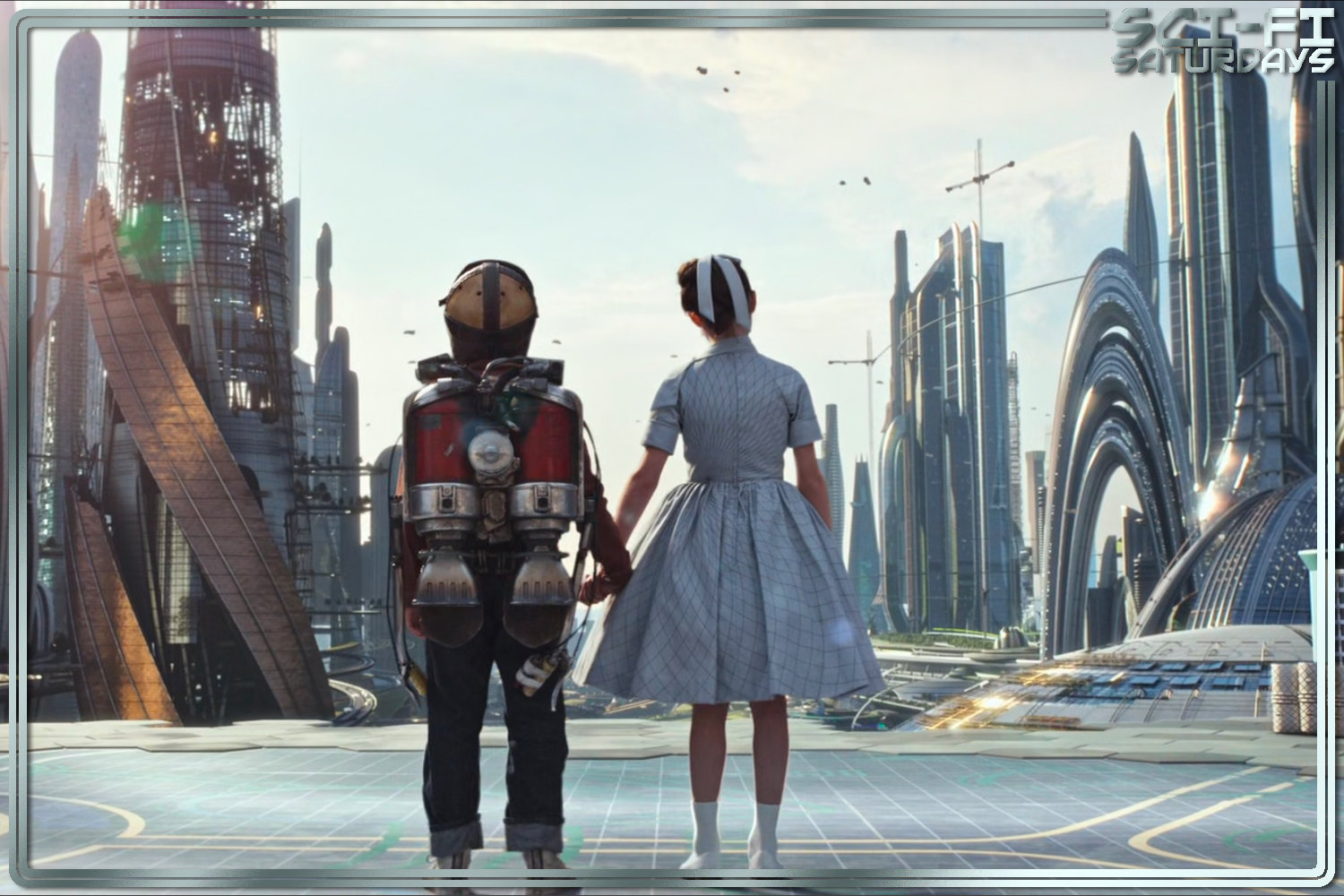
At the 1964 World’s Fair, young Frank Walker (Thomas Robinson) brings his rocket pack invention to the Hall of Innovation inventor’s competition to be judged by David Nix (Hugh Laurie). Nix scoffs at the device, which he says won’t even work. A young girl, Frank’s age, named Athena (Raffey Cassidy), finds it interesting and gives Frank a small pin with a “T” on it. She encourages him to follow her. Frank sneaks aboard the It’s a Small World ride, where the pin is scanned by a laser, and he is transported into what appears to be the future. A giant robot fixes his jetpack, and he flies through the clouds following Athena. In the present day, an older Frank (George Clooney) argues with Casey Newton (Britt Robertson) about the best way to tell their story.
Casey tells her tale, which she says is more optimistic. After being arrested for sabotaging her father’s wrecking machinery at a NASA decommissioning site, she finds a strange “T” pin in her things, which, when touched, shows her a vision of Tomorrowland. The pin soon runs out of power, so she travels from Florida to Houston to find more information at a store called Blast From The Past. Inside, the owners, Ursula (Kathryn Hahn) and Hugo (Keegan-Michael Key), want to know more about where she received the pin, and then try to kill her. Athena, who looks the same as she did in 1964, enters and helps defeat the two people–revealing they are audio animatronic robots, as is Athena. She then takes Casey to New York to get some assistance.
Athena drops Casey off at Frank’s house, which is protected by various deterrents. He wants nothing to do with Casey, Athena, or the future, but Casey finally convinces him that something is wrong and that their world is in trouble. Frank only believes her when his probability machine briefly lowers its count to 99.9%. A group of evil audio animatronic men attack the pair, smashing up the house. Frank uses an ejection sled (built into the bathtub) to fire them into a nearby lake as he detonates the house. Athena picks them up, much to Frank’s distress, and takes them to a local television station, where they enter a secret lab and teleport onto the Eiffel Tower in Paris.

Young Frank, with the spirit of imagination, tests out his rocket pack in a field.
Frank and Athena explain that this is the headquarters of Plus Ultra, a group of futurists made up of Gustav Eiffel, Jules Verne, Nikola Tesla, and Thomas Edison. The dark-suited audio animatronic men arrive in Paris and attempt to stop the trio, who activate a rocketship built into the tower. The ship blasts off and turns around, plummeting towards the tower, where a wormhole is opened, transporting the vehicle into an alternate dimension known as Tomorrowland, and the same one Frank visited in 1964. The world is not as fantastical as it appeared to either young Frank or in Casey’s visions. Nix, who is the governor of the world, tells Frank he’ll be exiled, again, for returning without permission. Frank urges Nix to listen to Casey, who he says can fix the future.
Frank shows Casey a tachyon-powered machine, The Monitor, which shows the destruction of the Earth by all types of various natural and manmade disasters. She refuses to believe what she’s seeing, and a momentary glitch reveals an altered future, proving Frank’s point. Thinking about the device further, Casey realizes that not only is the machine showing the future, but it’s creating a feedback loop, sending the despair and depression back to Earth, “feeding the wrong wolf,” as she and her Dad (Tim McGraw) like to say. Nix admits that he’s doing it on purpose, which shocks Frank. Nix’s plan is to show reasonable people their future, but since no one seems to care, he believes that humanity really wants to die.
Frank’s optimism returns after hearing this, and he sends Casey onto an antigravity platform to blow up the tachyon device with a bomb, smuggled in by Athena. Nix stops the platform, so Casey must toss the bomb into a transit portal, which causes a section of the wall to fall and pin Nix to the ground. With tachyon particles in flux, Athena sees the future and saves Frank from being shot. Frank cradles Athena, who jumped in front of the pulse blast, as she dies. Her final recording explains how Frank made her feel like a real person. Realizing Athena’s self-destruct mechanism will kick in, Frank uses a jetpack to fly the young robot up to the tachyon sphere. The explosion destroys the device, saving Earth from further bombardment and triggering an EMP that blacks out Tomorrowland. Frank and Casey restart the idealistic Tomorrowland program, creating new T-pins and sending new young robotic recruiters back to Earth to find the remaining dreamers, the ones who haven’t given up.
“Every day is the opportunity for a better tomorrow.” – Nix

Prop replicas or the real thing? By the time you figure it out it may be too late.
History in the Making
Tomorrowland is another film in the arsenal of Disney-related projects that attempted to create a filmic version of the park-related attractions. It was not the best adaptation, but not the worst either, sitting somewhere in the middle. It creates a nostalgic throwback to the optimism and futurism of the 1960s as it attempts to explain the poor state of the 21st Century and the lack of progress on the promises made 50 years prior. It was the second live-action film directed by Brad Bird, a director known more for his animated work on The Iron Giant, The Incredibles, and Ratatouille. His previous film, and only other live-action film to date, was Mission: Impossible – Ghost Protocol, the fourth film in that growing franchise. Bird wrote the screenplay for this film, along with Damon Lindelof (Star Trek, Cowboys & Aliens, Prometheus), drawing from the ethos of Disney Imagineering and the mythos of the Tomorrowland themed section of the parks.
Disney had attempted to capitalize on film versions of their rides in the past, to middling success. The first three attempts, Tower of Terror (1997), Mission to Mars (2000), and The Country Bears (2002), were minor to moderately accepted. In 2003, the company released two different films based on their most popular attractions, The Haunted Mansion and Pirates of the Caribbean: The Curse of the Black Pearl. The action and adventure of the Pirates film, along with Johnny Depp’s iconic portrayal of Captain Jack Sparrow, created a long-running franchise that released four sequels in total, with three of them, Dead Man’s Chest (2006), At World’s End (2007), and On Stranger Tides (2011), coming prior to Tomorrowland. The Haunted Mansion was a fun film, but it did not captivate the audience the way these other films had. It would get another shot with a 2023 version that was better received. An adaptation of The Jungle Cruise in 2021 would also be well received for its Indiana Jones-like moments.
Unfortunately, Tomorrowland didn’t get as much goodwill. While it contains honorable and important themes about imagination and humanity, it also suffers from the enormous weight of melding these ideas within the film. The mystery of what’s going on with this future place drives the action for the first half of the film, yielding some exciting action moments as Casey (and sometimes Frank) avoids the attacks of those out to stop her. But the back half of the film fails to capitalize on the goodwill created in the opening. It creates a two-dimensional villain who, at one point, was all about creating a utopian society, but has become just as jaded and callous (or more) than the society he wants to improve. There’s no doubting the heart of the film is about the intersection of personal dreams, making for a better society, and just having fun. But in the end, Tomorrowland comes off as a bit naive in this endeavor.

Casey shows her T-pin to the security camera in an attempt to discover what it all means.
Genre-fication
Tomorrowland feels very much like a live-action experience of the Disneyland park aesthetic. It is steeped in the retro-futurism that debuted in Anaheim, California, in 1955 and has been made popular in other films from the past decades. Much of the design style of the future portions of the film looks like the architecture of the park, including a strategically placed version of the Space Mountain ride. The idea of many other rides from the park is also included, such as the Monorail, the Rocket Jets, the People Mover, and the Innoventions attraction. The classic designs for these are rooted in mid-century modern, retro-modernism, and retro-futurism, which often emphasize form over function, providing a strong stylistic vision of the future.
Brad Bird’s enthusiasm for the subject matter derives from several other films. Some are thematically similar, while others have a similar retrofuture vibe. Unsurprisingly, many are also Disney films. Both The Rocketeer (1991) and Treasure Planet (2002) fit the vibe aspects for Tomorrowland. The Rocketeer has a pre-mid-century design of ‘imagineers’ (in this case, Howard Hughes), inventing a rocket pack to aid in the American war effort. It also dealt with the risk takers who flew stunt planes and chewed Beeman’s gum, a key plot point to the film, and also a reference from The Right Stuff (a pack of the gum also sits on Frank’s workbench in this film). Treasure Planet has a more fantastical setup with steampunk-style space yachts and cyborg pirates, which strikes closer to the designs of the Plus Ultra crew and the Jules Verne-inspired Parisian rocket. The Iron Giant is more thematically similar to Tomorrowland, because it’s a Brad Bird film, but also because it deals with the question of destiny. What are we put on Earth to do, and how can we make the planet a better place? In that film, the Giant decides that he doesn’t want to be a weapon, but instead will help people, like Superman. Finally, Tomorrowland shares a lot of similarities with Meet the Robinsons (2007), a film about a more perfect future. Both films embrace the prospect of healthy imaginations and the theme of invention to “keep moving forward.” The future in that film is also a more perfect place, inspiring Lewis to be a better person and give his ideas back to society in the form of conveniences.

There’s a 100% chance that they world is going to hell, but only if you believe that to be true.
Societal Commentary
Tomorrowland contrasts two ideologies that seem to be constantly at odds with one another in the modern age: fun and cynicism. Some of the film’s criticism may come from its rather simplistic mantra of having fun and staying optimistic in order to combat the cynics and depressives of the day. While that seems unrealistic, so many people have forgotten the unbridled energy and enjoyment of their younger years. Frank wants to build a rocket pack for the sole reason that it’s fun. Not because it was a good business model. Not because he could sell it. And not because anyone needed it. “If I was walking down the street, and I saw some kid with a jet pack fly over me, I’d believe anything’s possible. I’d be inspired,” Frank says. Inspiration and the belief that anything was possible. It’s a bold way to live your life, especially in an age where hate and vitriol are the bread and butter of much media, both traditional and social. Tomorrowland wants to inspire and bring back the can-do attitude of yesteryear, even in the face of overwhelming negativity.
The present-day world of the film looks much like the real world of 2015. News stories focus on floods, fires, famines, and other horrible events. NASA launch sites, once the pinnacle of imagination and an example of dreaming beyond ourselves, stand in disrepair and are being torn down because going to the stars no longer makes sense. Even the wide-eyed boy who built a jet pack from an old vacuum cleaner and other parts has succumbed to the cynicism of modern life, having been banned from living in the utopian Tomorrowland. The film tries to serve as a reminder about how easy it is to criticize and how hard it is to create. Even from the 1960s, Nix was not trying to help people along as it seemed. He had already become cynical and was critical of Frank’s invention. So how was he to really help shepherd the utopia along? Only Athena, who was designed to look for and nurture people just like Frank, saw his potential. She encouraged him in ways that were immeasurable, only to again have his hopes dashed by Nix.
Tomorrowland reminds audiences that where you put your effort is where you see your gains. Casey and her father have a saying about an infinite struggle between a pair of wolves. One is darkness and despair, while the other is light and hope. The question becomes, which one wins? The answer is the one that you feed. Optimism, hope, and positive energy beget more of the same. It’s the harder road, for certain. But the rewards of this feeding regimen are monumental. The easier road is despair, fear, and cynicism. These lead to the dark side, as a wise mentor once said. They are the easier of the two paths and present instantaneous benefits. Hate feels good now, while hope is not instant gratification. These ill feelings are a self-fulfilling prophecy, and as shown in the film, a feedback loop that is difficult, if not impossible, to break out of, without some outside intervention.

Athena, Frank, and Casey try to reason with Governor Nix.
The Science in The Fiction
While the main conceit of Tomorrowland is science and invention, it’s not all tachyons and rocket packs. Starting with Frank’s house, he’s created all sorts of devices out of common items, some very Rube Goldberg-like, to protect himself. It’s as if Kevin McAllister grew up to become a genius inventor, but had no access to well-machined parts and had to make due with anything he could find at the scrap yard. The world at large also contains several scientific inventions that are unknown to society. Part of the world underneath the world includes something referred to as a “wire station.” This is a teleportation pod hidden underneath a television studio, which is able to beam the characters, both organic and robotic, halfway around the globe. The technology is not explained, but it causes the recipient to lose their blood sugar and experience disorientation. Perhaps it’s like a gigantic fax machine.
That takes the heroes to a steampunk-inspired rocket hidden within the Eiffel Tower. A rocket that is capable of opening up a hole between dimensions, allowing access to Tomorrowland. That title is actually a misnomer, since they are not actually in the future, but a neighboring dimension (possibly even a pocket universe) where Nix has built his Utopia. In that place, the scientists of Tomorrowland have discovered tachyons, faster-than-light particles, and put them to use powering The Monitor. It allows them to open a window to the future, similar to the time lens in Paycheck, which can see around the curvature of the universe. These tachyons become a key plot point as they allow Frank to cheat his fate once he realizes he’s seeing into the future. There are also the advanced audio-animatronic characters, such as Athena and Dave Clark (along with his five robo-agents). These characters are indistinguishable from humans (at least as long as they’re not damaged), and are based on the real-world robots created by Disney Imagineers. The filmic ones are obviously more realistic, but present the illusion of real people, much like Disneyland’s Abraham Lincoln or its Pirates of the Caribbean.

Nix reveals his (cruel) plan. Luckily, the heroes packed their imaginations!
The Final Frontier
Nostalgia is the key to the film, especially for children of the ’60s, ‘70s, and ‘80s. Which makes watching the battle at the Blast From the Past shop so difficult to watch. Just look at all those cool retro collectibles get blasted and burned! But perhaps that is one of the problems with the film, or maybe the audience watching the film. Because Tomorrowland is so tied into the nostalgia of those years, perhaps its core attraction didn’t hit the mark with audiences from other generations. Are viewers so cynical now that the moderately optimistic tone of the film falls flat? Perhaps Tomorrowland is raising another concern. Maybe society has gotten too precious about nostalgia and living for the past. Have we become so hung up on how it “used to be” that we can no longer see where we’re going? Nix only thinks about one way of doing something, and has for over fifty years. He fails to adjust his thinking, standing rigid and thinking that nothing is working, as a new group of dreamers tries to make room for themselves. But without those new, and oftentimes challenging, ideas, society will become complacent and stagnate, just as Tomorrowland does in the film.
If anything, the world we live in has gotten darker and more dangerous than it was 10 years ago. But it’s not for having a lack of dreamers and imagineers. It’s about not having enough of these types of people in leadership positions. One person can only do so much on their own; this is certain. But a group of people can accomplish the impossible. Just look back at the 9-year push to put men on the moon between 1960 and 1969. That energy and vitality seem light-years away. It’s so much easier to tear down dreams than erect substantial new ideas that it does feel like the world is caught in a negative feedback loop. It all comes down to a question of what sort of future you want to live in. Feed that future, and it can come to pass.
Coming Next


Having grown up on comics, television and film, “Jovial” Jay feels destined to host podcasts and write blogs related to the union of these nerdy pursuits. Among his other pursuits he administrates and edits stories at the two largest Star Wars fan sites on the ‘net (Rebelscum.com, TheForce.net), and co-hosts the Jedi Journals podcast over at the ForceCast network.