
This is the way the world ends. Not with a bang but with five pints of ale.
If there were ever an apocalyptic alien invasion, this is the type I’d like to see. The World’s End is a dense and comedic approach to sci-fi invasion films and end-of-the-world stories. It reteams Edgar Wright with Simon Pegg and Nick Frost for one of their darkest films to date.
First Impressions
The trailer confirms this is a new comedy from the people who made Shaun of the Dead and Hot Fuzz. At first, it appears that the film is a comedy about people getting back together to complete a pub crawl that goes through 12 different bars–which it is. But something weirder is happening as well, when people around them begin blasting light out of their eyes and mouths. It teases an Invasion of the Body Snatchers vibe while also intimating The World’s End.
Presented below is the trailer for the film.


The World’s End title card (and pub sign).
The Fiction of The Film
In the town of Newton Haven, in 1990, five high school friends gather to take part in The Golden Mile, a pub crawl through 12 bars ending at The World’s End, led by Gary King (Thomas Law). They are unable to finish and watch the sun rise from a hill over the town–a shooting star flitting past. Twenty-three years later, Gary (Simon Pegg), still wearing the same clothes and driving the same car as he did in high school, gathers his four friends together to have another shot at The Golden Mile. None of them are particularly enthused by the prospect, but they decide to join him nevertheless.
They arrive in town and start at The First Post, where Gary is incensed to learn that Andy (Nick Frost), a corporate lawyer, doesn’t drink anymore. After downing their drinks, it’s on to pub number two, The Old Familiar, which looks just like the first pub. Oliver (Martin Freeman), a boutique real estate agent, takes a call from his sister, Sam (Rosamund Pike), who joins them and is shocked to see how little Gary has changed. At The Famous Cock, the five are not allowed in due to Gary being banned. Outside, Gary sees three partial pints of beer left on a table and consumes them, accomplishing his goal of drinking at the pub.
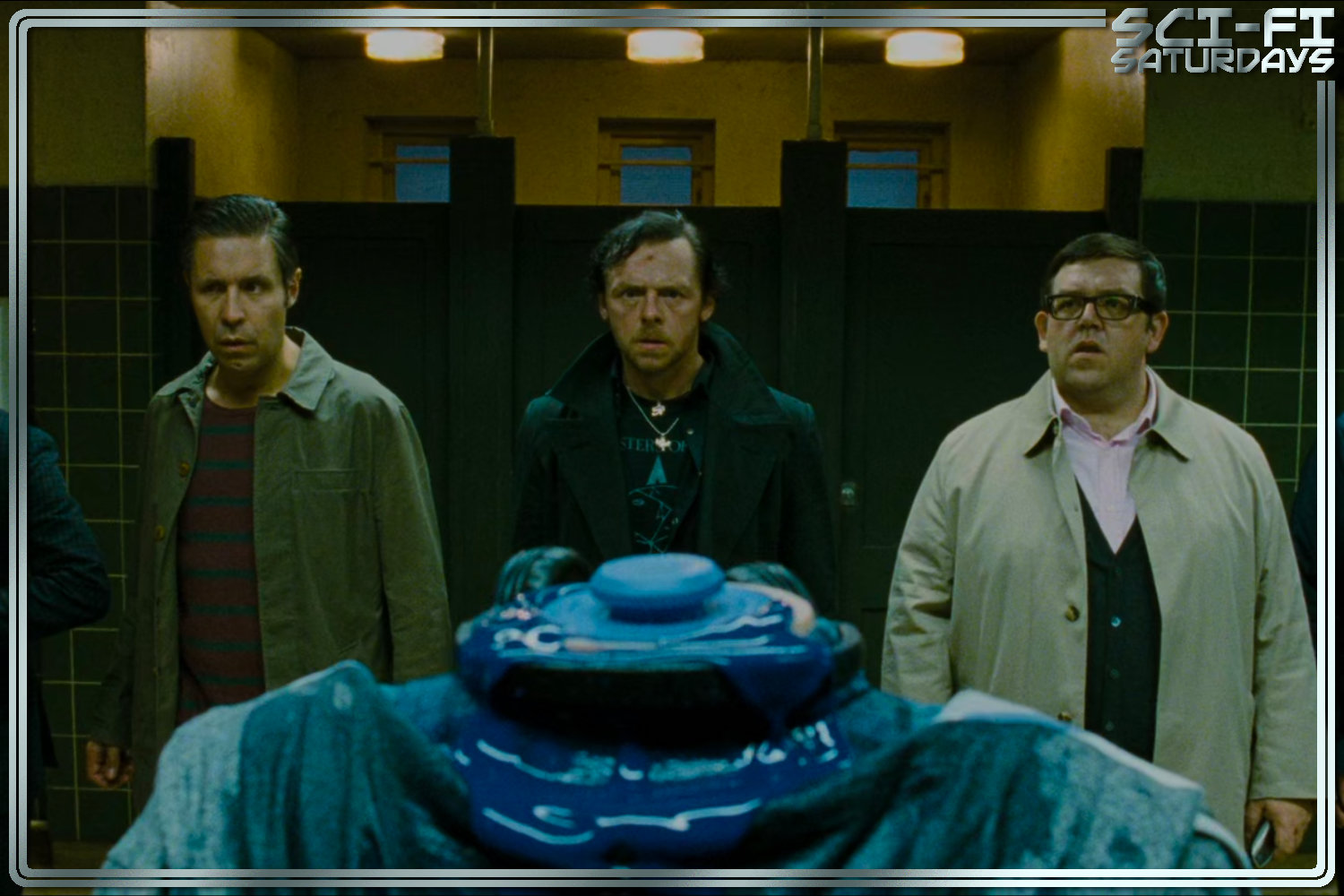
In The Cross Hands, Peter (Eddie Marsan), a car salesman, recalls his trauma of being bullied by Shane Hawkins (Darren Boyd), who doesn’t even remember him when they bump into each other. Gary becomes angry as the rest of his friends decide to call it a night. In the loo, he is confronted by a young man who reminds him of his past. When the young man attacks Gary, he fights back, knocking the head off of a robot that oozes blue blood. Andy and the others come into the bathroom along with the young lad’s friends, and a massive fight breaks out. The heroes realize that something is amiss and believe the entire town has been replaced by robots.

Gary and his friends Steve Andy, Peter, and Oliver enter their first pub for the legendary Golden Mile.
Moving on to The Good Companions, all five continue their drinking–now including Andy–so as not to arouse any suspicions. After The Trusty Servant, Oliver (nicknamed “O-Man” by Andy) seems a little bit different. They have a discussion with two other townsfolk who explain that they are not robots, as that word means “slave,” and they are free. Next in The Two-Headed Dog, the publican greets the group with the same speech Gary gave in pub number one. Gary meets Sam outside and tries to explain what is going on when they are attacked by twins. Gary coins the term Blanks to refer to the strange automatons. Steven (Paddy Considine), an architect, admits his love for Sam.
At The Mermaid, Steven is pulled aside by “crazy” Basil (David Bradley) and told that aliens have invaded Newton Haven. Gary, Andy, and Peter are seduced by three young women (the marmalade sandwich of two blondes and a redhead) who look just like the women they had a crush on as kids. The Blanks can appear as someone at any age, and a young man tries to seduce Sam before she realizes that he died years ago. Mr Shepherd (Pierce Brosnan) tries to reason with the boys at The Beehive, but a fight ensues. Peter is grabbed by Blank Shane as Sam goes to find the car. Gary, Andy, and Steven try to discern if any of them have been replaced.
Gary decides he must finish the pub crawl and races to The King’s Head as Andy tries to talk sense into him. They head to the Hole in the Wall, avoiding roving gangs of Blanks who are looking for them. At the final stop, The World’s End, Andy and Gary are lowered into an arena and confronted by a talking alien light. It explains they are The Network, and they are taking over some of the population to make the Earth a better place, preparing it for inclusion into a larger galactic federation. Gary rejects their offer to make him young again and says that it’s a human’s right to mess up. The Network decides to leave, which destroys Newton Haven and all the other cities in which they have taken root, as well as destroying all the technology on the planet. Years later, Andy is telling the story to a group of survivors by a campfire. At some point, the Blanks came back online and are reintegrated into society. Gary and his new companions, four Blank lads, roam the apocalyptic wastes getting into brawls.
“We want to be free! We want to be free to do what we want to do!” – Gary King

Gary is shocked when he pops the head off of a young lad in the loo.
The First Post
The World’s End, not to be confused with This Is The End or Seeking a Friend for the End of the World, is an apocalyptic comedy, which I know sounds like a weird thing to say. It certainly seems that filmmakers were wanting to make light of the genre at this time, as the other two films listed above are also comedies. The resurgence of apocalyptic comedies at this time is probably due to the failed predictions about the end of the world in 2012, according to the Mayan calendar. The film is the third in a trilogy of genre comedies from Edgar Wright and Simon Pegg, known collectively as the Cornetto Trilogy. The first is the zombie-rom-com Shaun of the Dead. The previous film was Hot Fuzz, a love letter to 80s cop action films. Edgar Wright directed all three and co-wrote all the films with Simon Pegg, who starred. A large number of the cast members were shared across the trilogy, with Nick Frost playing Pegg’s friend in all the films.
While The World’s End is a comedy, it features a darker tone than previous Wright films, making it one of the less popular in the trilogy. That’s saying something since Shaun of the Dead dealt with a zombie apocalypse. But fans of Wright’s work will find something to love in this film as he takes his notorious filmmaking style to new heights. The World’s End has some amazing shots and dynamic editing that convey a lot of information in a relatively brief time. Wright cuts on action and sound effects to transport characters across a long distance or recontextualize a shot for comedic purposes. Hot Fuzz famously spends 30 seconds showing how Pegg’s character moves from the city (full bars on his Vodafone) to the country (no bars) by rapidly cutting between Pegg on a train, a shot of the phone, and Pegg waiting at a station for the next train. This is repeated three or four times, saving exposition. In The World’s End, Wright makes fun of that style, showing four pints of beer being rapidly poured and then a fifth glass filled with water for Andy, paying off the joke that everyone knows Andy no longer drinks, except for Gary. It’s an action conceit to a very non-action scene.
Wright’s films are also densely packed with details, which lead to enjoyment on future viewings. As with Shaun of the Dead (which replays the events of Shaun going to the store on a normal day and then on the first day of the zombie outbreak) and Hot Fuzz (where Danny presages the entire action-packed finale by asking Nicholas is he’s ever partaken in cop movie tropes), The World’s End tells the plot of the film in the opening moments. Both Gary’s remembrance of the failed Golden Mile attempt and the names of the 12 pubs all set up the events that play out through the film. Wright also provides deeply complex characters with a simple setup and dialogue. There’s a lot of backstory provided in the jokes (Steven’s 26-year-old fitness instructor girlfriend, or Gary’s struggle with addiction) as well as in the characters’ surnames, which are all some type of royalty: King, Knightly, Prince, Chamberlain, and Page. This is also his second film in his trilogy to feature a former James Bond in a villainous role: Timothy Dalton in Hot Fuzz and Pierce Brosnan here.

Gary and Sam have a heart to heart. This shot also shows an example of the level of technical detail Edgar Wright achieves. Where is the camera in the reflection?
The Old Familiar
Apocalyptic comedies were apparently in vogue during the early 2010s. The previous year featured the apocalyptic black comedy/rom-com Seeking a Friend for the End of the World with Steve Carell and Kiera Knightley. It features the actual end of the world from an asteroid impact as two characters discover love and connection amidst the chaos of the end of times. This is the End was a second apocalyptic black comedy that came out a few months before The World’s End. Originally titled The End of the World, Pegg had asked Seth Rogen to change the name to avoid possible confusion with his film coming out later. Jay Baruchel, Rogen, and James Franco (and others) all play heightened versions of themselves in a film where the Rapture strikes Los Angeles. The World’s End plays into the tropes of world-ending stories, but makes it seem like a much smaller film instead. The actual World’s End is the final pub in the Golden Mile, allowing audiences to believe the title refers to a bar. But the events that take place in The World’s End eventually lead to the destruction of the infrastructure of the planet. In that way, The World’s End has much in common with last week’s film, Snowpiercer. Both contain a group of people on a linear quest, in which they lose members of their party, and accidentally (or purposefully) destroy the world by the end of the film.
Wright also includes a lot of horror elements in his films. Shaun of the Dead is an obvious homage to the zombie genre that plays into all the tropes of numerous horror films over the years. From the eating of brains to the shambling horde of the undead, it plays with the conventions of the horror tropes while creating new ones in the process. Hot Fuzz, while primarily a police action film, also features horror elements. The hooded killer evokes connections to both the Scream franchise as well as Agatha Christie murder mysteries. The World’s End features elements of science-fiction related horror, primarily with the 1978 version of Invasion of the Body Snatchers, but also other small town horror films like Village of the Damned (1960), which features weird goings on in a small English village, and The Stepford Wives (1975), where the women of a small town are replaced with replicants and whose poster features a bodyless head, much like the one that ends up on the floor of The Cross Hands. Besides the replacement of townsfolk by an alien race, the other main element that links this film to ‘78s Body Snatchers is the characters pointing at the heroes and screaming. Anyone who has seen that original film was probably just as scared of Donald Sutherland’s character as I was. Here, the Blanks not only scream and point, but also feature glowing eyes and mouths, which is reminiscent of the poster for John Carpenter’s The Thing, though not something that actually happens in that film. Wright also references Richard Donner’s The Omen, which may pass over some people’s heads, due to the sheer speed and volume of the jokes surrounding the scene. Oliver is shown with a birthmark shaped like a six over his left temple, which he has removed with plastic surgery. This is how Gary and his group realize that he has been replaced with a Blank, since the birthmark reappears. Gary also calls Oliver, “O-Man,” a common usage of vernacular where adding “man” to the first letter of someone’s name becomes their nickname. These two character moments are not explicitly linked, but knowing Wright’s dry sense of humor, this is intended to equate Oliver/O-Man to Damien (The Omen) with the 666 birthmark on his scalp.
One other sci-fi film that may not be one people might normally think about in relation to The World’s End is Hot Tub Time Machine. That’s expected, because the two films are not very similar. Except, both feature themes about the recapturing of one’s youth. Like the character of Lou in Hot Tub Time Machine, Gary is a character who has recently attempted suicide and goes on a trip with his friends where he attempts to relive some painful moments of his youth for the better. Lou uses a time machine to return to the past and confront his mistakes head-on. Gary takes his friends back to what he considers the last happy moment of his life in his attempt to correct the way he’s feeling now, by reliving better times. The World’s End also evokes elements from Reign of Fire, as Andy sits around a campfire retelling the stories of the past, and medieval tales (Arthurian quests and even The Odyssey) as Gary, with his four Blank squires, draw their swords in an apocalyptic pub.

Join the Network and get all sorts of rewards, like cool headlights!
The Mermaid
The main theme of The World’s End is individuality in modern society. Gary famously touts himself as an individualist playing the song “I’m Free” by The Soup Dragons, which repeats the phrase “I’m free to do what I want any old time.” He claims that his friends have all sold out and that only he remains true to their teenage convictions. They are slaves and he is free, he also states at the beginning of the film. This leads, humorously, into the repetition of the group calling the aliens “robots.” Mr. Shepherd and others explain that the word robot comes from the Slavic language for “slave.” They are not slaves, but free–which echoes Gary’s proclamation. But both statements are untrue. Gary is a slave, a slave to the past. He suffers from addiction and has just been released from a care facility after he tried to commit suicide. He is a slave in needing to complete The Golden Mile to prove some outdated and false notion of who he is. The first humorous clue is when the group exits the third bar (where they’ve been banned) and he sees three partially drunk pints on a table. His compulsion is to combine these partials into one pint as he drinks all three, thus completing his self-imposed quest. Even when the world is ending around them, and he and his friends are being chased by the Blanks, he can’t help but run into each remaining pub for a drink. It’s the only way he can exercise control over his out-of-control life. Instead of growing up and moving on, he is a slave to his past self and its idealized depiction of what a successful Gary looks like.
Wright also uses the film to speak to the homogenization of English culture, though this applies to elements in other cultures as well. The joke is that all the pubs in this quaint village outside London are very similar in a corporate-overseer type of way. Specifically, the first two, The First Post and The Old Familiar. They are literally the same set. Each pub has a chalkboard with a similar type of font used to list the specials. It’s not a unique handwritten style performed by a person, but something churned out by a machine. The kitchy atmosphere is all purposefully picked to create an air of hominess and charm, but dictated by some business enterprise miles away (see also American food chains, like Fuddruckers, Bennigans, or Applebee’s). The point of this swipe at consumerism and culture equates to the theme of individuality that The World’s End presents. It’s faux individuality. It eschews some kind of control on the smallest of things that don’t need to be controlled, as an attempt to mine further profits from niche markets.

Peter is captured and attacked by a bully from his past.
The Hole in the Wall
The joke about the aliens in The World’s End is that they’re not here for dominance or to kill humanity. They just seek peaceful coexistence. The Network wants to connect Earth with other races, and to do so, it needs to guide humanity in the right direction. They don’t want to replace everyone, just key individuals to help the intervention. But as Gary points out, they’ve replaced everyone in Newton Haven except three people. They discover that humans may need further work. But the joke goes further, since the Network is actually a network. Other towns around the globe have also been homogenized and are interconnected with the aliens in Newton Haven. When Gary convinces them to leave the planet (aka “F*** off you big lamp”), their interconnectedness destroys all the other locations as well. A large EMP-type of explosion reverberates through Newton Haven, and in other locations, wiping out all technology, and reducing humanity back to the Dark Ages.

Gary tells the Network where it can stick it’s socket!
The World’s End
Edgar Wright is a brilliant visual storyteller who combines imagery, sound, music, and dialogue in humorous and exciting new ways. His film Baby Driver puts this on display with the soundtrack informing the visuals as car chases and shootouts riff off the pop songs being played. His most recent film is a dark horror movie that is light on comedy, but high on technical merits, Last Night in Soho. Fans are eager to see what he will do with his newest film, due out later in 2025, which is a remake of the Arnold Schwarzenegger action flick, The Running Man.
For all of its details and well-crafted jokes, The World’s End is really a film about friendship. They say you can’t go home again, but if you do, your friends are who you want by your side to protect you from dominating, blue-blooded mannequins that are set to homogenize the world.
Coming Next


Having grown up on comics, television and film, “Jovial” Jay feels destined to host podcasts and write blogs related to the union of these nerdy pursuits. Among his other pursuits he administrates and edits stories at the two largest Star Wars fan sites on the ‘net (Rebelscum.com, TheForce.net), and co-hosts the Jedi Journals podcast over at the ForceCast network.