
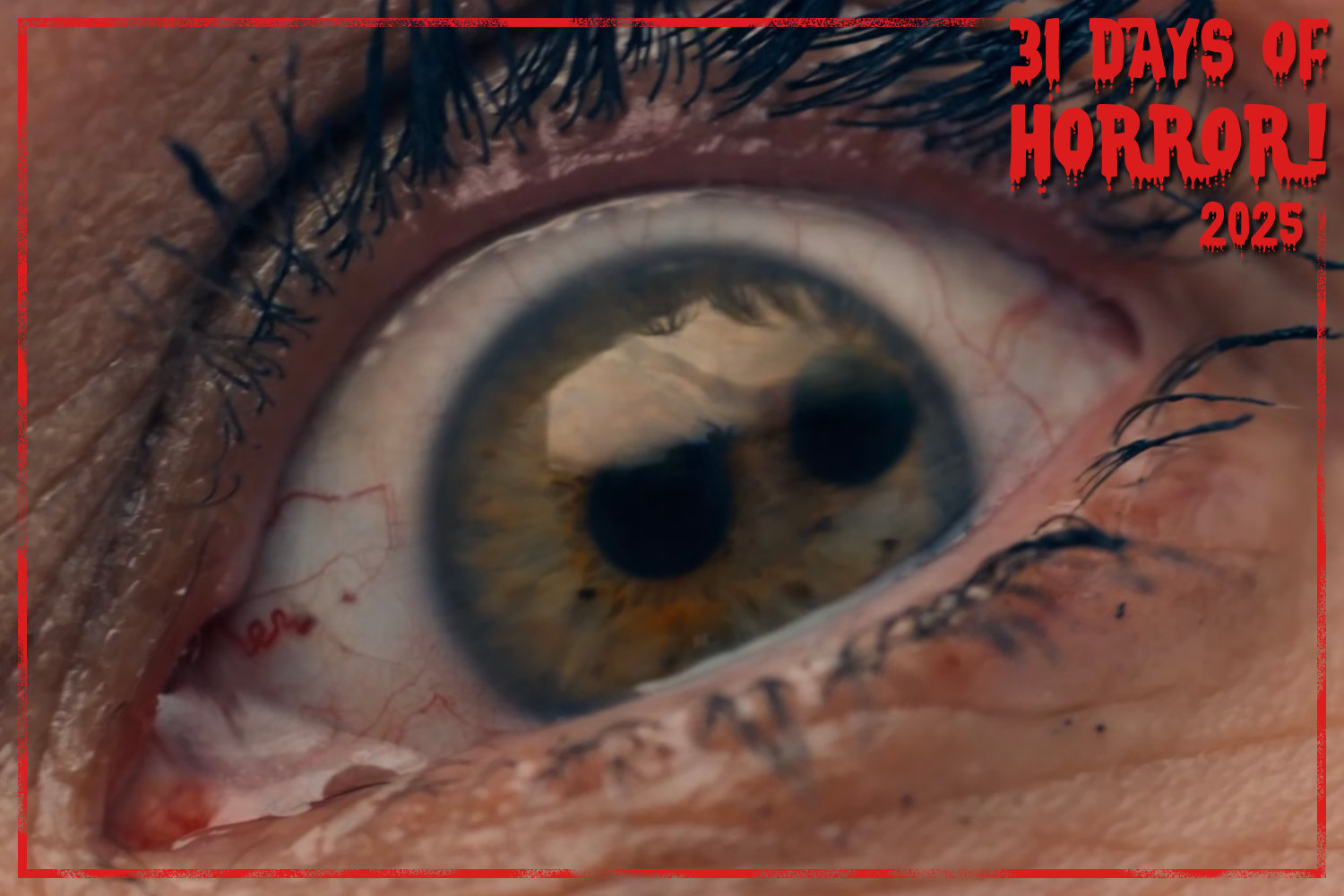
Beauty may be only skin deep, but ugly is to the bone.
The Substance is a chilling look at the objectification of feminine beauty through the lens of Hollywood and society. It points out the hypocrisy of Western views of women, especially older women, and the detriment those views have on their physical and emotional health. It does it all with a wicked wit, opening a space for discussion about some of these outdated ideas.
Before Viewing
The trailer begins with an aging actress meeting with an agent or plastic surgeon. She is provided with an injectable that will make her young again, transforming her body into one at least half her age. Things look good, until they don’t. Some slight misuse of the substance may have occurred. The Substance looks like Dr. Jekyll and Mr. Hyde meet body horror with elements of The Shining thrown in for good measure.
Presented below is the trailer for the film.


The Substance title card.
After Viewing
Film star Elisabeth Sparkle (Demi Moore) celebrates her 50th birthday and is fired from her long-running jazzercise show by producer Harvey (Dennis Quaid). Distracted on her way home by a billboard featuring her image being torn down, she gets into an accident. At the doctor’s office, a Nurse (Robin Greer), with a large birthmark on his forearm, tells her she’s a good candidate. On her way out, she discovers a thumb drive with the label “The Substance” and a phone number in her jacket. Elisabeth watches a video from the thumb drive, which solicits a “better version of yourself.” She calls the number and is soon provided with her first installment of The Substance.
Elisabeth looks through the instructions on the cards in the kit: You Activate, You Stabilize, You Switch, with a reminder that “You are one.” She injects herself with the neon green liquid and passes out. Her back splits open, and a full-grown, but younger, version of herself emerges. She calls herself Sue (Margaret Qualley). Sue stabilizes herself with fluid drawn from Elisabeth’s spine. She attends a casting call at the studio to replace Elisabeth and wins the role on a new, more erotic exercise show. After one week, Sue performs a transfusion between her body and Elisabeth’s, which reawakens Elisabeth.
Several weeks into the process, Sue becomes careless of the regimen, wanting extra days for herself. She extracts more stabilizer than allowed, and when Elisabeth returns, she discovers one of her fingers is withered and crone-like. When Elisabeth calls the Substance phone number, she is told that there is no going back and that she should respect the balance. After picking up her replacement package of The Substance, Elisabeth stops into a diner where an old man (Christian Erickson) asks her how it’s going, adding that seven days is a long time. She notices the large birthmark on his forearm, identifying him as the young nurse who helped her. Elisabeth gets freaked out by this moment.

Elisabeth is about get the sparkle taken out of her life.
Returning home, Elisabeth gives a call to Fred (Edward Hamilton-Clark), an old friend from high school whom she met outside the studio recently. She agrees to get together for a drink, but as she’s getting herself ready to go, she continually sees flaws that she wants to hide and ends up staying inside. When Sue returns, she is disgusted by the messy and chaotic way Elisabeth is living. Sue has a dream about pulling a full-sized chicken drumstick out from under her skin. Harvey tells Sue that they can’t continue the exercise show because Sue is such a megastar now. He presents her with the honor of hosting the New Year’s Eve show, much to her excitement.
Sue has taken more than her fair share of time with her body, having taken as much stabilizer as she can to last until New Year’s Eve. When Elisabeth awakens, she finds she is wizened, older, and hunchbacked. Elisabeth calls the help line to get a termination kit. She begins injecting the black liquid into Sue’s inert body, but can’t bring herself to finish, needing to switch back. Unfortunately, Sue awakens at the same time as Elisabeth. Sue beats Elisabeth into a bloody pulp, leaving her for dead, before heading to the studio for the big show.
At the studio, Sue’s body begins to fall apart, and she returns home with the idea to use the Activator on her new body, despite its “one use only” warnings. She does anyway. A new body emerges from Sue that is a horrific monstrosity of flesh and bone, called Monstro Elisasue. The freakish creature puts on Sue’s lovely ball gown and glues an Elisabeth mask to its face, returning to the studio. The creature tries to perform for the crowd, but begins dissolving, spraying blood and body parts on the crowd. Elisasue runs from the angry mob, tripping on the sidewalk and rupturing into a pile of parts and goo. A piece of Elisabeth’s face slides and dissolves over her Walk of Fame star. The next day, a street scrubber cleans up the remains of any mess that was left.
“It gets harder each time to remember that you still deserve to exist!” – Old Man at diner

Sue know what she wants, and Oliver isn’t it.
The Substance concludes a week-long look at horror films directed by women, with what has to be the most disturbing film so far. Previous films from this week include Near Dark, Jennifer’s Body, The Invitation, Relic, and Candyman, all of which feature horrific moments. But The Substance is the most horrific of them all. Its body horror, which pays homage to films by David Cronenberg and John Carpenter, is disgusting and not for the squeamish, but that only scratches the surface of the story. The treatment of women in this film is the most horrible thing. Old women and young women alike are objectified and treated like commodities. What makes that even worse is that they have also been conditioned to treat themselves in a way that devalues them as people and turns them on each other. Yet these horrible scenes are still not some of the most disgusting parts of the film. Conceived by French director Coralie Fargeat, The Substance is her Academy Award-winning follow-up to her well-received rape/revenge film Revenge (2017). The Substance, which deserves all of its nominations for Best Film, Best Screenplay, Best Director, and Best Actress, only won for Best Makeup and Hairstyling, unfortunately. But Fargeat’s achievement goes beyond actual awards, as she became the first woman to be nominated for writing and directing a horror film, not normally a genre that gets recognized for the “big” awards. These types of films often are nominated (and sometimes win) for smaller technical categories, such as Makeup, Effects, or Art Direction. Occasionally, a Best Actor or Supporting Actor may be recognized. But to date, only six other horror films have been nominated for Best Picture: The Exorcist (1973), Jaws (1975), The Silence of the Lambs (1991), The Sixth Sense (1999), Black Swan (2010), and Get Out (2017), with only The Silence of The Lambs taking home the award (even as a non-traditional horror film).
For any actress taking part in this film, they needed to trust the director and take a leap of faith with the material and its presentation. Both Demi Moore and Margaret Qualley laid themselves bare, literally, for these roles, which focus hyperrealistically on women’s bodies. They would surely have never made a film like this if it had been directed by a man. It would have been an entirely different type of project. One can assume that rather than a film about sexuality, it would have been a film that sexualized the characters in more ways than it already does. Sue’s overt and youthful sexuality is contrasted with Elisabeth’s aging beauty. Elisabeth dismisses her beauty due to her age and the opinions voiced by others. On the other hand, Sue flaunts her body with every moment she has. These scenes are filmed in a way that appears to be sexy, using camera angles that tease and titillate with close-ups of butts and breasts, but end up being just as gross as some of the stomach-churning makeup effects from the final act. Fargeat’s technique of close-up photography objectifies characters, invading their personal space, in a different way than similar photography of women might appear in other horror films. The sexuality of the images may appear equal, or even more overt, in The Substance to the nudity in Friday the 13th: The Final Chapter, as an example. But the scenes lead to more discomfort due to the gaze from Fargeat’s camera being neither subtle nor glamorized. There’s no teasing or sexiness. It’s overt, intrusive, and in your face, pushing the audience to a place of revulsion with the imagery being shoved into their faces.
Because the subject matter is about the aging bodies of women and their presentation as a commodity in Hollywood, the film could have been conceived without any of the horror aspects and still be a disturbing portrait of societal norms. The initial scene with Elisabeth entering the bathroom and overhearing Harvey scream into the phone about needing to find a younger, hotter girl for the show depicts an all too common occurrence. The double standard by which women are presented versus men is apparent in all of Harvey’s scenes. Quaid, as an older actor, is still viable for any male parts that may come his way, while Moore, a decade younger than Quaid, may not get the same types of calls she used to. Harvey’s imagery is created with wide-angle lenses pushing in close to his face, distorting his features in a grotesque way, not unlike the arrival of Monstro Elisasue in Act Three. His ability to look like a slob (the restaurant scene) only exacerbates his grossness, as does his lecherousness as he peers distractedly at showgirls (along with the old men of the Board), all while telling Sue to “smile!” This is only the beginning of the unsettling imagery in the film.

Who does Harvey remind you of? I’ll give a clue. A douchebag.
At its surface, The Substance is a body horror film. But at its core, it’s really a twisted retelling of the almost 140-year-old Robert Louis Stevenson story, Strange Case of Dr Jekyll and Mr Hyde. In this story, Elisabeth is the personification of Mr. Hyde, since she sees herself as an ugly and unsavory character. While she is certainly an attractive older woman (as is Moore), her inner ideal of her beauty eventually manifests itself on her exterior, first minimally, but eventually into a Gollum-like crone. Her use of a mysterious serum allows for her younger doppelganger, Sue, to emerge into the world as a taut, vivacious young woman. Unlike the original story, where Jekyll’s potion transforms him into the murderous Hyde, Elisabeth and Sue are two separate entities. Even though they do not share the same body, their continued existence is dependent on each other. They are the same, as they are continually reminded, and what one does affects the other. It’s tragic since both come to see the other as a threat to their continued existence, rather than as a necessary piece to their livelihood. Elisabeth surely remembers her struggles coming up through “the business,” but provides no support to Sue in her interactions with Harvey and his kind. Sue relishes the limelight and doesn’t take into account any mentoring that Elisabeth may provide, nor that what she does affects the others’ bodies. Parts of the film seem like Fargeat reminding women that they need to look out for each other, especially in predatory situations, otherwise they will all get destroyed.
The element of the film that gets the most discussion is absolutely the body horror elements of the film. From the birth of Sue to her transformation into Monstro, these graphic visuals stick with the audience long after the film is completed. Fargeat’s style of body horror derives from the work of David Cronenberg, who was turning stomachs with his 1980s hits Videodrome, The Fly, and Scanners. The genre of body horror can cover a wide range of imagery, from early sci-fi horror, like Invasion of the Body Snatchers and The Blob, films about characters transforming into mutated creatures, such as Sssssss, An American Werewolf in London, or Tusk, to grotesque flesh mutations as seen in The Thing, Society, or this film. The Substance makes use of many of the same techniques used 50 years ago to create horrific deformations of the body, rather than computer-generated imagery. Anatomical models loaded with slime and fake blood create a more visceral reaction than the digital creature creations of a computer. The special effects makeup also gives the actors something to work with in reality, allowing them to use the props as part of their performance instead of reacting to something unseen. The buildup to the final creature is somehow more disgusting than the final monster. It’s more than the closeups and graphic depictions of snapping bones and deforming body parts. It’s the audience’s relation to the characters that creates the horror. Without a viewer caring about the character’s suffering, the graphicness is nothing more than gore. It’s easy to disgust an audience, but can more be done with the body horror genre? Can the body horror work in favor of an audience connecting to a character instead of repulsing them? Sue’s final form, while disgusting, is more pitiable than shocking, devolving into parody with the ungodly amounts of blood that got hosed onto the audience of the New Year’s event; the finale feels like something from Peter Jackson’s Dead Alive. Fargeat achieves an amazing level of pathos for both female characters, given the huge amount of torture she puts them both through, something that will be tough to beat for other filmmakers.
The Substance deserves all its accolades, especially for scenes that may not have been focused on in adverts. Fargeat talks in a behind-the-scenes video of the sequence that early viewers and producers asked her to trim or cut. It is a sequence that disgusted everyone and provided the most visceral feelings from the viewer. It’s the sequence with Harvey eating the shrimp while discussing Elisabeth’s career with her. The combination of Quaid’s over-the-top performance with the closeups of slimy shellfish and the loud slurps and crunching is hands down the most stomach-churning moment of the film. It is due to its realism that the audience reacts to the moment. It’s like people finding out how squirmish I can be while watching a video of an operation or some other medical procedure. They point out all the disgusting horror movies I’ve watched. Yet I know that the horror films aren’t real, and the operation footage is. The realization that this is actually happening can be horrific. The Substance has so many other things going for it in terms of cinematography, color theory, and metaphorical content. It’s an amazing film, along with being an amazing horror film, and will be a title that will be analyzed for decades for its visual storytelling, characterization, and social commentary.

Sue and Elisabeth, just two peas in a pod (or two yolks in an egg).
Assorted Musings
- As Sue begins to literally fall apart in the third act, her devolution follows Seth Brundle’s collapse in Cronenberg’s The Fly. Like that character, first she loses teeth, then a fingernail, and finally, an ear.
- The design of the hallway and bathroom at the television studio is designed to mirror sets from The Shining. The orange colors of the hallway, the carpet design, and the corridor of blood all recall similar moments at the tragic hotel. The bathroom at the studio also mimics the colors and layout of the bathroom behind the bar, where Grady talks to Jack Torrence.
- Elisabeth’s bright yellow jacket is a visual element that recalls both the egg yolk splitting apart in the opening frames as well as the two pieces of yellow clay seen in the promotional video for The Substance, foreshadowing her transformation.

Having grown up on comics, television and film, “Jovial” Jay feels destined to host podcasts and write blogs related to the union of these nerdy pursuits. Among his other pursuits he administrates and edits stories at the two largest Star Wars fan sites on the ‘net (Rebelscum.com, TheForce.net), and co-hosts the Jedi Journals podcast over at the ForceCast network.