
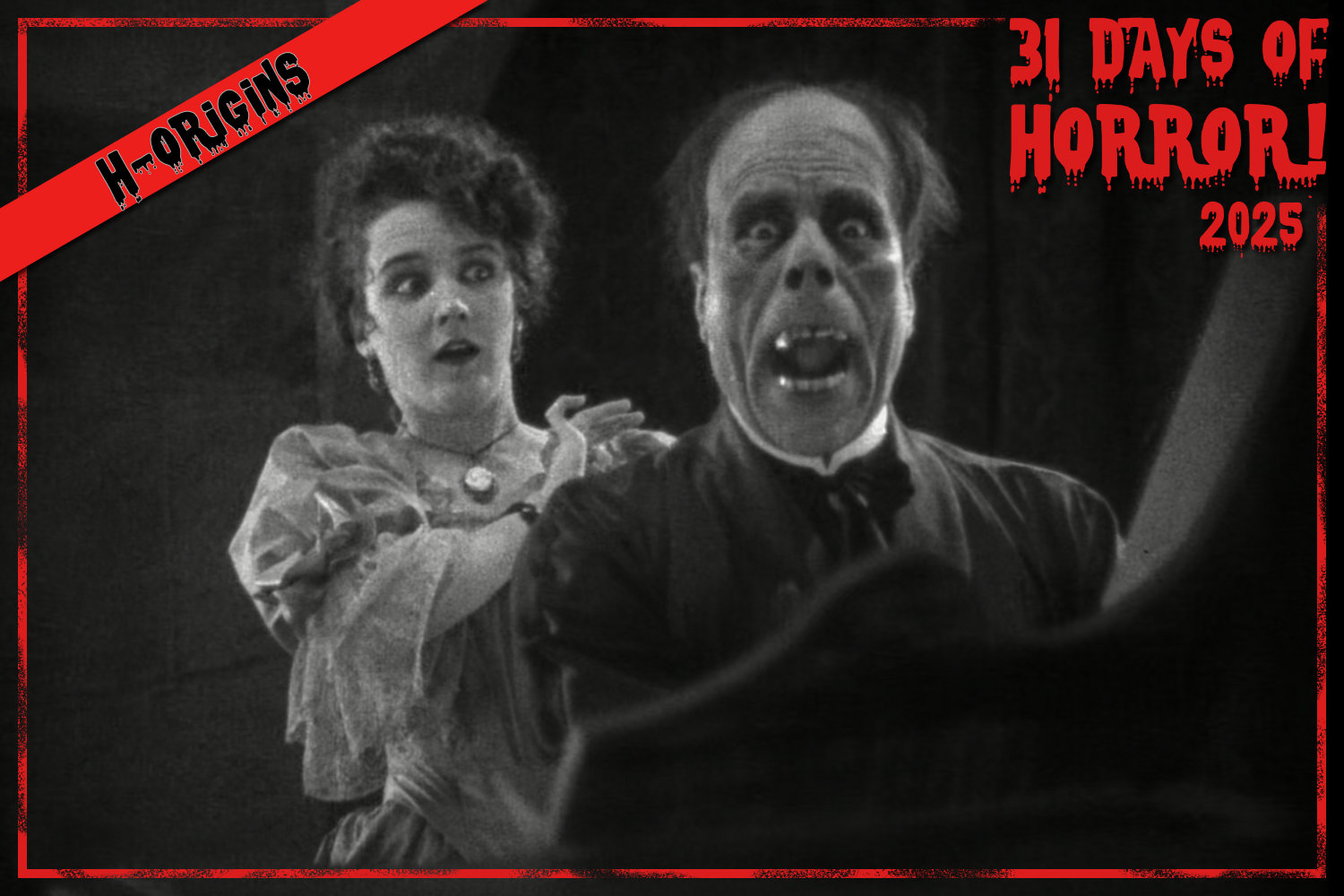
Open up your mind, let your fantasies unwind. In this darkness that you know you cannot fight.
From the depths of a beautiful Opera House comes one of the most terrifying creatures to emerge in horror, the Phantom of the Opera. This film, now celebrating its centennial, was an inspiration to many and one that continues to inspire spooky characters and creepy situations in modern film.
Before Viewing
The trailer for this film opens by letting audiences know that the film is based on the novel by Gaston Leroux and produced (painstakingly) by Carl Laemmle. Images portray a giant figure hovering over the Paris Opera House, along with hundreds of people on its Grand Staircase. The intertitles tell viewers that Lon Chaney’s makeup is amazing and that no advance imagery of it will be presented (but they might catch a glimpse of him in some shots that follow). The grandness of the Opera performance is contrasted with the imagery of the “500 dungeons.” Go see this film to reveal the Phantom of the Opera.
Presented below is the trailer for the film.


The Phantom of the Opera title card.
After Viewing
New owners purchase the Paris Opera House. The previous owners tell them that they may hear a Phantom in the building, and to check with the mysterious man in box number five. They look into the box, seeing a cloaked figure, which spooks them. But when they look again, he has quickly vanished. The dancers at the Opera are all scared of stories about the Phantom and jump at strange shadows on the wall. Stagehand Joseph Buquet (Bernard Siegel) shows the women where he spotted the Phantom coming and going, which also spooks Papillon (Snitz Edwards), a comedic character.
The owners are visited by the prima donna’s mother (Virginia Pearson), who received a note from the Phantom stating that Carlotta, the prima donna, must fall ill and be replaced by Christine Daae (Mary Philbin). Christine goes on to perform and then meets her boyfriend Raoul (Norman Kerry), the Vicomte de Chagny, who proposes marriage. Christine says she can’t think of such a thing, as she owes much to the Opera and her mysterious, unseen benefactor. The Phantom’s voice comes through her dressing room, reminding her he’s given her a career and not to forget him.
When Carlotta (Mary Fabian) performs the following night instead of Christine, the Phantom cuts the rope holding the immense chandelier, which falls into the audience, nearly killing people. Christine is led through a secret doorway in her dressing room by the Phantom (Lon Chaney), who wears a face mask to hide some disfigurement. He leads her into the chambers underneath the Opera House, first on a horse and then on a boat over the sewers. He professes his love for her and tells her of his given name, Erik. She realizes he is the Phantom oft spoken of and then faints.

Raoul greets his true love, Christine, the ingenue of the Opera.
In the morning, she awakens in a chamber set up for her, complete with clothes and shoes, along with a note. It says that she can be free as long as she loves Erik and never touches his mask. She enters the catacomb to discover Erik playing a lovely theme on his organ. Overcome with emotion, she pulls off his mask, revealing a shocking face with no nose, sunken eyes, and a wicked grin. But his love for her supersedes his warnings, and he offers her freedom to sing again if she promises never to see Raoul again. She agrees, but upon release sends a note to Raoul to meet her at the Bal Masque the next evening.
Raoul and Christine steal away to the roof, where she pleads for Raoul to take her away after the next performance. Little do they realize that the Phantom is hiding on the statuary above them, overhearing. A man in a fez, later revealed to be Inspector Ledoux (Arthur Edmund Carewe), warns the two to take an alternate staircase out of the building. Christine performs in Faust the next evening, but is abducted by the Phantom right from the stage. Ledoux teams up with Raoul, and they both descend into the catacombs to look for her, but fall into a room of mirrors, a torture pit.
A mob led by Simon Buquet (Gibson Gowland) heads into the catacombs as well to avenge the murder of his brother, who he discovered dead backstage. The Phantom turns on a heating element to cook Ledoux and Raoul, but they escape into another room with barrels of gunpowder. Erik offers Christine the choice to free the men or blow up the Opera House, which she chooses the former. A switch drains the sewers, flooding the room the men are in, but fortunately, Erik opens a trap door, freeing them. The torch-carrying mob continues unabated through the mostly drained sewer. Erik grabs Christine and escapes into the carriage left outside the Opera House by Raoul. She leaps from the conveyance as it crashes, and the mob chases Erik to the river. He pulls something from his cloak, threatening the angry men, but then he laughs, revealing it’s just an empty hand. The crowd beat him and throw his body into the water.
“If I am the Phantom, it is because man’s hatred has made me so.” – Erik, the Phantom of the Opera

Christine recoils from her benefactor when she realizes that he is The Phantom.
The Phantom of the Opera is a return to the roots of the horror film as it becomes another entry in the “H-Origins” series on 31 Days of Horror. This original version of the film celebrates its 100th Anniversary this year, making it one of a small handful of horror films that have survived the last century. This includes Nosferatu, The Hunchback of Notre Dame, and The Hands of Orlac, all of which have been featured in this article series in the last three years. So much of this film has inspired other filmmakers’ imaginations, from the atmosphere of the sets to the amazing makeup transformations used by Chaney, not just in remakes of the story but in all aspects of horror.
Unlike other films of this era, many of which were also based on pre-existing novels or stories, The Phantom of the Opera’s source material was only 15 years old. For example, Nosferatu (1922) is based on the 1897 novel Dracula, Dr. Jekyll and Mr. Hyde (1912, 1913 & 1920) was based on an 1886 novel, and The Hunchback of Notre Dame (1923) was based on a 1831 novel, making it the oldest adaptation of the time. With Phantom, the source material was positively fresh, and acquired by producer Carl Laemmle immediately after reading the novel by Gaston Leroux. Laemmle was the man behind Universal Studios and helped produce the antecedents of horror, which would continue to grow at the studio with his son, Carl Laemmle, Jr. Besides producing Phantom, he also shepherded the aforementioned 1923 version of Hunchback (also with Lon Chaney) and The Man Who Laughs (1928) with Conrad Veidt. His work on horror films continued with his son, who produced some of Universal’s best-known monsters, including Dracula, Frankenstein, and The Invisible Man.
The Phantom of the Opera may have the most released versions of any film until Star Wars came on screen, over 50 years later. This is unsurprising as the filmmakers had shot enough footage to create a four-hour initial cut of the film. After an initial screening in January 1925, which audiences felt was too melodramatic, an unscripted ending that was shot by director Rupert Julian, in which Christine kisses Erik on the forehead as he dies just before the mob arrives in the catacombs, was removed, and the New York premiere of the film, canceled. A reshoot was scheduled to film additional elements relating to Christine’s love life with Raoul, directed by Hoot Gibson. Even more additional footage, directed by Edward Sedgwick, was filmed to add comedic subplots with new characters, lightening the tone of the film. In April 1925, a screening of this version was met by enthusiastic vitriol from the audience. The movie was then re-edited, removing most of Sedgewick’s footage (except for the ending of the mob killing Erik and tossing his body in the river), and replacing it with the original footage shot by Julian. This was the resulting film screened at a gala premiere at the Astor in New York City. What a crazy turn of events and an epic waste of time and resources!
But the alterations to the film didn’t stop there. With the advent of sound pictures and the 1927 release of The Jazz Singer, Universal planned a sequel to Phantom, which would have sound. They opted instead to re-release the original version with some newly added sound sequences. At least two scenes from the original 1925 version were cut and have since been lost, including a scene in a graveyard and some of the original photography of the Bal Masque sequence. A re-edited version of the 1929 release was used for this review. It features tinted scenes, similar to what Nosferatu had used, to indicate daytime (yellow), night (cyan), and eerie (magenta) moments by dyeing the film. The Bal Masque sequence, including the rooftop sequence with Erik overhearing Christine and Raoul, was filmed with a two-color Technicolor process, of which the vivid reds of Erik’s Red Masque outfit stand out. Up until recently, this was thought to be the only surviving color sequence until color footage of the opening ballet sequence turned up on YouTube. Various edits of the film exist on DVD and video, some with different title cards or without tint.

In a rare color moment from the film, the Phantom masquerades as the Red Death.
Outside the tempestuous production, the film is primarily known for Lon Chaney’s standout makeup, created solely by himself, which turned him into the Phantom of the Opera. Known as the man of a thousand faces, Chaney was much sought after at the time. Not only could he change his appearance, sometimes painfully, but he also had the acting ability to back up his cosmetic changes. For this film, Chaney used primarily greasepaint makeup to accentuate the skeletal look of Erik’s visage, but also used wires to draw his nostrils upward and a set of fake teeth with prongs that stretched his lips outward. This looked frightened audiences of the time, and is still a rather chilling reveal in the context of the film. This makeup, along with Quasimodo and the Vampyre from London After Midnight, has cemented Chaney as a master dramatist and the original special-effects make-up artist.
The legacy of the film remains strong 100 years later. This version is still looked on as the best adaptation of the source material to date, but other versions have also resonated with audiences. The 1943 version with Claude Rains as the Phantom, also produced by Universal, reused some of the sets from the 1925 version and was the first full Technicolor release of the story. A 1986 musical version of the story by Andrew Lloyd Webber became the longest-running musical in Broadway history and created a renewed interest in musical theater with multiple songs transcending the play, including the title track and “Music of the Night.” This musical was eventually adapted into a film by director Joel Schumacher in 2004. Other successful interpretations of the original story include the rock-opera version from 1974, Phantom of the Paradise, directed by Brian DePalma, a 1989 version touting Robert “Freddy Krueger” England as the Phantom, and a 1998 version by Italian horror director Dario Argento.
The 1925 Phantom of the Opera begins an anniversary week on 31 Days of Horror, celebrating the release of this film 100 years ago, followed by a film from every decade from the last 50 years, starting with 1975 through 2015. Getting a chance to go back and rewatch some of these classic films showcases how far the horror film has come as a genre, but also how similar the sensibilities can still be. Lots of people may assume the movie to be more of a love story, like Hunchback, due to the romantic overtones created by the Webber musical. But this is incorrect, as Erik is very much a stalker who terrorizes and kills people at the Opera House, attempting to spirit a young woman away for nefarious purposes. His death is not a tragedy, as with some Hollywood monsters (including Quasimodo), and he gets (mostly) what he deserves in the end. Don’t be fooled by the fact that the film is in black and white either. Given the right mood and setting, a film like this can still cause the chills to run up your spine.

Christine check on Raoul after he is freed from the Phantom’s trap.
Assorted Musings
- During the mob’s chase of the Phantom through the streets of Paris, the action passes by the Cathedral facade used for The Hunchback of Notre Dame.
- Chaney’s contract specified that his makeup not be revealed in behind-the-scenes photos or trailers, yielding a more shocking reveal in the film. If only modern studios would prevent creature reveals in the trailers, perhaps audiences would be more curious about the final film.
- A thorough list of differences between the 1925 and 1929 versions can be found on this Reddit Thread.

Having grown up on comics, television and film, “Jovial” Jay feels destined to host podcasts and write blogs related to the union of these nerdy pursuits. Among his other pursuits he administrates and edits stories at the two largest Star Wars fan sites on the ‘net (Rebelscum.com, TheForce.net), and co-hosts the Jedi Journals podcast over at the ForceCast network.