
Let’s check the math on this one.
The Martian is not what the title might imply, a film about an alien being stuck on Earth. It’s the complete opposite as a human gets stranded on Mars, discovering new things about himself as he finds a way to survive the harsh conditions. It’s a return to science-fiction for Ridley Scott, but an entirely different sort than he normally creates, in a film that celebrates the human spirit.
First Impressions
A star-studded cast stars in a Ridley Scott film, adapting a best-selling novel, according to this trailer. A six-man crew on Mars needs to escape before a storm hits, when one of them, Matt Damon, is blown away and presumed killed. A press conference on Earth confirms this. Except, he’s not dead. Not by a long shot. Marooned, he has to figure out a way to survive for potentially four years before he can be rescued, as well as find a way to contact NASA. Does he make it, and is he The Martian of the title?
Presented below is the trailer for the film.


The Martian title card.
The Fiction of The Film
As the crew of Ares III is exploring the surface of Mars on Sol 18, a massive storm hits them, causing them to abort their mission. As the crew rushes back to their rocket, botanist Mark Watney (Matt Damon) is struck by a satellite dish and presumed dead. Captain Lewis (Jessica Chastain) makes the call to save herself and the other four crewmembers, and the ship takes off. On Earth, Teddy Sanders (Jeff Daniels), director of NASA, makes the announcement of Watney’s death to the press. Back on Mars, Watney awakens to a low oxygen warning and finds a section of the antenna has pierced his suit. He struggles back into the HAB (crew habitat), operates on himself to remove the shard of metal, and records a log entry that he has, indeed, survived.
Watney begins making plans on how to survive for the three years until the next manned Ares flight. Luckily, he’s a botanist who has potatoes. Watney uses the remaining hydrazine and a small flame to create water to grow his crops inside the HAB. He then begins to figure out how to take the Rover 3,200 kilometers to the new landing site, without losing heat. He digs up a radioactive isotope to keep the cockpit warm. Shortly after Watney’s funeral, satellite planner Mindy Park (Mackenzie Davis) alerts NASA Director of Mars Missions Vincent Kapoor (Chiwetel Ejiofor) that Rover 2 has somehow moved between satellite images of the landing site.
Two months later, Watney harvests his potatoes and begins devising a way to communicate with NASA. He discovers the remains of the Mars Pathfinder and begins to repair it. NASA scientists, led by Vincent and Bruce Ng (Benedict Wong), gather at the Jet Propulsion Laboratories (JPL) to use a duplicate Pathfinder to receive and broadcast back to Watney. They eventually provide him with a hack so that he can use the computer in the Rover to communicate via text messages with Houston control. Mitch Henderson (Sean Bean), the crew flight director, sends a video message to the Hermes four months later, informing Commander Lewis and the others that Watney is still alive.

The crew of ‘Ares III’ watches the monitor as a storm approaches.
Watney has become extremely adept at his daily routine, which includes working on his crops, modifying the Rover for his travel needs, and listening to the god-awful disco music left behind by Lewis. One day, a seal of the HAB bursts, damaging Watney’s space suit and freezing his entire crop. NASA plans to send a resupply probe to Mars, but the rushed vehicle explodes shortly after takeoff. This catches the interest of Guo Ming (Eddy Ko), the chief scientist at the Chinese Space Agency, who offers the use of their rocket at the expense of a Chinese mission. Meanwhile, astrophysicist Rich Purnell (Donald Glover) has spent weeks looking into a complex solution, which he relays to Teddy, Vincent, Mitch, and Annie (Kristen Wiig), the NASA PR director.
The solution, codenamed Project Elrond, involves the Hermes making a slingshot maneuver around the Earth, picking up a resupply package, and heading back to Mars. Teddy believes this is too risky and plans to use the longer and safer option. Mitch feels that the crew needs to be made aware of the option, so he goes rogue and provides Hermes with the data. The crew mutinies and accelerates their spacecraft, making their preference to save Watney known. Luckily, everything goes as planned, and the Hermes heads back to Mars. In the seven-month wait, Watney completes the original Ares III mission parameters. The toll of living alone on a barren planet with limited rations has taken its toll on Watney’s body, but his attitude remains positive as he calls himself a space pirate.
Watney begins on the 100-day trek to the location of a pre-deposited Ares IV MAV rocket. Using instructions from NASA, he strips the MAV of over 5,000 kilograms of weight and awaits an automated ascent, remotely piloted by Hermes pilot Rick Martinez (Michael Peña). The launch works, but Watney’s vehicle does not make it nearly as far into orbit as anticipated, and the Hermes has to make some alterations so they will be in position to catch him. Even with a course change and an explosive decompression to slow down, Watney is still over 100 meters further away than needed. Watney takes an insane risk and punctures his glove, creating a thrust vector so he can “fly like Iron Man.” His stunt barely works, and he makes it to the tether Commander Lewis is holding. Watching on screens all over the globe, the world celebrates the retrieval of the American. Later, Watney teaches a class on astronaut survival to new candidates while the Ares V prepares to launch for a new mission.
“They just keep repeating ‘go faster than any man in the history of space travel’, like that’s a good thing. Like it’ll distract me from how insane their plan is.” – Mark Watney

Luckily, Mark Watney is a botanist.
History in the Making
Ridley Scott’s The Martian oftentimes feels so much like a documentary of a doomed mission to Mars that viewers might have to remind themselves it’s actually a movie. This was the second of three sci-fi films directed by Scott in the 21st Century (to date), following Prometheus and in advance of Alien: Covenant. The film makes use of an adapted story, touching on elements from many other films, some science-fiction and some drama, about characters stranded alone. The Martian also serves as a love letter to STEM, acting as a recruiting video for NASA and JPL, in the same way that Top Gun served as an advertisement for Naval aviation. It’s a beautifully uplifting film that affirms the best aspects of humanity, along with our ability to troubleshoot and solve complex problems, at least when lives are on the line. It also creates a scientific realism for the genre not seen since films like 2001: A Space Odyssey, excising alien cultures or fantastical elements. It’s not one-hundred percent accurate, but that is more a factor of creating engaging movie sequences, rather than ignoring physics.
The original story for The Martian was published in 2011 (and re-released in 2014) by author Andy Weir. Unable to get a publisher to greenlight the book, Weir self-published a Kindle version and released chapters via his website and through the website Reddit, garnering a grassroots group of fans. Anyone who has read the story knows that it’s a difficult book to put down, containing action, humor, and suspense. Since then, Weir has written two other titles, Artemis in 2017 and Project Hail Mary in 2021. The latter is due to be released in March 2026, directed by Phil Lord and Christopher Miller, and starring Ryan Gosling. It has a similar vibe to The Martian, focusing on a lone astronaut, but instead of being stuck in space, he is on a mission to save the Earth, which only he can accomplish. Unlike many other science-fiction authors who create fantastical accounts in their stories, Weir opted to learn as much as he could about the real-world physics involved in a manned space flight to Mars. His research paid off by creating an extremely accurate portrayal of the orbital mechanics and timeframes involved in such an expedition.

Sometimes, little things make a big difference.
Genre-fication
Humanity has been visiting Mars for decades, at least in the movies. In fact, the very first article on Sci-Fi Saturdays was for Rocketship XM, which features the first film about a manned trip to Mars. However, in the pantheon of films about trips to Mars (including Total Recall, Mission to Mars, Red Planet), The Martian stands alone as an uplifting and realistic trip to the red planet. Mission to Mars and Red Planet are both films about manned missions to the planet that go horribly wrong, including appearances by the original alien inhabitants of the planet. Because that seemed to be the way to go when discussing Mars, there were always Martians around somewhere. Total Recall has nothing to do with the exploration of the planet, as it is already colonized. This film is more of an action-mystery, using the mystique of Mars as a location (along with ancient Martians), rather than the same story of manned trips to the Red Planet for scientific expeditions. The Martian is iconic in that it takes its cue from other films that have little to do with space exploration. The only science-fiction film that comes close is the 1964 Robinson Crusoe on Mars, which owes much of its story to the Daniel Defoe Robinson Crusoe novel, just set in space on another planet instead of on a deserted island. In both films, an astronaut finds himself stuck on a planet with no way home, except that in this older film, Commander Christopher Draper doesn’t have to worry much about freezing, decompression, or companionship (as he finds a humanoid he befriends). The Martian finds its groove by being a strange mashup between the Tom Hanks films Cast Away and Apollo 13.
It may be strange to say that a sci-fi film is most inspired by two non-sci-fi works, but here we are. Mark Watney’s time on Mars is more similar to a man stranded on a desert island than Robinson Crusoe on Mars is, aping the 2000 film Cast Away. That film is about Tom Hanks’ character, Chuck Noland, surviving a plane crash and being stranded for four years on a South Pacific island until he is able to devise a way to rescue himself. The most important thing, in a situation like this, is taking care of shelter, water, and then food, as characters from both films must figure out how to survive for months and years based on the supplies they have with them. Watney’s ad hoc surgery session on his abdomen, repairing the puncture by the antenna, is very similar to Chuck’s improvised dental surgery with a rock. Luckily, Watney had other people to speak with, so he didn’t have to resort to drawing a face on a Martian rock to talk with. The Martian also pulls elements from the true-to-life (though not a documentary) Apollo 13, which recounts the efforts of NASA to save the lives of three astronauts stuck in a disabled spacecraft returning from the Moon. Like them, Watney only had what he came with (plus a few more things he discovered), but luckily, he was ingenious enough to be able to work everything to his advantage. He’s not the astronaut from older films, who only has his good looks to go by. Watney is a trained scientist, complete with botanical knowledge, something that absolutely saves his life. The Martian sets a high bar for a new wave of sci-fi films that are more scientifically grounded. Not all sci-fi films need to achieve this level of accuracy; movies are still a form of entertainment after all, but the details make for a more engaging and harrowing story.

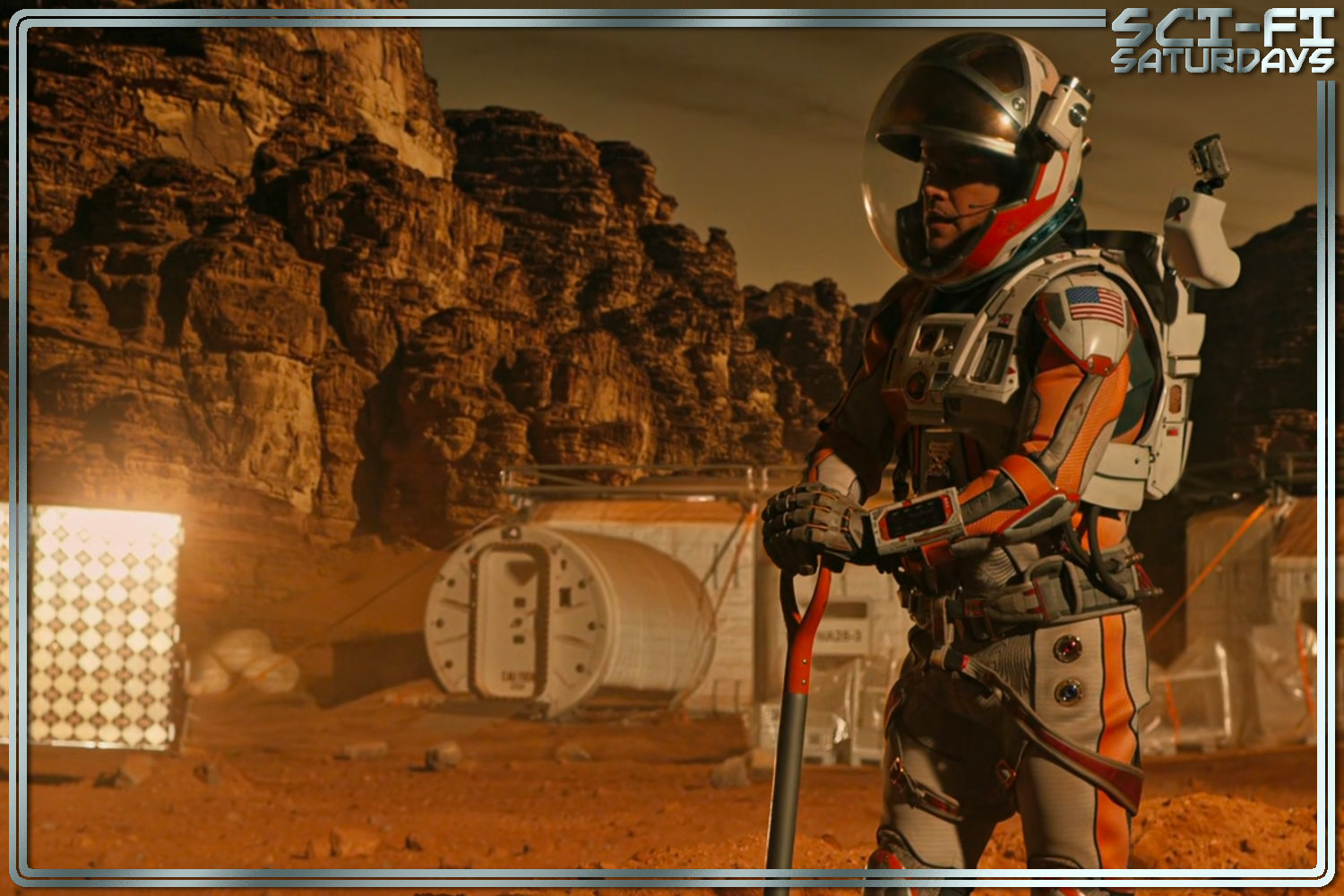
The visually stunning expanse of Mars was actually filmed in Radi Wum, Jordan.
Societal Commentary
The Martian is a truly uplifting film. It sees the best in people, and it shows the best in them as well. And while there are elements of nationalism and politics involved, the film is not about those things. Instead, it focuses on the strength of individuals working together to literally move mountains (er, rocketships) and rescue one man from an alien planet. There are no discussions, at least no overt discussion, about the risk of rescuing one person, as Mark will eventually get rescued when Ares V returns in three years. But he would have to stretch his rations to an absurd amount in order to survive that long. The film instead sees the other astronauts making the sacrifice of spending an additional 533 days in space rather than stranding their friend any longer than he needed to be. The strength of these ties, through all the fun ribbing and teasing that characters share, displays the best attributes for astronauts and for humans. There’s no secret agenda by any of these characters (or a hidden spy), as seen in tons of other space travel films. Any of these people will gladly die for their work, and Mark believes he just might. He asks Commander Lewis to speak with his parents if he doesn’t make it and tell them that he died doing what he loved. It’s a story of humans being bigger than the individual, and caring about the species as a whole. A story that could use a lot more publicity in our present times. Even though the mission is an American one, affecting a United States citizen, the whole world is wrapped up in the story, pulling for Mark’s survival. The Chinese Space Agency even decides to assist in the rescue, knowing that their choice would scrub any mission they’ve been planning for. It’s a beautiful sentiment as humans help humans regardless of borders, but audiences might have to ask themselves, would the same be true in the real world?
One of the biggest selling points for humanity in the film is Mark’s positivity. With only a few exceptions, where he becomes depressed and breaks down, he remains extremely upbeat, focusing on the task at hand. He knows the problems, he applies logic to them, and works them out. As he says, he sciences the shit out of them. The humor seen in the film is not just a way to connect the character to the audience, but a way of demonstrating Mark’s method of keeping himself going. He makes puns. He derides the musical choices of his fellow astronauts. He jokes about being the first colonizer of Mars and a Space Pirate (complete with a wretched beard). When Mark digs up the radioactive isotope so he can warm the inside of the Rover, he chooses to play Donna Summer’s song “Hot Stuff” while driving back to camp. It’s no accident that a person of this character was chosen for such a dangerous mission. NASA officials do not want the crazy sociopath who snaps months into a voyage and kills the entire crew aboard one of their flights. It makes for entertaining horror fiction, but not for successful manned missions.
The film also showcases the ingenuity of the astronauts, proving that people picked for this job are all extraordinary people. They are smart and calm under pressure, but yet still have their breaking point, as Mark shows. He keeps up his spirits, which help sustain him just as much as the potatoes and rations he eats. The film starts with Mark having to do something incredible, which many might be unable to accomplish. He has to operate on himself to remove the errant piece of metal in his abdomen. How many people could do this? Maybe when it’s the choice between survival and death, the decision becomes obsolete. Even though he’s a botanist by training, it’s obvious that Mark is trained in many other areas. Maybe it was part of the NASA training. Maybe he’s just a fan of the Mars missions. Either way, knowing things, such as the location of Pathfinder and the best way to plan a 3,000-kilometer trek across an unforgiving planet, makes him a superhero of real-life proportions. It’s not a prospect that I’d like to personally experience, being stuck on a planet for nearly three years by myself, but who wouldn’t want to have the confidence and perseverance of Mark Watney? It’s yet another series of strong character traits that the film shows the audience as something to aspire toward.

Rich Purnell explains his maneuver that might just bring Watney home.
The Science in The Fiction
Everyone who works for NASA is smart. This is evidenced by the focus and attention to detail seen by everyone in the film. But there are some people who are scary-smart. The type of people, like Rich Purnell, played awkwardly by Donald Glover. His brain does not live in the normal world with you or me. It exists in some larger, cosmic space as he conceives a way to bring Watney home ahead of plan. The trick of space travel, at least in real life, is that you can’t just take off when you want to. Well, you can, but not if you want to reach a particular location. The Earth and the other planets are always moving, rotating around the sun (no matter what those ancient Greeks told you), and with the limited resources of fuel and the constraints of Newtonian laws, launch windows must be calculated to achieve the correct pathways between places. This is known as orbital mechanics. Imagine driving a car from Los Angeles to Las Vegas, but both cities are moving independently from one another, and if you pass Las Vegas, you might not be able to turn around in time to make it back before you run out of gas. No pressure, right? Weir looked into these complexities when he wrote the book, so that he could understand what it actually takes for a ship to return to Earth but slingshot back to Mars. In short, it’s a lot of effort and time to do things correctly.
You’re stuck somewhere on Earth. The first thing you need to do is find a source of potable water. It may be difficult, but not impossible. Now imagine you’re stuck on an inhospitable planet millions of miles from the nearest fresh water source. What do you do? Most people might not have the first clue. But Mark Watney is not most people. He is able to use his knowledge of the inventory at the HAB to realize that if he can start a fire (a horrible thing to do in the oxygen-rich environment under any normal circumstances), he can use the hydrazine to create water. He just sets up the system, fires it up (so to speak), and creates a renewing source of moisture to feed his thirsty crops. It’s one of the first amazing, yet scientific, aspects of The Martian. The film is scientifically accurate for the most part, but takes liberties with some elements for the sake of a more exciting film. One sequence of note is the opening storm, which forces the Ares III crew to depart early. With the limited atmosphere on Mars, it’s very unlikely that such an event would take place as depicted. But it serves the purposes of the story, within the realm of “close enough.”

Having spent the entire film amazingly positive and upbeat, Watney is provided one ugly-cry on the eve of his rescue.
The Final Frontier
The Martian makes me cry. Not because it’s a sad film. But rather because it presents a world that is so much better than our own. At the time of its release, 2015, NASA was a long way off from instituting a manned mission to Mars. And in the last 10 years, it’s not something that has gotten any closer, as the leaders of the country look to close borders and isolate America from the rest of the world. The dream of the 21st Century had always seemed like one where the world would look past the pettiness and hostility that defined so much of the 20th Century. It was to be a future where scientific breakthroughs would elevate everyone. A future where space exploration would become a priority again. And a future that brought people closer together. Well, like Frank Walker in Tomorrowland, perhaps I’ve been burned too often. The world of the real 21st Century is one that is insular instead of expansive. One where the world seems to be becoming dumber. And one in which scientific breakthroughs benefit the one percent rather than the world as a whole. I want more Star Trek and less Idiocracy. The Martian is still the dream, however. It’s the promise of the past reminding everyone what is still possible. It’s a film that proves that people can be better than we give them credit for and that imagination (the imagination to dream big) is still more important than knowledge.
Coming Next


Having grown up on comics, television and film, “Jovial” Jay feels destined to host podcasts and write blogs related to the union of these nerdy pursuits. Among his other pursuits he administrates and edits stories at the two largest Star Wars fan sites on the ‘net (Rebelscum.com, TheForce.net), and co-hosts the Jedi Journals podcast over at the ForceCast network.