
It’s the end of Star Wars as we know it, and I feel fine.
The Star Wars Sequel Trilogy continues with its second film. The adventures of Rey, Finn, and Poe persist as the galaxy devolves once again into a fascist regime. Yet, while many Star Wars films bring fans together in their enjoyment of the galaxy far, far away, The Last Jedi is a much more divisive film, due to its challenging the boundaries of the franchise and the real-world negativity of a society experiencing its own culture wars.
First Impressions
The trailer opens with a voice, presumably Snoke, talking about the raw power of an individual. Rey gets her time to shine as she trains with Luke, but Kylo is back and looking more pissed off than ever. Who’s got the power, though? It seems to be a darker mood in this film as the Resistance ships are under attack from lots of First Order troops. This isn’t going to go the way we think it is. And if that’s true, then who holds the title of The Last Jedi?
Presented below is the trailer for the film.


Star Wars: The Last Jedi title card.
The Fiction of The Film
Immediately after the events of Episode VII, and the destruction of Starkiller Base, the First Order has discovered the hidden base of the Resistance. General Hux (Domhnall Gleeson) orders the base destroyed as Leia Organa (Carrie Fisher) evacuates as many of her people as possible. Hotshot X-wing pilot Poe Dameron (Oscar Issac) distracts the First Order long enough to allow a swarm of bombers to attack the First Order Dreadnaught, destroying it. Returning to the Resistance cruiser, he is demoted for failing to follow orders and losing many pilots. Meanwhile, on a remote island planet, Rey (Daisy Ridley) hands a lightsaber to Jedi Master Luke Skywalker (Mark Hamill), who just throws it away. He says he will not train her, and he will definitely not return to help his sister, Leia. Supreme Leader Snoke (Andy Serkis) revels in his training of Leia’s son Ben, now called Kylo Ren (Adam Driver), claiming Kylo’s killing of his father, Han Solo, has split his spirit.
Rey surprises Luke by discovering a wizened tree that holds ancient Jedi texts, which helps convince the elder Skywalker she may be worthy of training. The First Order launches a barrage of TIE fighters against the Resistance fleet. Kylo Ren senses his mother on the bridge of the large frigate and opts not to fire, but his wingmen have no such compassion. Many are killed, and Leia is ejected into space, using her Jedi powers to survive and draw herself back to the safety of the ship. While Leia survives in a coma, Vice Admiral Holdo (Laura Dern) is put in charge of the shrinking fleet of ships. Finn (John Boyega), having awoken from his bacta treatment for injuries previously sustained, tries to flee the doomed fleet, but is stunned by Rose Tico (Kelly Marie Tran). After awakening, he and Rose realize that the First Order is using active tracking to follow the fleet through hyperspace. They convince Poe that they need to get on the First Order flagship and disable the beacon.
Contacting Maz Kanata (Lupita Nyong’o), the pirate queen directs the young Resistance members to Canto Bight and a master codebreaker. Back on the island planet, Rey and Kylo connect via the Force in some strange linking that allows each to see one another across the vast distances. Luke begins Rey’s introduction to the Force, explaining the balance between the light and the dark. He becomes shocked when she is immediately drawn to a dark cave near the shore. Finn, Rose, and spherical droid BB-8 visit the gambling planet of Canto Bight. Finn is captured by its beauty, but Rose tells him to look closer at the cruelty under the veneer. They are arrested before they can contact the codebreaker and thrown in jail. Luke explains why the Jedi failed, and relates his own failure as he attempted to teach young Ben Solo, but succeeded in helping to create Kylo Ren. Poe and others lose faith in the leadership of Holdo and plan a mutiny to salvage what they can of the fleet, which is being diminished by the First Order as each ship runs out of fuel.

General Leia Organa is forced to make some tough decisions.
In the Canto Bight jail, Finn and Rose meet DJ (Benicio Del Toro), a codebreaker of ill repute. He frees them and disappears. Running from the police officers, Finn and Rose lead a pack of fathiers (horse-sized feline-like racing mounts) through the city, smashing everything around them. They are saved by DJ, with BB-8, on a stolen ship. The gangster agrees to help them disable the tracking device for the right price. Rey has another Force connection to Kylo, who explains his version of the incident at the Jedi Temple. Rey believes he’s lying, but also feels that he has a conflict within him and can be turned back to the light. Seeing that as the best way forward, Rey departs in the Millennium Falcon with Chewbacca (Joonas Suotamo), leaving Luke to contemplate burning the tree with the Jedi texts. A Force ghost of Yoda (Frank Oz) appears, and summons a lightning bolt that destroys the tree before the conflicted Master can make his decision. With only one cruiser left in the Resistance fleet, Poe stages a mutiny, taking over the bridge from Holdo and her leaders. He is soon stunned by Leia, who has finally awakened from her coma.
The Falcon arrives in the system and fires a shuttle with Rey inside at the First Order flagship, while Finn, Rose, DJ, and BB-8 sneak aboard disguised as officers. The Resistance teammates are captured by First Order stormtroopers led by the shiny Captain Phasma (Gwendoline Christie), and are to be put to death after DJ sells them out by telling Hux the Resistance escape plan. Rey is taken before Snoke, who tortures her in an attempt to turn her. He offers Kylo a chance to kill the young girl, but the student turns on his master, killing Snoke instead. The two team-up against a group of Praetorian Guards before fighting each other over Luke Skywalker’s lightsaber when Rey refuses to join with Kylo. Leia and the remaining Resistance members board a small group of transports and attempt to sneak down to the nearby mining planet of Crait. The First Order, using DJ’s intel, begins picking off the vessels one by one.
Vice Admiral Holdo makes a sacrifice play by staying aboard the Resistance frigate and jumping to hyperspace directly into the First Order flagship, destroying many vessels in the process. Kylo declares himself Supreme Leader and takes a contingent of troops to Crait to wipe out the remains of the Resistance. Poe, Finn, and Rose lead a series of mining vessels against the TIE fighters and armored walkers, while the Millennium Falcon arrives, destroying much of the air support. Rose saves Finn from sacrificing himself, and retreats with the rest of the survivors as the First Order readies to blast the door to the base open. Luke arrives, comforting Leia, before facing off with Kylo in front of the base. When Kylo attacks with his lightsaber, Luke remains unharmed, showing he is only a Force projection. He was only there to delay Kylo and allow the small band of rebels an escape route through the back of the base, aided by Rey, who gets them safely on board the Falcon. Back at Canto Bight, a young slave boy tells the story of Luke Skywalker to his friends and uses the Force to grab a nearby broom as he continues sweeping out the stables.
“This is not going to go the way you think!” – Luke Skywalker

Poe, Threepio, Rose, and Finn decide to take matters into their own hands.
History in the Making
Star Wars: The Last Jedi is the tenth film in the Star Wars franchise, but is only considered episode 8 thanks to the 2008 release of The Clone Wars and the 2016 release of Rogue One: A Star Wars Story, both unnumbered releases. It is the second film in the Sequel Trilogy, following The Force Awakens, and continues the adventures of a new band of heroes in the galaxy far, far away. As with the Original Trilogy (Star Wars, The Empire Strikes Back, and Return of the Jedi), this film featured a different director than its predecessor. Writer/Director Rian Johnson was tapped by Lucasfilm to head this particular film. It was his second sci-fi film, after the 2012 Looper, and his fourth film overall. To date, it’s his last genre film, as he has moved into the mystery/detective genre with the Knives Out trilogy and the TV series Poker Face. As with JJ Abrams’ The Force Awakens, Johnson leans heavily on the style and expectations of the Star Wars films as a whole, creating a more fleshed-out middle addition to the trilogy. He also takes the film (and series) into some new and varied areas that have alienated some of the fan base.
The Last Jedi is arguably the most divisive of the Star Wars films to date. Many fans expressed dissatisfaction with the direction of the plot and characters, while other groups review-bombed the film for its diverse casting and liberal agenda. It boggles the mind that a film that speaks to resistance, unity, and hope in the face of a fascist regime received so much misogynistic and hateful attention. It is almost as if the attacks were some performance art piece commenting on the nature of American society. But alas, that is not the case. It was more of a showcase of the times. As the social pendulum began swinging ominously into a dark direction, speaking vile hate speech became lauded by leaders and applauded by a vocal minority. Hit hardest, and perhaps more so than John Boyega (who had dealt with racial backlash since the release of the previous film), was Kelly Marie Tran, who had to put up with some truly disgusting online commentary and bullying. She eventually left social media, much to the sadness of real fans. The truth was that the perpetrators were bothered enough by the racial and gender diversity in the film that they somehow felt they were being personally attacked. For those who called themselves fans, perhaps they were not. Others were trolls coming out for whatever online bloodsport was the cause célèbre. For general audiences, it ended up being difficult to see through the detritus as to what the movie was really about.

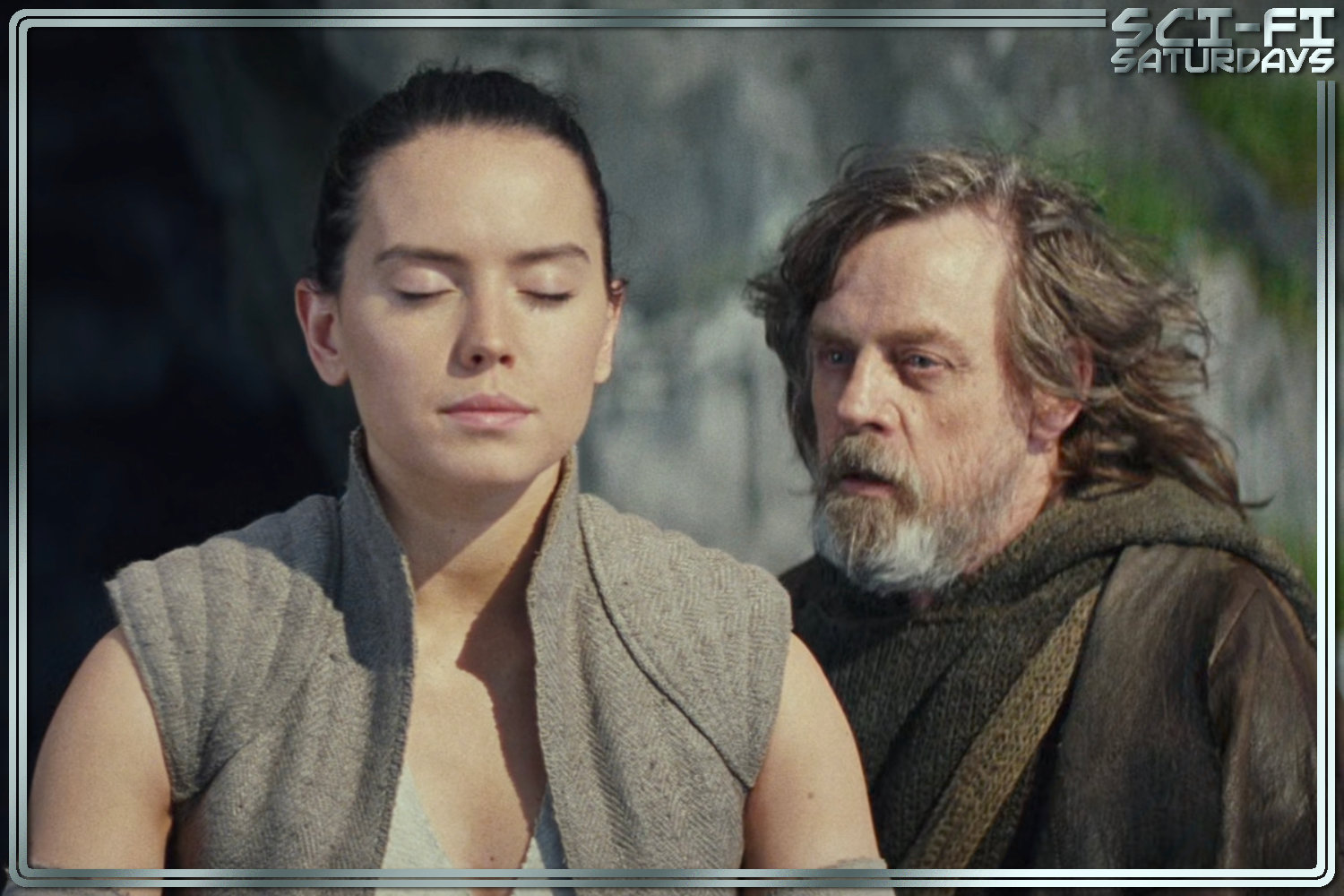
Luke begins to understand that he may not know as much as he thinks.
Genre-fication
Humor is nothing new to the Star Wars franchise. There are funny moments in every film, whether based on a specific character (like Jar Jar Binks in the Prequel Trilogy) or just general situational humor amongst the characters. The Last Jedi starts with its humor settings at full blast. Right out of the gate, audiences are presented with a bizarre sequence where Poe calls General Hux (referring to him as General Hugs) and pretends that he cannot hear the First Order leader. It’s akin to a Verizon commercial with Hux asking, “Can you hear me now?” The joke is extremely au courant in its method and delivery, taking many viewers out of the film before it has even begun. Star Wars hadn’t normally referenced current social elements in this way, and as such, it seems very strange for the film. Later, Jedi Luke Skywalker survives a barrage of laser blasts and gently brushes dust off his shoulder, referencing an oft-used internet meme that originated in 2004 from the Jay-Z song “Dirt Off Your Shoulder.” It’s a power move symbolizing the brushing away of machinations and the criticism of detractors. There’s also slapstick comedy beats with Finn wandering around in a leaking Bacta suit and Force Ghost Yoda clubbing Master Skywalker on the head with his cane. All over, they’re an odd choice for the film.
But is there any doubt that The Last Jedi is a Star Wars film? Absolutely not. It features so many of the elements that make up the world of Star Wars. There are the clear good guys and the clear bad guys. There are Force users doing magical things. Space battles. Lightsabers. Strange planets. Collectives of weird aliens. And the iconic John Williams score. And like The Force Awakens, The Last Jedi includes many homages to the Original Trilogy. As this is the second film in its trilogy, you might expect that it focuses on riffs towards The Empire Strikes Back. It does, such as the main element of Rey seeking out training with an older Jedi master, an assault of four-legged mechanical walkers on a Rebel base, and a rogue-ish character turning out to be a traitor (DJ). But it also has a lot in common with the third film of the Original Trilogy, Return of the Jedi. There’s a large space battle (which opens the film instead of closing it), a Dark Side character attempting to seduce the hero to join them and rule the galaxy, and Yoda returning as a Force ghost knowing something that the audience does not (in this case, the fact that Rey has taken the books of the Jedi library with her).
The Last Jedi also breaks with a number of unwritten rules, which may be the reason that some people have difficulty with the film. The first unwritten rule involves the naming of this chapter. Lucas had named his films with a certain cadence and word count for each chapter. The first films in the trilogies were both three words and made up of an article, an adjective, and a noun: A New Hope and The Phantom Menace. The second chapters each had four words, following a similar pattern: The Empire Strikes Back and Attack of the Clones. The final chapters were also four words and riffed off each other with Return of the Jedi and Revenge of the Sith. Abrams had followed the pattern with The Force Awakens. But Johnson broke from the template with The Last Jedi, causing some online comedians to predict the title of Episode IX would be From His Nap. Another broken rule is the lack of a proper lightsaber duel. There’s plenty of lightsaber usage. Rey trains with hers. Both she and Kylo use their sabers to fight Snoke’s Praetorian Guard. And Luke comes for Kylo with his saber at the ready. But no actual saber battle exists in the film. The film also picks up immediately after the last chapter (or within a day), which is also new to the Saga. Usually, there is some time that has passed between episodes, with the film picking up in media res. That last part is still applicable, but barely any time has passed since the destruction of Starkiller Base in the previous installment. Johnson also creates new mythology about the Force, entering a new era of the ideology of the mystical energy field.

Rey and Kylo in a spectacular fight with Snoke’s guards.
Societal Commentary
Balance. That’s the main theme to take from The Last Jedi (along with stop being a fascist douchebag). The film is designed in such a way to emphasize this theme, opening on lighter notes, but closing out with death and despair. It’s a lesson Luke attempts to teach to Rey, just as Yoda had spoken to him. The Force is about the balance of everything: the light, the dark, and the gray. Except that Luke hasn’t quite accepted that maxim himself. He still comes from the thinking that the darkness must be fully snuffed out. He sees it first in Ben Solo, and it terrifies him enough that his actions cause Ben to flee the Jedi Academy and embrace his new role as Kylo Ren. Luke sees it again in Rey when she reaches out with the Force, and immediately travels to the source of darkness on the planet. His point of view has no place for this darkness. But Rey and Kylo both see it as a necessary part of the equilibrium, the balance, of all things. Fans have often argued about the prophecy of Anakin Skywalker. He was said to bring balance to the Force. The Jedi saw this as a wiping out of the Sith. But what he did was change the status quo and balance the sides. By the end of the Prequel Trilogy, there were two Jedi and two Sith. All things in perfect balance. It’s another lesson for Luke to learn, and a different tactic for the franchise to take. It embraces the nature of all things, rather than singularly declaring the light as supreme.
But The Last Jedi does come down strong on one area: authoritarian regimes. A constant struggle in the Star Wars universe, whether it’s the Empire or the First Order, rule by might is not the right way. Johnson identifies Snoke, Hux, and the others as a group of bullies, driving Leia’s resistance towards extinction. Unlike other Star Wars films, this one feels like a more extreme reaction to the current political climate in America at the time. The rise of the alt-right and their extremist ideology put half of the country on edge. The Last Jedi provides a guide to surviving trying times. These include Kylo Ren urging Rey to “let the past die,” a message to the political climate but also to the fans of the franchise about letting go. Stop looking back, and look forward instead. Later, Rose proclaims to Finn, “We’re going to win this war not by fighting what we hate, but saving what we love.” Again, speaking very plainly to the haters and trolls of the world, stop doing things that you hate and complaining about it. Instead, focus on what you love and makes you a better person. And the biggest message, one which is omnipresent throughout the Saga, is from Leia. “Hope is like the sun. If you only believe it when you see it, you’ll never make it through the night.” Optimism and hope are the way to nourish your soul in the dark times. Believe in the things you can’t see and use that to guide you into the dawn of a new era. Unfortunately, this overt messaging is one of the more divisive points in the film.
Another element that has become contested is the film’s notion that heroes can come from anywhere. After The Force Awakens, many fans speculated on the lineage of Rey NoLastName. She claims to be from nowhere (Jakku, that is pretty much nowhere). Her parents abandoned her “for drinking money,” claims Kylo. And she proclaims herself as nothing special. Yet, she is the focus of this new trilogy of films. Obviously, she must be someone special. Fans thought she might be Luke’s daughter or related in some other way. But this film definitely answers the question that she is not. Rey is not special. She’s not a Skywalker. But that’s okay, because a hero isn’t based on their lineage, or name, or upbringing. Heroes are everywhere. That’s why Johnson chose to focus on a stable boy in the final moments of the film, rather than any of the main characters. This seemed to conflict with the worldview of the Star Wars franchise for many fans. It contrasted with the myriad of fan theories and backstories that had been written in the intervening years between films. And it would quickly be the first thing erased when the follow-up film came out two years later.

Finn faces off against Phasma.
The Science in The Fiction
The Star Wars franchise is not known for its scientific accuracy. There’s been sound in space, and spaceships don’t always obey the laws of physics. It’s a space-fantasy, rather than truly being science-fiction. But there’s a moment in The Last Jedi that makes apologists cringe, and that’s the scene where Poe causes his X-wing to skid into a U-turn above the First Order ship. It feels like someone dropped a little bit of The Fast and the Furious franchise into my Star Wars. It’s ludicrous, but everything in the opening of the film is extremely heightened, from the humor to the action. It’s no more outrageous than the new Force powers that are introduced. Snoke shows the ability to be able to affect characters from immense distances, dragging Hux across the bridge of his starship. He also creates a Force-link between Rey and Ren, connecting the two of them telepathically. Not that this needed to be explained, as Force powers have always been a feat of superior might. But powers seen to date usually affect the vicinity around the Jedi or the Sith. But, not to be outdone, Luke projects himself halfway across the galaxy, managing to produce a physical manifestation of not only himself, but of the dice from the Millennium Falcon, which disappear with his death.

It’s another binary sunset.
The Final Frontier
While The Last Jedi begins comically, it ends on a somber note. A beloved character to the franchise has passed away, and the Resistance has been reduced to a small handful of loyal followers. It’s the dim ending to the middle chapter, as a second Legacy character has been killed to make room for the new, younger characters. It’s an ending that shows an example of the balance that the film is trying to describe in the Force. A balance between the absurd and the tragic. The ending also breaks from the tradition of featuring members of the main cast in a celebratory or hopeful moment. Here, the film chooses to identify with the lone stable boy–a nobody–who has a touch of the Force. After telling his fellow stablekids the tale of Luke Skywalker, he Force calls his broom and stares at the stars, the rebel insignia ring Rose gave him signifying that the fire of Rebellion continues to burn outside of the main cast. It’s a bold choice, and one many disagreed with. The Last Jedi plays with the status quo of the franchise and introduces many new and interesting ideas to the universe. Unfortunately, it feels like many of the choices were negated by the follow-up film, The Rise of Skywalker, two years later. Fans may have been looking for clearer-cut answers in this film, which rarely occur. Who is the last Jedi? What was the deal with Snoke? How did BB-8 fit so many coins inside him in Canto Bight? The goal of the middle film in a Star Wars trilogy is to urge the audience to come back in a couple of years to see how it concludes, and by that criterion, The Last Jedi did its job.
Coming Next


Having grown up on comics, television and film, “Jovial” Jay feels destined to host podcasts and write blogs related to the union of these nerdy pursuits. Among his other pursuits he administrates and edits stories at the two largest Star Wars fan sites on the ‘net (Rebelscum.com, TheForce.net), and co-hosts the Jedi Journals podcast over at the ForceCast network.