
Sounds like someone may have overslept!
Star Wars: The Force Awakens marks the return of the franchise after a 10-year hiatus. It looks both forward and backward, working the nostalgia of original fans and stoking the interest of younger ones. But for everything interesting about the film, there are also several poorly executed elements as Disney executives rush to profit on their very expensive purchase of Lucasfilm.
First Impressions
New heroes, new villains, new locations, and a few other surprises pepper this trailer for the newest Star Wars film. A young woman and an exiled stormtrooper team up with Han Solo to embark on a new adventure across deserts and ice plains. Looking like something out of a video game, there are lightsabers, space battles, X-wings skimming across a lake, and who knows what else. The film also leaves behind the standard Memorial Day opening for a Christmastime release as The Force Awakens.
Presented below is the trailer for the film.


Star Wars: The Force Awakens title card.
The Fiction of The Film
Thirty-some years after the Battle of Endor, Luke Skywalker has gone missing, a new threat called the First Order has risen, and Leia now leads a Resistance for the New Republic. On Jakku, Poe Dameron (Oscar Isaac) receives a thumb drive with a map to Luke Skywalker. He puts it into his spherical droid BB-8 for safekeeping before being captured by the First Order led by Kylo Ren (Adam Driver). Ren orders his stormtroopers to massacre the villagers, which weighs heavily on Stormtrooper FN-2187 (John Boyega). Elsewhere on the planet, Rey (Daisy Ridley) scavenges parts from a downed Imperial Star Destroyer, one of many wrecks on the deserts of the planet.
On board the First Order starship, Poe is being tortured for the location of the droid with the map. He is rescued by FN-2187, whom he now calls Finn. They escape in a TIE Fighter and crash back onto Jakku, where Finn walks away from the wreck believing Poe is dead. Rey rescues BB-8 from a junk trader, and the droid follows her back to the local town. At a trading post, Finn (who is wearing Poe’s jacket) is spotted by BB-8. Believing the man to have hurt Poe, Rey stops and questions the AWOL stormtrooper. He lies, saying he’s part of the Resistance, just before being chased by bounty hunters looking for BB-8. Rey, Finn, and the droid escape in the Millennium Falcon.
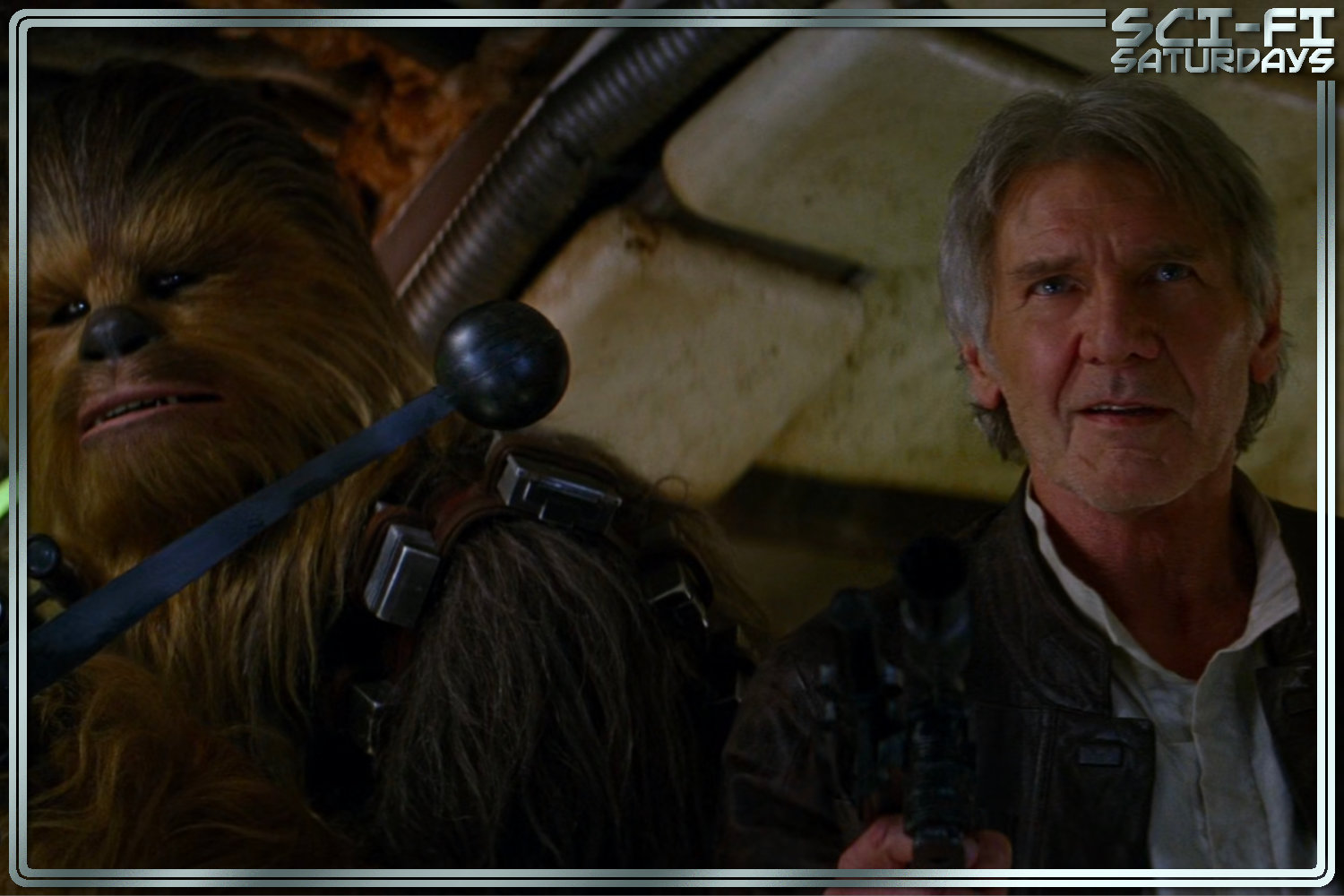
Rey uses her piloting skills to evade the pursuing TIE Fighters, but they are captured by a much larger ship, which they believe to be part of the First Order. Back aboard his ship, Kylo Ren has a tantrum, destroying a console, when he discovers the droid evaded capture. Rey and Finn meet with the real owners of the Falcon, Han Solo (Harrison Ford) and Chewbacca (Peter Mayhew/Joonas Suotamo). They avoid being captured and killed by a group of pirates and monstrous Rathtars, escaping to a peaceful, woodsy world. Rey is starstruck getting to meet Han Solo, who downplays his exploits. He reveals that Kylo Ren is really his son, and then tells Rey about Luke abandoning his Jedi Academy.

Kylo Ren is only trying to work through some Daddy issues.
Han takes Finn and Rey to meet Maz Kanata (Lupita Nyong’o), a wise and ancient owner of a bar. She offers good advice to all and is surprised when Luke’s old lightsaber calls to Rey. Freaked out, Rey turns into the woods, so Maz gives the saber to Finn instead. The First Order homeworld, Starkiller Base–a new Death Star of immense power–launches a hyperspace attack as ordered by General Hux (Domhnall Gleeson), destroying multiple New Republic core worlds. The First Order lands outside Maz’s castle and begins an assault, looking for the droid. Rey is captured by Kylo Ren, while Finn, Han, and Chewie fight the First Order troopers.
A crazy X-Wing pilot saves everyone, revealing himself to be Poe, who survived the crash landing on Jakku. Leia and C-3PO (Anthony Daniels) grab the survivors and return them to the Resistance base, where Leia tells Han she believes their son can still be saved. At Starkiller Base, Ren interrogates Rey through the Force, but she somehow turns the tables on him and escapes. Using details of Starkiller Base from Finn, the Resistance plans an attack to destroy a thermal oscillator before the weapon can be used on their base. Han, Chewie, and Finn make a landing on the planet to plant explosives, but Finn also plans to save Rey. Luckily, they see that she has already saved herself.
In the skies above Starkiller Base, X-wings and TIE fighters have a spectacular battle. Inside the base, Han finds Kylo Ren (known to Han as Ben) and confronts him. Kylo feels that he cannot do what he must, and appears to be backing down when his red lightsaber pierces Han, killing him. Kylo is hit in the side by a well-placed blaster bolt from Chewbacca as the explosives detonate, allowing the X-wings to make their attack. In the snowy forest outside the bunker, a wounded Kylo injures Finn and has a protracted lightsaber duel with Rey, who is surprisingly skilled for having zero training. Chewie saves the two of them as the planet explodes. At the Resistance base, R2-D2 is awakened and connects his map to the one from BB-8, revealing the location of Master Skywalker. Rey, Chewbacca, and Artoo head for a planet of islands, seen in her dreams. There she finds Luke Skywalker on a hill and offers him his father’s lightsaber.
“There has been an awakening. Have you felt it?” – Supreme Leader Snoke

Rey and Finn evade the First Order just before the discover why the Millennium Falcon is referred to as a piece of junk.
History in the Making
Can you believe it’s been ten years since The Force Awakens premiered? It marks the second time that the children of the Original Trilogy found out they were getting a new trilogy of films. But this one came about a little bit differently. It was sort of like your parents getting divorced and then Mom telling you a few years later that you were getting a new sibling. There was a lot to process. Back in 2005, George Lucas released the conclusion to his Prequel Trilogy with Revenge of the Sith, a film that concluded the introduction of the characters and plotlines that he had previously addressed with Star Wars, The Empire Strikes Back, and Return of the Jedi over 20 years previously. At the conclusion of that story, no future film plans were revealed. Lucasfilm continued their publishing efforts with books, comics, and magazines, telling stories of distant futures and pasts, plus filling in all sorts of niches about fan-favorite characters. In 2008, a new animated Star Wars film was released, The Clone Wars. It was part of the plan to create a television series that would tell the events in the three-year gap between Attack of the Clones and Revenge of the Sith. The series ran for five seasons (2008-2013) on Cartoon Network and was quietly canceled due to the purchase of Lucasfilm by the Walt Disney Company.
October of 2012. That was when the sale of Lucasfilm happened, and the wheels began to turn again as the Disney-infused Lucasfilm began planning a new series of films and other entertainment properties. Lucas had reportedly sold his company with a draft of an idea for a Sequel Trilogy, but those notes went unused as a number of writers, including Michael Arndt and eventually Lawrence Kasdan with J.J. Abrams, drafted what ended up becoming Episode VII, The Force Awakens. Things were coming, and the fans knew. Publishing contracts with Dark Horse Comics were cancelled in mid-2014, and the Star Wars Insider (the official fan magazine of the franchise) spoke of a new film being worked on. This would be the first Star Wars property without any direct involvement from George Lucas. It’s also the first Star Wars to switch release windows from the Labor Day holiday (in May) to a Christmas release, following other successful franchises such as Harry Potter, Lord of the Rings, and Avatar. Since it is meant to be a sequel to Return of the Jedi, taking place after the defeat of the Empire, it is set approximately thirty years later (being released 32 and a half years after the 1983 Jedi). Die-hard fans thought that meant they knew where these films were headed, based on previously released books and comics. They were sorely mistaken.
When Lucasfilm licensed Del Rey Books and Dark Horse Comics to begin telling additional stories set in the Star Wars universe, certain restrictions were set. The time frame that would form the Prequels, along with the time between the Prequels and the Original Trilogy, was listed as off-limits. The original book trilogy, Heir to the Empire, Dark Force Rising, and The Last Command by Timothy Zahn (colloquial known as the Thrawn Trilogy), and the first two comic book series, Dark Empire I & II, were all set in the aftermath of the destruction of the second Death Star, and followed Luke, Leia, Han, Chewbacca and all the other fan favorite characters, as they navigated a new and difficult time of building the New Republic and squashing the final remnants of the Empire. Enter talk of a planned Sequel Trilogy, in which fans wanted to know which storyline from the twenty-plus years of publishing would be adapted. It turns out, none of it would. Disney instituted a break in the publishing timeline, indicating that everything that had come before (from a publishing perspective, at least) would be considered non-canon, paving a way for new storylines to emanate from 2015 forward. While a considerable number of elements from the original stories would make it into future published stories and some television stories, there was a new, blank slate for Lucasfilm to do what they wanted. Gone was Luke’s love interest, Mara Jade, the three children of Han and Leia, and the advent of the most popular villain, Grand Admiral Thrawn (though he would get some love in the Ahsoka series, 8 years later). Many diehard fans of these stories were upset at the proposed changes (which they had no control over anyway). Along with the changing social and political landscape of the world in 2014 and 2015, and rumors that the new film would feature a female lead and a black stormtrooper, the online discourse over the film divided audiences prior to even seeing a single frame.

Han offers Rey a job with him, but don’t get all mushy on him or nothing. It’s just a job.
Genre-fication
When The Force Awakens debuted on December 18, 2015, fans came in droves. Star Wars is still a cultural phenomenon, even with all the negative online attention from trolls and agitators, so its success was guaranteed. The film definitely delivers the elements that audiences have come to expect with a new Star Wars film: space battles, good versus evil, lightsabers, fights, aliens, droids, and wild extraterrestrial worlds. Fan excitement was high with the return of screenwriter Lawrence Kasdan, who was responsible for the script of the highly regarded The Empire Strikes Back and Raiders of the Lost Ark (plus the slightly less regarded Return of the Jedi). The director was J.J. Abrams, a long-time fan of the franchise and a director who aspired to make other franchises more Star Wars-like, such as the 2009 Star Trek (and its 2013 sequel). Besides all the aspects of the Original Trilogy that Abrams wanted to play with, he also brought a love for puzzle boxes and mysteries that were explored on shows like Alias, Lost, and Fringe. And that’s what The Force Awakens provided. It was a return to the Original Trilogy style of visuals and storytelling (after a Prequel Trilogy focused on politics and angst), complete with a multitude of unanswered questions that audiences would have to wait at least three more years to get a resolution. On the downside, The Force Awakens was extremely similar to the Original Trilogy in plot, in characters, and in themes.
George Lucas always looked at the thematic elements of his Star Wars films as a motif that repeated, like a theme in a classical music piece. Luke loses a hand in the middle chapter of the Original Trilogy. Vader loses the same hand in the closing chapter. Two similar moments that rhyme within the similar themes (visually and metaphorically) of the two films. But somehow these moments don’t feel like Lucas ripping himself off. They are built into the visual language of storytelling as an element of the franchise. It’s one of the things that defines these films, and many fans and scholars have looked at the films forwards and backwards, finding many iconic coincidences between the six chapters. The Force Awakens also adheres to these tropes for the Star Wars franchise, so why does the Abrams-directed film feel like a reboot of the series rather than a fresh entry?
Actually, reboot may be too strong a term. The Force Awakens feels more like a remix of the Original Trilogy, complete with new characters in a reimagined story. It’s fresh with new characters and elements, but also familiar and comforting with the return of Original Trilogy characters and eerily similar moments. The plot of the film is essentially A New Hope, told with different characters. And instead of Alec Guinness, an iconic film actor to previous generations in 1977, Harrison Ford serves the role as mentor and sacrificial character. But that’s just the tip of the Hoth iceberg. Both films open with the MacGuffin of a secret bit of data being hidden in a droid and needing to be ferried to a secret rebel base. Princess Leia initiates the first one, while her elder self receives the latter. The stalwart droid meets characters, bringing them into the events of the wider story, including a young person who is unsure about heeding the call to adventure. A mentor figure is also brought into the adventure, knowing more than they share with their younger companions. Meanwhile, a character clad in black, and working for a fascist state, attempts to stop the heroes by sending his legions after them. After a brief respite at a watering hole populated with some of the weirdest-looking creatures in the galaxy, the characters stage a rescue for the one character that has been captured. The rescue has to take place on a giant battle station that is also threatening the hero’s secret base. In order to escape the battle station, the mentor sacrifices themselves so that the others can steal away. A lightsaber battle occurs just before, or during, an epic space battle where the heroes’ X-wing fighters take on the villains’ TIE fighters. Fortunately, there’s a pilot who’s amazingly skilled and helps weaken the defenses so the battle station is blown apart before it can launch its attack on the secret base. There is much celebrating in the end. And while The Force Awakens has all this going on, it also features elements and riffs from both Empire and Jedi as well.

Make the Galaxy Ordered Again. Hey, at least the accept women and black people now.
Societal Commentary
The Force Awakens, fortunately, does offer some new themes for the franchise, which are unique, sharing crossover with the real-world aspects of the franchise in the early 21st Century. The most prominent theme concerns generational issues and the handing off of the torch from one age group to the next. Rey is a mysterious young Force user who is drawn into the events surrounding the Resistance, becoming the focal point for the new trilogy in the same way Luke was the center of the first trilogy. Kylo Ren is the scion of two of the galaxy’s most beloved heroes (Han and Leia) but also the grandson of its greatest villain (Vader/Anakin). He is torn by his inability to court the light side, so he succumbs to the Dark side as a pawn for Supreme Leader Snoke and the First Order. What better way to remind the Resistance of its biggest failure than by having the son of its members become the leader of the First Order? These themes of generational trauma are much more nuanced than Lucas’ good boy Luke fighting the evil Lord Vader. Rey doesn’t know where she comes from but feels drawn to the Force, and the good guys (for the moment). Kylo knows too well where he comes from and prefers to avoid having to live up to the pressures of being the child of “royalty” (literally and figuratively), so he decides to go completely the other way. In some ways, the filmmakers were having to decide the same thing.
A conscious decision was made about how to create a new Star Wars trilogy. Stories set after Jedi had always featured the core trinity of Luke, Leia, and Han. Should the new film trilogy include them as well? All the actors were still alive and working. So the idea was created that the Old Guard should hand over the reins to the New Blood throughout the new trilogy. Unfortunately, the inclusion of these classic actors distracts from the new cast, never quite allowing them to have the film for their own. Luke Skywalker appears for mere minutes at the end of the film (and in one brief flashback shot, cloaked), yet the whole film is about the question: Where is Luke? Luke is missing. The Resistance must find him. You know Luke Skywalker? He’s my hero! Fans of the original generation may have preferred an adventure where Luke, Leia, and Han, all in their late 60s or early 70s, galavanted around the galaxy. It would have been a mess, just like Star Trek V. So the choice to go with a younger cast was made, as “galloping about the cosmos is a game for the young,” as a wise man once said. But rather than create a story solely about these new characters, they were latched onto the history and coattails of the older characters, never fully feeling like characters in their own right.
The film also decided to bring back a version of the best villains, fascists. If it’s good enough for Indiana Jones to fight Nazi’s time and again, then the heroes of the Star Wars franchise can fight space-fascists. In a stunning prediction of real-world upheaval, somehow fascism returned for real. It’s no secret that the Empire, with its stormtroopers, military might, and xenophobic beliefs, is a metaphor for the Nazi party during World War II, the greatest foe the world has faced. In that galaxy, far, far away, Rebels challenged that Empire–many with their lives–to overthrow a vicious regime. Yet thirty-some years later, General Hux and his army of nouveau brownshirts have decided that they need to make the galaxy great again, bringing back control, authority, and gigantic world-killing space stations. Perhaps the filmmakers saw what was happening in the real world, as a new generation failed to learn the lessons of their forefathers and picked up the banner of a petty and deranged narcissist. Snoke is that same type of leader, at least from the short sequences featuring him. He wants the Empire to live again, dressing it up in the guise of a new organization, The First Order. The Force Awakens ends up being a painful reminder of how the villains can be lauded as heroes, and some audience members can come away with the wrong answer to a very easy lesson.

Starkiller Base: It’s not your grandfather’s Death Star.
The Science in The Fiction
Technically, five of the seven Skywalker Saga Star Wars films feature a Death Star of some kind, along with one standalone film from the following year (Rogue One). Granted, two of those appearances are as a hologram or an under-construction sphere. The station is iconic, but also the most parodied aspect of the series. So, creating Starkiller Base as the ultimate weapon, four times larger than the original Death Star, feels like a poor move in terms of filmmaking. But looking at this from an in-universe vantage point, it’s the most cost-efficient move a fledgling dictatorship could take. Imagine you’re just starting out, trying to impose order on the galaxy, but you’re a new group and don’t have a lot to spend on research and development. Not a problem! Just over 50 years ago, a much more powerful Empire had already done the hard work for you, twice! Sure, there were some problems, but you know about those, too. You scale up the design and add some cool new features that weren’t available when your grandparents were building their Death Star. In the old days, you used to have to be in the same system as the planet you wanted to destroy. How quaint. Now, there’s hyperspace targeting along with the ability to select multiple targets at the same time. All you need is one sun to charge the device. What a small price to pay for the unlimited power. Unfortunately, removing the previous design flaws seems to have created a new one, which tears the entire surface of the planet apart. Oh well, they’ll fix it the next time.
Unlike previous Star Wars films, The Force Awakens has no real mentor to the ways of the Force–unless you count Han Solo telling Finn, “That’s not how the Force works.” Rey has some innate understanding of the Force, apparently able to tap into the power, especially when confronted by Kylo Ren. She doesn’t understand it, but her power seems to activate when someone else is using the Force on her. Kylo offers for her to join the Dark Side (see also Empire, Jedi), but she refuses. As the film progresses, she is able to use her powers more easily, as well as almost anything Luke ever did in terms of the Jedi Mind Trick. Finn also appears to have some sort of connection to the Force, but that too is unclear. Could they secretly be the offspring of Jedi? Of characters that we already know? These questions may be one of the more frustrating aspects of the film. There is a less clear idea of who these characters may be going forward. That’s not a bad thing necessarily, just a divergence from the formulaic development of the franchise as a whole.

How does Finn know how to use a lightsaber so well? Or is it that Kylo Ren is a poor swordsman?
The Final Frontier
The Force Awakens began a whole new era of Disney-owned Star Wars content. Since Marvel Comics had been previously purchased by Disney, the comic book rights returned to The House of Ideas after nearly 30 years away. New books were published, filling in gaps about the transition between the defeat of the Empire and the rise of the First Order. Why were all those Star Destroyers in the Jakku sand? Find out in books, comics, and video games. Lucasfilm would start an aggressive push of releasing a new Star Wars film every year for five years. A plan that took its toll on the quality of the franchise. Besides the three Sequel Trilogy films, two standalone prequel films, Rogue One and Solo, were released. Then, beginning in 2019 and the creation of the Disney+ streaming service, a new era of television series was released, starting with The Mandalorian. After seven shows, some with multiple seasons, Disney has slowed their output, finally deciding on quality over quantity. Two new films are scheduled for the next two years, after a seven-year hiatus from theatrical releases. The first is The Mandalorian and Grogu (2026), a spin-off following three seasons of The Mandalorian. The second is Starfighter (2027), an action-oriented film with Ryan Gosling. Perhaps with a bit of time and some maturity, the franchise can regain some of the goodwill it has lost.
Overall, and from the hindsight of a decade in the future, The Force Awakens may be the best of all the Sequel Trilogy films. What becomes clear as time goes on is that, obviously, the filmmakers did not have an outline for the entirety of the Trilogy when they started. They appear to have been flying by the seat of their pants. That becomes more obvious with The Last Jedi, which has an entirely different tone set by its writer/director, Rian Johnson, setting up some different ideas than this film. And then The Rise of Skywalker closes out the Trilogy, only to ignore several elements of the middle chapter. The number of unanswered questions from the film (that still remain unanswered 10 years later) is also frustrating. It can be assumed that Abrams was attempting to provide plot hooks that could be answered by comics, books, or other spinoffs. But coming out of The Force Awakens, it was easy to add up the biggest questions on one hand. Who really is Rey? How did Maz get Luke’s saber from Cloud City? Who is Snoke? What about the Knights of Ren? What happened to Luke? Some of these would be answered in the following films. Some acceptably, and others only barely, with a couple seeming like the filmmakers wrote the idea the day before their paper was due. The Sequel Trilogy is the most divisive Star Wars media out there. How you see these films has more to do with your baggage, aka what you bring with you, than the contents of the films themselves. That said, there are still some interesting ideas that have served to springboard the franchise into a new world full of new fans to appreciate.
Coming Next


Having grown up on comics, television and film, “Jovial” Jay feels destined to host podcasts and write blogs related to the union of these nerdy pursuits. Among his other pursuits he administrates and edits stories at the two largest Star Wars fan sites on the ‘net (Rebelscum.com, TheForce.net), and co-hosts the Jedi Journals podcast over at the ForceCast network.