
There’s no piercer like Snowpiercer, like no piercer I know!
Some science-fiction is fun and light, creating an entertaining look at the future. Other sci-fi is dark and brooding, taking the audience on a thoughtful exploration of things that might come. Snowpiercer is a dystopian drama that is like an unrelenting punch to the face.
First Impressions
The trailer shows a post-apocalyptic world where society is presented in microcosm aboard a train that runs through frozen wastelands. A woman shouts and tells the poorer-looking people that they should know their place. A man stages a riot against the guards with lots of fighting. The woman announces that 74% of the people will die. Chaos erupts in a very small space as this Snowpiercer continues along the tracks.
Presented below is the trailer for the film.


Snowpiercer title card.
The Fiction of The Film
In the year 2014, scientists released a compound called CW7 into the atmosphere to combat global warming. It works, but too well. The world’s temperature drops, and the planet freezes. A small band of survivors board a train, created by Mr. Wilford (Ed Harris), which circumnavigates the globe once a year and is called the Ark. Seventeen years later, in 2031, the following events unfold. Curtis (Chris Evans) and Edgar (Jamie Bell), two members of the tail section, the lowest class of people, are preparing for a revolution. Both young men are tired of living in squalor at the whims of the people in charge. They receive messages, called red letters, in small metal tubes that come encased in their jellified protein bars. Occasionally, members of the elite come to the tail section and take children away for an unknown purpose.
Curtis is mentored by Gilliam (John Hurt), an elderly man missing several limbs, who is helping him plan his revolt. When Mason (Tilda Swinton), Wilford’s spokesperson, arrives and takes Timmy (Marcanthonee Jon Reis) and another boy for a “medical check,” Andrew (Ewen Bremner) throws a shoe at her. She makes an example of him by having guards place his arm in a cuff outside the train and freezing it off. Curtis believes the guards no longer have any bullets left after 17 years, and puts that theory to the test. His followers beat the guards, and a small group begins to move forward on the train to capture the engine and take control. Their first stop is the prison car to free a security specialist, Namgoong “Nam” Minsoo (Song Kang-ho) and his daughter Yona (Ko Ah-sung), both kronol addicts.
The group moves past a car that manufactures the protein block from ground-up bugs and into the water car, believing they might be able to stop here and control the water distribution. Nam works to open the security doors, getting a block of uncut kronol, a waste product from fuel manufacturing, each time. Just as he is about to open a door, Yona screams for him to stop. She has limited clairvoyance and senses something on the other side. But it’s too late, and the group of revolutionaries is confronted with dozens of soldiers armed with blades. A fight begins, but halts momentarily as Mason announces they are crossing the Yekaterina Bridge. This signifies New Year’s Day. The fighting resumes as the train enters a tunnel where the soldiers slaughter some passengers, including Edgar. Curtis is able to capture Mason and uses her as a hostage to continue their trek forward.

Gilliam and Curtis plan the revolution to overthrow the train.
Curtis with Mason, Andrew, Timmy’s mother Tanya (Octavia Spencer), Gilliam’s bodyguard Grey (Luke Pasqualino), Nam, and Yona all continue on while Gilliam stays behind to tend to the wounded. They pass through an aquarium car, receiving a sushi meal for New Year’s. Curtis denies Mason the fresh fish and forces her to eat a protein block. In a school car, the teacher (Alison Pill) sings songs to the children about the wonderful Wilford, indoctrinating them into the world of the Ark. Fresh New Year’s eggs are passed out to all. Curtis’s egg contains a hidden message, “BLOOD.” The teacher and attendant pull hidden guns from underneath the cart of eggs and kill Andrew. Curtis retaliates and kills Mason. Franco (Vlad Ivanov), a leader in the security group, shows a video of Gilliam being executed in retribution.
The survivors are hunted by Franco into a sauna car where Grey manages to get a knife into Franco before being knocked out. Franco kills Tanya during the fight, and Grey sacrifices himself for the others. Yona attempts to stab Franco, but Nam stops her. Curtis ends up putting a knife in Franco’s side and leaves him for dead. Passing through a drug den car, Nam steals more kronol from the stoned-out partiers, along with a parka for himself and Yona. Outside the engine car, they rest for a moment. Nam offers Curtis literally the last cigarette in the world, and Curtis tells of his early days on the train. He recounts the cannibalism, his murder of Edgar’s mom, and Gilliam’s sacrifice of his own limbs to feed the hungry passengers. Nam admits to wanting to open the door to the outside as he believes the ice is melting based on evidence he’s seen over the last couple of years.
Wilford opens the door to the engine, welcoming Curtis inside. He speaks of the order of things and the pre-ordained positions of the passengers in the train. Curtis sees young Timmy inside the floor of the engine, working in place of a worn-out part. Curtis is offered control of the engine and the train. Wilford admits that he and Gilliam worked together to strive for balance in their new society, even going so far as to stage revolutions to curb overpopulation. Franco, who is wounded but not dead, arrives and fights with Nam, who uses the kronol as a bomb to blow the door off the train. It also causes an avalanche, which derails the Ark. Curtis pulls Timmy out of the engine, sacrificing his left arm in the gears to save the boy. Yona puts a parka on Timmy and herself as they venture out into the snow. She sees a polar bear on the mountain, indicating that not all life is dead.
“Curtis, everyone has their preordained position. And everyone is in their place except you.” – Wilford

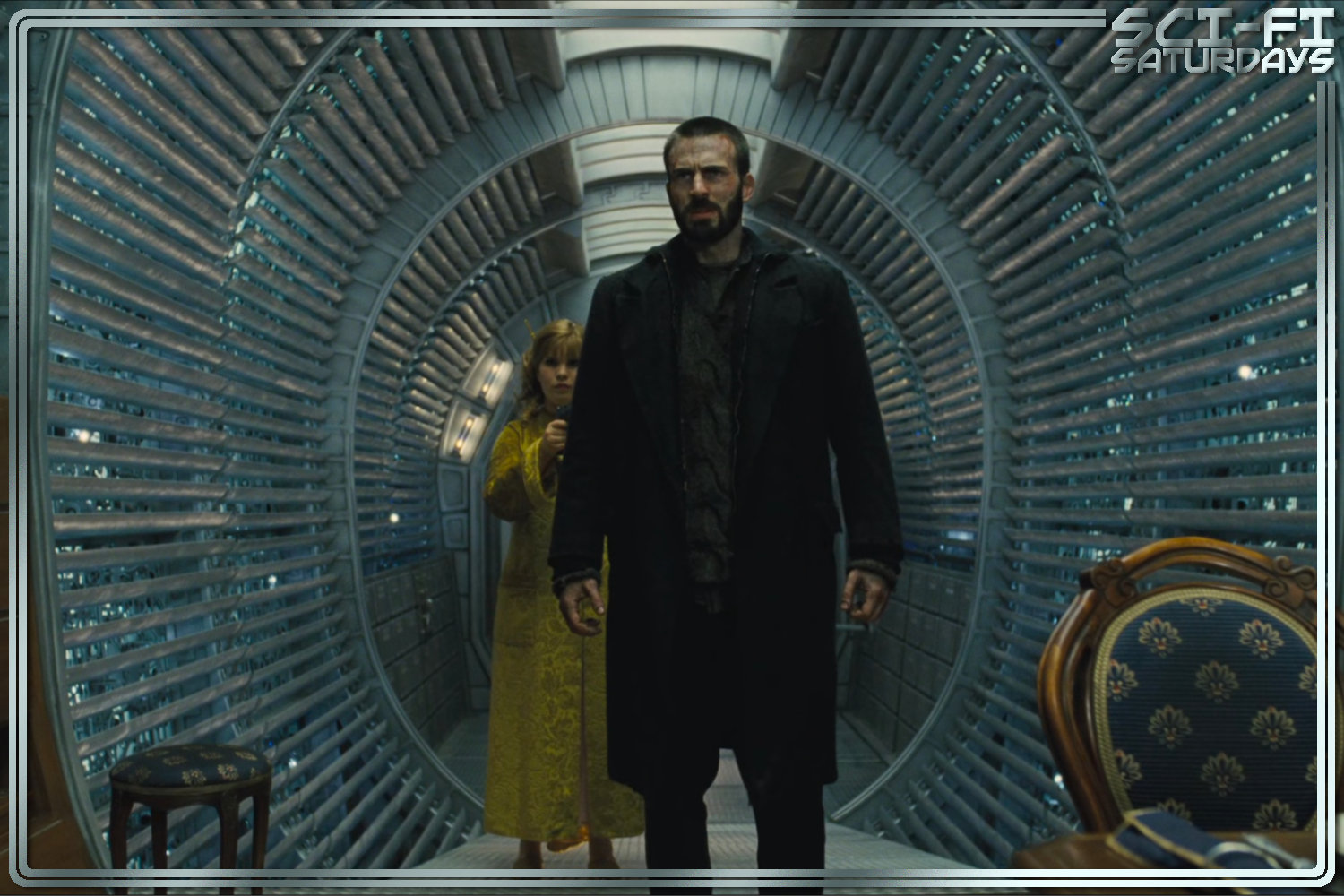
Curtis marvels at Yona’s ability to see briefly into the future.
History in the Making
Snowpiercer presents a new style of dystopia that is more in tune with modern sensibilities as it explores social conventions, religion, and classism in a frozen future world. Dystopian fiction has been around for over 100 years, but it has changed to fit the times. Snowpiercer has an additional element going for it, being based on a French graphic novel, directed by a South Korean director, and starring a mostly English-speaking cast. It builds on what has come before it and addresses modern concerns about society and the welfare of the planet.
Two of the earliest dystopian films include Fritz Lang’s Metropolis and the adaptation of H.G. Wells’ Things to Come. Since then, dozens of films with varying degrees of dystopian futures have been released, with many being covered on Sci-Fi Saturdays. Some, like The Time Machine or THX 1138, offer some final measure of hope, while the majority, including The Omega Man, Fahrenheit 451, Soylent Green, and the Mad Max series, offer a more dire warning about the future that is to come if society stays on its current course. Snowpiercer falls very squarely in the latter category, with both an apocalyptic event that has dwindled society to a small number of people, along with social strife and authoritarianism taking center stage.
This was director Bong Joon Ho’s first English production and a follow-up to his successful Korean films Mother and The Host, a semi-comedic kaiju film also starring Song Kang-ho and Ko Ah-sung. Snowpiercer made a name for him in America, and he followed it up with the fantastical Okja, the Academy Award-winning Parasite, and his most recent sci-fi film, Mickey 17. His sensibilities and upbringing provide an entirely different flavor to the film, making it feel like a foreign film documenting a future world. Ho worked with screenwriter Kelly Masterson to engineer a new story that is inspired by the original graphic novel, but not a direct adaptation.

The tailies pose for a “picture” with Mason before setting off to reach the engine.
Genre-fication
Dystopian sci-fi films can take a varied look at the future and society. In some cases, there has been a cataclysmic event, such as with a nuclear war, as seen in A Boy and His Dog or The Road Warrior. Sometimes the future is a bleak authoritarian nightmare, like 1984 or Brazil. And more often than not, some small element of modern society has been allowed to run rampant, such as the corporatization of the police in Robocop, or the consumer culture of Idiocracy. Snowpiercer contains elements of all these dire futures, making for one terrible train ride.
The impetus for Wilford’s Train is a climate disaster brought on by people trying to do the right thing and stop (or reverse) global warming. Scientists somehow get things wrong, and by releasing the chemical that is supposed to reduce temperatures back to “normal” levels, they manage to plunge the world into a new Ice Age. The survivors, or at least those that had an opportunity to survive, board the huge transcontinental train run by Wilford the industrialist. Presumably, having a train that moves, rather than a single domed city to survive in, is merely an interesting plot point and not something that is necessarily better for survival. His corporation runs the train and, by either the virtue of necessity or more likely, the layout of the vehicle, imposes a social order on the passengers. Everyone is in their preordained position. The talk of preordination provides a quasi-religious aspect to the society, creating a fundamental hierarchy, with Wilford as the deity (who speaks through his mouthpiece, but will not deign to come out of his Engine), with everyone else as his followers, or at least in his debt.
Snowpiercer goes further than most of the other popular recent dystopian films in terms of social consciousness, but shares similar aspects as well. The films Children of Men, The Book of Eli, and I Am Legend are all considered road pictures of one degree or another. The characters come into the plot of the film and are driven towards an ultimate goal in support of society. Theo Faron falls in with an underground railroad, shepherding a pregnant woman to safety. Eli travels west, hoping to reach a group preserving books that were destroyed after a nuclear war. Robert Neville is forced out of the city and into the country to meet up with the survivors of a mass plague. In this film, Curtis makes the journey from the tail section to the engine, encountering all aspects of society along the way. It’s like a dystopian version of The Wizard of Oz or Alice in Wonderland. It is both an obvious ascension through the social strata of the train and a refreshing change from other apocalyptic dystopian films. It even gives a fun (if you can call it that) shout-out to Soylent Green, with the revelation that the jellied protein bars consumed by the tail section passengers are made from ground-up insects. Not as gross as pulverized people, but still pretty nasty.

In the school car, Tanya looks hopefully for her young son Timmy.
Societal Commentary
One of the more interesting aspects of the film, and one that goes unknown until the end of the film, is a quote from Curtis, who asks how he can be a good leader with two arms. It is initially presumed to be his interpretation of Gilliam’s leadership, likening it to the fact that he has only one arm. It’s a rough future, fights happen, or maybe Gilliam suffered the same punishment that Andrew received, and had his appendages frozen off. But the answer is more chilling. Curtis relates a story about himself getting ready to kill and eat a baby after killing and eating his mother. Gilliam steps in and cuts off his own arm, offering it to the starving passengers. Curtis has a scar on his arm from where he’s attempted a similar sacrifice, but failed. In his mind, leadership is about sacrifice, and specifically sacrificing one’s body parts for others. He refuses to listen when other people say that they will follow him, because he doesn’t consider himself a leader. In the end, Curtis does end up losing an arm as he saves Timmy from the Engine, proving, at least to himself, that he has the leadership skills he believes important.
Whatever society existed before the decimation of the planet, that hierarchy is no longer around. The train has created an entirely new society that combines elements of the old with new traits and connections. This new society is modeled on the classism of modern society. The more well-to-do are ranked higher in the train, being closer to the engine, with the poor and unfortunate being at the bottom, or rear, of the train. A whole new language has emerged to speak to the prowess and importance of Wilford and his Engine. No longer are the people just living on a planet that sustains them. The train is now the most important focal point of daily living. Is it still working? Can it continue running? The train is the Alpha and the Omega, with Wilford being the One who brought it into being. Without the Train, there is no life, and therefore no society.
Another interesting aspect that Snowpiercer discusses is the disconcerting exploration of the world around us and the truths that get uncovered by such an exploration. Curtis wants a change to happen, and he knows that it will not happen by staying in the rear of the train. He needs to move forward and explore parts of the world he’s never seen before, in the hope of getting to the truth. It raises the question about keeping your head down and staying in your place versus setting out and potentially having your worldview shattered. Curtis believes he understands the way the train is run and why it’s run the way it is. But Wilford reveals that he’d be willing to trade places with Curtis, something that is completely unexpected. Curtis also discovers that his mentor, Gilliam, is cahoots with Wilford, as they work together to keep the world in balance. What would you prefer? Living your life not knowing, or realizing that everything you believed is a lie? This is a modern take on age-old philosophical arguments, and one best explored previously in The Matrix.

Ed Harris plays a darker version of Christof, his character from The Truman Show, and master puppeteer behind the scenes.
The Science in The Fiction
A lot has been talked about in the last 12 years (and before) regarding the changing temperatures of planet Earth. At the time of this film’s release, global warming was a popular topic, primarily due to the Al Gore 2006 documentary An Inconvenient Truth. While the global average temperatures of the planet have been increasing, global warming is somewhat of a misnomer. Not every place is getting warmer, even if the average temperature is going up. What’s important to remember is that the climate is changing, with climate being the longer-term weather patterns within a region. Sometimes that manifests as just higher temperatures within a year. But it could also be increased effects of hurricanes or tornadoes in an area that was not prone to them 30 years ago. Scientists in the film created some type of chemical to release into the air, which presumably helped remove the excess greenhouse gases that are warming up the atmosphere. I’d be interested to know more, and what happened that made them reverse the effects so devastatingly.
The other marvel of technology in the film is Wilford’s train, which has a circuitous route that takes it across the entire globe, on a 438,000-kilometer trek annually. Based on a graphic shown to the students during the Wilford documentary, the train travels westward, starting New Year’s Day at the Yekaterina Bridge, a fictional bridge somewhere in Russia. It continues towards India and into the Middle East, entering into a loop of Africa. Leaving Africa the way it entered, the train travels around the Iberian peninsula and up and over Europe. Exiting out of the northern tip of Russia, the train crosses into North America, following the coasts of Canada, the eastern United States, through the Caribbean, and into South America. Its route comes back up the western United States, exiting from Alaska back into Asia. And the train never seems to slow down. It just rams through ice floes that have covered the tracks. This is the most amazing aspect of Snowpiercer.

Yona and Timmy make it off the train into a bleak landscape, but one with some element of hope for their future.
The Final Frontier
The biggest tragedy in Snowpiercer is not the loss of innocent lives or the shattering of world views. The biggest tragedy is the destruction of the world for a second time. Humans managed to destroy the environment of the planet, reducing their numbers to a small handful and forcing themselves into a perpetually moving train. The end of the film comes when Nam blasts open the door of the train with his block of Kronol, initiating an avalanche that derails and damages the train–once again wrecking the “world” that the humans live in. But in this case, it may be for the better. It allows the playing field to be leveled with the survivors getting a chance at survival on their own terms, rather than imposed by some social construct designed by another.
Snowpiercer is a film that really captures the audience’s imagination. It was turned into a television show that was an alternate version of the events in the film. It ran for four seasons, between 2020 and 2024, and took place seven years after the freezing of the planet. It features many of the same themes and issues that the movie deals with, but has a much longer timeline in which to play out the events. As with The Walking Dead, another popular apocalyptic and dystopian show of the early 21st Century, Snowpiercer speaks to the anxieties of modern life. Both the show and the film offer questions about the hierarchy of society and the individual’s place within that structure. The answers are left to the audience to decide for themselves.
Coming Next


Having grown up on comics, television and film, “Jovial” Jay feels destined to host podcasts and write blogs related to the union of these nerdy pursuits. Among his other pursuits he administrates and edits stories at the two largest Star Wars fan sites on the ‘net (Rebelscum.com, TheForce.net), and co-hosts the Jedi Journals podcast over at the ForceCast network.