
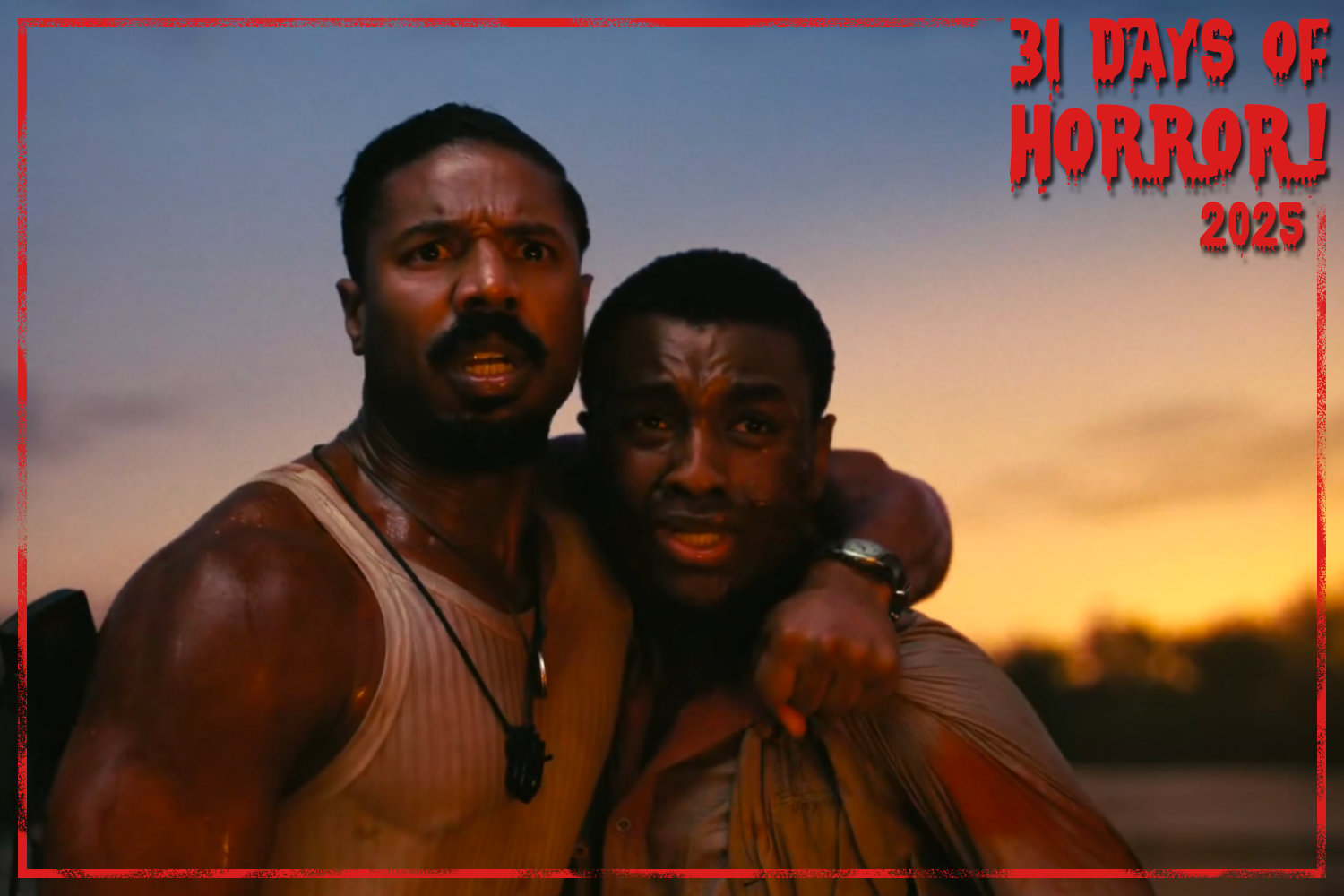
♪ Care ye sun don’t shine once more. Don’t let it shine. ♪
Ryan Coogler’s Sinners presents a horror film told within the complex realities of a racially segregated South. The film is shaped through its characters, its setting, and its music, all of which may over shadow the creatures lurking in the dark.
Before Viewing
This trailer appears to show a film that takes place in 1920s Southern America, as two black brothers ready their guns for some kind of trouble. They get scared by something. A group of people approach a building. A lone man bangs on a door wanting to get inside, while everyone inside gets ready for some kind of fight, collecting molotov cocktails, rifles, and spears. Come ye Sinners and get ready for a new kind of horror.
Presented below is the trailer for the film.


Sinners title card.
After Viewing
On Sunday, October 16, 1932, in Clarksdale Mississippi, an injured and disheveled Sammie Moore (Miles Caton) walks into his fathers church carrying the neck of a guitar, where Jedidiah (Saul Williams) tells him to give up his sinful ways. Flash back to the previous day, the Twins, Smoke and Stack (both played by Michael B. Jordan), back in Mississippi from Chicago, purchase an old mill from Hogwood (Dave Maldonado), planning to convert it into a juke joint. They pick up their cousin, Sammie, outside the church where he is picking up his resonator guitar and receiving a warning from his father; “You keep dancing with the Devil, one day, he’s gonna follow you home.” In the woods, the twins check a truck loaded with crates of alcohol. The two split up, with Stack and Sammie taking the car and Smoke driving the truck into town.
Smoke secures the food and a sign they need from the Chow’s, Bo (Yao) and Grace (Li Jun Li), after shooting two would-be robbers in the leg for pawing through the truck. At the train station, Stack hires Delta Slim (Delroy Lindo), a musician, to play at their joint. Sammie meets Pearline (Jayme Lawson), a young married woman, while Mary (Hailee Steinfeld), a Caucasian-looking woman, confronts Stack. She had previously been in a relationship with Smoke, before the Twins left for Chicago. Stack, Sammie, and Slim drive past the cotton fields where they hire Cornbread (Omar Benson Miller) to work as the bouncer. Smoke visits the grave of his dead child and his estranged wife, Annie (Wunmi Mosaku), where she freshens up his Mojo bag (and gets Mr. Mojo rising).
Outside a lone farmhouse, a posse of Choctaw follow Remmick (Jack O’Connell), a vampire, who hides with a married couple affiliated with the Klan, Bert (Nathaniel Arcand) and Joan (Lola Kirke). One of the scouts, Chayton (Nathaniel Arcand), warns them of the dangers of this man before departing. Remmick turns the couple into vampires. The party kicks off at the juke joint, bringing in dozens of people from all around. Sammie plays a blues song that is able to “pierce the veil between life and death,” apparating spirits from the past and future. The musics catches the ear of Remmick, who arrives with Bert and Lola, asking for admittance to play music. But, the Twins are suspicious of the white folks and send them on their way. Mary goes outside to speak to the trio, sussing out how much money they have, and is bitten by Remmick.

Stack and Smoke are back in town and ready to do some damage.
Mary hits on Stack and the two begin having intercourse in the back room. She bites Stack, apparently killing him, as Smoke unloads a gun into her. No damage is done and she escapes out the club. Slim sends everyone home as they begin closing up. Cornbread, who had been out using the bathroom, asks to be invited back inside, but Annie, a practitioner of Hoodoo, realizes he’s a haint and denies his entry. Stack comes back to life, pleading with his brother to let him out, before breaking through the door and escaping. Annie lets them know they can defeat these vampires with stakes to the heart or sunlight, but killing the head vampire won’t return anyone to them.
Outside, Remmick has gathered a mass of vampires (having turned many that tried to flee), including Bo. Each of the survivors inside eats a piece of garlic to prove they’re not a haint. Remmick communicates Grace, and the others, via a telepathic link, through Bo. He urges Sammie to come out and join them, promising to spare the others. He wants to use the boys’ musical power to see people he’s lost. Remmick also admits that Hogwood is part of the KKK and he’s coming back at dawn to kill them all anyway. Grace screams for Remmick to “come on in,” surprising everyone, who must now pick up weapons to defend themselves. Grace immolates herself, killing a vampire. Stack bites Annie, and Smoke keeps his promise by killing his ex-wife before she can turn. Delta Slim causes a distraction, but gets killed by a bunch of vampires, while Remmick bites Pearline before they both come for Sam.
Smoke fights the vampiric Stack, getting the upper hand. Sammie hits Remmick in the head with his resonator guitar, getting the silver disc stuck in the vampire’s skull. The pain Remmick feels resonates through his followers. Smoke stakes Remmick as the sun rises, turning him, and all his followers, into ash. Smoke sends Sammie home to the scene depicted at the beginning, while he shakily gathers his weapons. Fourteen Klan members show up to kill the partiers, but are surprised by Smoke, who shoots them all to death. He is wounded in the melee and as he dies, sees Annie and his daughter again on “the other side.” Sixty years later, in Chicago, Sammie is an elderly and extremely successful blues musician at his own club. Stack and Mary arrive to see him, one last time. Stack reveals that he promised Smoke he would leave Sammie alone, and the three discuss that fateful day 60 years ago, which was the best day of their lives–and the last time Stack saw his brother or the sun.
“Can’t we just, for one night, just all be family?” – Remmick

Remmick and his starter batch of vampires appear too overly friendly to the locals.
Sinners is a rich film that is as much about Blues music as it is about vampires. Director Ryan Coogler presents a robust character piece that is also a non-traditional horror film, drawing inspiration from a myriad of sources. Is there horror in the film? Most certainly. But a lot of that horror derives from the society that the characters are living in as much as the supernatural creatures that stop by for a visit. When Smoke and Stack first meet with Hogwood, they threaten that if the see him or “any one of [his] Klan buddies” they’ll kill them. Hogwood’s calm response is the same lie that is being told today, “Klan don’t exist no more.” Of course, no one believes him. And the proof appears twenty minutes later when Remmick arrives at Bert and Joan’s house and notices the white robes on a table inside the door. Maybe no one talks about the Klan and others deny it exists, but it’s there waiting below the surface to bubble back up when the time is right. The same goes for vampires. They don’t exist anymore. They’re part of the old country. Yet, here comes one across the fields, looking to infect the locals of Mississippi. Good God, Klan-pires all around. The first member of the core cast that Remmick turns is Mary, the one Black character that can pass as White (her grandfather was half Black). After she kills Stack, she looks up at Smoke with blood smeared all over her face and says, “It’s not what it looks like.” Further proof that he Black characters of Sinners have much more to fear than just blood suckers, creating an interesting dynamic. They have to fight for the lives this night, just to be able to continue fighting for their lives during the day. The film is rife with this kind of duality.
Thematically, Coogler has crafted a very slick film that contains layers of details and references. Primarily, it’s a movie about duality. Duality between characters, between situations, and between ideology. First, there’s the idea above about the antagonists of the film coming from multiple sources. Blood sucking vampires versus white hooded Klansmen. They come during night or day, staying hidden from plain sight, but they’re around if you know where to look. Then there’s the Twins, Elijah and Elias Moore. According to people more well versed in costuming, Smoke is dressed in a style befitting of the Irish mobs of Chicago, while Stack is dressed more like the Italian mobsters. Two rival factions in the city that the Twins are able to bridge. At one point Stack mentions to Sammie how evil their father was. So much so, that Smoke killed him. This is contrasted to Sammie’s father, who is a preacher. Mary has a duality with her as a woman who is biracial. She wants to be part of her Black community, but can, and does, pass for White. Cornbread doesn’t recognize her when she first walks up to the door, and asks if she’s sure she’s in the right place. Annie walks between two world, that of Hoodoo practitioner and local business owner. Her knowledge of haints and vampires, being the one thing that saves people, at least for a little while. Finally, all the vampires have a split between their bodies and souls. They are enthralled to Remmick, having eternal life, but have lost the ability for their souls to rejoin their ancestors, leaving them stuck in their bodies. None of the bitten can ever attain their transcendence.
Ryan Coogler has been transparent with the types of films that inspired him when drafting Sinners. Some are obvious, but others may not be. The film that many will think about when watching Sinners is From Dusk Till Dawn, the Robert Rodriguez/Quentin Tarantino vampire western. Both films have a core group of characters experiencing a siege by vampires at a bar of questionable repute. Another obvious homage is John Carpenter’s The Thing, specifically the sequence where the survivors take a blood test to determine which of them may be infected. That mirrors the garlic eating scene here. Coogler plays the scene similarly, with the audience believing one of the characters may be a vampire that is stuck in the building. A character complains about the test, drawing suspicion, but in Sinners it’s all a fake out and leaves everyone reeking of garlic. Coogler also includes an original episode of The Twilight Zone television series in his list of inspiration. In “The Last Rites of Jeff Myrtlebank,” a late season episode from Season 3, the episode concerns a Southern man in the 1920s who has died and comes back to life. The episode intimates that he may have some greater power but not that he’s specifically a vampire. As far as horror films go, I see a connection to the original Candyman film, only as a potential homage with the epilogue of the film taking place in 1992 Chicago, the same location as that film. Audiences may also see similarities to Inglorious Basterds as Smoke guns down the Klan much like the Basterds cathartically gun down Hitler and other Nazis in that film. Finally, there’s several parallels to O Brother, Where Art Thou, mainly through the use of folk music both in the soundtrack and as performed by the characters.

Bloody Mary!
The music used in the film becomes another thematic element of Sinners. From the opening narration, which describes the ability for musical individuals capable of piercing the veil between life and death, conjuring spirits from the past and future, and healing communities or attracting evil, music, and specifically the Blues becomes a religious experience. The audience also gets to understand that the Sammie’s preacher father believes that his music leads to ways of sin. Playing in juke joints for philanderers who shirk and sweat is the way to the Devil. But Sammie is one of the mystical beings, a griot, whose music can enthrall and heal. It’s also the same music that attracts Remmick; the Devil who follows you home. Hearing Sammie perform “Travelin’” in the car as it drives along the dusty back roads of Mississippi, conjures the legends of Robert Johnson (and scenes from O Brother, Where Art Thou) who reportedly sold his soul to the Devil at the crossroads of U.S. Routes 61 and 49 (in Mississippi, no less) in exchange for extreme musical talent. Later, Sammie performs “I Lied To You” at the juke joint, where audiences get to experience the piercing of the veil between worlds as tribal African characters and future pop superstars appear during the song that literally burns the house down. While the songs that Sammie, and Slim, perform come from the traditional Delta Blues repertoire, Remmick and his Klan-pires perform more traditional songs from Ireland or America. Their upbeat version of “Pick Poor Robin Clean” is the most ominous, about pickin’ the meat off of Cock Robin, intimating the destruction of the revelers later in the night. The song can also be considered offensive to the Black people, as it’s an appropriation of a local tune used by the Whites without understanding of its meaning. Later, Pearline sings about never seeing the sun shine no more, just as all hell begins to break loose in the club, symbolizing the tradeoff made by those bitten by the vampires. They can experience eternal life, but at the cost of never being able to see another sunrise. Something that is also equated to a religious experience in the film.
While Sinners has received much praise, there are still many who have been critical of the film. Saying it was not enough of a horror film, or it was too much about the Black experience. Both are dismissive of the efforts of the filmmakers, who created a film specifically to tell this story, as is. All of Coogler’s films are about the black experience, in some fashion, so to expect something different is ignorant of the filmmaker’s body of work. Perhaps critics feel that the visibility of Sinners as a Black film, dealing with the complexities of race, music, and family in the 1930s South, somehow diminishes stories about some type of White experience. This is ridiculous, as critics would not apply the same criteria to predominantly White films. It more likely has to do with state of society in 2025, where everything has to feel like a political action, and to elevate one story, another must be put down. Coogler has put together one of his strongest films to date, complete with interwoven thematics, cinematography, and costuming. It deserves to be nominated for several Academy Awards this upcoming season, to celebrate its rich story, which is something that will continue to be unwoven over time.

Black and white vampires, living in harmony. Why can’t we all get along?
Assorted Musings
- This is the third non-traditional vampire film this month on 31 Days of Horror, following two Vampire Westerns in Near Dark and Sundown: The Vampire in Retreat.
- Smoke and Stack being the nicknames of the Twins, is an homage to “Smokestack Lightning” by Howlin’ Wolf, one of the most influential Delta Blues songs of all time.

Having grown up on comics, television and film, “Jovial” Jay feels destined to host podcasts and write blogs related to the union of these nerdy pursuits. Among his other pursuits he administrates and edits stories at the two largest Star Wars fan sites on the ‘net (Rebelscum.com, TheForce.net), and co-hosts the Jedi Journals podcast over at the ForceCast network.