
More and many others offer a tale of conscience and calamity.
Self/Less self-imposes its idea of a good time. Maybe it’s too self-centered to see that what it provides is less self-serving than it seems. It’s not that it’s selfish. Maybe it’s just not as self-aware as it could be.
First Impressions
In this trailer, an older, rich man (who is a power player in New York City) is dying when he is approached by a group that offers him true immortality. He visits their building, where he sees living donor bodies awaiting him. The scientists perform a medical procedure where his consciousness is transferred into one of the bodies, and his old body is killed. Things seem to be fine. The new body is strong and healthy, but then he begins having flashbacks to the body’s original life, while scientists speak of sacrifice. What will the man need to do? How can he be Self/Less?
Presented below is the trailer for the film.


Self/Less title card.
The Fiction of The Film
Real estate tycoon and millionaire, Damian Hale (Ben Kingsley), schools one of his younger business associates on why he is considered such a ruthless businessman. He admits to his friend Martin O’Neill (Victor Garber) that he only has six months, or less, to live from the cancer that’s eating him alive. Damian’s daughter, Claire (Michelle Dockery), won’t return his calls, so he visits her at her business, a community coalition, where he awkwardly offers her money that she refuses. He finds a card in his things for a visionary new process called “shedding,” which allows those who can afford it, more time on the planet. Visiting Doctor Albright (Matthew Goode) at Phoenix Biogenic, Damian is told a bit of the process and how they can move on to the next step.
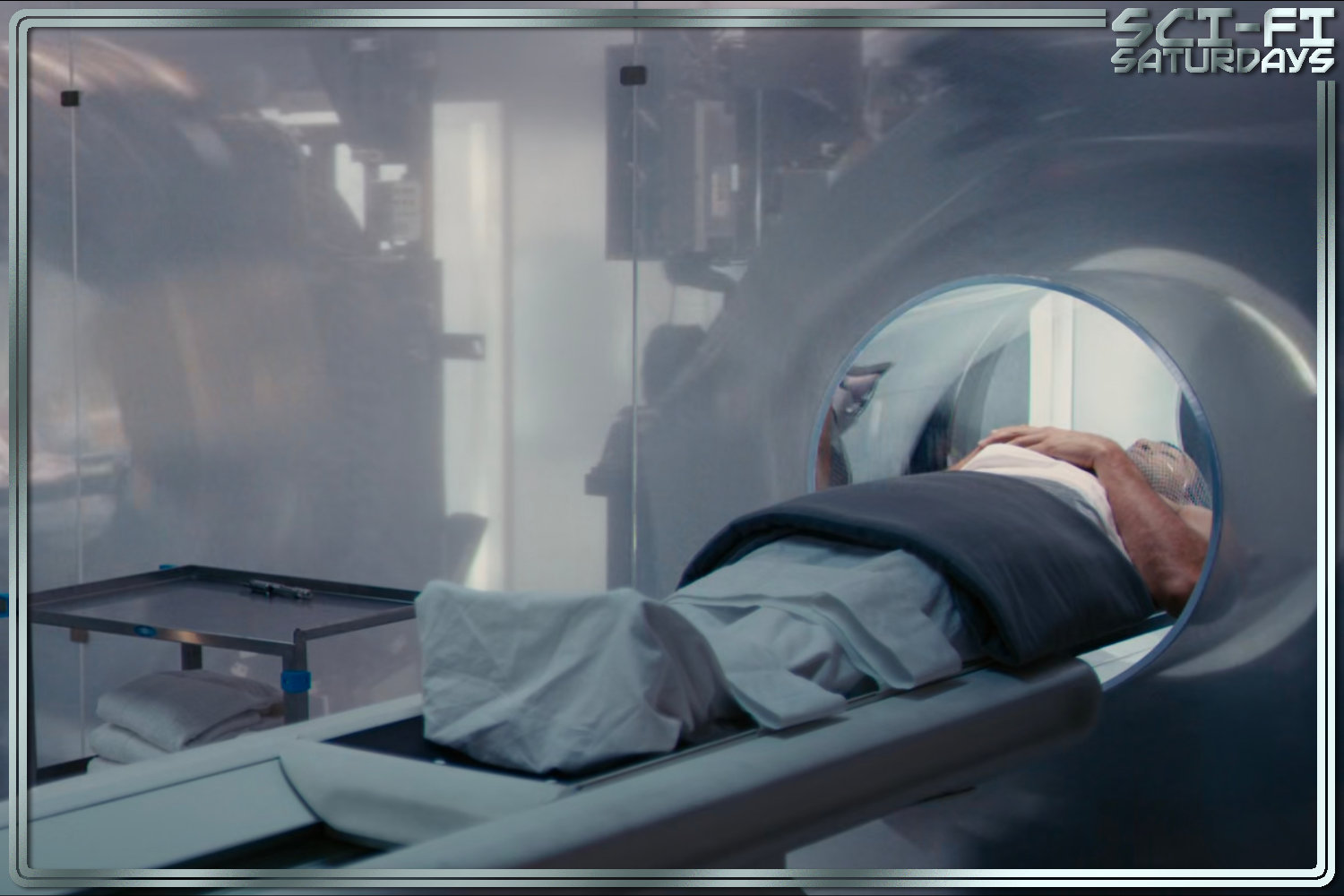
Having everything he can want, except for friends, in his life, Damian arranges a public “death” as recommended by the doctor. At a restaurant in New Orleans, Damian goes into anaphylactic shock and is carted away in an ambulance to a Phoenix facility, where Damian and one of the “lab-grown bodies” are put into a machine. Moments later, a new, younger body (Ryan Reynolds) emerges, complete with Damian’s consciousness. The new body, known as Edward Kidner, takes a few weeks for Damian to acclimate to it, as he takes a daily pill to avoid hallucinations. Albright calls them ‘elements of rejection.’ Eddie is set up with an apartment and enjoys wining and dining young women to the extreme.
Damian enjoys the vitality of his new body and meets neighbor Anton (Derek Luke) playing basketball. The two bond, sometimes double-dating, and continuing to play ball. Damian misses his pill one day and has a vivid hallucination (which he calls a recollection) of a woman and her young daughter. When he mentions it to Albright, the doctor seems to know that the woman is Latina, even though Damian never mentioned it. Albright suggests a trip to Hawaii to relax, but Damian travels to Missouri instead, where he finds the woman, Maddie (Natalie Martinez), and her house. She is shocked to see her husband Mark (the real name of the body Damian is inhabiting) in front of her, who she thought was dead.

All alone in a gilded cage. What a terribly sad life this man had.
Confused, Damian is even more shocked when Anton and two goons show up and attack them. Anton explains that Mark made a deal with the company in exchange for money to save his daughter. Luckily, Mark was an ex-Marine, and his muscle memory allowed Damian to shoot the two goons and injure Anton. He takes Maddie, and they pick up their daughter, Anna (Jaynee-Lynne Kinchen), who is ecstatic to see her father. Searching for answers, Damian watches a video about the creator of the shedding process, Doctor Jensen, and realizes that Albright is really Jensen in a new body. Damien takes Maddie and Anna with him to visit a demented Mrs Jensen (Sandra Laugherty), hoping to get some details on her husband’s work and a new supply of pills. Albright shows up, explaining that the pills suppress the memories of the person’s body Damian inhabits, and without them, his consciousness will disappear.
Anton, now in a new body (his third, from his boasts), attacks Damian, but Maddie saves him. They stop by Martin’s house, as this strange young man convinces the older man that he is really Damian in a new body. During a discussion, Anna finds the O’Neill’s son, Tony, which freaks Damian out. Tony supposedly died two years ago, and Martin has obviously shed his son into a new body. Martin is unaware of the more grotesque aspects of the process, but believes Damian enough to help him get Maddie and Anna away. Damian drives off in a car, distracting Anton and his men, but the mother and daughter are eventually caught and taken to the Phoenix facility. Abstaining from his pills, Damian gets visions, via Mark’s recollection, about the facility where Maddie and Anna are being held.
Damian attempts to break in but is captured and told he will be used as the body for Anton’s next shed. During a struggle, Damian slips a bullet into his mouth so that when he is put into the machine, the metal will interfere with the process. Albright believes that everything has worked as planned, allowing Damian (still in Mark’s body, but pretending to Anton instead) to rescue Maddie and Anna, and burn Albright with a flamethrower. Damian sends mother and daughter to the Caribbean to stay safe. In New York City, Damian (as Mark) visits Claire, claiming to be a friend of her fathers, and gives her a note from him. In a hotel room in the Caribbean, Mark awakens and watches a video recorded by Damian (still as Mark), thanking him for the use of his body, and explaining that he stopped taking the pills so that Mark can reclaim his life. Mark reunites with Maddie and Anna on the beach, and they all embrace.
“We offer humanity’s greatest minds more time to fulfill their potential. Designed to offer you the very best of the human experience.” – Doctor Albright

Anton lays it all out for Damian. Do the oranges mean someone is going to die?
History in the Making
Self/Less is a film about the vanity of the one percent, and its effect on those close to them. Watching it so close to the holiday season may be the reason that the role of Damian skews a little close to Ebenezer Scrooge, at least in terms of morality. It is the fifth film from director Tarsem Singh, most known for The Cell and Immortals, and written by Alex & David Pastor, two Spanish writers/directors known for several films, including Bird Box: Barcelona. It’s a film that seems extremely similar to a popular 1966 film, which was also featured on Sci-Fi Saturdays, but without so much as a tip of the hat. Self/Less imagines a life-altering, scientific breakthrough that is designed for the betterment of society, but as with many science-fiction stories, the breakthrough is disastrous.
The film wants to make a point about the level of classism in America during the second decade of the 21st Century. It does, but the effort is superficial in nature, skewing more towards a star vehicle for actor Ryan Reynolds, and an action-adventure story with multiple chases, fights, and car stunts. Still, there are some important elements of the transhumanism movement interspersed around the scientific sleight-of-hand and technobabble. However, the film still fails to achieve cohesion of these various elements, whether by accident due to the lack of focus by the creative team, meddling from the studio, or a conscious decision by the director. Self/Less ends up being a hamfisted and blunt exploration of truly interesting and human ideals that have been better explored elsewhere.

Damian discovers Albright’s secret, so the doctor lays it all out for him in classic villain style.
Genre-fication
Following up on last week’s utopian Tomorrowland (well, somewhat utopian, with a dash of dystopia) comes Self/Less, which depicts a most dystopian world for the average person (but a potential utopia for the wealthy). From Damian’s standpoint, as a soulless and somewhat heartless businessman, the ability to escape the cancer that is consuming his body (too many years early) must seem like a welcome relief. Even if he doesn’t fully buy into the promises of the doctor, however. He takes certain precautions, planting a metal box in a graveyard which contains elements of his old life that he might use to prove his providence to old friends or family. From his viewpoint, as with Martin and his wife, the process is a godsend. It allows him to continue his life, free from pain and death, but at the loss of his previous relations and standing. But for those on the other side of the equation, the decisions are fewer choices and more coercive. It becomes another parable in the genre about the strong and wealthy praying on the week and the poor. It becomes a social dystopia, along the lines of Z.P.G., The Handmaid’s Tale, or even Children of Men. But Self/Less chooses to avoid overtly talking about these social schisms in lieu of slotting in de facto action sequences.
It’s also a curious film, having much in common with the 1966 Rock Hudson film Seconds. Both films deal with an older man, in his 60s, needing a change in his life, one dying of cancer, the other having a later mid-life crisis. Both men switch into the guise of a younger man, living out hedonistic fantasies. Arthur undergoes a thorough treatment of plastic surgery, while Damian has his consciousness transferred into what he believes to be a human husk devoid of any identity. Unfortunately, things sour for both of them almost immediately. The biggest differences are that the John Frankenheimer film creates a darker tension about the motives and reasoning behind The Company, while Self/Less has no such confusion; it’s about Doctor Albright’s hubris and, to a smaller extent, money. Seconds invests more time in the head of Arthur, played in a younger form as Rock Hudson, as he falls back into the familiar patterns of his old life, making similar mistakes over and over again. Ryan Reynolds, while a fine actor in this film, doesn’t quite capture the feeling that he’s the reincarnation of Sir Ben Kingsley, and that may be because he’s also playing the other man inside the body. With both films, I doubt there’s any audience member who sees the promises made by the antagonists and doesn’t think, “there’s going to be trouble,” making the characters dumber than the audience.

Damian attempts to prove who he is to old and dear friends.
Societal Commentary
Self/Less sets up a parable about the haves and the have-nots and gives a hard lesson to a man who thinks he has it all. The filmmakers are not trying to even provide the idea that Damian is a good man or that Phoenix Biogenic might be working for the betterment of society. The first scene with Damian, at the lunch where he chastises and fires one of his executives, shows what a bastard he is. The audience then learns he yearns to reconnect with his daughter, but she wants nothing to do with him or his money, having traveled an entirely selfless path from his. He lacks the empathy to connect with others, which is why he is shown in his ostentatiously gilded penthouse, alone, looking over the city that he helped create. It seems very much like another New York real estate tycoon of wealth and power that has an entire lack of empathy, maintaining relationships of convenience and power without substance (and unsurprisingly, the gilded penthouse belongs to that same man). Instead, the film sympathizes with the Bitwells as they attempt to unentangle themselves from the games of the elite. Damian feigns disgust when he realises what has occurred, with Mark having given up his life to save his daughter, knowing that he would never have done the same for his own child. He claims he would have paid for the procedure if he had known, but Albright mocks him, again knowing that he wouldn’t. By the end of the film, Damian learns an important lesson about love, kindness, and sacrifice as he decides to let go of his own life in order for Mark and his family to have a chance at happiness that he never did. Trite, but a great reminder to audiences that there’s always time to change (just like Mr. Scrooge).
The other theme of the film is immortality. It’s something that Damian toys with, but the real subject of that issue is Albright. It’s implied that he got into the business of shedding due to his own realization that he was dying. And who wouldn’t want to live forever? Well, maybe as long as it was on your own terms. It seems that the fees paid by the clientele help advance the funding for the Phoenix group (an apt name for a business that kills you and literally resurrects you from those ashes). The rich people who choose to have the work done advance the technical side of the business, providing new bodies to continually test the procedure on. And the pills! The pills are a wonderful way to keep everyone in check, and dependent on Albright and his whims. This is the part about playing the game on your own terms. If you’re egotistical and you’re not in charge, then it’s no fun. The filmmakers show that immortality is not that great, unless maybe you’re a narcissist or a sociopath. For regular people, watching your loved ones age and fail around you would be difficult. And if you’re too hard on your body, like Anton, then it can be exceedingly painful. It’s not like the wounds don’t hurt! Unfortunately, Self/Less doesn’t go as deep as it could. Instead, the moral of the film is one life equal good, immortality equals bad.

Damian connects with Mark’s daughter, Anna, filling in some of the time he missed with his own daughter.
The Science in The Fiction
The films of the 21st Century have advanced a lot of new ideas about humanity and the world we live in. The Matrix imagined a world where people were used as human batteries in support of sentient machines. Eternal Sunshine of the Spotless Mind explored the ability to edit our memories and how that would affect people emotionally. Surrogates explored the bridging of a human/machine hybrid to the extent that real human interactions were as foreign as rotary dial phones in 2025. Self/Less approaches notions of transhumanism, with the ability to move everything about a person that makes them an individual into another body. There’s also the ethical aspect of not using actual cloned bodies, as advertised. While films like Chappie explore the idea of consciousness (just what makes a person), Self/Less is more self-assured. A person is the sum of their electrochemical experiences in the brain, and if we control-C/control-V those elements into another body, voila! It’s a whole new world.
The more thought put into this, the more ludicrous it gets. Especially in the fact that it’s an instantaneous effect. I can’t even copy the contents of my terabyte hard drive to the cloud as fast as the consciousness zips from one body to another. And other than the consciousness of the donor body trying to fight its way back to dominance, there appear to be very few other side effects. One might argue that the more times the consciousness is copied between bodies, the more unstable it becomes, as with Anton. But I see that as more of an exploration of how pissed off Anton is becoming at being bested by a newly shed individual, like Damian. It’s a curious process that would have been fun to explore in greater detail, or with some greater stakes, rather than as a backdrop for the action moments.

Damian chooses to reconnect with Claire as ‘Mark,’ an old friend of her father.
The Final Frontier
This may be reading too much into the film, but it seems as if the writers tried to make their character names fit who the character is. As a start, Damian is the main character. The name is based on a Greek name, which means “to tame” or “to subdue,” much like Damian subdues his business dealings, but also in the way that he is subdued by Dr. Albright. And then the doctor, Albright–as in all bright. He’s a smart guy who has figured out the secrets to creating life in some way. How about Mark, who is the victim in this film. Picked by the Phoenix group to be used as a donor body. In conman parlance, he is the mark. Chosen specifically because he’s easy prey. The doctor’s company, Phoenix Biogenic, is an obvious play on the mythology of a phoenix, a bird that bursts into flames and can rise from its own ashes. This is not something that I usually think about, but Self/Less works on such a low level that it just seemed a possibility.
The other major problem with the film is its cinematography and editing. There are a lot of shots that seem poorly composed or edited in such a way as to become confusing, especially some of the fight sequences. This could be for several reasons. Perhaps it was due to parts of sequences filmed later in the production as pick-ups. Perhaps it was sloppy attention to detail by the filmmakers. But the idea that stands out the most is that it was purposeful and done to keep the audience off balance, in the same way that Damian feels off balance. That’s the best hypothesis, even though that’s not how Ryan Reynolds plays the character. Damian is often surprised by the muscle memory that exists in Mark’s body. His reflexes kick in during the fight sequences, and he instinctively knows how to handle himself. So, why make the blocking and editing work in a way that would make things confusing? Self/Less is an okay film, but one that I would not choose to watch again. As with Damian, a lot of the film is very surface-level, not delving into the real psychological reasons behind his actions. He’s very much about his self, but then he becomes selfless. Get it? Yeah, not super deep.
Coming Next


Having grown up on comics, television and film, “Jovial” Jay feels destined to host podcasts and write blogs related to the union of these nerdy pursuits. Among his other pursuits he administrates and edits stories at the two largest Star Wars fan sites on the ‘net (Rebelscum.com, TheForce.net), and co-hosts the Jedi Journals podcast over at the ForceCast network.