
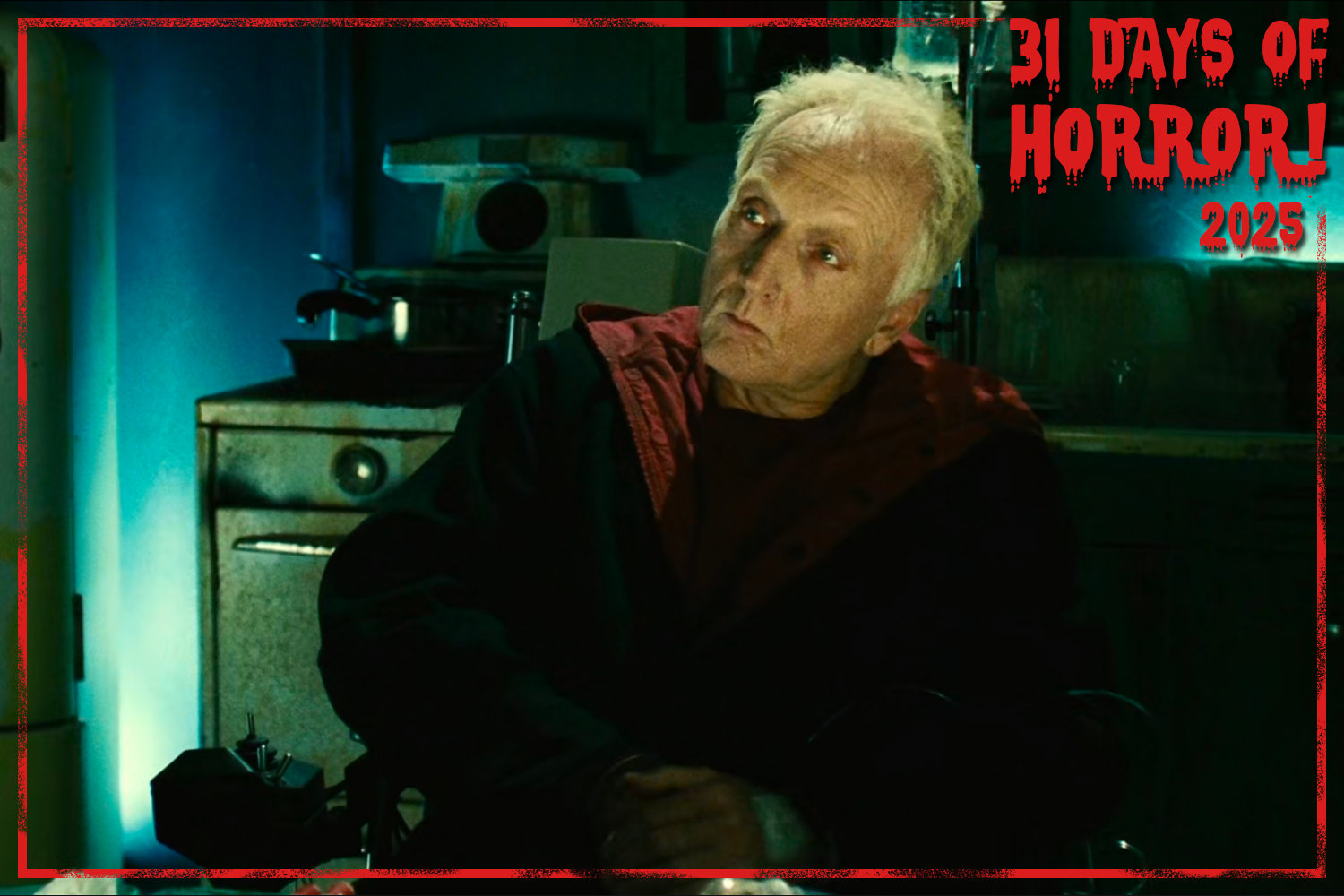
This movie gives the song, “The First Time Ever I Saw Your Face,” a whole new meaning.
Jigsaw is back with another, even more brutal, series of traps for the characters in this film. This sequel also expands on the villain in a way not many horror franchises have chosen to pursue.
Before Viewing
After a briefly edited sequence from the original film, the trailer shows Jigsaw is back and up to his old games. This time, he has a group of people trapped in a house with multiple traps which they must figure out to be able to escape. It appears just as deadly as the first time, with three times the number of characters. It’s more of the same in Saw II.
Presented below is the trailer for the film.


Saw II title card.
After Viewing
An informant, Michael (Noam Jenkins), is trapped in a room wearing a barbaric looking iron maiden mask (a death mask). A video hosted by Billy the Puppet informs him that all he needs to do is extract a key surgically implanted behind his right eye before a timer goes off, which will swing the nail studded mask closed. He fails. Elsewhere, Detective Eric Matthews (Donnie Wahlberg) picks up his delinquent son, Daniel (Erik Knudsen), from a holding cell for shoplifting. He shouts at Daniel in anger as they part. At work, Eric is approached by Detective Kerry (Dina Meyer) to assist in her Jigsaw murder investigation of Michael’s death, which contains a note left at the scene asking Detective Matthews to “look closer.”
An obvious clue leads the police to the Wilson Steel factory, where the Detectives and SWAT team discover an invalid John Kramer (Tobin Bell), also known as Jigsaw. He appears to be no threat and indicates a larger problem in the next room, which contains monitors showing eight people, including Eric’s son Daniel, trapped in a house with Jigsaw’s traps. The individuals are informed that they need to solve puzzles to gain antidotes for the nerve agent they are breathing, or they will die in two hours. The first casualty is Gus (Tony Nappo), who is shot in the head when they attempt to use a key to open the main door of the room, after being told not to.
John tells Eric that he only wants to talk to him, and that if he does, Daniel will be found “safe and secure.” Eric begrudgingly listens while debating options as Kerry calls a tech team to trace the video feed to the house’s location. The victims discover a basement area where Obi (Timothy Burd) is outed, by a tape recording, as Jigsaw’s assistant. He attempts to grab two antidotes in a small crematorium, but gets burned to death instead. Xavier (Franky G), a buff drug pusher, becomes further angered by their situation, scaring everyone.

Detective Matthews and Kerry look on in shock at the horrors awaiting eight of Jigsaw’s victims, including his son.
John relates his story to Eric, in which he attempted suicide after a cancer diagnosis, only to survive miraculously. He believes that he is providing a service to these individuals and giving them a chance to actually live their lives. One of the victims, Amanda (Shawnee Smith), was Jigsaw’s only winner, having previously survived one of his traps. She is being judged again for some reason, and in the next room, gets thrown into a pit of hypodermic needles by Xavier, who wants her to find the key to a door containing more antidote. She doesn’t do it in time, sending Xavier off in more of a rage.
John reveals the commonality of all these individuals in the trap is Eric, being the arresting officer who also happened to have planted evidence against them. Xavier kills Jonas (Glenn Plummer) with a spiky bat after realizing that on everyone’s neck is a number, which is part of the combination to an antidote-laden safe. Laura (Beverley Mitchell) dies from the nerve agent, and Addison (Emmanuelle Vaugier) bled to death in a trap attempting to get a syringe of antidote. A picture of Eric and Daniel with the text “father and son” is found, doubling Xavier’s efforts to hunt for the young man. Amanda is the only one who seems willing to protect Daniel and helps him hide in a bathroom–the same location as the original film.
Eric has had enough and beats up John, who then decides to take the Detective to the location of the house. The SWAT team decodes the location moments later and heads out. When the officers arrive, they discover the video feed is a recording and the events happened some time in the past. A timer by the monitors ends, and a large safe next to John’s desk opens, revealing Daniel unharmed. Eric finds the bathroom, with a dead Xavier (who was killed when he attacked Amanda and Daniel), but is given an injection by Amanda, who is hiding in the dark. She reveals she is working with Jigsaw and will carry on his work when he dies. Eric is her first test subject, and she leaves him chained up in the dark room.
“Those who don’t appreciate life do not deserve life.” – John Kramer

Jonas, Amanda, Laura, and Addison ponder how they will escape without dying.
There’s nothing easy about Saw II, as producers Leigh Whannell and James Wan return to the franchise that jump-started their careers. This time, Whannell returns as the writer, along with first-time director Darren Lynn Bousman. But even though it’s a different team, they continue to infuse the same level of intensity in this film that was part of the original Saw the year before. The main aspect of these films that seems to grab people’s attention is the puzzle contraptions created by Jigsaw to test the mettle of others. They pit the audience against the filmmakers in a way, as viewers imagine what they may do in a similar situation. What comes from that is a heightened level of adrenaline as the films may switch locations, but very rarely ease up on the time pressure for the characters. There is always a ticking clock that drives the edge-of-your-seat tension. Saw II magnifies that by placing Daniel, Eric’s son, in danger, which seems even more wrong than that standard level of menace for horror films.
As a second film in a series, audiences certainly expect \ filmmakers to return to a lot of the same elements for that series. Whether that’s sex-craved teens at a lake cabin, a zombie apocalypse, or very real nightmares manifested outside of the bedroom. But in each of the cases, the audience is really coming for the villain. A horror franchise is only as good as its bad guy, and John Kramer, aka Jigsaw, makes for an enigmatic one. Unlike more traditional serial killers and monsters, he is all too human, possessing no supernatural powers. He has a methodology that has some altruistic value to it: he wants his victims to understand what life is truly about and yearn to live it. As a character who has been diagnosed with terminal cancer, he wants others to experience the epiphany that he has come to understand. That life is meant to be lived and experienced. It’s a great message for everyone to hear, but maybe not with a spring-loaded death mask on your neck and a timer counting down. To be fair, no one that Jigsaw puts into a trap (with the possible exception of the SWAT officers at the beginning of this film) is completely innocent. Everyone has some transgression that has been levied against society. In this film, he’s captured drug dealers, prostitutes, kidnappers, and ultimately a crooked police officer. The use of Daniel, while within the realm of characters Jigsaw might go after, appears to have been the enticement in the trap for Eric.
Audiences can’t help but feel some empathy towards the victims, but also towards Jigsaw. For starters, the audience only has Jigsaw’s say-so on what these characters have done. Only a psychopath would derive joy from the killing of these individuals, and our justice system still requires people to be proven guilty before a jury of their peers. So even if they are guilty of the crimes, it’s outside of Jigsaw’s place to convict and sentence them. Any empathy derives from the same place the horror comes from: people being abducted and placed on trial for reasons they may not understand, by a freelance judge, jury, and executioner. Hopefully, no one would hate to be placed in a similar situation for real. Saw II puts Jigsaw more in the spotlight as a character than the previous film did. There’s some pity that can be had by audiences once they understand that this character is dying of cancer. He’s weak and stuck in a wheelchair, yet Detective Matthews cannot see beyond his own anger as he beats John, believing that physical abuse will somehow change the outcome of this game. Other villains in horror films may be exciting to watch, like Freddy or Jason, but there are very few that have achieved the same level of empathy as this one.

Daniel helps Amanda who has been forced into a pit of hypodermic needles.
It would be interesting to see if the Saw films led, in some small way, to the popularity of escape rooms in the 2010s or if that was just a coincidence. Audiences like figuring out puzzles, and like some of the best mystery-thrillers, Saw II provides clues to help viewers figure out the traps. Jigsaw is very explicit in his rules, which often fall on deaf ears. But who can listen to instructions when your life is on the line? Usually, the ones that panic the most are the ones that get killed the fastest. Michael, the first victim, thrashes around and dislodges the wire, which starts the countdown timer. This is similar to Adam in the first film, losing his key down the drain in the opening moments of the film. In actuality, Jigsaw is not making it easy for these individuals to free themselves. He doesn’t want them to escape their penance, which is why Amanda is only one of over a dozen victims to have survived, and probably the reason he chose her as his successor. What makes these traps scary is that they’re insanely overdeveloped and seem incredibly difficult to beat. But even some of the worst ones, like the razor blade box Addison sticks her arms into, have a simple solution if the time is taken to look. A key is already in the lock on this case, as seen briefly when the scene starts. But again, people under threat in a fight or flight mode are probably not going to slow down to look at something like this if they’re not even willing to work together.
Readers of my articles know that I am a big fan of time travel films, and the first Sci-Fi Saturdays/31 Days of Horror article earlier this month was for Time Lapse, a film about the dangers of knowing the future. In that film, a special camera spits out an image 24 hours into the future, which causes stress and anxiety amongst the characters, leading to questions of free will versus fate. In Saw II, Jigsaw mentions that having the knowledge of one’s death could change the worldview of an individual. He continues that if he were to tell someone the time and place of their death, it would “shatter [their] world completely.” In this case, future knowledge allows for planning. He argues that this has freed him from the unknown, allowing him to live a fuller and more self-fulfilling life. Knowing that you had 2, 4, or 10 years left would absolutely change the way you responded to daily trivialities. Time would not be wasted, but would be savored and used to its fullest extent. Quite a broad philosophical idea for a film series that has helped usher in a new wave of graphic and torturous imagery.
This year, Saw II celebrates its 20th anniversary, and is part of a week of anniversary films on 31 Days of Horror, which started with the centenary of The Phantom of the Opera, and continues with the 50th anniversary of The Devil’s Rain, the 40th anniversary of The Stuff, and the 30th anniversary of In The Mouth of Madness. In the past 20 years, the Saw franchise has seen a myriad of tie-ins, including comic books, theme park rides, and (to date) eight other films. Chronologically, the tenth overall film, Saw X, comes between the first film and this one, filling in some of the missing pieces. An eleventh film has been in the works and was due to be released later in 2025, but that has since been canceled. Saw II may be a superior film over the original, depending on your point of view. It has more characters and thus more crazy deaths, which intrigues horror fans. But it also humanizes the antagonist in a way unseen in so many films of the genre, making it worth that element alone.

Addison suddenly has cause to rethink her life choices.
Assorted Musings
- While Eric Matthews appears to be the protagonist, he’s not a nice guy. Donnie Wahlberg also played a nasty character in The Sixth Sense.
- With hindsight, Jigsaw’s clues are relatively straightforward. He tells Detective Matthews his son will be found in a “safe and secure” place, which is revealed to be the safe next to them. The game contestants are told they all have the numbers in the “back of their mind,” which equates to the tattoos on their necks–conveniently below the collar of Xavier’s shirt (since he has no hair to cover it as the others), so it was not seen in advance.

Having grown up on comics, television and film, “Jovial” Jay feels destined to host podcasts and write blogs related to the union of these nerdy pursuits. Among his other pursuits he administrates and edits stories at the two largest Star Wars fan sites on the ‘net (Rebelscum.com, TheForce.net), and co-hosts the Jedi Journals podcast over at the ForceCast network.