
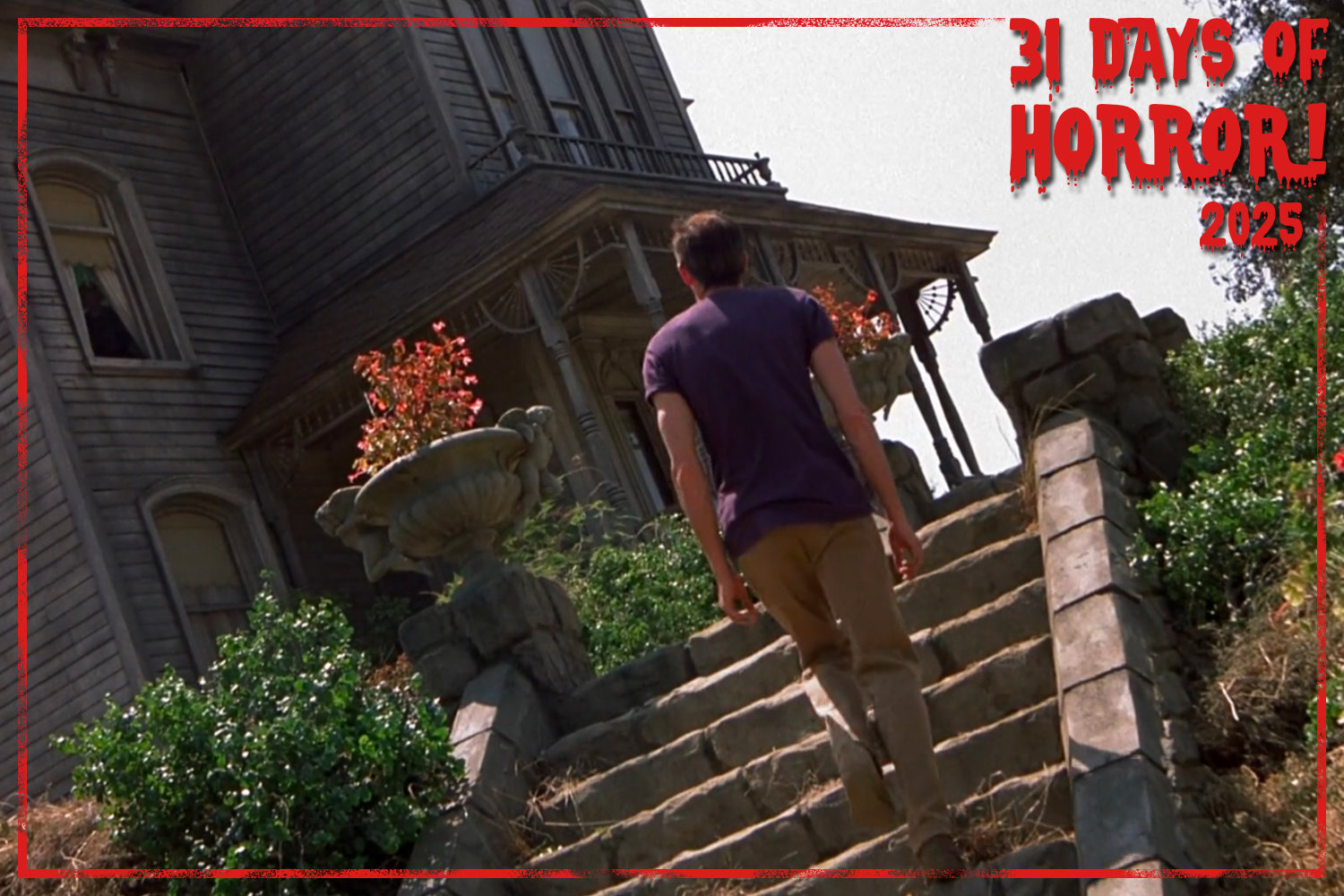
Qu’est-ce que c’est? Psycho killer?
Anthony Perkins returns after twenty-three years to the role that made him famous, Norman Bates. While appearing as just another horror sequel in the early 80s, Psycho II works well as an homage to the original film and Hitchcock’s style, creating a modern sensibility that pairs well with a vintage thriller.
Before Viewing
The trailer opens 22 years after the events of Psycho, as Norman Bates is about to be released from prison. Mrs. Loomis, Marion Crane’s sister, argues for his continued incarceration, but the judge overrules her. Norman returns to his home and the Bates Motel, still in business after all these years. There, he begins to hear the voice of his mother clawing at him while murders begin happening again. Is Norman losing his grip on reality, or has someone else gone Psycho II?
Presented below is the trailer for the film.


Psycho II title card.
After Viewing
An opening scene reminds audiences that 23 years ago, Marion Crane was stabbed to death in a shower at the Bates Motel. In the present day, Norman Bates (Anthony Perkins) is released from prison by a judge, much to the displeasure of Lila Loomis (Vera Miles), Marion’s sister. Norman’s doctor, Dr. Raymond (Robert Loggia), returns him to his home and motel in Fairvale, California. He reports for work at the local diner, where he meets Mrs. Spool (Claudia Bryar), who recommended him for the job, and Mary (Meg Tilly), a young woman on the outs with her boyfriend. Norman offers her a room at his hotel, which has stayed open and is being managed by Toomey (Dennis Franz), a drunk.
Norman fires Toomey for allowing drug use and running an “adult motel,” allowing Mary to stay in the house. After offering Mary dinner, he explains why he was incarcerated and tells her he needs her to stay. She agrees and places a chair under the doorknob for protection. The next day, Toomey harasses both Mary and Norman at the diner. Norman becomes agitated when he finds a note from his dead mother. Mary takes pity on Norman and decides to stay at the house after all. She takes a shower upstairs and is spied upon through a peephole in the wall. Believing it to be Norman, she finds him downstairs playing the piano. Returning to the motel to gather his things, Toomey is stabbed to death by a woman in a dark dress.
Dr. Raymond checks in with Norman and then stops by to ask Sheriff Hunt (Hugh Gillin) to keep an eye on Norman and Mary. Entering Mother’s room, Norman finds it looking as it did 20 years ago. He follows a sound to the attic and becomes locked inside. Two teenagers, Josh (Tim Maier) and Kim (Jill Carroll), break into Norman’s cellar to “smoke dope and mess around.” Josh is stabbed to death by a figure that looks a lot like Mother. Mary discovers Norman in the unlocked attic. Sheriff Hunt investigates, and Mary provides an alibi for Norman, saying that they were walking together.

Lila blames Dr. Reynolds and the court for allowing Norman Bates to be released from custody.
Mary meets with Lila in town, revealing that they are mother and daughter. Lila has been helping Mary leave notes, make phone calls in Mother’s voice, and rearrange Mother’s room to make Norman go insane again so he’ll get recommitted. Mary feels that they are doing something wrong, and there’s possibly a third person around committing the murders, telling her mother Norman was locked in the attic when the boy was killed. Dr. Raymond exhumes the body of Norma Bates to prove to Norman that his mother is dead. After “Mother” calls again, Norman now believes that it’s his real mother communicating with him.
Norman begins to get more confused, talking to voices on the phone that aren’t really there and questioning his sanity. Sheriff Hunt finds Toomey’s car in the swamp and tells Mary he knows what they’re trying to do to Norman, and that she and her mother need to leave town immediately. Lila sneaks into the cellar and pulls out a Mother costume stored under a stone tile, but another Mother figure catches her and stabs her violently. Having seen Lila sneak into Norman’s house, Dr. Raymond investigates. Norman begins hearing Mother’s voice again, so Mary puts on the Mother costume, telling him to hang up the phone. She is surprised when Dr. Raymond sneaks up on her (believing it’s Norman) and she stabs him. He falls over the stair railing to his death.
Norman comes after Mary, believing she’s actually Mother and losing his grip on reality. Stabbing Norman several times, she flees into the cellar, where she finds Lila buried in a pile of coal. Blaming Norman, she lunges for him with her knife, but the Sheriff and his deputy arrive and shoot her to death. Their report shows that Mary went crazy, dressing as Mother, and having killed Lila and others. Norman is relaxing at home, nursing his wounds, when Mrs. Spool stops by to check on him. He says he’s been expecting her. She admits to being his biological mother, explaining that her sister was the one who looked after him. She killed all the people trying to interfere with Norman’s return. Norman picks up a shovel and bashes her head in, carrying the body up to Mother’s room, where “she” berates the boy, reminding him that Mother is the only one who loves him.
“I just moved back here after being many years away, and I forgot to bring any cut-cutlery.” – Norman

Mary listens in on a phone call to see if Norman’s mother is actually phoning home.
At the time of its release, Psycho II was the longest wait between an original and its sequel, at a few days shy of twenty-three years (22 years, 352 days to be exact). That would change in three years with the release of The Color of Money, a sequel to The Hustler after 25 years. Today, so many new films are returning to their source material after decades; films like Tron: Legacy (28 years), Blade Runner: 2049 (35 years), Top Gun: Maverick (36 years), and reigning champ, which may never be broken in our lifetime, Mary Poppins Returns at 52 years from the release of Mary Poppins. However, Psycho II is still the record holder for horror sequels, which is not a huge surprise. The 70s and 80s were such a time for sequels, especially in the horror genre, that barely a year would pass between the original and the next film being released, as with Friday the 13th (1980) and Friday the 13th Part 2 (1981) at 357 days! With the glut of horror films being produced at this time, especially slasher pics, and the attempt to cash in on sequels for the more popular ones, this gave Universal a chance to dust off one of its most notable and well-regarded films, Psycho.
This series began as a novel, written by Robert Bloch in 1959. It was quickly procured by director Alfred Hitchcock and offered to Universal Studios to be filmed quickly and cheaply using the crew of his Alfred Hitchcock Presents television series, after Paramount Pictures passed on the adaptation. Psycho quickly became a phenomenon and is in Hitchcock’s top five most notable films, along with North by Northwest, Vertigo, and The Birds. Reportedly, the film sequel emerged when Block published Psycho II, a sequel to his original novel, in 1982. In a twist worthy of the modern Scream films, the book’s story follows Norman escaping from the asylum and heading to Hollywood, where a film version of Psycho is being made. It contained commentary and criticism of the current crop of slasher films, which Universal felt was critical of Hollywood. They decided to produce their own sequel, written by screenwriter Tom Holland (not the current Spider-Man actor), ignoring Bloch’s book and him completely. And while an adaptation of that story would have been light years ahead of its time in Hollywood, what happened was a much more interesting film.
For people unfamiliar with Psycho, it did to showers what Jaws did for the ocean. It was a massive hit, in no small part due to Sir Hitchcock’s showmanship, advertising the film by showing none of it, and stating that a strict policy prevented people from entering the theater after the film had started. It inspired notions of the modern slasher film, itself being somewhat inspired by the murderous Ed Gein (who also inspired elements of The Texas Chain Saw Massacre). It was also the first film to pull the rug out from under the audience by killing the main star of the film just 48 minutes into the almost 2-hour runtime. The crucial scene from that film, and the most memorable, is represented in the opening moments of this film, as Norman, disguised as Mother, hacks Marion Crane to death in her shower. This sequence shows neither nudity nor penetration by the knife, but is still considered an extremely violent sequence due to an amazing use of blocking and editing, due it giving the illusion of a violent attack. Films in the 1960s were not allowed to show gratuitous nudity or violence (or even toilets being flushed, see my original article on Psycho for that story), and had to accomplish these feats through movie magic. That movie magic would be crucial to the sequel as well.

Norman realizes he’s getting a bit confused, as Dr. Reynolds reassures him that everything is okay.
As the 60s and 70s progressed, filmmakers began pushing the boundaries of what they could show on film. In 1968, the Motion Picture Association of America (MPAA) created the earliest version of the modern film ratings categories. Films with nudity, adult language, and explicit violence were rated R, for restricted, which included the majority of horror films. Special effects technicians developed new ways of creating realistic gore and nightmarish scenes in films from Taxi Driver to The Thing. The status quo for horror films of the day was the more gore the better, whether that was in The Shining, Halloween, American Werewolf in London, or any number of other slasher films. Psycho II, arriving in the middle of the most populous deluge of horror films in America, went the other direction. The first two murders in the film show basically nothing. Toomey’s death features a small gash across his cheek as editing provides the shadows, the knife movement, and reaction shots, along with sound effects of the strikes. The death of the teenage Josh shows even less, but is a longer sequence featuring close-ups of the boy’s feet slipping on some logs as he attempts to escape, and multiple close-ups of the knife swinging. Only two brief extreme close-ups show Josh’s shirt with blood as a knife plunges in, while the rest of the sequence is a series of falling glass jars shattering their liquid contents on the floor. The end features his fingers drawing lines through the dusty window pane as he sinks out of sight. The depictions of both murders are heavily implied rather than graphically depicted. Director Richard Franklin was a student of Hitchcock’s style of filmmaking and does a wonderful job of both imitating Hitch’s style while providing just a tad more to audiences. But as Hitchcock had done with Marion Crane two decades before, Franklin subverts the audience’s expectations in order to set up an even more extreme moment.
The film builds tension in several ways as it progresses. The first is by raising the question of who is performing the murders. It could be Norman reverting, but as more details emerge, that seems less likely. So who could it be? The stress of returning to his previous life, and especially returning to the location of the gruesome murders, pushes Norman closer to the edge. Maybe he didn’t commit the first two murders, but could he be responsible for the next one? The third murder, of Lila Loomis (nee Crane), changes the direction of the film. She is discovered by Mother attempting to put on a disguise to fool Norman, and is killed for her trespass. Vera Miles’ demise apes her near-death at the end of Psycho, where she screams, flinging her hand up to knock an overhead light (in the same cellar) as Norman, disguised as Mother, comes towards her with a knife. Except this time, the killer puts the knife directly through her open mouth, plunging out the back of her neck. There’s no attempt to hide this graphic moment, which shocks the audience so much more due to the sanitized nature of the previous deaths. This also disrupts the audience’s notion that Lila may have become unstable and has been the one committing the murders. It is later revealed to have been Mrs. Spool, Norman’s biological mother, who committed all three of these killings. But by this point, the audience now thinks it must have been Mary instead. With tensions high, the plot becomes intense as Mary accidentally stabs Dr. Raymond, who flips over the balcony railing like Detective Arbogast in the original. She is then shot by the police who believe her responsible, having gone mad and dressing up like Mrs Bates after having killed Toomey, Josh, and her mother. This too mirrors the ending of the original film in a similar speech, which is delivered in both films by the officer in charge. The coda reveals the darker truth, and what Norman has been saying all along: his real mother is responsible. She admits to the wrongdoings as Norman poisons her tea, just as he did years ago to Mrs. Bates. But that’s not the end. Norman bashes her in the head with a shovel in a take that shows the full brunt of the object striking her head. Running a stunt like that with an older actress is shocking. He carries her upstairs as the Mother persona returns, letting the audience know that Norman Bates is indeed back and ready for another sequel.
Psycho II may not be everyone’s cup of tea, but in the universe of Norman Bates horror films, it’s a worthy successor to the original. Though some elements may seem overly complex or super coincidental, the film adheres to the rules of its world crafted over two decades previous. Anthony Perkins does a wonderful job playing a man who is uncertain if the occurrences around him are real or imagined. The filmmakers keep these surprises for the audience as well, such as not letting the voice of Mother be heard over the phone. This keeps the suspense about what is real and what is imagined a surprise until the end, when Mother’s voice is once again heard, confirming that Norman has indeed gone psycho.

Norman sits Mrs. Spool down for a cup of tea. Can you dig it?
Assorted Musings
- Only one more theatrical sequel was released in this franchise, Psycho III in 1986. A made-for-television film, released on Showtime in 1990, called Psycho IV: The Beginning, told the backstory of Norman and his mother. This era was also further explored in the 5 season show from A&E called Bates Motel.
- At one point, Jamie Lee Curtis was asked to play Mary, but declined. She is the real-life daughter of Janet Leigh, who played Marion, Mary’s aunt, in the series.

Having grown up on comics, television and film, “Jovial” Jay feels destined to host podcasts and write blogs related to the union of these nerdy pursuits. Among his other pursuits he administrates and edits stories at the two largest Star Wars fan sites on the ‘net (Rebelscum.com, TheForce.net), and co-hosts the Jedi Journals podcast over at the ForceCast network.