
What can go wrong this time?
Project Almanac wants to deliver a slick youth-oriented time travel film, framed in a modern style. But instead, it delivers a shaky and oftentimes illogical presentation, making the characters both smarter than their age and dumber, at the same time.
First Impressions
In the trailer, several students find an old video camera and watch footage of one of their birthday parties, when one of them notices themselves, from today, reflected in a mirror. This sends them on a quest to pull out some other machinery and documentation and create…a time machine. And they use it to do everything you would do if you were 14 and invented time travel: retake tests, make money, and buy expensive things. Of course, there are consequences which now must be corrected during Project Almanac.
Presented below is the trailer for the film.


Project Almanac title card.
The Fiction of The Film
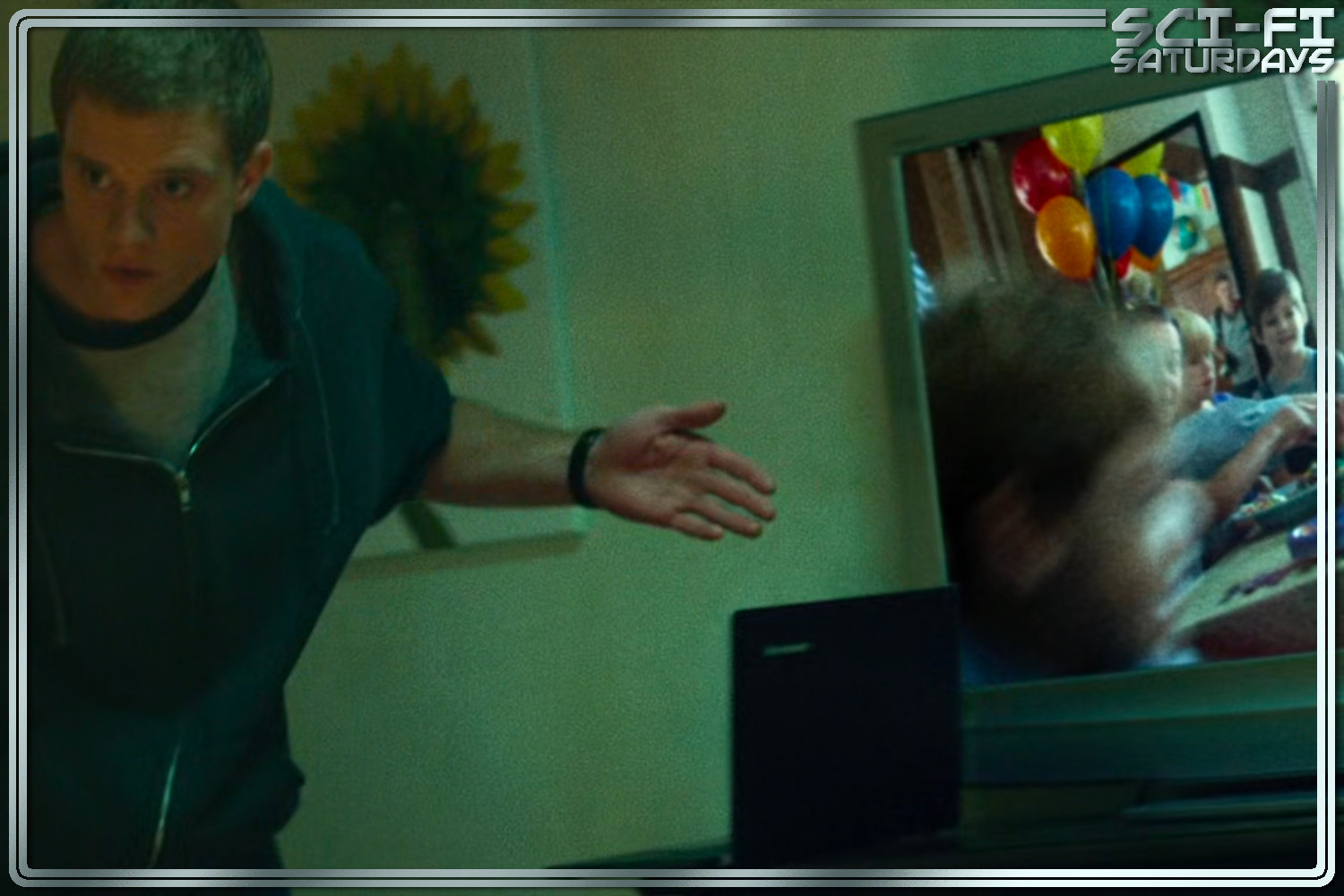
In 2014, high school senior David Raskin (Jonny Weston) demonstrates a modified drone for a video he’s submitting for acceptance into MIT. He gets admitted, but realizes his family cannot afford the tuition, forcing his mother (Amy Landecker) to put the house up for sale. He and his sister, Chris (Virginia Gardner), look through some of their deceased father’s old things in the attic for a suitable idea to make additional money. They discover an old camcorder that they did not know existed. While watching footage from his 7th birthday party on the tape, David notices his present-day self reflected in a mirror very briefly. He and his friends, Quinn (Sam Lerner) and Adam (Allen Evangelista), help him recreate the same angle seen in the video.
This leads the group to discover a light switch that activates a hidden compartment in the floor of their father’s fenced-off workshop in the basement. In it, they discover a container with electronic instruments and papers from DARPA chronicling something called “Project Almanac.” Reading over the papers, David realizes they have discovered blueprints for a time machine. David, Adam, and Quinn begin formulating a power source from many batteries, but the device explodes. They begin iterating new designs, creating a mobile phone interface to control the machine and steal small containers of hydrogen from the school chemistry lab to power the reaction. When the device spins up, it creates an electromagnetic field that causes loose objects near it to spin wildly. One night, in a fit of desperation, they hook up the device to a Prius hybrid battery, which allows them to send a toy car one minute into the past, but also knocks out the power in the town.
Jesse (Sofia Black-D’Elia), the owner of the Prius, discovers their clandestine experiment and joins the group, since David also has a crush on her. She pushes them to start using the device, now the size of a backpack, on themselves. The five youths, David, Adam, Quinn, Chris, and Jesse, all leap back in time to the previous night and enter Quinn’s house, drawing a smiley face on his sleeping past self’s neck–which creates the same design on current Quinn. Past Quinn awakens, and when he sees future Quinn, begins a feedback loop that nearly causes both of them to vanish. They return to their present, accidentally bringing a neighbor’s dog, and realize they have altered the past. They create two main rules for the use of the machine: no jumping alone, and film everything. The group uses the device to fix Quinn’s failed chemistry test, stop a girl from bullying Chris, and to win second place in the lottery. David gives some of the winning money to his mother, so they don’t need to move. They purchase a lot of other fun items, like cars and clothes.

Normally staring at the camera would be a faux pas, but this the “found footage’ genre, where rules are broken.
They successfully extend the range of the device and go back three months to the Lollapalooza concert. They have a blast, experiencing all the best parts of the festival with their knowledge of the future. David and Jesse experience a tender moment where she expects him to kiss her, but he misses the signal. They return to their present, having spent 9 hours in the past, while only being gone for 41 seconds. David begins to notice some things are suddenly different. The school basketball team has no longer won a championship, and the story of a crashed airline is all over the news. David chooses to return to Lollapalooza, by himself, and fix the moment with Jesse. When he returns, she is spending the night at his house, after having had sex. But other side effects have occurred, and David’s mother is now looking for a job, no longer being employed.
David pieces together the things that have changed and ties it back to the night of the blackout. One of the basketball players was injured in a car accident, which led to the team losing, and another boy’s father–who would have been at the game–wasn’t and was flying a plane that crashed. David is scared of losing Jesse, so he goes back to that night and saves the basketball player from the accident. Upon returning, he finds out that Adam is now in a coma from a car accident. Every change seems to have bigger and bigger ripples. He attempts to go back one more time, but Jesse walks in on him and is transported to the past as well. Her past self stumbles onto them, causing a feedback loop that vanishes both from existence.
When David comes back this time, he is being hunted by the police who believe he has something to do with Jesse’s recent disappearance. He decides he needs to do one final jump to destroy the machine, but he is out of hydrogen. He breaks into the school, managing to leap just before the cops grab him. He arrives at his house 10 years ago, during his 7th birthday party. David enters the basement, where he sees his father–who somehow recognizes this teen as his son. He tells his father about the problems, and the two of them burn the plans to the time machine and destroy the component, which causes David to wink out of existence. Back in 2014, David and Chris look through some of their deceased father’s old things in the attic, and discover two camcorders. Playing the tape reveals David, during the events of the film, discovering the time machine. At school, he approaches Jesse and tells her he’s going to “change the world.”
“So you’re telling me Dad left a time machine in the basement?” – Chris

David and his friends mess around with electronics attempting to activate a time machine.
History in the Making
While not the most sound of sci-fi films, Project Almanac provides some youth appeal to the genre that hasn’t been as prevalent since the 1980s. It takes the complex, and sometimes convoluted, topic of time travel, and attempts to glorify it for a younger audience with hip cinematography, attractive actors, and pop music. It does an okay job, too. But instead of creating something new and exciting for the genre, it relies heavily on the conceits of what has come before, breaking no real new ground whatsoever. It creates illogical conceits and random constraints during the teen escapades, trading solid characters and storytelling for flashy showmanship.
Project Almanac is often referred to as a found-footage film. This is a relatively new genre that appears to be a found piece of film or video documenting a real moment in time. It’s akin to a documentary in terms of cinematography and camera work, but lacking any curation of the footage, i.e., editing, of the footage. The style dates back to 1980 with the release of Cannibal Holocaust, having been used sporadically since. But it really took off as a viable form of media after the 1999 release of The Blair Witch Project. It best serves horror films, like Paranormal Activity or V/H/S, with their unblinking point-of-view shots, which force the audience to watch as events unfold, but the sci-fi films Cloverfield and Chronicle have also captured audiences’ imaginations. The conceit with these types of films is that the characters in the film are documenting the events with their camcorder, iPhone, or whatever. It needs to make sense why the characters are filming their environment (as with Cloverfield’s documenting a monster attack in New York City), but it also locks the film down to a one-camera perspective. No edits, no alternate footage, no cheating. Project Almanac begins that way, with Chris documenting her brother’s MIT experiment, but devolves as the filmmakers begin cutting to alternate angles (i.e., another camera) and switching between various cameras (Chris’s iPhone, David’s backpack cam, the random Go-Pro). Audiences may not notice this faux pas, as the footage works within the normal editing style of motion pictures viewers are used to, but for those who do see it, the suspension of disbelief in the format is instantly ruptured. This is not necessarily a good or bad thing, but it demonstrates the lack of attention to detail that the production is following. Honestly, I’ve seen better YouTube videos that convince me of their realism.

David explains, to the camera, how the time machine was resized into a backpack.
Genre-fication
What Project Almanac does well is understand the lineage of its time travel genre. The filmmakers create a movie that harkens back to the youth-oriented films of the 1980s, making a wish-fulfillment romp for the audience. It blatantly references Bill & Ted’s Excellent Adventure as a video the kids are watching in the cafeteria as they try to “understand” how time travel works. They also specifically mention at least two other films by name, Looper and Timecop, in ways that are slightly oblique. Timecop features a character interacting with another version of themselves, which morphs them together, in a similar way to how Jesse gets erased from existence–though here it’s just being in near proximity to each other that causes the erasure rather than a physical interaction. Looper shows what happens when a past version of a character has an appendage removed. The current version of the character suddenly finds themselves missing the same appendage, or having a scar suddenly appear where one had not existed moments ago. This is what Quinn demonstrates on his past self by drawing a circle on the back of his past self’s neck, which appears in real-time on the current Quinn’s neck. But these references are really only the tip of the iceberg.
The film that most influenced this film appears to be Back to the Future. Right off the bat, the title of the film (as well as the DARPA program), Project Almanac, appears to be a reference to the much-sought-after Gray’s Sports Almanac from Back to the Future Part II. There’s no real discussion of why it’s called that. It’s just the name that is on the plans that the kids find. Perhaps David’s dad was a fan of the franchise, being a product of that era, and named his Project, wryly, after the MacGuffin that was grabbed by Marty, and used by Biff to alter time. The film also has an overall vibe towards that series as well. The kids all record the experiments on video cameras, the way Marty did. The first experiment of time travel uses a model car, reminiscent of both the model car used by Doc in the 1950s to illustrate Marty’s return to 1985, but also the actual DeLorean used as a time travel machine. But Project Almanac also dips into the horror genre as it exhibits similarities to both The Butterfly Effect and Final Destination. David’s leaps through time, which can only extend backwards within his life, end up altering his reality in unexpected and detrimental ways, much like Evan’s travels in Butterfly Effect. Neither understands what they’re playing with, and both end up erasing themselves from existence through their experiments. The manifestation of Time appears to be a course-correcting entity, like Death in the Final Destination films. In those films, people who somehow evade Death’s design eventually succumb to an alternate fate, as the Grim Reaper corrects the oversight. Here, any change that David makes to avoid some tragedy ends up manifesting itself in another way, usually centered around his small cadre of friends. A final film style that Project Almanac apes is the 80s teen sex comedy, specifically with Quinn. Some may see it as American Pie-like, but either way, he’s a horny teenager who spends the opening of the film girl-obsessed. It becomes a stew of inspiration that is muddied by its clear lack of direction.

If you could time travel, where would you go? These kids picked Lollapalooza.
Societal Commentary
Historically, time travel films are usually about the protagonist’s regrets from their past and how they would go about correcting them. Project Almanac goes about it quite differently. There are no real regrets from David’s past. He is a successful student who has been accepted into MIT. The downside is his lack of scholarship money to pay for the education, coupled with his family’s limited income. He’s also awkward with girls, having been unable to get closer to the one he’s interested in, Jesse. In short, he has some obstacles that can be easily fixed (apparently) with the discovery of a time machine. Let’s change time so we win the lottery or kiss the girl. But in doing so, ripples of the change affect all of the good things in his life. Go back in time and kiss a girl; now the High School basketball team is no longer in the championships. Ripples include a plane crash and other catastrophes. This change is eventually traced back to the night of the original experiment, when the power is knocked out and the star basketball player gets hit by a car, breaking his leg. David’s continued attempts to preserve his new timeline, where Jesse is in love with him, result in Adam being hit by a car and falling into a coma. Eventually, David loses Jesse in the paradoxical effect where she encounters her past self, which spins David even further out of control. He spends the entire film so closely focused on holding onto his new life, he continues making further mistakes. Project Almanac seems to exemplify the old adage, If you love someone, set them free,

David’s camera manages to grab footage of him grabbing a Hydrogen container to make his last leap.
The Science in The Fiction
The suspension of disbelief in a sci-fi film is key to the audience being able to enjoy the film. Without that, the disbelief of the scenes can lead a viewer to fall out of the story, or worse, scoff at the events occurring on-screen. Project Almanac treads that line throughout and often falls on the disbelieving side more times than it should. As mentioned above, their early experiment is using a model car, with a GoPro attached, to test the time travel device. They plan to send the car one minute into the past, not one minute into the future like Doc Brown. Can you spot the problem with this experiment? If an object, which is currently sitting in front of you, is sent one minute into the past, how would you know? It would exist, and then continue to exist as it is replaced by its future counterpart, but there would be no discernible interruption, at least not anything excitingly filmic. Luckily, for the story, each time travel episode is accompanied by a blast of electromagnetic energy and levitating (and spinning) objects. The toy car is flung and, somehow, merges into a wall of the basement; the camera showing footage of them setting up the experiment. As they work through these tests, they soon realize they need more power. David suggests using a hybrid battery as “Something that can recharge itself as it puts out power.” Say what now? Hybrid batteries, as in the Prius, which they attach their system to, don’t make energy, like some perpetual motion device. The battery is recharged via the car’s regenerative braking system, not from some mystical daemon. That is not the weirdest part of the sequence, because when the DARPA device finally activates, it blows the battery on the vehicle, which also causes the neighborhood to go into a blackout. Perhaps the increased energy from the hybrid battery created an even larger EM pulse, which knocked out the local substation. Either way, these experiments are not condoned by OSHA.

David meets his father in the past, during his younger self’s 7th birthday party.
The Final Frontier
Overall, Project Almanac is an okay film. It features a lot of wish-fulfillment and fun youth-oriented moments, like the extended Lalapalooza sequence, that younger audiences may find more enjoyable. For all its foibles, the film serves as an important entry-level sci-fi film, like Clockstoppers, that might entice younger audiences to watch other time travel films (or harder sci-fi movies) as a result. It’s important to have these types of films available to audiences as choices within the genre. Films like The Terminator, Looper, or Time After Time might not entice a younger viewer to them, so having a film that speaks directly to that youth audience, even with its inconsistencies and inaccuracies, is important to keep the genre evolving.
Coming Next


Having grown up on comics, television and film, “Jovial” Jay feels destined to host podcasts and write blogs related to the union of these nerdy pursuits. Among his other pursuits he administrates and edits stories at the two largest Star Wars fan sites on the ‘net (Rebelscum.com, TheForce.net), and co-hosts the Jedi Journals podcast over at the ForceCast network.