
All you zombies hide your faces. The rain’s gonna fall on you.
If ever a time travel film could scramble your brains, Predestination is the one that will do it. The film presents a previously unfilmable story where the main character becomes a secondary character and the secondary character becomes the main character, both of whom are the same character. At least that seems like the case.
First Impressions
The trailer has a character asking the question, Would you kill the man that ruined your life? Bandages come off a man who is starting a new life. A mysterious voice from a tape recorder gives them information. The man identifies themselves as a temporal cop. Explosions, gunshots, and other unidentifiable moments all seem like Predestination, as the same quote ends the trailer that started it.
Presented below is the trailer for the film.

The Fiction of The Film

Predestination title card.
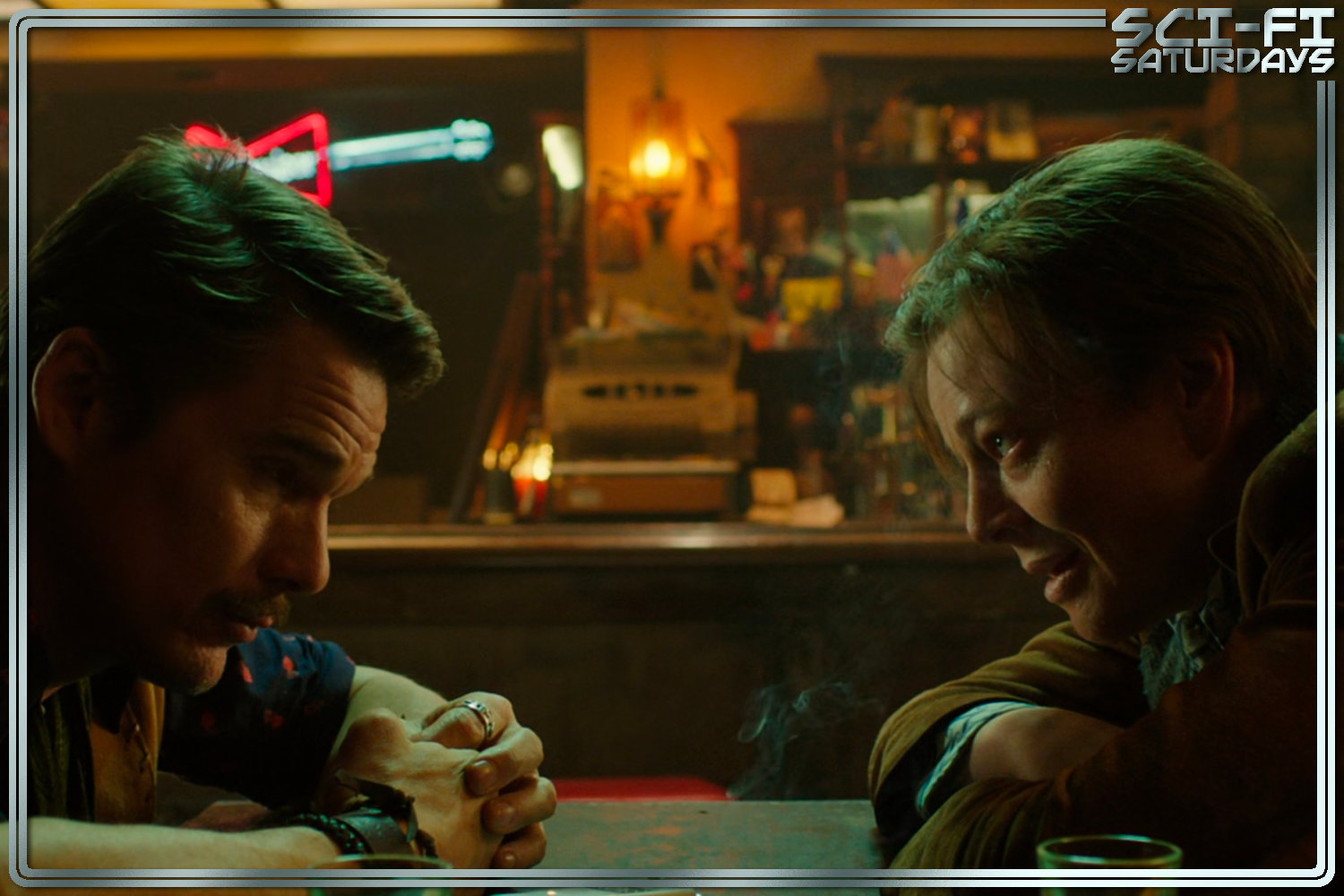
A male voiceover asks someone if they would kill the man who ruined their life. In 1970, in the engineering basement of a building, a man is seriously burned when trying to disarm a bomb planted by the Fizzle Bomber. The man blacks out and awakens in a medical facility wrapped head-to-toe in bandages. Two Agents give the man an award for his service. Months later, the bandages come off, and the man looks in the mirror, not recognizing himself due to the reconstructive surgeries. Some time later, the man gets his final mission orders to stop the Bomber and takes two guns, a watch, and a violin case. He ends up as a Barkeep (Ethan Hawke) at a New York City bar. The Barkeep speaks with another man who identifies himself as The Unmarried Mother (Sarah Snook), a writer of pulp confessional stories. The Unmarried Mother offers the Barkeep the most unbelievable story he’s ever heard.
The story begins, “When I was a little girl…” At a Cleveland orphanage in 1945, an infant appeared on the steps, baby Jane. She grew up knowing she was somehow different from others, and excelled in math, physics, and fighting. At her high school graduation, a man in a suit, Robertson (Noah Taylor), tells her she should apply for the Space Corps program. Jane is not being interviewed to become an astronaut, however, but as a sex surrogate for the male pilots. She continues to excel, fighting with the other recruits. After a physical examination, she is washed out of the program by Roberston and forced to go to night school and take decorum classes. She takes a job as a mother’s helper and finds work writing stories for a Confessional magazine. After class one night, she meets an enigmatic man, having a connection like she’s never had before, and within a couple of months, he disappears, leaving her pregnant.
Robertson returns, offering Jane a position at another, more clandestine organization. Unfortunately, her pregnancy negates that prospect. She gives birth by C-section, after which the doctor informs her that she contains two full sets of male and female organs. The birth destroyed her uterus and ovaries, but the doctors were able to reconstruct her with a male urinary tract. Depressed, Jane stays at the hospital until two weeks later, when her baby is abducted. With little choice, Jane continues her surgeries, transitions to a man, and calls himself John. During the telling of the tale, John explains how he continues to be a miracle of modern medicine, having received word that he is now a fertile man. John concludes his story by saying that he tried to re-enlist in Space Corp, this time as a man, but ended up moving to New York and becoming a full-time writer for the Confessionals magazine.

Jane interviews for a position in the Space Corps. Unfortunately, it’s a position on her back.
The Barkeep asks John the question that opened the film: if he could put the man who ruined their life in front of John, would he kill them? John follows the Barkeep into the basement, where he shows John a Temporal Field Kit, which looks like a violin case. The Barkeep sets the date to April 1963, and they teleport. The Barkeep explains he works for Robertson as one of eleven temporal cops, who can travel within 53 years, either direction, of the invention of time travel in 1981. The Barkeep believes that the man who ruined Jane/John’s life might be the Fizzle Bomber. He sends John towards Cleveland College to intercept him. John bumps into younger Jane, a student there, and is immediately taken aback, telling her she is beautiful. The Barkeep jumps back to 1970, into a building’s basement, where he fights with the Fizzle Bomber. He is beaten and left unconscious. When the Barkeep comes to, he hears an explosion and discovers a badly burned man. The Barkeep slides a Field Kit towards him, and the burn victim leaps to 1992. The Barkeep looks shocked to have seen his past self.
The Barkeep then leaps to 1964, where he recovers from the explosion and records some field notes on a tape recorder. He has a piece of the timer used by the Fizzle Bomber that he presents to Roberston. His boss reminds him that illegal jumps might induce psychosis and dementia. Roberston congratulates the Barkeep on his work, but is upset by what has to happen next. The Barkeep steps into a nearby room and steals Jane’s baby, dropping it off at an orphanage in 1945. He then travels to June 1963, where he collects John. John is upset that he was lied to and used, but sees the arc of his life from both sides. The Barkeep takes John to 1985, where he can now become an agent for the Temporal Bureau. The Barkeep then retires to January 1975 for the rest of his days by decommissioning his Field Kit, which errors out instead of terminating.
John trains for seven years to be a temporal cop, listening to messages recorded on tape by the Barkeep. The Barkeep purchases a typewriter from an antique store and types up his memoir called “Time, Love and An Unmarried Mother” by John Doe, having accidentally typed the name Jane first before crossing it out. He looks at dozens of notes about the Fizzle Bomber, who is due to blow up a building in March 1975. The Barkeep heads to a laundromat one evening and discovers an older man with long hair and glasses, the Fizzle Bomber. The Bomber is an older version of himself, who claims he’s saved lives by destroying buildings. He’s changed the time stream. The Barkeep tells the Bomber that he’s ruined his life before shooting him. Flashback images from throughout the film flicker past, connecting Jane, John, the Barkeep, and the Fizzle Bomber, eventually revealing the same mastectomy and C-section scars on the Barkeep’s body that were seen on Jane/John previously.
“I’ve changed so much that I doubt my own mother would recognize me.” – Agent Doe

Robertson visits Jane about a job with another, more clandestine, organization.
History in the Making
Based on a 1959 short story by Robert A Heinlein, Predestination seems like an adaptation that never could have been made. The original story, which is represented nearly flawlessly in the film, is so convoluted that it required clever casting, editing, and even some special make-up effects in order to convincingly bring it to the screen. While Heinlein is a prolific author of hard science-fiction, having helped popularize the genre, only a small handful of his works have been adapted, unlike other similar authors such as Philip K Dick or Arthur C Clarke. The first adaptation of a Heinlein text was the second film reviewed here on Sci-Fi Saturdays, Destination Moon. The Brain Eaters (1959) used his novel The Puppet Masters as an inspiration, although without permission. An authorized version of The Puppet Masters was released in 1994 along with a three-part animated adaptation of Red Planet on Fox Kids. But by far, his most popular adaptation to date, and the one that spun off the most sequels and prequels, was Starship Troopers (1997). These adaptations concerned themselves with space travel or alien invasions, all typical sci-fi fare for the 20th Century. On the other hand, Predestination deals with time travel, not an uncommon sci-fi conceit, but also causal paradoxes and sex change operations, making it a heady and complex film even for the best of audiences.
The story on which the film is based is entitled “’–All You Zombies–’” and contains about 80% of the storyline shown in the film. The elements with the Fizzle Bomber were all added by the filmmakers, presumably to provide a mission for The Barkeep/Agent Doe, and to distract the audience from the inevitable twist. “’–All You Zombies–’” was not Heinlein’s first foray into the causal paradox, also known as the Grandfather Paradox. In 1941, he released the short story “By His Bootstraps.” This story had similar interweaving timelines as the single character travels into the future and back to the past several times, creating multiple instances of themselves that interact with alternate versions of themselves. The title comes from the phrase to “pull yourself up by your bootstraps,” a late 19th-century phrase intended sarcastically in regard to bettering oneself, often financially or socioeconomically. The idea that one could lift oneself by pulling on their own bootstrap (a loop often used to pull the shoe onto the foot) is a physical impossibility. But since that time, its connotation has evolved to mean something that is exceedingly difficult, implying that the ability is within everyone’s reach as long as they have enough willpower. Predestination makes it abundantly clear that Jane/John is a special individual with unique abilities, thus able to accomplish infinitely impossible tasks.

John meets Jane, in a super awkward moment.
Genre-fication
Predestination is definitely in the top five most mind-boggling films about time travel. It falls behind a film like Primer, which is the most hardcore time travel film to date. 12 Monkeys also fits into this category, being both ominous and circular in its logic, as would any other film that includes a young protagonist’s trauma being caused by an older version of the protagonist who was time-traveling. Predestination is self-aware enough to be clever about its use of the causal or predestination loops. Upon watching a second time, many of these nonsensical phrases or casual remarks make perfect sense. The quote listed above is a perfect example. Agent Doe remarks that after being burned and receiving reconstructive surgery, his own mother wouldn’t recognize him. Humorous, since he is actually his own mother. Prior to stealing the baby, the Barkeep and Robertson have a cryptic discussion about “the way it’s always been,” and “the snake that eats its own tail, forever and ever,” referencing Ouroborus, and infinite loops. For the protagonist, there is no beginning and there is no end, especially when time travel is involved. It both makes perfect sense and no sense at the same time, which is why the film is such a perfect example of the genre. The protagonist was born only because the protagonist was able to time travel after a sex change operation. Effect precedes cause in this movie, similar to a film that is much less confusing, Somewhere in Time, in which the protagonist receives an object that he will carry into the past and present to a younger version of the person who gives him the object in the future. There is no logical way for any of this to exist, yet it does. And just one of the reasons that audiences enjoy these types of thought puzzles.
To play it out further, and picking the most appropriate starting point of Jane’s birth, the path of the protagonist can be traced. Jane is born in 1964 and taken by the Barkeep back to 1945, where she grows up, attends school, applies for the Space Corps, and is eventually impregnated by an unknown man. She gives birth to a baby, to herself, creating the first loop of the story. Her traumatic birth reveals that Jane is intersex, having both female and male reproductive organs, and is given reassignment surgery, without consent, becoming a man named John. John lives normally from 1964, working as a writer known as The Unmarried Woman, to 1970, when he meets the Barkeep in New York. John is taken back to 1963 by the Barkeep, where, now a fully functioning male, he is able to impregnate Jane (his past self). The Barkeep then takes John into the future, 1985, where John trains for seven years to become Agent Doe of the Temporal Bureau. Agent Doe may have other missions, but the one depicted in the film is the opening moments where he departs from 1992 for 1970. Agent Doe is burned during the mishandling of an explosive device by the Fizzle Bomber and is helped back to 1992 by an unknown figure in the shadows, putting his Field Kit within reach. The Agent undergoes reconstructive surgery, eventually returning to duty as the Barkeep, where he meets his younger self, listens to the story of John’s sad life, and takes John to 1963 to meet his Jane persona. The Barkeep then travels back to 1970 to stop the Fizzle Bomber, fails, gets beaten up, and helps his younger burned self reach his Field Kit. He then jumps to 1964 to steal Jane’s baby and take her to the orphanage in 1945 Cleveland, before returning to pick up John in 1963, and drop him off in 1985. The Barkeep then receives his final mission, which is supposed to terminate his time travel when his Field Kit decommissions in 1975. He writes one final confessional story of his life before tracking down the Fizzle Bomber, who he realizes is his older self, and kills the man. After more than half a dozen temporal journeys, Agent Doe/John/Jane becomes mentally unstable and continues using the Field Kit to bomb buildings, reportedly saving more lives in the process. Now known as the Fizzle Bomber, he stops the Barkeep from dismantling a bomb, eventually meeting his younger self in a laundromat, where he is killed.

The Barkeep (Agent Doe) takes the next step in his journey, doing what must be done.
Societal Commentary
While the story of Predestination is ultimately paradoxical and confusing, and seemingly contains multiple characters, there are really only two characters in the film: the protagonist and Robertson. Whether someone is talking about Jane, John, the Barkeep, the Unmarried Woman, Agent Doe, or the Fizzle Bomber, they’re all the same person. At least from the standpoint of the story, these are all the same character, even if they are played by two different actors. Yet, each version of the character can also be seen as a unique version of the whole at different milestones in their life. Imagine being able to visit with a younger or older version of yourself. Depending on what was occurring at that point in your life, it might be like meeting someone entirely different. What Predestination does is akin to therapy for the protagonist, allowing the character to practice self-affirmation. For example, Jane is self-conscious about herself, being bullied and treated differently by others. That is, until her future self, John, visits her six years later. Being able to see themselves from an outside perspective creates a new appreciation for Jane’s beauty. It’s something that John couldn’t understand when he was Jane. A similar interaction occurs between the Barkeep and the Fizzle Bomber at the laundromat. The Barkeep cannot understand the eccentric person standing across from him, who looks like a hippie. Yet, he will ultimately evolve into that place in his life due to circumstances he doesn’t yet understand.

Agent Doe steals Jane’s baby, just as he always has, and must always do.
The Science in The Fiction
While it’s never mentioned directly in the film, Jane is considered to be intersex, a person who has both male and female reproductive organs. Jane’s strength and aggressiveness appear to stem from having testosterone-producing testicles within her. While her medical condition was discovered during her time with Space Corps, Robertson directed the doctor not to divulge the information to her, presumably because he is aware of John/Jane’s history from some other moment within the timeline. There are many types of conditions that make an individual intersex, including an extra chromosome (such as XYY or XXY), but Jane’s version is one that doesn’t appear to occur in real life. The ability to have both a working uterus (with the ability to carry a baby to term) and also have working testes, even after a reassignment surgery, appears to be limited to this work of fiction. It makes for a good story and is necessary for the paradoxical nature of the film, but is as fictional as the time travel.
Predestination never divulges too much about the Temporal Bureau the protagonist works with. What’s it for? The Barkeep mentions that they prevent crime before it takes place, but other than a failed attempt to stop the Fizzle Bomber, nothing else is mentioned. The Bomber is unable to be caught primarily because he knows exactly who’s hunting him. There are also a lot of rules that The Barkeep mentions to Jane after the first trip, one of which is no unauthorized travel. But other rules include limiting the discussion to people to the absolute minimum and causing no unnecessary anachronisms. But interestingly, they can spend as much money as they want. Perhaps the Temporal Bureau is just a fictitious company used to house Jane and John. Even though the barkeep mentions there are ten other field agents, none are ever shown. Maybe the particular timeline audiences are shown is just a temporal terrarium in which Jane and John live out their life infinitely.

Agent Doe confronts the Fizzle Bomber, a man that has destroyed their lives.
The Final Frontier
The idea that the universe might be one that only revolves around Jane/John is not an out-of-the-world concept. A line, from both the short story and the film, is spoken by The Barkeep, “I know where I come from. But where do all you zombies come from?” From his standpoint, everyone in the world that matters (his parents, his lover, his nemesis) are all aspects of himself. Upon discovering that, everything that has ever happened in his life makes absolute sense, unlike these other random people (zombies) who act as background extras within his lifetime. It’s the highest form of narcissism and perhaps a valid reading of the subject matter. Predestination is also rife with references to the protagonist’s condition, many only understood upon a second viewing. At the bar, the Barkeep hears an argument between two men trying to play a song on the jukebox, which the Barkeep later sings a line from. It’s “I’m My Own Grandpa” by Lonzo and Oscar, a 1947 novelty song. It was used in the original short story, but it is unfortunately not about time travel and causal paradoxes, even though it sounds like it. It concerns a man (the song’s narrator) marrying a widow with a daughter, and then his father marrying that step-daughter. By genealogical charting, he’s now considered to be his own grandfather.
Predestination is a really fun film and a head-scratching mystery. If the viewer is unaware of the subject matter, it can really throw them for a loop. Most of the fun the first time through is trying to figure out what’s occurring. On the second viewing, knowing the twist, the viewer is free to look around a bit more at all the easter eggs and obvious foreshadowing. This was the film that first inspired what eventually became Sci-Fi Saturdays. Having seen this in early 2015, I was inspired to write a blog about the year that time travel predicted in Back to the Future Part II. I had so much fun doing that, a few years later, I started writing about all sorts of time travel films. And the rest is history.
Coming Next


Having grown up on comics, television and film, “Jovial” Jay feels destined to host podcasts and write blogs related to the union of these nerdy pursuits. Among his other pursuits he administrates and edits stories at the two largest Star Wars fan sites on the ‘net (Rebelscum.com, TheForce.net), and co-hosts the Jedi Journals podcast over at the ForceCast network.