
In this case, the meet-cute is a meet-creepy!
Passengers is a genre-bending attempt to create a thrilling and fun sci-fi/rom-com, but it falters on several levels. Viewers may still enjoy some of the performances, however, from this slightly awkward journey.
First Impressions
On a futuristic spaceship, a man uses a small robot to ask a woman to dinner. They have drinks in a bar where a robotic bartender serves them. The ship is a colonization vessel where everyone is in hibernation on their way to a new planet. But somehow, the man has woken up early and is by himself. He meets the woman, who has also been awoken early. They experience issues with the ship, which requires the man go outside. Apparently, something happens to him as the woman drags his unconscious body across the floor. All they signed up for was to be Passengers on this cruise!
Presented below is the trailer for the film.


Passengers title card.
The Fiction of The Film
The Starship Avalon is thirty years into its 120-year colonization mission to Homestead II. It flies through a meteor storm, damaging some parts of the vessel, which causes Pod 1498 to prematurely open. Jim Preston (Chris Pratt) awakens to find that he’s the only person on the ship. He looks around for help, but even the AI computer system is not designed to help anyone awakening too early. His lack of credentials keeps him from the necessary areas where he could find potential help. He sends a distress call to Earth, but is informed (after the fact) that it will take 55 years for a reply–at which time Jim may be dead. Passing the lounge bar, Jim notices another person, or so he thinks.
Jim chats with a robot bartender named Arthur (Michael Sheen), who lends an ear but is also incapable of providing any real assistance. Jim breaks into one of the nicer suites, figuring if he’s stuck, it should be in style. He lets himself go, physically, experiencing a huge depressive swing. Looking for things to do, he performs an EVA and then considers suicide. On the way back through the ship, he passes by one of the hibernation pods housing Aurora Lane (Jennifer Lawrence). He is smitten by her appearance and spends hours sitting by her pod, watching the videos she made for the cruise. He gets the idea to awaken her and mulls it over, speaking with Arthur about it. After one year on his own, he can no longer take the isolation and awakens Aurora.
He finds her on the Grand Concourse, pretending that she, too, had a faulty pod. Jim watches Aurora go through the same psychological problems he had, as she tries to find a way back into hibernation. The ship begins to experience other technical issues, but no one is around to deal with them. Jim and Aurora begin to get closer, as she interviews him about why he would choose to colonize a new planet. He believes he’s an optimist, while she’s cynical about the whole trip, planning on only staying a year and then returning to Earth. Jim still feels guilty about his actions, but Aurora seems to like him, and they begin to date, eventually sleeping together.

Th Avalon, a potentially doomed vessel, makes its way along a 120 year journey to a new colony.
On Aurora’s birthday, Arthur accidentally shares the truth that Jim woke Aurora up from hibernation. She feels betrayed and angry, physically beating Jim at one point. From this point, Aurora stays as far away from Jim as possible. He plants a tree in the floor of the Grand Concourse as a gesture of goodwill. One day, Gus Mancuso (Laurence Fishburne), the Chief Deck Officer, awakens as his hibernation chamber severely glitches. He is surprised to find two other people who are awake. Gus figures out what Jim did to Aurora and sympathizes, even though he does not agree. Gus begins working on the problems aboard the ship, realizing that they must solve the issues or the ship will never reach Homestead II.
Gus becomes ill, having a multitude of ailments from his malfunctioning pod. He only has hours left to survive. He provides Jim and Aurora with his ID and code, which will allow them to gain access to fix the ship after he dies. After Gus’s death, the two survivors find and patch a hole and fix a broken computer in the reactor. To complete the process, they must vent the reactor, lest it become critical and destroy the ship. When the automated internal components don’t work, Jim goes EVA to open the vent from the outside. He must hold it open, standing in a hot plasma stream, while Aurora completes the process inside. She breaks down, realizing she doesn’t want him to die and leave her alone. However, Jim comes to terms with his sacrifice, urging her not to let the other 5,000 people on the ship die.
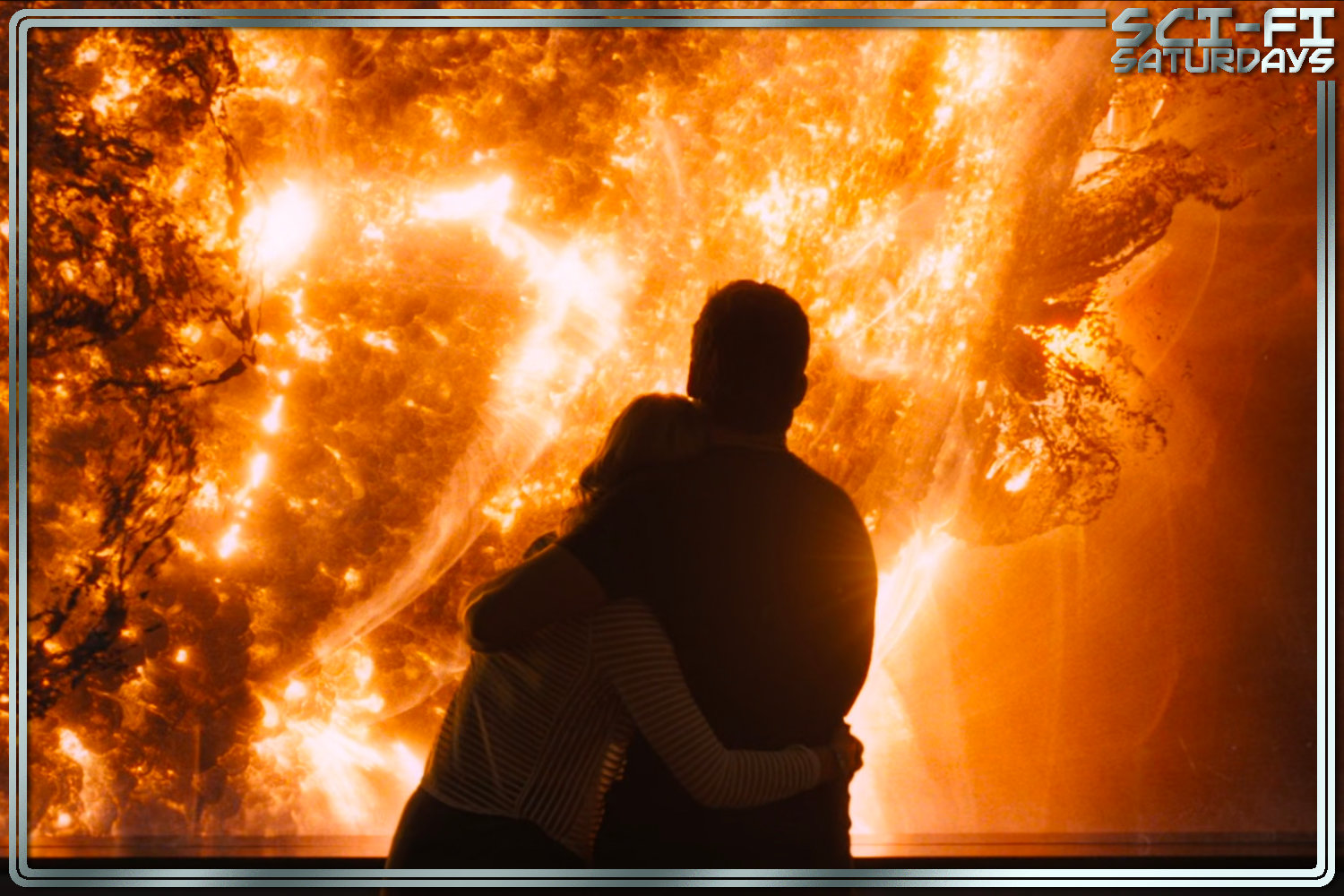
Aurora vents the plasma, saving the reactor. Jim is blown off the ship by the fiery gas, breaking open his EVA suit and his tether. Aurora puts on her own suit and goes outside, managing to just barely catch the lifeless Jim before he drifts off into space. She manages to revive him in the Auto Doc, an automated medical pod. Realizing that the machine can serve as emergency hibernation for one of them, Jim offers it to Aurora, but she doesn’t want to wake up without him, so they choose to both stay awake. Jim offers her an engagement ring he crafted. Eighty-eight years later, Captain Norris (Andy Garcia) and his officers awaken to find a huge tree, along with other flora and fauna, in the Grand Concourse. A voice-over from Aurora’s story recounts her and Jim’s life aboard the Avalon.
“Do you trust me?” – Jim

Jim becomes fascinated with Aurora, to such an extent that he awakens her from hibernation.
History in the Making
Maybe Passengers just came out at the wrong time, or was trying to achieve something else with its story of tragic homesteaders in space. Potentially, it might have been a different movie if it had a different cast, instead of its two stunningly beautiful leads. Maybe it’s a film that is tragically misunderstood, as it attempts to meld two genres that are polar opposites. Whatever the case, the film was certainly a big star vehicle for Jennifer Lawrence and Chris Pratt. Written by Jon Sphaits (Prometheus, Dune trilogy) and directed by Norwegian Morten Tyldum (The Imitation Game), Passengers is an eclectic mix of genres and styles, unsure of what it really wanted to be when it grows up. Lawrence, already a bankable star (and the headliner of the film), was coming off three consecutive Oscar nominations (with one win for 2012’s Silver Linings Playbook), the completion of the Hunger Games quadrilogy, and the first three (of four) X-Men films. This was her “fun” film in between more series work, Joy and Mother. On the other hand, Chris Pratt was a known comic actor, having small roles in many films, and having just finished up six years on Parks and Recreation. He was beginning to get more leading roles as a sci-fi/action star with work in both the first Guardians of the Galaxy film and Jurassic World. This was his first romantic lead.
The film stands out for being an incredibly tone deaf release about the mistreatment of women at a time, in the mid 2010s, when hundreds of women were stepping forward to confront their abusers. All the while, the patriarchal power structure was laughing it off, revelling about grabbing “‘em by the pussy.” For a film about a future world where humanity can make its way to the stars, Passengers seems like it has its feet firmly planted in the past. There’s a 1950s vibe about the sexual politics of the film. With Jim awakening Aurora (and condemning her to death before arriving at their destination), he makes all the choices to negatively affect her life. He chooses to hide his sin, but when it eventually comes out, Aurora is understandably distressed. The film eventually smooths that over, believing that it’s okay because otherwise she’d be alone. While not immediately evident, Pratt is eleven years older than Lawrence, continuing a contrived ideal of Hollywood that justifies older men with younger women. That by itself is not a dealbreaker, but the overall ideal of the movie leaves a bitter taste for many that seems impossible to ignore.

Aurora, unaware of the reason for her awakening, courts Jim in the bar.
Genre-fication
As mentioned previously on Sci-Fi Saturdays, science-fiction is a resolutely versatile and adaptable genre. It can be mashed up with almost anything. There have been sci-fi comedies (Frequently Asked Questions About Time Travel), sci-fi horror films (Event Horizon), sci-fi westerns (Cowboys & Aliens), and sci-fi romcoms (The Fountain). But to everything there is a limit. Passengers ends up being a weird mix of at least four genres, with sprinklings of other ill-fitting elements. For those keeping count, besides being rooted firmly as a sci-fi film, the movie also shares elements of horror, action, and romance. This eclectic combination seems revelatory, but overly complicates that which would otherwise be a simple story. The film opens with the giant spaceliner, Avalon, drifting through space like a technological seed on the solar winds. Details of the passenger complement are displayed on screen, with the reason for their travel: colonization of a new planet. The designs of the ship and its mission gives of vibes of the Axiom, from WALL-E. That film had the passengers living on the ship, outside of hibernation, as they interacted as if on a large ocean-going cruise vessel. That is also the plan for the Avalon as the ship nears the planet. The design of the ship is reminiscent of 2001: A Space Odyssey, with the curved decks that rotate to simulate gravity, while a space walk sequence harkens to Gravity (2013).
Jim is awoken early by the malfunction in his hibernation pod, leading to approximately a year of isolation for him. As with The Martian, he is stranded, alone, in space. And also like that film, Passengers goes full Cast Away, complete with Chris Pratt’s Robinson Crusoe-like beard. The element of horror begins to creep into the film at this point, with the emphasis on the creep. A lonely Jim speaks with the robotic bartender of the ship. Arthur is not alive himself and exists in a room designed to look like elements of the Overlook Hotel from The Shining, right down to the colors and style of the carpet. Jim experiences an existential descent into madness as he cyber-stalks Aurora by watching the videos about her that she provided to the cruise company. His interest turns into an obsession as he seriously contemplates awakening her from hibernation to end his loneliness, knowing that it will condemn her to death before the ship reaches its final destination. If the film had skipped this 30-minute preamble and begun with Aurora awakening (noted reference to Princess Aurora from Sleeping Beauty) to find Jim awake as well, the film would feel much more like a quirky romcom. The meet-cute would be the fact that the two happened to awaken early on the long-flight of a starship. So fun! Unfortunately, the horror elements and Jim’s selfishness taint the latter half of the film, always providing a tense undercurrent as the audience is aware of Jim’s sins before Aurora is.

Aurora admires a tree planted into the deck by Jim, as a simple apology for his actions.
Societal Commentary
Romcoms, in general, are often fun and sometimes a nostalgic look at the way couples meet and fall in love. They provide insight into the interpersonal relationships between individuals and also remind audiences of their experiences on the dating scene. Sci-fi tinged romcoms change the dynamic, as science-fiction is a speculative genre of the future, while the romance genre is a personal journey for connection. Historically, these types of genre unions create questionable storylines that are often tinged with creepy behavior from men and a patriarchal slant. Passengers may be the worst of these, but sci-fi romcoms About Time and The Time Traveler’s Wife also feature men doing creepy things to win the love of a woman. Your mileage may vary on these films’ levels of creepiness. Both have real, honest emotions about meeting people and falling in love, albeit with a time-travel twist. About Time has the main character meeting a woman and making an ass out of himself, a situation many can relate to. He uses his time traveling ability to redo that moment, utilizing elements from previous conversations to know more about the woman than he would on a first meeting, making their first meeting “perfect.” Except, it’s perfected over the course of numerous dry runs of trial and error, essentially faking the perceived perfection of the moment. For The Time Traveler’s Wife, the main character, who has no seeming control over random jumps forward and back in his lifetime, grooms a young girl with whom he’ll eventually meet again as an adult and marry–flopping between seeing her as an adult and a girl. The only sci-fi romcom that provokes a real connection between individuals, even when one of those individuals is a sentient AI, is Her. This film features some awkwardness as characters are shown in real relationships with a computer program, but also utilize sex-surrogates to provide intimacy. This leads to questions about what constitutes a “real relationship” between consenting beings. Consent becomes a big part of Passengers, since Aurora’s consent is built on a false premise of her meeting with Jim.
That being said, the revelation about these characters and their initial intent is not so cut and dry. Ethically, Jim is in the wrong about his awakening of Aurora. She gave no consent, and he gave her no choice. But look at it this way, without Jim awakening (and dooming Aurora), more than 5,000 other passengers and crew would have perished. Jim was unable to fix the ship, even with his engineering background, due to the inability to access the sensitive areas of the ship. He was contemplating suicide prior to waking Aurora. If he had died, no one would have been around to assist Gus and eventually vent the plasma drive. The ship would have exploded, and all the colonists would have perished peacefully in their sleep, unaware of the reasons for their deaths. The selfish act of Jim becomes a bit of a philosophical quandary. Perhaps it’s a space-faring version of the trolley problem, where a participant is asked to choose between two train tracks. On one track is a single individual, and on another track are multiple individuals (or babies, or dogs, or baby dogs). What does one do? Jim chose to sacrifice another (as well as himself), and in that process, saved an entire ship and the futures of thousands. Though ultimately, Jim doesn’t really realize that he’s making the choice to save 5,000 people when he awakens Aurora, so this becomes a moot point.

Aurora and Jim spend the last minutes with Gus before he passes away from his hibernation sickness.
The Science in The Fiction
Sci-fi films differ drastically in their approach to the “science” portion of the genre. Some use it as an absolute element that informs the remainder of the film. 2001: A Space Odyssey, Contact, and Interstellar are just a few examples of films that try to work within the realm of what is known and represent logical choices about space travel. Passengers, on the other hand, take the lower road. The road that thinks it’s cool to have spaceships function no differently from large ocean liners on Earth. Not that there’s anything particularly wrong with that. Sci-fi allows for the fun elements as much as the harder ones. And it’s not like Passengers plays loose and fast with the rules. It creates a gigantic spaceship which has a rotating tine, almost like an auger or a seed pod, that provides gravity to all the main areas of the ship. They have a force field of some kind that is designed to prevent stellar objects from disrupting the ship. That doesn’t work as well as it should, which, again, is okay. But what type of society that can manage intergalactic trips, hibernation, and interstellar colonization, chooses to leave no one in charge on a ship of this size?
If Passengers teaches anything to anyone in a future space-faring society, it should be that you never send a ship off with nobody in charge or awake. The ship includes sufficient AI that could be used to intelligently deal with issues, but not the faceless one that Jim tries to get instructions from. Arthur seems better versed in dealing with human issues, plus he has a humanoid body, which he could use to repair human compartments and the like. As mentioned above, if Jim and Aurora had never awakened, the ship would have been doomed from the cascading failures brought on by the small but dangerous meteorite strike. So maybe the Homestead II group, for all their imagination, didn’t quite think far enough ahead.

In the end, Aurora celebrates Jim, pleased that she doesn’t have to spend time alone on the ship.
The Final Frontier
Your enjoyment of Passengers may vary. There are certainly enjoyable moments of the film, including Michael Sheen’s robotic bartender and Laurence Fishburne’s ill-fated naval officer. Out of context, there are even aspects of the interactions between Jim and Aurora that are sweet and heartfelt. Lawrence shows why she’s such a good actress, making believe that Aurora forgives Jim for his transgressions. Yet overall, there’s not a huge amount of real chemistry between these characters. It’s two random people, a man and a woman, who happen to be awake on a deserted ship at the same time. Of course, they’re going to hook up.
Coming Next


Having grown up on comics, television and film, “Jovial” Jay feels destined to host podcasts and write blogs related to the union of these nerdy pursuits. Among his other pursuits he administrates and edits stories at the two largest Star Wars fan sites on the ‘net (Rebelscum.com, TheForce.net), and co-hosts the Jedi Journals podcast over at the ForceCast network.