
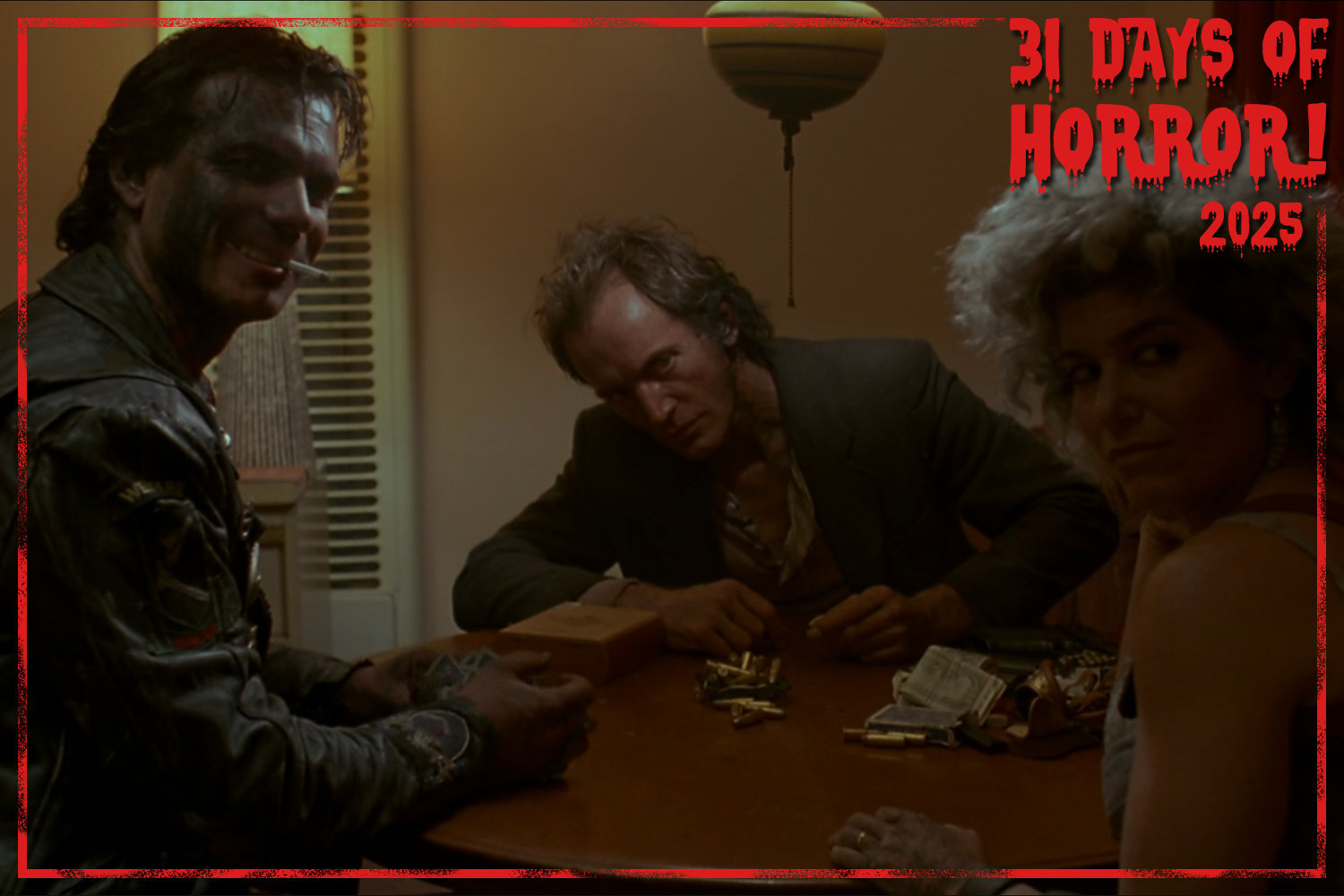
When the lights go down in this Oklahoma town, vampires emerge for the evening.
Near Dark starts a week of horror films directed by women on 31 Days of Horror. It revives the genre of the horror Western, creating a film that prioritizes character development over jump scares, while also setting the stage for an impressive career for director Kathryn Bigelow.
Before Viewing
In this trailer, a man is abducted by an RV somewhere out near the desert. The narrator says that he no longer belongs to our world, but to “hers,” indicating a woman in the vehicle. The group appears to be a group of vampires, and they have a new recruit. Later, the man is questioned by a police officer who believes the man may be on some drugs. Gunshots, fast cars, and a semi truck that tries to run over someone in the middle of the street, only to have that person climb onto the hood and punch a hole through it. These are the kinds of things you can expect Near Dark.
Presented below is the trailer for the film.


Near Dark title card.
After Viewing
One night, in the small town of Fixx, Oklahoma, Caleb (Adrian Pasdar) hits on an attractive young woman, Mae (Jenny Wright), outside a convenience store. He offers to give her a ride back to her place, but takes her to his stable to show off his horse, which is scared of her. They continue driving as she says she needs to be home by dawn. He stops the car short, demanding a kiss from her instead. Mae gives Caleb a passionate kiss and then nips his neck before running off along the road. Caleb tries to drive home, but his truck breaks down, so he begins walking through the fields. As the sun begins to rise, Caleb begins slowing down, feeling woozy. His clothes begin smoking. As he approaches his family’s farmhouse, an RV with tape and foil on its windows speeds past, picking him up. His father, Loy (Tim Thomerson), and young sister, Sarah (Marcie Leeds), see him abducted.
Inside the vehicle, Mae protects a sick Caleb from Severen (Bill Paxton) and the leader of their group, Jesse (Lance Henriksen), who tells Mae that Caleb has one week to become “one of them.” Meanwhile, Loy and Sarah begin driving around, combing gas stations and other rest stops looking for Caleb. Caleb isn’t sure of what’s going on and walks away from Mae the next night, attempting to get back home. He tries to get a bus ticket, but is short of the money needed. A police detective (Troy Evans) believes him to be on drugs, given his ragged look. The man eventually relents and provides Caleb with three dollars to get on the bus, but he soon exits the bus, feeling ill. Caleb manages to make his way back to Mae, who bites her wrist and allows him to drink some of her blood. This makes Caleb feel new again, and the two go off for a walk.
A montage shows how each character feeds themselves: Homer (Joshua Miller), a young boy, plays dead at a bike accident, Severen picks up two women on their way to a bar, while Jesse and his woman, Diamondback (Jenette Goldstein), pick up a hitchhiker or two. Mae takes Caleb with her, and they are picked up by a trucker (Roger Aaron Brown), who explains to Caleb about how his rig works. Caleb cannot bring himself to kill the man, so Mae does it for him and again allows him to drink the blood from her veins.

The derricks pumped up and down to the sucking of the blood. This film reads like a vampire romance novel.
The next night, the group goes into a bar where they take turns terrorizing and attacking the patrons. Caleb chases after the last man, a cowboy (Jame LeGros), but again is unable to complete the kill, letting the man run away. Jesse is furious! They pack up and head to a nearby bungalow as night is fading, getting inside just as the sun is coming up. Shortly, there’s a knock on the door. It’s the police. Severen blows away one office with a shotgun, and the police open fire. Caleb makes a run for the group’s van, bursting into flames from the sunlight even though he’s covered in a blanket. They manage to escape, everyone congratulating Caleb for his plan.
At a new motel, Homer discovers a young girl getting a soda, who turns out to be Sarah. Severen grabs Loy and threatens them. Caleb, who is pleading to let his family go, manages to push past everyone with Sarah and Loy, and they drive away. Caleb tells his Dad he’s sick and needs a transfusion, which Loy provides. Caleb is back to normal for a while, when Mae and the others come looking for them again. Homer kidnaps Sarah, and they head out of town.
Caleb grabs a semi rig and crashes it into Severen, killing him in a monumental explosion. Mae, feeling ashamed, leaps out of the back of the car with Sarah, who runs to Caleb. Mae begins smoking as the sun comes out. Homer chases after Sarah, but he explodes from being exposed to the light for too long. Jesse and Diamondback turn the car around, trying to run over Mae, Caleb, and Sarah, but they’ve been exposed to the sun too long, and they explode, taking the car with them. Later, Mae wakes up in Caleb’s shed as sunlight falls on her face, without consequence. He has given her a transfusion, and she can go back to living a normal life with him.
“Caleb, those people back there, they wasn’t normal. Normal folks, they don’t spit out bullets when you shoot ’em.” – Loy Colton

Severen jokes with Caleb as a bar patron looks on incredulously. That trucker also tried to put a cigar out on a naked man, and was beat up by a Terminator in T2.
Near Dark was not director Kathryn Bigelow’s first film, but it was the one that achieved her the most notoriety at the time. She became part of a small but burgeoning club of female directors who helped set the tone to change the male-dominated Hollywood machine. Women had always worked in film behind the camera, but in more traditional roles like costuming, script supervising, or set design. While there was an occasional female writer, director, or producer, they were few and far between until well into the 20th Century. Notable female directors began appearing in the 70s and 80s, including such big names as Elaine May (The Heartbreak Kid), Amy Heckerling (Fast Times at Ridgemont High, Clueless), and Martha Coolidge (Valley Girl, Real Genius). Some female directors from the era began as screenwriters, graduating to directing their own work, like Nancy Meyers (What Women Want, Something’s Gotta Give) and Nora Ephron (Sleepless in Seattle, You’ve Got Mail). What’s most notable about the films directed by these women is that they are all, primarily, comedies. Bigelow came to the party from an entirely different direction, favoring action and horror genres. Prior to her work, there were so few female horror directors that they could be counted on one hand. Notable names include Stephanie Rothman, a producer/writer/director from the Roger Corman school who directed the exploitative The Velvet Vampire (1971), and Jackie Kong, a director of lower-budget horror who directed The Being (1981) and Blood Diner (1987).
As a genre, the horror film has been a male-dominated scene for decades, from the Universal Monster films of the 40s, to Psycho and into the modern era. With the advent of the slasher genre during the mid to late 70s, with its point of view shots and sexually charged atmosphere, the style adapted to include more lingering shots of bosoms and butts, colloquially known as “the male gaze.” Female directors attempting to break into the genre often felt the need to include similar shots in their films, like Amy Jones’ The Slumber Party Massacre (though Jones chose to subvert the genre in other, more interesting ways). But as society evolved and women gathered power in Hollywood, running studios and producing films, the style of these films changed as well. Near Dark was originally intended to be a Western film, but when it became difficult to secure the necessary funding–due to the Western genre being in a downturn–Bigelow and her co-writer Eric Red added in elements of vampire fiction, which was a genre on the upswing in the mid-80s. The post-modern vampire film was hot, scoring hits like Fright Night and The Lost Boys, and finding comedic teen thrillers like My Boyfriend’s A Vampire, Once Bitten, and Vamp filling in the gaps. As mentioned in the article earlier this month for Sundown: The Vampire in Retreat, the horror western was an untapped area of the genre. There had only been two films of this type by 1987, both, coincidentally, vampire films: Curse of the Undead (1959) and Billy the Kid Versus Dracula (1966). Near Dark also approached its vampire story in a highly non-traditional way, as was the style at the time.
Classic vampire stories were often about the character of Dracula or a relative of his. Films with female vampires were few and far between. Mario Bava’s Black Sunday was an early female vampire story. Another example is films that told variations of the Carmilla Karnstein story, such as the Hammer Films trilogy The Vampire Lovers, Lust for a Vampire, and Twins of Evil. Other films might contain female vampires, but not in a leading capacity. Near Dark continues the modern idea of vampires attempting to turn others to the dark side as bloodsuckers rather than just killing innocents. Dracula and its ilk typified the vampire as a sexually charged force that comes to town to seduce women to become its bride. In the 80s, that idea had altered to be about clans of creatures roaming together (as in The Lost Boys) that would attempt to lure others into their embrace, turning them into vampires as well. The romantic nature of vampire tales still existed, but had become twisted around. This time, the sexuality is feminine in appearance, and Bigelow is not shy about the overt symbolism of intercourse. During the second night, when Caleb refuses to kill and Mae feeds him from her own blood supply, they do so in front of two oil derricks. The grasshopper-like pumps rise up and down, rhythmically as Caleb kneels before Mae and sucks the blood from her wrist. A hugely metaphorical scene.

Mae, Caleb’s father Loy, Severen and Caleb with his sister Sarah have a tense standoff in a motel room.
The horror in the film comes from, as with most vampire films, the killing of innocents. It begins slowly by showing the setup for each of the vampire characters, but no resolution. Homer lies by an upturned bicycle, appearing to have had an accident as a motorist drives up to help. Severen plays a hitchhiker who charms two lovely ladies heading to a bar. Jesse and Diamondback pick up what appears to be an indigent hitchhiker, but he turns out to be one of two men with shotguns who are intent on robbing their Samaritans. Too bad for those dudes. The culmination of who these characters are becomes apparent in the bar scene, where they all kill their prey with no remorse. Caleb is shocked by what he sees, such as slicing the waitress’s throat and draining her blood into a beer stein, or a biker’s head being crushed by bare hands. The moment is meant to be a training exercise for Caleb, as Jesse and the others show him that he has nothing to worry about from humans. He can take what he wants/needs (blood) and kill with impunity. They’re just going to light the place on fire later, so it doesn’t matter. But Caleb stands firm in his conviction that he cannot kill, much to the vampire’s displeasure. And he doesn’t kill anyone, not even the villains of the film. Their deaths are all created by their own hands in one way or another. This allows a moral virtue for Caleb’s character to shine through. All of the difficulty and stress prove to him and others that he’s a good man.
There are some wonderful small touches to this film which may not be evident on a first viewing. Caleb’s first line to Mae is “Can I have a bite?” as he looks at her ice cream cone. This ends up being what she literally does to him, nibbling his neck to turn him into a vampire. The film also has some incredible cinematography for a horror film from the 1980s. Playing into the Western genre, there are wide shots of silhouetted characters that evoke the vastness and beauty of the Old West. Bigelow frames sequences in similar ways to evoke symbolism from her characters. Early on, Caleb limps home across a field that first morning; instead of filming the actor outright, only his feet and shadow are shown, implying that he is no less than a full man. After receiving his transfusion, he seeks out the villains who stole his sister. Caleb is silhouetted against a steam cloud, riding his horse, followed by close-ups of the horse’s hooves and shadows on the ground. Bigelow draws the visuals back to the earlier scene, which showed Caleb at his lowest point. The new shot shows him at his most powerful, and a master of the night–even though he no longer has the strength of the vampires. But for all its cinematic innovation, there are several continuity issues, especially with the end of the film. It’s a little distracting, as it appears that Jesse is driving the car away from Caleb, only to have the next shot show them driving towards him. Mae is also more exposed to the sun (even with Caleb’s jacket over her) than any of the other characters, yet they all explode and die while she survives. All of these can be overlooked as the emotional arc for the characters overshadows the missing footage or continuity errors.
Bigelow’s career continued with major Hollywood films, which created an impact on audiences and the business. Point Break, Strange Days, her Academy Award-winning The Hurt Locker, and Zero Dark Thirty all elevated her status as a filmmaker, regardless of her gender. Her influence helped allow directors like Sofia Coppola (Lost In Translation), Greta Gerwig (Barbie), Ava DuVernay (Selma), or Chloe Zhao (Nomadland) to create their visions, whether that’s horror, fantasy, drama, or action. But her contribution to the horror genre, and its atypical characters, settings, and themes, provided a springboard for numerous other female directors to create similar (and greater) horror films. If you liked this review, stay tuned this week on 31 Days of Horror for a whole series of horror films all directed by women. If you can’t wait and are in the mood to check out some other female-directed films, read these articles associated with female directors, including Pet Semetary, Saint Maud, American Mary, or The Babadook.

Loy attempts to save his son with a blood transfusion.
Assorted Musings
- Bigelow was dating director James Cameron at this time, and used a large chunk of his cast from Aliens: Henriksen, Goldstein, and Paxton.
- At no time is the word ‘vampire’ uttered in this film.
- In this vampire film, only sunlight is seen as a deterrent for the creatures. There are no crosses, garlic, or holy water present. No mirrors that reveal who’s a vampire and who isn’t. It’s also the first vampire film to use a transfusion to cure the characters, including someone who has been a vampire for several years.

Having grown up on comics, television and film, “Jovial” Jay feels destined to host podcasts and write blogs related to the union of these nerdy pursuits. Among his other pursuits he administrates and edits stories at the two largest Star Wars fan sites on the ‘net (Rebelscum.com, TheForce.net), and co-hosts the Jedi Journals podcast over at the ForceCast network.