
Cthulhu called. He said, “Y’ai ‘ng’ngah, Yog-Sothoth h’ee-l’geb f’ai throdog uaaah.”
John Carpenter returns with his best horror film from the 1990s, which completes his apocalyptic trilogy and offers his take on the works of H.P. Lovecraft.
Before Viewing
After letting viewers know that John Carpenter was responsible for Halloween, Christine, and Starman, the trailer depicts a man hired by publishers to find the missing writer Sutter Cane. He soon claims it was all a setup, but a setup by whom and for whom? Strange occurrences happen, including a man with an ax attacking the window where the man is having lunch. The publisher indicates that Cane’s work might drive some people crazy. The fictional book In The Mouth of Madness takes a twist that no one will see coming.
Presented below is the trailer for the film.


In the Mouth of Madness title card.
After Viewing
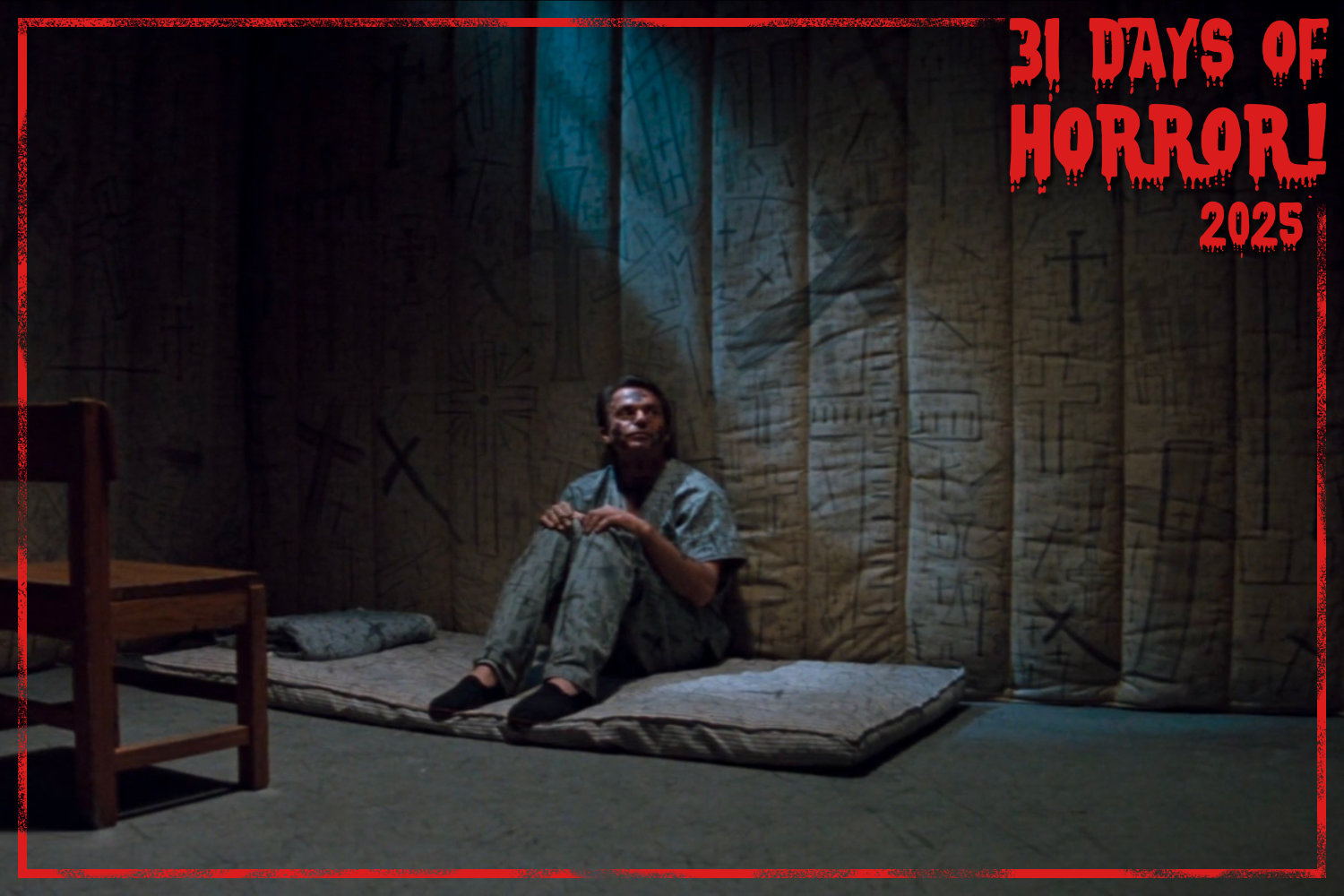
John Trent (Sam Neill), an insurance investigator, is brought kicking and screaming into an asylum in New York state. Dr. Wrenn (David Warner) arrives to question the man about what he knows. Trent decides he no longer wants to leave, having drawn crucifixes on every square inch of his padded cell, including himself. He relates his story to Wrenn. His employer, Robby (Bernie Casey), is asking if Trent will look into the disappearance of author Sutter Cane, when a man with polycoria and an ax busts into the restaurant they’re eating in. The crazy man asks Trent if he’s read Sutter Cane just before the police shoot the lunatic. News reports describe similar outbreaks of violence due to the inability of bookstores to stock sufficient copies of Cane’s new book, The Hobb’s End Horror.
Trent meets with Arcane Publishing executive Jackson Harglow (Charlton Heston) and Sutter Cane’s editor, Linda Styles (Julie Carmen). Harglow mentions that Cane’s less-stable readers are sometimes affected by his work, apparently including his agent–who was the man with the ax. Trent believes all of this is a publicity stunt, wanting to look into the disappearance deeper. He begins reading some of Cane’s horror novels and experiences a strange, lucid dream. Noticing the red outline of a puzzle piece on each book cover, he cuts them apart and forms a map of New Hampshire, showing the exact location of the town of Hobb’s End.
Trent and Linda drive into New Hampshire but get lost, due to the fact that there’s no real town of Hobb’s End in the area. While Linda is driving that evening, she experiences some surreal moments, believing the car is flying over the clouds just before they emerge from a covered bridge in the small, but deserted town of Hobb’s End, where it is daylight. Linda has a vision of children chasing a three-legged dog, which Trent does not share. They check in at the Pickman Hotel, a hotel which Linda knows all about from reading Cane’s most recent book. Disbelieving, Trent says if that were true, then a Byzantine church would be visible out their window–which it is.

Trent meets with Linda and Harglow about finding the missing author, Sutter Cane.
Visiting the damned church, where, according to the book, a race of ancient creatures is trapped, Trent and Linda encounter gun-toting villagers who want their children back. The villagers are attacked by dogs directed at them by an ominous Sutter Cane (Jürgen Prochnow) who stands in the doorway. Linda admits to Trent that this did begin as a PR hoax, but everything that’s happening now is real. She returns to the church and meets with Cane, who tells her that demons tell him what to write. His words now dictate reality, and he exposes Linda to his newest manuscript, “In the Mouth of Madness,” which drives her insane.
Trent experiences several other strange occurrences, including a father, Simon (Wilhelm von Homburg), shooting himself in the bar, and witnessing Mrs. Pickman (Frances Bay) turning into a tentacled creature. Attempting to leave the town, Trent finds his car mysteriously transported back to the town center, where an angry mob confronts him. He awakens in the church, where Cane reveals that he is the gateway for the “old ones” to return to the world due to the sheer number of people who read and believe in his work. Cane tells Trent that he created the character of John Trent and needs him to take his new manuscript back to New York. Cane then rips himself apart, like a page from a book, opening a chasm which the ancient creatures use to return to the world.
Trent awakens on a country road with the new book. He ends up burning it at a local hotel, returning to Arcane Publishing with nothing. However, Harglow says the story was delivered by him months ago and is a great seller. The movie is due out shortly! Outbreaks of violence are becoming more common around the world. After murdering a man on the sidewalk with an ax, Trent is committed to an asylum, where he finishes his story to an unbelieving Dr. Wrenn. After the doctor leaves, a strange madness sweeps across the building, killing everyone except Trent. He wanders into town, finding a theater playing In The Mouth of Madness, starring John Trent. Inside, the film contains scenes from Trent’s life during his Sutter Cane investigation. He laughs at the screen maniacally.
“A reality is just what we tell each other it is. Sane and insane could easily switch places, if the insane were to become the majority.” – Linda Styles

John Trent studies the poster for Sutter Cane’s latest novel, realizing there are clues to his location hidden within.
As part of the anniversaries being presented this week, please welcome In the Mouth of Madness, which is celebrating its 30th Anniversary. It is the fourth film celebrating a milestone after The Phantom of the Opera (100 years), The Devil’s Rain (50 years), and The Stuff (40 years). It is the seventh horror film by director John Carpenter (with Halloween being his most famous) and the end of his “Apocalypse Trilogy,” which features The Thing (1982) and Prince of Darkness (1987) as the other two installments. Together, these three films form a bleak and depressing trilogy in which the good guys lose, there is no happy ending, and in the end, darkness prevails. Your mileage may vary on any one of these films (I’ve heard people say they don’t enjoy individual ones, yes, even The Thing!), but together they form a desolate world view. In the Mouth of Madness is the bleakest of them all, and the reason Carpenter is considered the Master of Horror.
There’s no denying that In the Mouth of Madness is a film inspired by and honoring classic horror author H.P. Lovecraft. Lovecraft produced his main body of work between 1926 and his death in 1937, but was never celebrated during that time. His work, which often dealt with strange cosmic beings (the Old Ones) and bleak, apocalyptic events, underwent a revival in the late 1960s and early 1970s as new audiences found his pulp stories. In the Mouth of Madness pays tribute to him and his work by invoking elements of his Cthulhu mythology, linking Sutter Cane with Lovecraft himself, and Hobb’s End, New Hampshire, with Arkham, Massachusetts–Lovecraft’s main locale. Some viewers see parallels with Stephen King, who was the best-selling horror author of the late 20th Century (and also because he’s name-dropped in the film), but that may only be a coincidence. While King’s work is certainly popular, reaching the number of readers that Sutter Cane can, his work is not as apocalyptic as Lovecraft’s.
Thematically, In the Mouth of Madness deals with the erosion between reality and fiction, sanity and insanity. This is an extension of Carpenter’s previous themes from the Apocalypse Trilogy. The Thing dealt with the reality of who was human and who was an alien (as did They Live), and Prince of Darkness dealt with understanding reality via science or religion. Now, Carpenter blurs the line further between fiction and reality both within the film universe as well as in our reality, viewing the film. The story supposes that reality is only dictated by the beliefs of those living it. Linda’s quote above imagines that if individuals were all able to change their outlook on what was real (or allowed in society), then those beliefs would dictate a new world. This is not far from wrong, as it’s how change occurs in the world. Newer beliefs replace older beliefs, whether that’s science over superstition or in social norms of acceptable behavior. John Trent, a skeptic of Cane’s influence, is given the job of proving that Cane has mysteriously disappeared. He clings to the reality that nothing he’s experiencing is real, that it’s all a sham. This is his standard worldview, as he encounters individuals in his job as an insurance investigator, where people lie to him constantly. He has become the source of truth. But when confronted with a new reality, he is still unable to accept anything beyond his own viewpoint. Because of this, does he succumb to madness at the end of the film? From the standpoint of a rational individual, he might seem insane. But the film’s viewpoint is that the notion of sanity and insanity has switched places by the end. Perhaps he has remained sane. But, in a world of insanity, the only sane man must now be considered insane himself.

Does this church look like the kind of place that belongs in rural New Hampshire?
The change occurring in the world is presented as the power of the Word. Sutter Cane’s work, over a billion sold and in 18 languages, reaches all parts of the globe. His fiction affects readers, scaring them and instilling a new belief in the reality of his stories. When enough people believe the fiction, it begins to become reality. He goes as far as to say that his work is more important than religion. No one has ever believed in religion enough to make those elements of the dogma real. With his work, he sees the proof around him as the walls of reality weaken to allow the Old Ones inside. He is a God, writing the lives of his characters with impunity. Is this not the work of the author, whether it’s a book or a screenplay? Cane claims to have created John Trent, but isn’t that true for the person behind the typewriter for this film? In the world of fiction, humans do have the ability to create and destroy, turn characters’ lives around, and release dread into the world, making humanity infinitesimal. Carpenter dictates despair to the audience by revealing that none of us may be in control of our actions or fate. A great cosmic horror may be out there, defining a reality that we will never understand, as “the human race will just be a bedtime story for [the Old Ones] children.”
When I first viewed In The Mouth of Madness sometime back in the 1990s, I was unfamiliar with the works of Lovecraft, and felt that this movie was not a great example of Carpenter’s filmmaking. With time and age comes insight into different aspects of humanity, which causes the horror of the film to ring truer. One of the most stressful and horrific aspects of cinema is the protagonist who will not be believed, and this film has a lot of that. Whether that’s John Trent trying to convince others of the dangers lurking in Cane’s recent novel, or Kevin McCarthy’s character from Invasion of the Body Snatchers screaming at people, “You’re next,” knowing that aliens are slowly replacing humanity, their plight is known only to the audience. The fear becomes that your perception of reality does not align with the majority, removing the sense that things are okay with the world. It’s the fear that the beliefs of others will erect a new world in which the things that you believe are lessened or destroyed. It doesn’t make you crazy, but it does alter reality in ways that seem very much like those depicted in the film.

Sutter Cane finishes typing his latest manuscript, In the Mouth of Madness.
Assorted Musings
- John is placed in Room 9 at the asylum and is given Room 9 at the Pickman Hotel.
- The tag line for The Hobb’s End Horror is “If this book doesn’t scare you to death, you’re already dead,” which is extremely similar to the tagline for the movie Phantasm, “If this one doesn’t scare you, you’re already dead!”
- Hayden Christensen, who would go on to play Anakin Skywalker/Darth Vader in the Star Wars prequels, made his first appearance here as the boy on the bicycle.
- John Glover plays a doctor at the asylum named Saperstein, which is the same name as the doctor in Rosemary’s Baby.
- Hobb’s End was the name of the rail station (the main setting) in Quatermass and the Pit, another story featuring strange interdimensional aliens.

Having grown up on comics, television and film, “Jovial” Jay feels destined to host podcasts and write blogs related to the union of these nerdy pursuits. Among his other pursuits he administrates and edits stories at the two largest Star Wars fan sites on the ‘net (Rebelscum.com, TheForce.net), and co-hosts the Jedi Journals podcast over at the ForceCast network.