
Mind over matter matters more than willful mindlessness.
How does this live-action remake of a beloved anime film from the 90s stack up? Scarlett Johansson stars in this noir cyberpunk thriller about terrorists targeting the unethical bioscientists. Does it bring anything new to the table, or have we seen it all before?
First Impressions
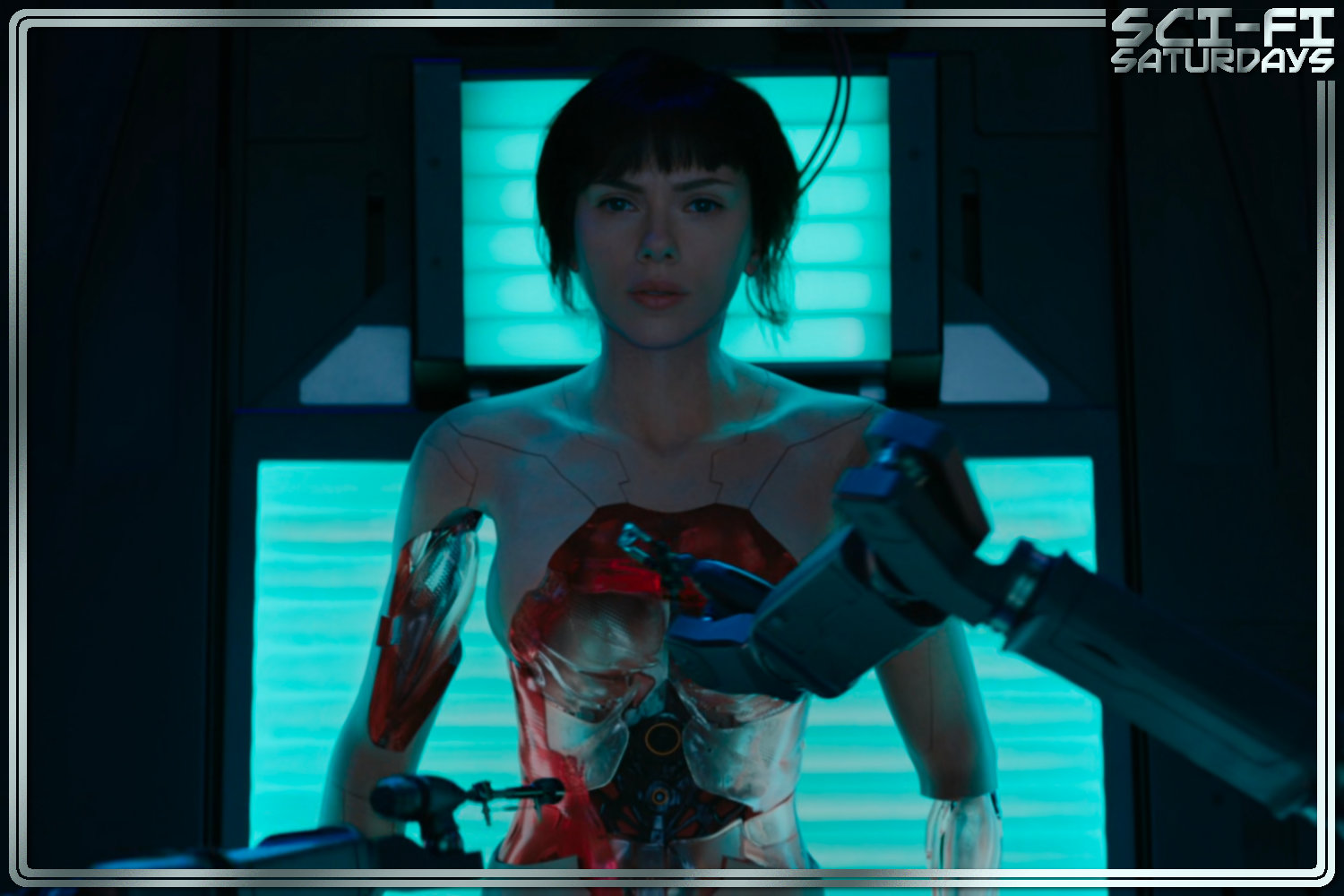
In a cyberpunky future, men with guns breach a building. A female, who appears to be an officer, stalks someone and then strips off her clothes before leaping off a skyscraper. She bursts through a window, revealing that she is fully (or partially) cybernetic. Her body was recreated after an accident. Action, slow-motion action, CGI-enhanced action, all pepper this trailer for the live-action remake of Ghost in the Shell.
Presented below is the trailer for the film.


Ghost in the Shell title card.
The Fiction of The Film
A montage of the building of Project 2571 opens the film. A human brain is put into a cybernetic body at Hanka Robotics. This is Mira Killian, a young survivor of a terrorist attack in which her parents were killed. She is to become a new weapon for Section 9. One year later, Mira, now known as Major (Scarlett Johansson), is on a police stakeout for the counter-terrorism group Section 9. Hanka scientist Dr. Osmund (Michael Wincott) is attacked and killed by a robotic geisha, his mind being infiltrated by her neural tendrils. At the same time, at least three other Hanka employees are killed by terrorist leader Kuze (Michael Pitt).
Major is checked out by Dr. Ouelet (Juliette Binoche) due to glitches she’s experiencing. She has been seeing visions of a cat and of a small pagoda. Getting the all clear and taking her daily dose of medication, Major–with the help of Batou (Pilou Asbæk)–performs a deep dive into the memories of the geisha-bot to find more details on Kuze. While inside the neural network, Major is attacked by rogue programs, and Batou must pull her out manually. But the session was enough to get some details to start an investigation.
Major, Batou, and Ladriya (Danusia Samal) investigate a Yakuza nightclub, using mind-comms for secret communication. Unfortunately, the Major is grabbed and tortured while Batou is attacked. After a small shootout, the Major finds potential evidence linking the club to Kuze, but is caught in an explosion, which blinds Batou. Back at Section 9, Batou is given cybernetic eye implants while the Major’s body is reconstituted by a machine. Hanka CEO, Cutter (Peter Ferdinando), threatens Section 9 Chief Aramaki (Takeshi Kitano) with the shutdown of the division if he can’t keep Major in line.

Major walks through a futuristic and cyberpunk inspired downtown.
Dr. Dahlin (Anamaria Marinca) is the next to be killed by Kuze, revealing that the list of deaths is everyone who worked on Project 2571, with Dr. Ouelet being next. Kuze hacks into the brains of two garbage men, forcing them to drive their truck into Ouelet’s car. Major and her team arrive and kill one of the men and track down the second. During his interrogation, Togusa (Chin Han) discovers a location for Kuze, but the terrorist manages to infiltrate the secure protocols of Section 9 and forces the garbageman to kill himself. At the location, Major finds dozens of men all neural linked into a network before being stunned and captured.
Major awakens in Kuze’s custody. He explains that she was not the first test subject, and he is seeking revenge for everything Hanka Robotics has done to him and his friends. She notices a small pagoda tattoo on Kuze, the same as in her glitches. Major confronts the recovering Ouelet, who admits that Mira was not the first cybernetic organism. There were 98 before her, and she was given false memories. Later, Cutter instructs Ouelet to kill Major, but instead she provides the operative with her former address, where her mother still lives. Cutter kills Ouelet, but blames it on the Major, sending the Section 9 operatives to bring her in.
Major discovers that she was a young girl named Motoko, and finds the woman who was her mother. Getting closer to the truth, Major finds a small pagoda where Kuze is hiding out. He was named Hideo and was a friend of Motoko. Cutter unleashes killers on the Section 9 team and a spider tank on the two of them, attempting to destroy them before his secret can get out. A sniper takes out Kuze as Major destroys the tank with her bare hands. Aramaki confronts Cutter and, with Major’s consent, kills him. In the wake of the revelations about Hanka’s unethical program, Major reconnects with Motoko’s mother and goes back to work for Aramaki, continuing to stop evil in its many forms.
“What we do is what defines us.” – Doctor Ouelet

Comparison of frame from the 1995 ‘Ghost in the Shell’ to the 2017 version. Just one of several homages to the original film.
History in the Making
Ghost in the Shell is a live-action remake of a 1995 animated film, both of which are based on a 1989 Japanese manga by Masamune Shirow. It mostly follows the plot of the original Ghost in the Shell film, choosing to pay visual homages to that adaptation, but alters the story for the third act. Visually, the film builds on a variety of cyberpunk films and shows that have come before, being able to utilize advanced visual effects to create a fantastical future world. As with so many futuristic films before it, Ghost in the Shell deals with modern themes of isolation and loneliness in a technological utopia while also addressing the nature of what it means to be real. It stars Scarlett Johansson in the lead role as the cybernetic police officer. It’s a role that created quite a stir at the time of the film’s release, as yet another film where a Caucasian person plays a person of color. In reality, the entirety of the furor was made prior to people having seen the film, nor did they understand the reasons behind the casting choice.
This was another film in a long line of genre work for Johansson. Ghost in the Shell was her fifth science-fiction film after The Island, Her, Under The Skin, and the critically panned Lucy. It was also her fourth comic book adaptation after Ghost World, The Spirit, and counting the Marvel Cinematic Universe films (Iron Man 2, The Avengers, Captain America: The Winter Soldier, Avengers: Age of Ultron, & Captain America: Civil War) as one ongoing story. Some of the other actors also had their share of roles in similar genre films. Pilou Asbæk co-starred with Johansson in Lucy, making this his second sci-fi film. Over twenty years before this film, Takeshi Kitano worked on a seminal film in the cyberpunk genre, Johnny Mnemonic. Juliette Binoche had a small part in the 2014 version of Godzilla, while Chin Han had a small part in Independence Day: Resurgence. The cast is really what makes this film stand out. Other than Johansson, most of the other actors are unrecognizable, leading to audiences being able to immerse themselves in this story, rather than continually recognizing actors from other works.

The cybernetic Major stands above a perpetrator she has just taken down.
Genre-fication
Ghost in the Shell was part of the second wave of cyberpunk stories emerging in the 1990s (the manga was serialized between 1989 and 1991), which are characterized by high technology in a dystopian future, often featuring low light and neon. The William Gibson novel Neuromancer is often cited as the first true cyberpunk book, but the genre had been percolating for at least several years prior to that. Elements of the 2000 AD comics, including Judge Dredd (which has been adapted twice as a film), dealt with proto-cyberpunk ideals, as did the Ridley Scott adaptation of Do Androids Dream of Electric Sheep, better known as Blade Runner. The Japanese comic Akira (1982, made into a film in 1988) and the DC Comics series Ronin (1983) are early illustrated examples. The late 80s also saw the emergence of the television character Max Headroom, who began on a British series entitled The Max Headroom Show (1985) and followed as a commercial spokesbeing for New Coke in 1986, and the character of Robocop in a 1987 film of the same title. The 90s wave of cyberpunk expanded with Johnny Mnemonic, The Matrix (and its spinoffs), Nemesis, and Strange Days.
This adaptation of Ghost in the Shell borrows a little bit from all of these sources, creating a familiar future with familiar themes, but with new characters and situations to entertain audiences. As with the original animated Ghost in the Shell, this version opens with Major leaping off a building and crashing through the glass. The reasons are different (here, she’s trying to save Dr. Osmund), but they lead to her and Section 9 investigating a new character in town; the Puppet Master in the original and Kuze in this version. Both characters are antagonists for Major, which leads her to question her surroundings and purpose. The Puppet Master is a rogue program that wants only to exist, the same as any other sentient being. Kuze follows basically the same path, but is a human who was experimented on and wants revenge on the scientists who did this to him. In fact, the character of Kuze is built upon several antagonists from the Ghost in the Shell franchise, including the Puppet Master, the Laughing Man, a hacker from the Ghost in the Shell: Stand Alone Complex (2002), and Hideo Kuze, a childhood friend of Motoko Kusanagi from Ghost in the Shell: Stand Alone Complex 2nd GIG – Individual Eleven (2006). The director even threw in a sly reference to Spike, the lead character from Cowboy Bebop, where Kuze points his finger like a gun at the Spider Tank. Outside of the various Ghost in the Shell homages, there are plenty of allusions to cyberpunk films and comics, including the sprawling neon-infused metropolis, complete with adverts for companies (such as Pan-Am) and the technological advancements present in the cyborgs of the future.

A living neural network, as dozens of individuals join their brains together.
Societal Commentary
The biggest theme for the 2017 Ghost in the Shell film is the isolation and loneliness felt by Major/Motoko. She is told she is the only one of her kind by Dr. Ouelet, having lost her family in a terrorist attack. With no family and no real companions, her passage through life is bereft of real emotional interaction. One scene has Major visiting a brothel and interacting with a sex worker. She asks the female if she is human, desperately trying to relate to someone else, as she strokes the woman’s face. Other characters care for Major, especially Batou. He becomes offended when Major intimates that he’s been sent to kill her. She can’t understand his compassion and attraction for her. Her loneliness is finally abated when she discovers Kuze, who unveils an entire world for her. One that she had been purposefully left unaware of.
While Kuze is the antagonist of the film, he’s not really the bad guy. He is trying to get his revenge, but also to see what memories he might elicit from Major–known to him previously as Motoko, a friend and confidant in an anti-technology group. Ghost in the Shell deals with the nature of reality, or maybe “the truth,” with the false memories implanted within Motoko. Unaware that her past is not really her past, Major is given the impression of control within her world. She is asked for consent every time the doctors need to check her systems for something, such as the glitch. This is shown as only a ruse because when Cutter finally gives the order to erase her memory, Major states she does not provide that consent, only to have them continue regardless. It demonstrates the power given to corporations and the veil of reality used to “protect” users. Users need to follow protocols, but those in power do not. The false memories are also a level of control forced upon Major so that she will not question the ethical implications of what Hanka Robotics did to her. Once that veil is also lifted, she takes the role of judge, jury, and executioner against her jailers. The film demonstrates her freedom within her group of operatives in one final way. Aramaki wants to kill Cutter, but he doesn’t do it until he has asked Major for her consent. Allowing her to make the ultimate decision on the fate of her abuser, but also showing that he respects her as a sentient being, too.

Kuze knows more about Major than he lets on.
The Science in The Fiction
Many films in the cyberpunk genre deal with the advancements of humans beyond their genetic origins. Blade Runner creates Replicants that may not know that they are false humans (much like with Major and her implanted false memories). Johnny Mnemonic has various characters with different implants, allowing them to do superhuman things. And Robocop is much like Major, having had his consciousness transferred into a cybernetic body against his wishes. As these types of cyberpunk media evolve, elements of transhumanism occur with more frequency. This is the idea that humans can evolve beyond their flesh and blood bodies with technological advancements. It’s not always cybernetic-related, as humans have been looking for ways to live longer since they realized they had an expiration date. Better hygiene, vaccinations, improved medical conditions, and improved health in general have led to longer lifespans. The use of technologically assisted devices is the next step. Glasses, hearing aids, replacement limbs, and replacement organs offer the next steps in living better through technology. Batou’s enhanced eyesight and Dr. Dahlin’s enhanced optical interface are only two further examples here. Transferring consciousness into electronic devices is a future step in the process, one that is seemingly far away in our real world.
For all the cybernetic enhancements, there are several interesting pieces of technology reserved for military use. For the majority of the film, the operatives use standard tactical gear that might be used by real life 21st Century SWAT teams. They have guns and comms, but surprisingly little enhanced technology. There is the use of mind-comms, which is probably an advanced augmentation that allows thoughts to be transmitted to receivers in the same way as voice communications. There’s also the stealth suit worn by Major on several occasions. It allows her to become basically invisible in her environment. This may be part of her cybernetic body or a separate piece of clothing (the film never confirms how it works), but since Kuze also seems to possess the same technology, it may be part of their body. The final big piece of hardware, which is held in reserve until the denouement of the film, is the spider tank. It’s just as described, a spider-like, heavily armored piece of military gear. Just the kind of advanced armament that a metropolis might purchase for use by its police force. But in this case, it’s part of the private security for Hanka, in control of Cutter.

Major, acting on a tip from Dr. Ouelet, visits the mother of her former self, Motoko.
The Final Frontier
Director Rupert Sanders takes moments in this adaptation of Ghost in the Shell to reference the animated film. There are several moments of stillness, as the camera lingers on objects or environments that appear very similar to moments from 1995. The most obvious one, and the moment contained in the trailer, is Major skydiving from the building as she turns invisible. This is a near shot-by-shot recreation of the same scene at the beginning of the previous film. The other moment that comes to mind is the pursuit of Lee Weeks, the garbage man possessed by Kuze. A shot in the alleyway showing a giant airplane above mirrors a previous sequence in the animated film, as does Major’s pursuit and attack. His feet splash in the water in a similar way, and the sequence pays homage to the angles and cinematography that came before. You can see a comparison of the frames above.
As mentioned at the top of the article, the release of the film met with some controversy due to casting Scarlett Johansson in the title role of Major–a cybernetically recreated version of a Japanese woman named Motoko. Major is clearly a Japanese character in previous installments of the franchise, and Johansson is certainly not. Audiences have become more savvy over time, realizing that not all characters need to be played by Caucasians, as once was the case. Early Hollywood did so because of where the films were made (Southern California) and the lack of depth to the talent pool. But in the global age of filmmaking, there are fewer constraints to finding a suitable actor of a proper nationality or descent. Socially networked audiences in the 2010s began spreading their displeasure with such casting practices, such as with Johnny Depp portraying a Native American Tonto in The Lone Ranger or Tilda Swinton portraying a historically Tibetan Ancient One in Doctor Strange. Johansson was the next one on the list. But for people who have watched the film, it’s not that she’s playing a Japanese character. Motoko was Japanese, but the body that was built for her, and which her brain was put into, was built as a Caucasian woman. Hanka Robotics is a corporation made up of unethical people who made the decision to eliminate any racial elements for the Major, lest they allow her to remember her past. This becomes clear in the viewing of the film.
Ghost in the Shell is one of those films that doesn’t seem like it needs to be remade. There are a small handful of such genre films that exist as perfect entries in their own right: Star Wars, Blade Runner, Akira, and Back to the Future are several examples. But this film is not really a remake. It’s more of a reinterpretation. It contains elements different from the original (even for all the homages and similarities), which make its version unique. Like the characters in the film, even though they may seem like copies of their human counterparts, their existence is distinctive enough to warrant them as special.
Coming Next


Having grown up on comics, television and film, “Jovial” Jay feels destined to host podcasts and write blogs related to the union of these nerdy pursuits. Among his other pursuits he administrates and edits stories at the two largest Star Wars fan sites on the ‘net (Rebelscum.com, TheForce.net), and co-hosts the Jedi Journals podcast over at the ForceCast network.