
We’re twilight’s parasites, with self-inflicted wounds. We are the dead of night.
The premiere and original horror anthology arrives on 31 Days of Horror for its 80th Anniversary. It features many common tropes familiar to modern audiences, having dreamed them up long before they were popular. Don’t sleep on Dead of Night.
Before Viewing
This trailer starts with a man driving to a small inn, where he believes everyone is part of his dream. Other characters have vignettes of accidents or of avoiding accidents (such as a bus crash). One woman is attacked by her husband. Another man slaps his ventriloquist dummy, who seems to be a bit out of control. The original man is in the middle of a group of kids who want to play hide and seek, so he volunteers, before being attacked by a group of adults. It’s the Dead of Night, and time for a spooky film.
Presented below is the trailer for the film.


Dead of Night title card.
After Viewing
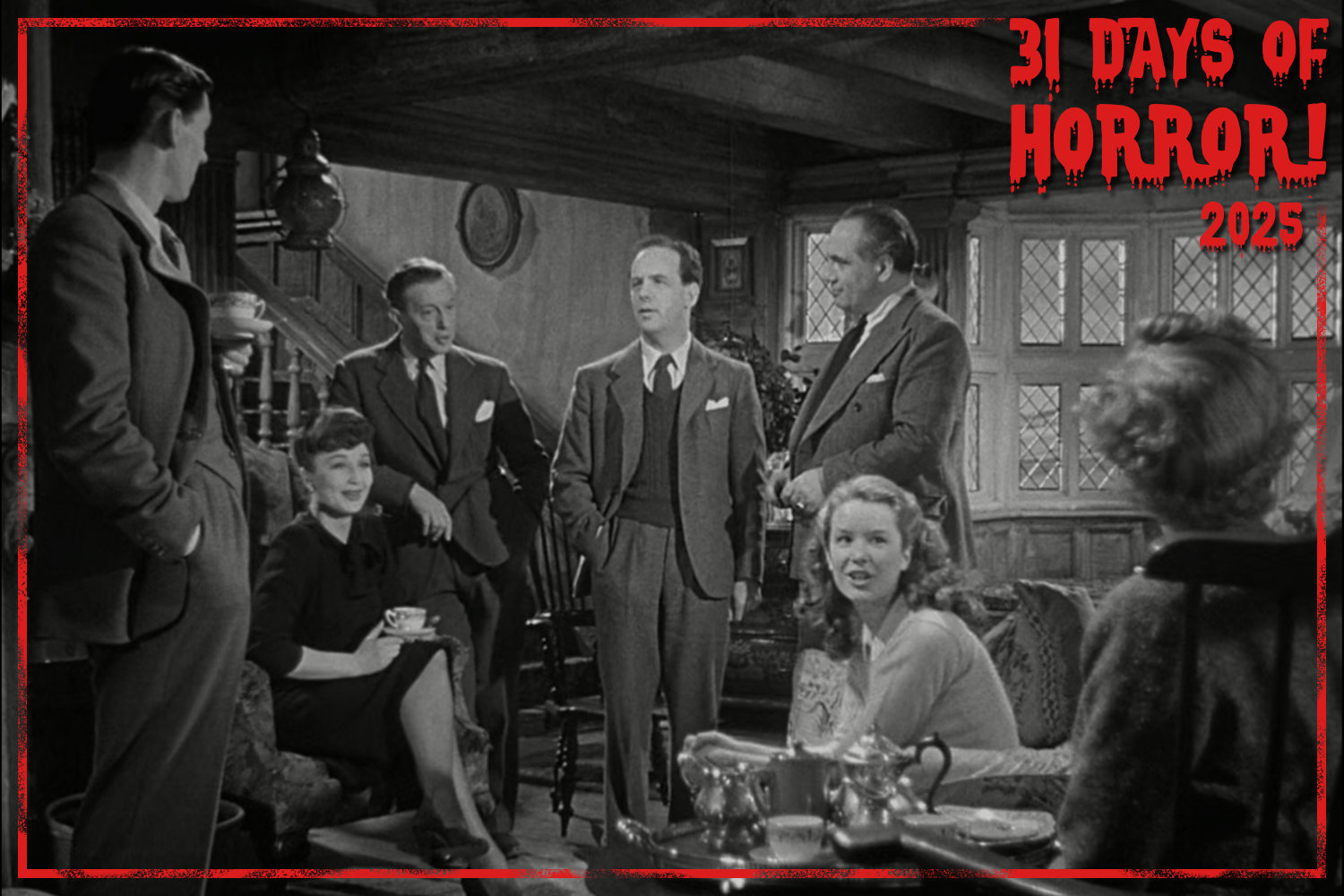
Architect Walter Craig (Mervyn Johns) arrives at the country home of Eliot Foley (Roland Culver) for a consultation on building renovations. Walter is struck by the familiarity of the place, mentioning to Eliot that he’s dreamt all of this before. After meeting the other guests, he is certain that a sixth person, a woman short on money, will arrive later. Doctor Van Straaten (Frederick Valk), a psychoanalyst, thinks that there is a logical explanation for everything and no mystical forces at play. Hugh Grainger (Anthony Baird), a race car driver, relates a story about a similar premonition. He was injured in a race car accident and, while in the hospital, dreamt of a horse-drawn hearse outside. The driver told him there was “room for one more inside.” Upon being released, he begins to board a bus, but stops when he recognizes the conductor as the hearse driver. The bus soon crashes, killing everyone.
The doctor believes this is all a coincidence. Everyone is surprised when Hugh’s wife, Joyce (Judy Kelly), arrives, fulfilling Walter’s prediction of a sixth person. Walter also tells Van Straaten that he will later break his glasses before a power outage, at which time Walter fears some inescapable evil. Young Sally O’Hara (Sally Ann Howes) relates a story from a Christmas party she attended, where the kids were all playing hide and seek. Jimmy (Michael Allan) tells her the story of a 1860 murder in the house by a girl who cut someone else’s head off. Sally finds it spooky, but is disbelieving overall. As she searches for another place to hide, she enters a room to find a crying young boy, Francis Kent. She consoles him and helps him back to bed. When Sally relates this encounter to the matron, both she and Jimmy are shocked. Francis was the boy killed by his sister, Constance, in that very room.
While everyone at Eliot’s cottage finds that story suitably real, the doctor, once again, presents an alternate and reasonable explanation. Walter predicts that Sally will leave soon. She decides to stay so that his premonition won’t come true, but her mother arrives and whisks her away. Joan Cortland (Googie Withers) offers a story about her husband, Peter (Ralph Michael), which she hopes will sway Dr. Van Straaten. She had given him a fancy mirror for his birthday, but every time he looks into it, regardless of its location, all he can see is a fancy bedroom with a fireplace and a four-poster bed. The two marry, and Peter’s situation improves until one day when he feels overcome by the visions he sees. Meanwhile, Joan speaks to the antique dealer from whom she bought the mirror. It was part of a set that contained a four-poster bed that belonged to a man back in 1836 who ended up strangling his wife, believing she was having an affair. When Joan returns home to tell this story to Peter, he attacks her, attempting to strangle her, believing she, too, is having an affair. Joan ends up smashing the mirror, freeing them both.

A creepy hearse appears to Hugh outside his hospital.
Walter decides he should leave before too long, but Van Straaten says that would only prove his obsession. Eliot tells the story of two golfers, George Parratt (Basil Radford) and Larry Potter (Naunton Wayne), both obsessed with the love of Mary Lee (Peggy Bryan). They decide that they shall play one round of golf, and the winner gets to marry her. George wins, and so Larry walks into the lake, drowning himself. A short while later, Larry’s ghost returns, accusing George of cheating on the game. Settling their differences, Larry attempts to disappear with a complex waving of his hands, but has forgotten the exact sequence. Having to remain six feet from George at all times, his apparition puts a crimp on the honeymoon festivities. Exasperated, George shows Larry a hand waving move he has not tried, and then vanishes himself, accidentally. Larry shrugs and decides to enter the matrimonial suite instead.
Everyone appreciates the levity of Eliot’s story. The doctor has one of his own about a patient he treated (in the days before HIPAA regulations), legendary ventriloquist Maxwell Frere (Michael Redgrave). A rival, Sylvester Kee (Hartley Power), comes to see Frere’s performance and is struck when the dummy, Hugo, asks him back to the dressing room at a Paris show. It appears that Hugo is actually sentient and shopping for a new partner, as Frere is completely oblivious. When Kee sees the two again in London, Frere is drunk and insults a lady. Kee defuses the situation and takes Frere back to his room, putting Hugo next to the bed. In the morning, Kee is shocked to find Hugo in his room, as Frere enters and shoots him twice. In prison, Van Straaten gives Hugo to Frere in the hope that it will help him come back to reality. Frere destroys the dummy in a rage as Hugo berates him. Van Straaten then brings the injured Kee to see Frere, who is now catatonic. The ventriloquist begins speaking in Hugo’s voice, shocking everyone.
Walter becomes concerned that he didn’t leave when he had the chance, as an accident shatters the doctor’s glasses, and then the power goes out. As others go off to get candles or turn the generator back on, Walter is overcome by some powerful mania and strangles Van Straaten. He runs, dreamlike, somehow entering parts of all the stories told by the others. It’s disorienting and freaky. Suddenly, Walter awakens at home, and his wife (Renee Gadd) asks if he’s had another nightmare. Walter, still disoriented, takes a call from Eliot Foley about stopping by his country home to discuss an architecture consultation. The film ends as it began, with Walter driving along a country lane to a house in Kent.
“But it doesn’t end there. You see, everybody in this room is part of my dream. Everybody.” – Walter Craig

Joan and Peter admire themselves in the new mirror she purchased for a wedding gift.
Many modern horror fans may not know about Dead of Night, but already know its impact on horror and thriller fiction. It is considered the first horror anthology film, setting the standard for dozens of other similar works from the 1960s through today. It also inspired the types of comic book tales that became popular in the 1950s through EC Comics (such as Tales from the Crypt, The Vault of Horror, and The Haunt of Fear), or with the television shows Alfred Hitchcock Presents and The Twilight Zone. It established the style of creating a feature-length film made up of smaller stories and vignettes, which are strung together by an overarching story made up of characters that may or may not appear in the vignettes. Each of the stories usually contains a twist ending, creating an ironic or scary reveal. Dead of Night also established having various directors handle each of the segments, rather than one person being responsible for the entire film. Without this film, there would not be classic horror anthologies such as Creepshow, The House That Dripped Blood, or Trick ‘r Treat.
The stories in Dead of Night come from a variety of sources. “The Hearse Driver” began as a short story, called “The Bus-Conductor” by E. F. Benson, first published in magazine form in 1906. Benson also wrote the adaptation for this film, along with the framing story. This tale has been re-adapted at other times, but most notably as the episode “Twenty Two” from the second season of The Twilight Zone. In that story, a dancer suffering from nervous exhaustion is in the hospital, where she has a recurring dream of following a nurse to the morgue, room 22. Every night, it’s the same, with the nurse telling her there’s “room for one more.” She is eventually discharged and heads to the airport, where she is told there’s room for one more and directed to Flight 22. She backs away, and as the flight takes off, it explodes, killing everyone. It’s easy to see the similarities between the two.
“The Golfer’s Story” is based on “The Story of the Inexperienced Ghost” by H. G. Wells, which first appeared in The Strand Magazine, March 1902. It serves as a story with a lighter, comedic tone after three rather intense shorts. The actors playing the golfers, Radford and Wayne, reprised similar characters to their Charters and Caldicott from Alfred Hitchcock’s The Lady Vanishes. They would be seen in several other films in similar roles. The second story, “The Christmas Story,” was the only one based on an actual occurrence. An original story, written by Angus MacPhail, he based the ghost on the actual person, Francis Kent, who, in 1860, was murdered by his 16-year-old sister, Constance Kent. Even without knowing this tidbit, this episode provides a suitable chill down one’s spine during the denouement.

Parratt and Potter may an exceptional wager over the love of a woman.
“The Haunted Mirror” and “The Ventriloquist’s Dummy” were also original stories to this anthology, written by John Baines. Modern audiences may see some of the twists coming in advance, only because there have been stories about cursed objects and living dolls for many decades. Haunted mirrors (and other cursed objects) are a popular subject for films like Oculus and From Beyond the Grave (another anthology about haunted antiques). Murderous ventriloquist dolls appear both in episodes of Alfred Hitchcock Presents and The Twilight Zone, as well as in films like Magic and Dead Silence. Being two of the longer acts in the film, these both present a longer-form character arc as the audience gets to know the protagonists and their madness before taking expected, darker turns.
Two other aspects of this film stand out outside of the horror genre. The first is the character of Beulah, played by Elisabeth Welch. She is the black owner and operator of the Paris club where Frere is performing his ventriloquist act. When Kee enters, he asks how she’s doing, to which she shows the jewelry and clothes she is wearing and says, “Mighty fine.” This may not seem like a big deal now, but looking at the role of black actors in films of the era (such as Hattie McDaniel playing the maid in Gone With the Wind or Eddie Anderson’s Rochester character on The Jack Benny Show), this is an amazing breakthrough. She is portrayed as an entrepreneur and an important character who helps facilitate the plot. Her color has nothing to do with her role. But her color has everything to do with how Hollywood would see actors of color. Racial attitudes aside, the portrayal of sex and sexuality was something that was often only hinted at in period films. The Hayes Code forbade anything too overt. That’s why the dialogue between Parratt and Potter is so shockingly funny. Parratt is perturbed that Potter must keep within six feet, especially as he’s trying to go to bed with his wife on their honeymoon. It gets quite racy with innuendo, for the time.
For a black and white film that is 80 years old this year, I was not anticipating the visceral reaction that I would have to it. Even knowing or guessing where the first two stories were headed, they still sent a chill down my spine. The story of Hugo, the ventriloquist dummy, had me guessing as well. It seemed like a story about a sentient doll (not unlike Chucky from Child’s Play), but as the story plays out, it becomes about a man who has broken his sanity, having two personalities, one of which manifests as Hugo. Everything about this film seems so familiar, but it was fresh when it was released. From the structure of the film to the bizarre twist at the end, with Walter hallucinating himself into each of the narrative stories. His awakening, only to find that he’s back at the beginning, is a common trope for films and television that is familiar. But in 1945, none of this was familiar, and everything was new and fresh, which is interesting to reflect on, given the many inspirations this film has created.

Kee is amazed at the quality of Frere’s ventriloquist dummy, Hugo.
Assorted Musings
- The lullaby that Sally sings to Francis Kent may sound familiar to fans of The Beatles. The lyrics are from “Cradle Song”, and are the opening lines to “Golden Slumbers” on the Abbey Road album.
- Besides Radford and Wayne, two other actors from Hitchcock’s The Lady Vanishes appear in this film, actors Michael Redgrave and Googie Withers.

Having grown up on comics, television and film, “Jovial” Jay feels destined to host podcasts and write blogs related to the union of these nerdy pursuits. Among his other pursuits he administrates and edits stories at the two largest Star Wars fan sites on the ‘net (Rebelscum.com, TheForce.net), and co-hosts the Jedi Journals podcast over at the ForceCast network.