
Introducing a multiverse of probabilities!
Coherence is the little sci-fi film you’ve never heard of. It tackles big issues surrounding interpersonal relationships and self-perception, and it played with multiverses before they were cool!
First Impressions
The trailer for the film has a group of friends having a dinner party on a night when a comet passes overhead. Soon, the power dies, and tempers begin to flare, as a sense of paranoia erupts amongst these people. Who can be trusted, and what is going on? If we all remain calm, we can have a moment of Coherence.
Presented below is the trailer for the film.


Coherence title card.
The Fiction of The Film
On her way to a dinner party with her friends, Emily (Emily Foxler) has a difficult phone call with her boyfriend Kevin (Maury Sterling) before her cell phone screen shatters. She arrives at the home of Mike (Nicholas Brendon) and Lee (Lorene Scafaria), where Beth (Elizabeth Gracen) and Hugh (Hugo Armstrong) have already arrived. The gossip is that their friend Amir (Alex Manugian) is bringing Kevin’s old girlfriend Laurie (Lauren Maher). Kevin arrives separately as well. The group realizes that there is no cell service, but chalks it up to Miller’s Comet passing overhead. Beth offers Emily and Lee her own concoction to “take the edge” off that contains just a dash of ketamine.
They sit down for dinner discussing Mike’s acting background on the TV series Roswell, which Laurie fails to recognize him from, even though she was a huge fan. Emily shares the story about losing her job at the San Francisco Ballet to Katherine Merris, when Laurie points out that Katherine has Emily’s life now, basically. The power goes out just after Hugh’s phone screen cracks without anyone touching it. Looking outside, they see that the entire neighborhood is dark except for one house up the street, whose lights are still on. Hugo and Amir leave to investigate. While they are gone, strange things are happening, such as a random knock on the side of the house.
Amir returns with a small lock box while Hugo has a gash above his temple. Inside the box, the group discovers some random objects plus pictures of them all with numbers written on the back in red ink, apparently in Emily’s handwriting. Hugo says he saw a dinner table set for eight at the other house before rapping on the side door and then tripping and hitting his head. Mike wants to check this out, so he grabs some blue glowsticks and gives them to Emily, Kevin, and Laurie, who accompany him. What they find is a house that looks just like Mike’s house and a group of people across the street that appear to be them, except wearing red glowsticks. They run back to Mike’s house.

Kevin and others listen as Emily tells some strange stories about what has happened when comets pass by.
Hugo and Kevin go out to Hugo’s car, where he has a science book left by his brother called “Decoherence and Schrödinger’s Cat.” The book explains that simultaneous realities exist at the same time, separate and unique. Laurie mentions the film Sliding Doors as an example. The group agrees that somehow the comet has caused another reality to bleed into this one. Mike argues that they should kill the “others” or at least stop them from finding their copy of the same book. Lee wakes from a nap and reveals that she took some of Beth’s concoction, while others question if they were drugged without their knowledge.
In a back bedroom, Hugo and Amir identify themselves to each other with red glowsticks, indicating they are the duplicate versions. Laurie comes onto Kevin, and Emily overhears the conversation, later confronting her boyfriend about what he really wants. After another power outage, the group hears a car window shatter. Outside, Emily gets a toy ring from her car that Kevin gave her at a fair. She gets the idea that they should make a marker box and leave it at the house so they know if they’re at the right one. Going through the process of getting photos and what she remembers from seeing the others’ box, Emily concludes that there are at least three other copies of themselves, if not more.
Mike copes with the pressure by getting drunk and belligerent when a note from another Mike shows up on their door, blackmailing him. He and Beth had an affair 12 years ago, which everyone knew about except for Beth’s husband, Hugo. The group becomes upset and devolves into arguing. A second Mike busts in the door, attacking Mike. This causes Emily to leave. She wanders in the darkness, finding multiple other versions of the house with the people inside in different states of agitation and/or knowing what is happening. When she discovers a house where their doppelgangers appear unaware of the events, she drugs the other version of Emily and takes her place. The following morning, Emily awakens, noting that everything seems fine in this version of reality. Kevin hands her the toy ring, which he found in the bathroom, but she is already wearing one on her finger. At that moment, his phone rings with a call from Emily, which he answers confusedly.
“Decoherence keeps us separate.” – Kevin

Beth, Hugo, and Laurie discuss various interpersonal matters as things start to get weird.
History in the Making
My guess is that most fans of science-fiction have not heard of Coherence, a small independent film shot in 2012, screened at several film festivals in 2013, and released on VOD in 2014. This release to the general public occurred in early August, placing this film in a summer full of big-budget superhero films (including Guardians of the Galaxy, X-Men: Days of Future Past, and Amazing Spider-Man 2), a Transformers and Planet of the Apes sequel, along with Edge of Tomorrow and, later, Interstellar. But given all that other hype and expense, Coherence may be the most engaging and engrossing film of that year.
As defined by Merriam-Webster, “coherence” is “systematic or logical connection or consistency” in speech or ideas, making the process logical and easy to follow, which itself creates unity and order. And that’s how this film starts. Right away, audiences will notice it’s quite different. Coherence is filmed with a cinema vérité style that utilizes handheld cameras, natural lighting, and realistic dialogue (most improvised). It puts us in the house with these characters, getting to know them and wondering just what to expect next. It accomplishes with eight characters what many of the blockbuster films of the year couldn’t. It creates an engrossing story that allows the audience to ask what they might do in a similar situation.

A strange knock on the door spooks everyone after discovering a box with pictures of themselves inside.
Genre-fication
Films about parallel worlds and multiversal dimensions were not an uncommon idea in film and television at this time, but they hadn’t had the mainstream success that has shown up post-2020. Coherence even references one of the more famous films at the time, Sliding Doors, with Gwyneth Paltrow, about a split decision that creates a branched timeline of events. The most usual version of this type of genre is films about alternate dimensions or fantasy realms, such as The Chronicles of Narnia, where characters enter another world via a wardrobe, or television shows dealing with an alternate version of our world, like The Man in the High Castle, a series positing what if Nazi Germany won World War II. Coherence considers a multiverse of possibilities, with multiple versions of the same person existing in a shared reality, something that would not become more popular until the release of the Academy Award-winning Everything Everywhere All At Once and multiple superhero films such as The Flash and Doctor Strange and the Multiverse of Madness.
Comic books from DC and Marvel Comics have been entertaining the notion of a multiverse since 1961 (with The Flash #123’s “The Flash of Two Worlds” story), and pitting multiple versions of heroes and villains against one another in the popular 1985 Crisis on Infinite Earths maxi-series. Television shows have also looked upon a multiverse, such as with the 1995 Fox show Sliders, where characters slide into different parallel worlds, and the 2008 Fringe show (also on Fox), where a multiverse of worlds was discovered with fringe science. Like time travel fiction, multiverse theory allows for shows to explore “what if” scenarios, with the idea being that in other worlds, other universes, characters made different decisions, allowing events to play out slightly differently.
In some ways, Coherence feels like Primer, which was released ten years earlier. Both are low-budget films shot with a limited cast and locations, and deal with heavier science-based fiction than mainstream films. But while Primer is dense and often difficult to parse (containing purposeful decoherence), Coherence is much more understandable, though also dense. The difference comes in the approach of the filmmakers and the story they want to tell. Coherence starts more like a horror thriller, but quickly makes some weird turns to land itself into the Twilight Zone-style of film. Early on in the film, I thought that it was going to be more like the classic Twilight Zone episode, “The Monsters are Due on Maple Street,” about the breakdown of society when aliens cause a power outage in a small neighborhood. Each person turns on the other, believing them to be responsible for the strange occurrences that night. But the film goes much further than that, exploring the experiences and regrets of the characters.

As the night wears on, the characters begin to questions everyone’s motives and authenticity.
Societal Commentary
Coherence is a great metaphor about dealing with modern life. This group of characters, a mix of longtime friends and at least two love triangles, showcases living with the shame, embarrassment, and trauma of past decisions by having them literally face themselves. People often talk about “finding themselves” as a way of soul-searching. Here, those introspections can be as easy as looking in the window down the street to see how your other half is living. From the outside, everything appears copacetic, but what other secrets are hiding that can’t be seen? Mike is the first one to showcase his anger and meanness towards his duplicate. He suggests writing a blackmail letter early in the film. The audience doesn’t learn of the nature of the letter until it shows up on the front door in Act Three. He knows what will rile his other self up, and uses that willingly to inflict the same anger on his other self. He wants to kill the others before they get the same idea, probably knowing that his other selves are thinking the exact same thing. Mike’s double from a different reality breaks in to attack Mike, yielding one of the many possible ways that the encounter may have happened across the multiple houses. In this film, the internal struggle is manifested on the outside by creating multiple versions of the same character to take abuse.
The film also provides a classic sci-fi theme about the fear of replacement. Films like Invasion of the Body Snatchers or The World’s End deal with humans being replaced by something else without anyone being the wiser. The remaining characters fear being replaced, as a way of their individuality being removed from society. Coherence goes deeper, as it’s not just swapping out individuals for copies–as they are really the same person, not clones, robots, or aliens. Each version of Emily, Mike, or Kevin is just slightly different from the original ones. As predicated on Emily’s discovery of the marker box, at least half the group is not from the same reality, mixing at least three separate versions of the characters. Just how big a deal is it if they’re not all the originals? Seeing this distinction, Emily decides to insert herself into a cadre of friends that seem to be unaware of the drama and betrayal they experienced this night. Is that what other characters like Hugo, Amir, and Mike thought as well? That they might be better off in a different group of friends, the same but not quite the same? Apparently attempting to take shortcuts to simplifying your life can lead to even more problems. Who knew?

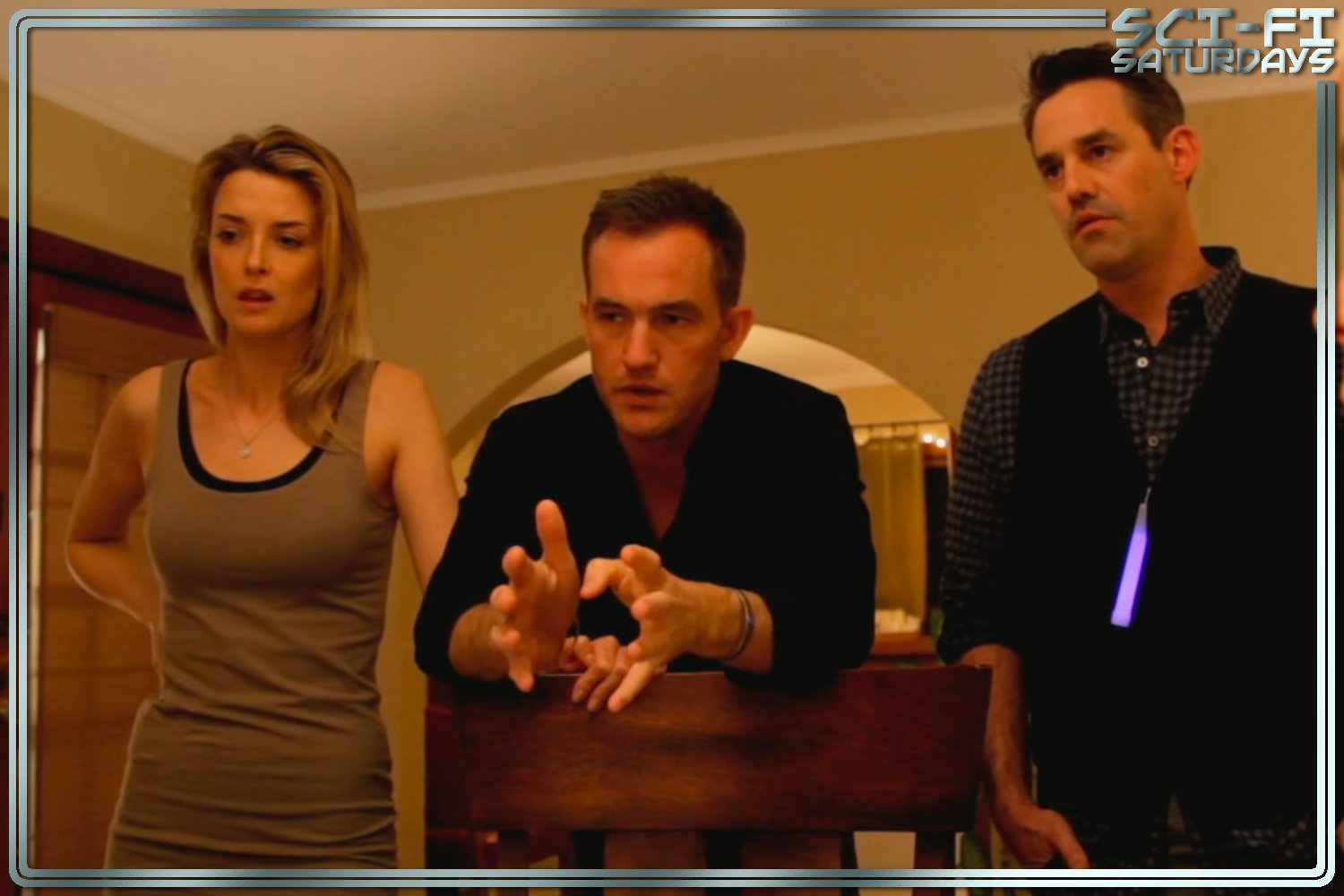
Mike argues with Kevin that they need to do unto the others before they are attacked themselves.
The Science in The Fiction
Coherence talks a tough game, but manages to keep up with its references. Emily begins the evening by relating the story of a comet that passed over Finland in 1923. She says there were reports of people becoming confused and ending up in the wrong house. She mentions one woman who swears the man in her house (who looked like her husband) was not her husband because she had killed him a week prior. Her story sets up strange occurrences surrounding celestial phenomena and foreshadows the events of confusion and characters entering the wrong houses (even though they look like the correct house). Later, Emily brings up the Tunguska Event, which was a real atmospheric disturbance over Siberia in 1908, where an explosion, attributed to a meteor or asteroid, occurred, decimating over 800 square miles of forest. Fans of The X-Files may recall an episode of that series that also used the Tunguska explosion as the basis for odd happenings. By having characters mention these real or real-sounding events, it provides further believability regarding the incidents occurring in the film.
The biggest scientific pull Coherence uses is the introduction of a book entitled “Decoherence and Schrödinger’s Cat.” The film does a good job of explaining the basis behind this thought experiment. A cat is in a box that also contains a vial of poison. Upon observation of the cat, there is a 50/50 chance that it will be dead, but one can’t know what the outcome is until it’s observed. So, until that observation, quantum physics argues that two states exist simultaneously: the cat being alive and the cat being dead. Only when someone looks in on the cat does the reality resolve into one of the two possibilities. The film goes on to postulate that those two options do not exist in isolation, but are part of a branching reality that creates a new multiverse. There are then two worlds, one in which the cat is alive and one in which it is dead. This is the basis behind the multiple instances of Emily and her friends. For every choice they’ve made, another reality has branched from it, creating potentially infinite versions of these people. The comet creates some type of interference, breaking down the veil between these realities and allowing the various iterations of characters to interact and crossover to alternate planes of reality. It’s a fun thought experiment and a truly clever idea in creating a low-budget film with a limited cast.

The next morning, Emily is confronted by Kevin just as he receives a phone call from Emily.
The Final Frontier
Coherence works best because the cast carries no baggage with them in the minds of the audience, except perhaps Nicholas Brendon. Fans of the television series Buffy the Vampire Slayer may immediately recognize him as Xander, but others may only slightly recognize him. The fact that his character is also an actor who appeared on the TV show Roswell creates a split from our reality, where the character might be a multiversal version of the actor. Coherence is available on multiple streaming services and is highly recommended. If, after reading this article, you decide to watch the film, don’t let knowing the twist stop you. Having that information in advance only helps see all of the other small details inserted early in the film. Talk of previous comet encounters, husbands who are not themselves, and frenemies that steal people’s lives. It’s such a refreshing film, I’m already watching it again in another universe.
Coming Next


Having grown up on comics, television and film, “Jovial” Jay feels destined to host podcasts and write blogs related to the union of these nerdy pursuits. Among his other pursuits he administrates and edits stories at the two largest Star Wars fan sites on the ‘net (Rebelscum.com, TheForce.net), and co-hosts the Jedi Journals podcast over at the ForceCast network.