
A heartwarming story about the little robot who could.
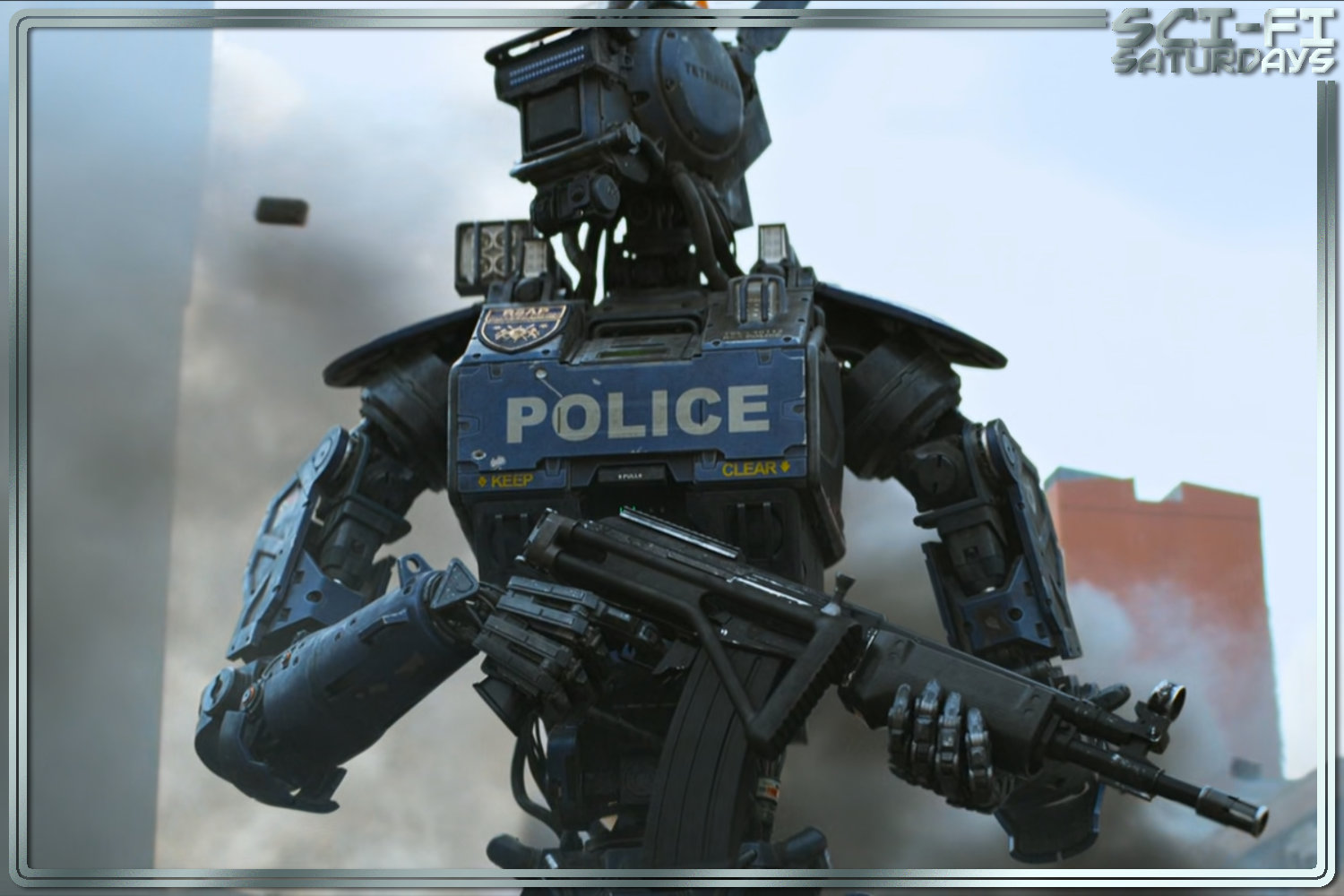
The robot revolution is on the horizon in Chappie, another near-futuristic sci-fi film from Neil Blomkamp. It focuses on the evolution of a robotic drone as it becomes self-aware, developing emotions and feelings just as any other human might. So then why does it feel so stale?
First Impressions
This trailer features a group of people deploying an army of humanoid robots to pacify civil unrest in the city. An older man is corrupted by power, while a younger man is inspired by change. A single robot is found by some people and adopted, like a stray dog. A woman tells the robot it can be anything it wants to as it paints a quick picture of a car. The robot says it doesn’t want to die and introduces itself as Chappie.
Presented below is the trailer for the film.


Chappie title card.
The Fiction of The Film
Attacks on the police of Johannesburg, South Africa, escalate, and a group of autonomous robotic police officers is brought online to deal with the unrest. The scout project is overseen by Deon Wilson (Dev Patel), a software engineer at Tetravaal, a local weapons manufacturer. He is interested in developing a more robust artificial intelligence for his robots, but is opposed by Vincent Moore (Hugh Jackman), the engineer of a larger, tank-like project called MOOSE. He fears AI advancements, choosing to use a neural transmitter connected to a human pilot for his massive drones. After a heist, criminals Ninja (Ninja), Amerika (Jose Pablo Cantillo), and Yolandi (Yolandi Visser) return to their base, where they are threatened by gang-leader Hippo (Brandon Auret). Ninja owes $20 million rand to Hippo and has seven days to get it.
During the argument between Ninja and Hippo, the police scouts swarm the compound. Scout #22 is hit by an RPG and damaged, being returned to the Tetravaal warehouse to be decommissioned. Deon suggests to Tetravaal boss Michelle Bradley (Sigourney Weaver) that he implement his new AI on scout #22, but she tells him absolutely not. He, of course, ignores her and steals the damaged robotic shell, along with the Guard Key, a USB key needed to update the machine’s firmware. On his way out of Tetravaal, Deon is carjacked by Ninja and Yolandi, who are looking for the maker of the robots to provide them with an on/off switch to incapacitate them. Finding the damaged scout in his van, they hold him at gunpoint to enable the robot to work for them. With no choice, Deon uploads his robotic AI into the shell.
The robot comes online, acting very child-like. Yolandi takes to it in a very motherly way, calling it Chappie (Sharlto Copley). Ninja is interested in the possibilities of having a robotic “gangsta” on his side, but not one that is feeble and scared. Deon points out that Chappie’s battery is fused to his body and only has 5 days’ worth of power. He introduces himself as Chappie’s Maker and tells him that he doesn’t need to do what others tell him. Vincent notices a missing scout and traces it, and the missing Guard Key, to Deon. The following day, Ninja drops Chappie off on rival gang turf to “toughen him up.” He is firebombed by locals and kidnapped by Vincent, who cuts off Chappie’s left arm and then steals the Guard Key for himself. Chappie returns home, where Amerika replaces his arm, and Yolandi reminds him that he’s special on the inside. Meanwhile, Ninja continues to attempt to train Chappie for an upcoming heist, but Chappie explains he cannot “do crimes.”

Deon works on his pet project while on company time, while a model of his robotic officers sits in front of him.
Ninja tricks Chappie into stealing cars by telling him about the bad people who have stolen them from Daddy. They use the stolen vehicles as collateral for weapons they need. At a criminal lair, Chappie sees a dead dog. Ninja explains that you can either be the live dog or the dead dog, and then mentions that Chappie only has a few days to live. Vincent uses the stolen Guard Key to implement a virus into the scout robots, bricking them. Deon manages to find Chappie and quarantine his OS to save him. While at Tetravaal, Chappie sees the neural transmitter and takes it with him. At the hideout, he experiments with the helmet on Yolandi, showing her how it can read the consciousness of a person. Unfortunately, it doesn’t work on himself. He scours the internet for details about neuroscience and electronics and discovers how to record a backup of himself onto a drive.
Deon discovers Vincent’s program, but instead of reporting the engineer, he goes to see Chappie, allowing Vincent to lie about Deon’s true motives. News footage shows a police robot assisting criminals in robbing an armored car. Michelle agrees with Vincent that it’s finally time to test MOOSE, which has been launched to find the rogue AI-bot. A showdown occurs at Ninja’s hideout as MOOSE and Hippo arrive at the same time. Amerika is killed by MOOSE, while Chappie decks himself out with weapons to stop the bigger robot. Deon is shot while Ninja beats Hippo to death. In the hideout, the neural helmet is destroyed. Ninja attempts to distract MOOSE while Yolandi gets away, but she is shot by the machine moments before Chappie activates a bomb attached to its chassis, destroying the robot. Upset at his “mommy” being shot, Chappie returns to Tetravaal with the wounded Deon and attacks Vincent, beating him up–but not killing him.
With only minutes of power left within his battery, Chappie uses Tetravaal’s neural helmet to transfer Deon’s consciousness into the final scout shell in the building, saving his life. Chappie locates two nearby scouts and reactivates them, transferring his consciousness into the nearest one. Deon, now in his robot body, finds the new Chappie, and they return to the hideout. Ninja burns Yolandi’s things, but finds a small thumb drive labeled as “Mommy Consciousness.” Deon and Chappie help Ninja bury Yolandi outside the hideout. Later, Chappie remotely logs into a factory and builds a new scout body, with a more humanoid face, which resembles Yolandi. He uploads her consciousness file into the new body, and the robot opens its eyes.
“Listen, Chappie, in life, lots of people will try to tell you what you can’t do. And you must never listen.” – Deon

Amerika, Yolandi, and Ninja discover a robot drone in the back of the van they hijacked.
History in the Making
As the third film from writer/director Neill Blomkamp, Chappie presents a story that is incredibly modern, but also rooted in sci-fi films of the 1980s. Blomkamp, a South African filmmaker, burst into the film scene with his 2009 documentary-style District 9. Its combination of a low-budget approach with its themes of racism and xenophobia captivated audiences and made Blomkamp a name to watch out for in the genre. His follow-up film, Elysium, continued the director’s strong thematic work, as well as allowing him an extended budget. Unfortunately, the film suffers from an unclear plot and too many genre elements, creating an overloaded movie that didn’t resonate with audiences. Chappie also suffers from an extensive desire to include many ideas about robotic evolution, artificial intelligence, the singularity, family dynamics, the military-industrial complex, and technological innovation. Even with its interesting characters, it fails ultimately due to its inability to focus its scope.
That said, the film has some interesting thoughts on the world of emerging technology and the singularity. Blomkamp is obviously a fan of classic sci-fi films from the 1980s, offering many great nods to films of his youth. There was obviously a lot of thought regarding the technology and how it evolved from real-life science to the filmic representation of AI-driven robots. As one of several films from the mid-2010s about the rise of artificial intelligence, it bridges questions that audiences may be concerned about, but ends up glossing over some of the more imposing and interesting elements.

Hugh Jackman plays against type, and becomes a thoroughly unlikable, and also two-dimensional, character.
Genre-fication
On first blush, Chappie has much in common with the classic 80s film Short Circuit. Both are about robots designed for military capabilities, which escape into the world, get adopted by humans, and become sentient (in their own ways). While Short Circuit’s Johnny Five is never referred to as having artificial intelligence, he transforms from a drone robot into a full-blown character by the end of the film. On the other hand, Chappie is imbued with experimental software designed to create an autonomous and free-thinking robot. He starts with zero experience and understands the world from those he interacts with, which happen to be gangsters and thugs, but also humans with emotional depth. That’s about where the similarities end, however. Short Circuit was much more light-hearted than the higher-stakes Chappie, with the latter exploring the moral implications of free-thinking automatons. The film also draws parallels between the autonomous police force scouts and the human-controlled MOOSE enforcers. The design of MOOSE is obviously inspired by that of ED-209, from Paul Verhoeven’s 1987 film, Robocop. That film drew the parallel between Murphy’s Robocop character, which was a man/machine cyborg who could think (mostly) for himself, and the Enforcement Droids, which had limited autonomy but were mostly confined to a preset program. In Chappie, MOOSE has zero autonomy and is controlled by a human operator through a neural helmet that links the operator’s brain to the machine, while the scout robots run on a rudimentary program that is decidedly not artificial intelligence. Tetravaal’s CEO does not want to mess with that. Robocop was about humanity triumphing over machines, with a cyborg retaining its humanity in the face of adversity. Chappie goes the other direction, championing the evolution of the robot as it becomes more human through experience.
Chappie also furthers the exploration of artificial intelligence in cinema, specifically as seen in the rise of this theme during the mid-2010s. An early film from this Century about the evolution of robots towards a more autonomous and humanlike state was the fantastical A.I. Artificial Intelligence. A young robotic boy seeks to become more human in a Pinocchio-like story where he steps beyond his limits to evolve. More recent films that feature the blurring between the real and synthetic include Her, about a sentient digital assistant that transcends known parameters and evolves into the Singularity, and Ex Machina, the film for next week, which explores the evolution of machines beyond the ability for humans to differentiate them from their flesh and blood selves. Chappie continues the evolution of the likeable robot in film, after Johnny Five, C-3PO, or even Sonny from I, Robot. His child-like nature makes him hard to resist as this menacing-looking robot flinches at gunfire and tries to emulate the gangsta-style speech patterns of Ninja and his team. The downside of this character is that even though the film is about him evolving, his story is sidetracked by the transition of Deon and Yolandi to synthetic bodies. Suddenly, humans can become robots as easily as robots can become human. Yet, the lessons Chappie learns are ones that are great for humans to learn as well. These include don’t let others tell you what you can’t do, and that what’s inside of you is the most important and special thing.

Chappie, outfitted with spray painted tattoos and other bling, learns how to commit crimes from Ninja and Yolandi.
Societal Commentary
As mentioned above, Chappie suffers from multiple, overlapping themes that all vie for supremacy. The ones that stand out include the way in which humans treat others. Every character in the film, with the possible exception of Yolandi, is out for themselves. To get what they want, they will go to great lengths, using anyone and everything around them to attain their goal. For example, Deon is set on uploading his new AI software into a robot body. It doesn’t matter who it affects at his job. He ignores Michelle’s instructions not to do it, and like a mad scientist, charges forward without considering the consequences. On the subject of Tetravaal employees, Vincent is single-mindedly focused on his MOOSE project. He doesn’t care what he has to do to push Deon out of the way, including framing him and lying about it. He shuts down all of the scout police robots to “prove” that they don’t work, knowing he’ll be able to get his shot at deploying MOOSE. But, at what cost? Because that happened, how many other people were injured? Of course, the most self-serving character is Ninja. Concerned about getting the money to Hippo, and the consequences of not doing that, he is focused solely on the heist. He is told by both Deon and Yolandi about how Chappie needs to be treated as a child, but he pushes forward, doing what he wants, when he wants. Imagine if Chappie were actually a child. Ninja would be the worst father ever. Even with all of these examples of poor behavior around him, Chappie still manages to learn the best lessons from Yolandi, who treats him with kindness and empathy. He transitions from being a child in the relationship to becoming a parent, having become the individual who provides “new life” to both Deon and Yolandi.
The film also asks about the nature of consciousness. It’s the age-old question about what makes a person. It’s more than the sum of their parts, and Blomkamp indicates that it’s the soul of the individual that is the unquantifiable element. As Yolandi explains while reading Chappie his book about the Black Sheep, it’s what’s inside that makes him special. The film glosses over Chappie performing the amazing work of understanding neuroscience and creating a device that allows him to download that special element of an individual into an array of PlayStations. But this relatively quick sequence allows him to make a monumental breakthrough in technology, allowing human beings to be saved off into digital spaces. He also manages to figure out where that special spark within himself resides and makes a backup of this, after initially not being able to register on the neural helmet. It would have been nice to focus a little more on this incredible leap of technology for humanity and what it implies, but that was not to be.

The MOOSE project, a direct homage to ED-209 from Robocop.
The Science in The Fiction
Blomkamp focuses a lot of the time of the film on the battles within the police force about the best ways to serve the public trust. The Johannesburg Police have replaced the beleaguered human officers with robots that can stand up (mostly) to the gang violence in the streets. Unfortunately, this escalates the violence to new levels as gang members look for ways to shut down the robots or get one working for their side. It’s difficult even to begin thinking about the programming these autonomous drones would need to be able to function effectively in the streets of the city. They are only seen standing up to the aggression of the gangs, and not performing the equally important task, perhaps more important than fighting crime, of liaising with the citizens and creating positive relations. They are definitely not doing that. They are instead fighting a war that is ever escalating. As the police bring in new weapons, so too do the criminals escalate their tactics to deadlier levels.
Still, the robot police force appears more humanoid than the MOOSE, which is hugely ominous and tank-like. It’s apparent why the police force would forego this unit and choose to put things that appear more human-like in place. It’s a solid public relations move. But the flip side is that the drones are limited in their scope. They can function together autonomously, but only within their programming, while each MOOSE is controlled by an operator with human skill, intuition, and the ability to adapt. The parallels between drone pilots in modern warfare are obvious. The fact that these versions are not just piloted with analog controls, but controlled through a complex neural link that allows for faster reflexes, makes it a technological breakthrough that exceeds the levels of what is currently capable. This is definitely an evolutionary extension of the robotic exoskeleton Blomkamp introduced in District 9. The MOOSE allows for remote activation, putting the operator in less danger while upping the power and firepower on the unit.

Chappie has an emotional breakdown over Yolandi’s dead body.
The Final Frontier
The hardest part of the film to reconcile, still, after 10 years, is the inclusion of the South African zef hip-hop group Die Antwoord. As non-professional actors, Ninja and Yolandi basically play themselves. Perhaps it’s just that Ninja is such an unlikeable character that the performance is colored by that. It just feels like a weird piece of stunt casting to include these characters. Overall, Chappie is entertaining, but lacks the kind of insight that Blomkamp showed in District 9. It’s fun to see Chappie parading around as a robotic gangsta, thumbing his nose, and cursing. But the film feels rushed in other ways, the human ways, with stock characters (or caricatures) and superficial situations.
Coming Next


Having grown up on comics, television and film, “Jovial” Jay feels destined to host podcasts and write blogs related to the union of these nerdy pursuits. Among his other pursuits he administrates and edits stories at the two largest Star Wars fan sites on the ‘net (Rebelscum.com, TheForce.net), and co-hosts the Jedi Journals podcast over at the ForceCast network.