
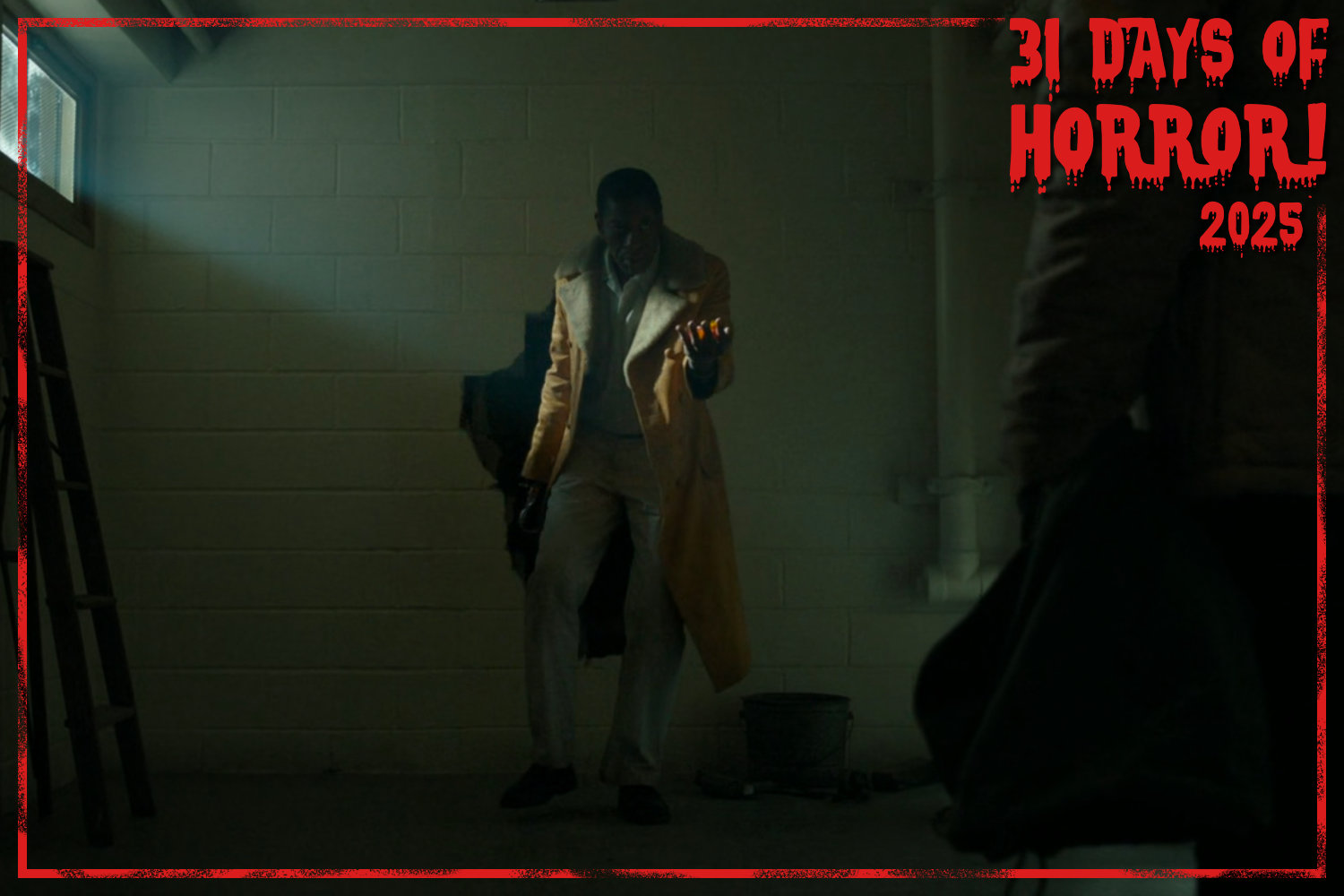
The Candyman can ’cause he mixes it with blood and makes the world taste good.
In an era of remakes and reboots, Candyman stands out as a necessary return to the decades-old story, looking at the character through the lens of the Black Lives Matter era. In this version, the horror comes from outside as Candyman becomes a crusader for his community.
Before Viewing
This trailer breaks down the origin of the Candyman, a man who gave out Halloween candy filled with razor blades, who was eventually beaten and murdered by the police. A man, who appears to be the main character, digs deeper into the legend, disbelieving at first. But he sees the legend as truth, and tells his girlfriend about saying Candyman’s name five times in a mirror to bring him back to life. Of course, after doing so, weird things begin to happen around the man. Say Candyman or else!
Presented below is the trailer for the film.


Candyman title card.
After Viewing
In 1977, at Chicago’s Cabrini-Green, young William (Rodney L Jones III) encounters a local character known as Candyman in the basement laundry room, who startles him. His real name is Sherman Fields (Michael Hargrove), and he offers the youth some candy. In 2019, Anthony McCoy (Yahya Abdul-Mateen II) and his girlfriend, Brianna (Teyonah Parris), host her brother, Troy (Nathan Stewart-Jarrett), and his boyfriend, Grady (Kyle Kaminsky), at their apartment, built on the site of the Cabrini-Green slums. Troy dims the lights and tells the scary story of Helen Lyle, a white grad student who went crazy in 1992 and abducted a baby. The child was rescued, and she eventually killed herself in a bonfire in the middle of the Green.
As an artist, Anthony is having difficulty coming up with his next idea. He begins investigating some of the details from Troy’s story and looking at the disused parts of the old slum. While taking a picture of an old church, he is stung by a bee on his right hand. He meets an adult William (Colman Domingo), who runs a laundromat nearby. William tells Anthony the full story of Sherman Fields, the Candyman, who was suspected of killing kids with razor-blade-laced candy. The cops killed him in front of young William, but the man was actually innocent. This provides Anthony with new ideas, and he begins painting again.
Anthony teases Brianna by saying Candyman five times in front of her, which is the way to bring him to life according to the urban legend. Anthony joins an art show hosted by Clive (Brian King), where his display is a mirror inviting people to say Candyman’s name. Inside the mirror is a hidden room with artwork reflecting the murders. After hours, Clive’s young girlfriend, Jerrica (Miriam Moss), repeats Candyman’s name, and the killer appears (but only in reflective surfaces) and slaughters both of them. Brianna finds the bodies the next morning, causing her to remember her father’s suicide in front of her as a child. Anthony’s bee sting begins to get infected, with an open sore forming.

Everything seems to be going great for Anthony and Brianna.
Anthony continues his painting manically. He takes a meeting with an art critic named Finley Stephens (Rebecca Spence) at her apartment. She previously criticized his work harshly, but with the news regarding Clive’s death, she’d like to rewrite the story, bigger. Anthony sees a reflection of himself as Sherman, complete with a hook for a hand, and leaves, terrified. Finley is killed by an invisible assailant. Anthony returns to speak with William again, doubting his sanity. The dry cleaner relates that Candyman is not just one person, but many people over the years, before telling the story of the original, Daniel Robitaille. The 19th-century black man’s sin was falling in love with a white woman, for which he was brutally tortured (having a hook shoved into his amputated forearm) and killed in an apiary. He returned and slaughtered his assailants.
Four girls in a high school bathroom, who have heard the legend, say Candyman’s name five times and are slaughtered. At the local hospital, Anthony realizes that he was born near Cabrini-Green, and not the South Side, as he was told. He visits his mother, Anne-Marie (Vanessa Williams), who admits that she lied to him. He was the baby that was abducted by Helen Lyle 27 years ago. Brianna returns to the apartment to gather her things, having become fed up with Anthony’s wild mood swings. She discovers a pen from the laundromat and decides to visit William to see if he can provide any clarity.
William kidnaps Brianna, revealing that his sister was killed by the Candyman, and he’s looking to bring the killer back for revenge. Anthony, who is in a fugue state, has infected skin all along his right side. William hacks off Anthony’s right hand and replaces it with a hook after calling the police about a hook-handed killer in the area. Brianna frees herself and stabs William to death with his own ballpoint pen. The police arrive and shoot Anthony in front of her, believing him to be the killer, and then arrest Brianna. An officer intimates that he can make things go easy or hard for her. She invokes Candyman by calling his name five times. The killer now appears as Anthony and murders all four police officers. He morphs into a visage of Robitaille, who tells Brianna to “tell everyone.”
“Candyman ain’t a He. Candyman’s the whole damn hive. If you’re out here looking for Candyman, you ask me, stay away!” – William

Mirror mirror all around who’s got the best candy in town?
Candyman returns to its roots, literally, in a film that is not a remake, but a direct sequel to the original 1992 film. Two other sequels were released in 1995 and 1999 but failed to live up to the success of the original. A new entry in the film series had been in the works since the early 2000s, but it wasn’t until Jordan Peele became involved in late 2018 that things began moving forward. Unlike Peele’s recent films (Get Out, Us), he chose only to produce Candyman, rather than directing, along with having a co-writing credit. Nia DaCosta was chosen as the director, having made one previous feature film, Little Woods. She was not the first Black female director of a horror film, but the first one to have a film debut at number one at the box office, regardless of genre. The weirdest thing about the film’s crew and its character, as a seminal black work of fiction, is that it was originally written by a white guy. English horror author Clive Barker released his original short story, “The Forbidden,” in the mid-80s as part of his Books of Blood anthology series. That story is very similar to the original Candyman film, with a character named Helen exploring the urban legend of the murderer called Candyman. As yet, it had nothing to do with the black experience. It wasn’t until English director Bernard Rose directed the 1992 film that he switched the setting from the flats of Liverpool to the slums of Cabrini-Green, and made Candyman an African-American character killed in the late 19th century for having an affair with a white woman. Still, that film was told from the perspective of a white woman “risking” her safety by investigating murders in an urban setting. It’s a film that created a strong Black horror icon, portrayed by Tony Todd, who seeks to perpetuate his legend by murdering innocents via the white graduate student. The character resonated with audiences as one of a small number of monsters in horror portrayed by a Black man. With the newest version, Peele and DaCosta envision a new manifesto for the killer.
The new film takes place 27 years after the previous one (though it was released 29 years later). As a direct sequel, it provides the same mythology and backstory for the character of Candyman, but adds a new twist, which all sequels should do. Daniel Robitaille is still the original character of Candyman, and the events from 1992, with Helen kidnapping a baby while being possessed by the spirit of Robitaille, still happened. But this new iteration of the story creates Sherman Fields, a local character in late 1970s Chicago who is also a version of the monstrous Candyman. The original story was about suppressing the myth of the Candyman within the community. The creature gained power with each retelling of the story, as well as with each body he was able to kill when people were gullible enough to repeat his name in front of a mirror. Helen, a student of sociology, began diminishing his name through her research, so he possesses her to make others afraid again. In 1992, Candyman kills to perpetuate his reputation among the families of Cabrini-Green. In 2021, he kills as a form of retribution, becoming a protector of the oppressed. The differences can be seen in Candyman’s victims. In this film, Candyman only kills non-black people as part of his comeback tour. He’s no longer a single soul, but a member of a hive (perpetuating the bee metaphor) made up of wrongly convicted (and slain) black Americans. Thirty years ago, the idea was that the truth about Candyman needed to be hidden. That an angry, black boogeyman would draw too much attention towards the slums. In the modern age, with its gentrification, that same angry, black boogeyman becomes a voice for the marginalized people.

The Candyman cometh.
Thematically, Candyman is still a social allegory about race relations in urban America. Much has changed in the last thirty years, but too much has stayed the same. This version of the film addresses the idea that poor neighborhoods in large cities are cut off and allowed to die. This allows for businesses and rich individuals to come in and displace those who can no longer afford to live in the new neighborhood. But some of those who return to newly gentrified neighborhoods are ones who had grown up there, as seen with Anthony. True, he was unaware of his lineage, but returned to live in an apartment on the site of the old Cabrini-Green. It’s no longer in vogue to dunk on poor black people if you’re white, so characters like the art critic, Finley, deride the artists that come back seeking cheap loft spaces to “dick around in their studios.” Her statement feels like the same old sentiment, just dressed up and gentrified for a new generation. Once Anthony’s name and works get mentioned on the television news in conjunction with the other murders, she suddenly rethinks her position, wanting to now attach her wagon to his rising star, however morbid it might be. As one of Candyman’s early victims, her death is both retribution for her attitude plus her callous disbelief in his power. She is one of the few victims whom the audience doesn’t hear recite Candyman’s name, but the editing makes it clear she was on the verge of doing just that. It’s almost impossible to view this film without equating Candyman’s hive and the other black characters to the Black Lives Matter movement. The systemic racism is portrayed blatantly for audiences in the final act, when the police officer offers Brianna two choices: either she was in cahoots with the killer, Anthony, or she was saved by the cop in shining armor who killed the vicious thug. Either way, she loses. Candyman becomes a force to fight injustice by taking the battle back to “the man.” In the end, he tells Brianna to spread the word about him to everyone. He’s done fighting from the shadows and will stand up to those who are guilty of crimes, even if the powers-that-be say otherwise. He tells the last police officer, “You are far from innocent, but they’ll say you were. That’s all that matters.” Candyman becomes a new black superhero, bringing racial equality to the streets and honoring those who have died innocently.
As with the 1992 film, mirrors are also an important thematic element in this film. Mirrors represent the portal through which Candyman lives and his conduit into the real world. In this way, Candyman only exists in the backwards world of the mirror, as some sort of reverse vampire. Clive and Jerrica cannot see him coming towards them, unless they look into one of the reflective surfaces of the gallery. Yet, he is still able to affect the real world, slicing, choking, and beating upon his victims. For Anthony, who is slowly being groomed by Candyman (and William) to become the next angel of death, the mirrors are surfaces where he can see Candyman as his true reflection. In life, a mirror reflects a version of ourselves back to us. It’s a way of seeing who we are. Anthony sees a bloody and hook-handed version of himself, which eventually comes to fruition when William cuts his arm off and inserts a hook into the stump. These reflections, which are not always mirrors, show various facets of the characters, for good or bad.
Candyman shows that stories have power. The tales told by the characters provide power to Candyman by continuing his legend. Rather than use flashbacks to previous installments of the film to tell some of these stories, DaCosta decided to use a unique style of shadow puppetry to depict the legends of Candyman. Reminiscent of the tales of the Three Brothers from Harry Potter and the Deathly Hallows, these scenes utilize paper cutouts of various characters from Daniel Robitaille to Sherman Fields and the characters from the original 1992 film. Hopefully, the story of Candyman will continue in the future, as his power is needed more than ever. Tomorrow concludes 31 Days Of Horror’s look at films directed by women, following an ever-increasing list of frightful tales which include Near Dark, Jennifer’s Body, The Invitation, and Relic.

William places the hook on Anthony’s arm, bringing a new Candyman story to life.
Assorted Musings
- Several of the film’s characters may be references to people or characters associated with horror films. Clive’s (the art dealer) name seems like a shoutout to Clive Barker, the author of the original story. Anthony is called Tony at least once, perhaps a shoutout to Tony Todd, the original Candyman actor. Finally, Boof (one of the white girls murdered in the bathroom) seems like an obvious nod to a similar character in Teen Wolf.
- The animated puppets in the ending credits depict three real Black men who were murdered. The first is Anthony Crawford, who was a farmer in South Carolina, lynched over a disagreement with a white store owner over pricing. Next is George Stinney Jr, a fourteen-year-old boy who was executed after being falsely convicted of murdering two white girls. And finally, James Byrd Jr, a man from Texas who was murdered by three white supremacists in 1998.
- We are all Candyman.

Having grown up on comics, television and film, “Jovial” Jay feels destined to host podcasts and write blogs related to the union of these nerdy pursuits. Among his other pursuits he administrates and edits stories at the two largest Star Wars fan sites on the ‘net (Rebelscum.com, TheForce.net), and co-hosts the Jedi Journals podcast over at the ForceCast network.