
OWIA. LFRAODI. SAXET. Those are some seriously altered States.
Where did we come from? How did life evolve? These are some of humanity’s biggest questions and ones that Altered States chooses to take on. It does so via a single character and his exploration of the origins of life. Unfortunately, that exploration proves dangerous for all involved, making his experiments deadly.
First Impressions
This trailer begins with an ominous narrator telling audiences that a candidate for the Nobel Prize is experimenting on himself. There are shots of him in a cave with some indigenous people, perhaps taking some type of psychedelic. He admits to having blackouts that expand his consciousness, while a woman, possibly his wife, tells him he needs to be more cautious. One night, he begins to experience a strange cramping in his arm as another doctor yells at him. Just what sort of Altered States are we talking about here?
Presented below is the trailer for the film.


Altered States title card.
The Fiction of The Film
In 1967, Eddie Jessup (William Hurt), a physiology student at Columbia University, experiments with the use of a sensory deprivation tank in his lab along with his fellow researcher, Arthur Rosenberg (Bob Balaban). At a party, Eddie meets with the hot new anthropology student, Emily (Blair Brown), who is working on her dissertation. Eddie and Emily hook up. He equates lovemaking to a religious experience, having not thought of his religion since the death of his father. Returning to the sensory deprivation tank, Eddie experiences crazy religious imagery, including elements from the Book of Revelation. Several months later, Emily propositions Eddie for marriage, even though she admits he is very weird. Eddie agrees because he doesn’t want to lose her.
Seven years later, Emily and Eddie, and their two young daughters, reconnect with Arthur and his wife, Sylvia (Dori Brenner), along with endocrinologist Mason Parrish (Charles Haid). Sylvia informs Arthur that the couple is planning to get divorced after Emily returns from a trip to Africa (studying primates) and Eddie returns from Mexico, where he is meeting with the Hinti Indians studying their rituals with psychedelic mushrooms. In Mexico, Eddie meets with Eccheverria (Thaao Penghlis), who introduces him to the Brujo of the Hinti tribe. They are permitting Eddie to take part in their sacred ritual, which reportedly creates a common experience for all participants. Eddie sits with the natives, who slice his hand with a knife, adding some of his blood to a boiling cauldron of roots and fungi.
After taking some of the mixture, Eddie experiences a profoundly realistic hallucination that incorporates religious imagery along with visions of Emily. The two of them become sculptures made of sand that get eroded by increasingly stronger winds. The next morning, Eddie remembers little of the event, being told by Eccheverria that he killed and ate part of a lizard. Disbelieving the story without proof of it happening, Eddie heads back to Boston–but still decides to take some of the mixture with him for further tests. In studies at his lab, Eddie achieves maximum saturation of the mixture, while Mason worries he might get cancer from taking too much. Eddie decides that enhancing the hallucinations with the sensory deprivation tank is the next best step.

Eddie, bathed in light, has his whole career ahead of him.
In the tank, Eddie experiences visions of protohumans, relating that he’s actually one of them and is killing a goat. Five hours later, Arthur and Mason pull him out of the tank and find blood on his mouth. Eddie is non-verbal, but writes out instructions for a blood sample and an X-ray of his neck before he “reconstitutes.” Mason thinks Eddie has suffered a stroke, but when he asks a radiologist to look at the X-rays, the man identifies the film as being from a gorilla. Eddie experiences several instances of his physiology devolving into protohuman proportions, or perhaps he’s just hallucinating. Emily returns from her trip, and he’s excited for her to look at his data.
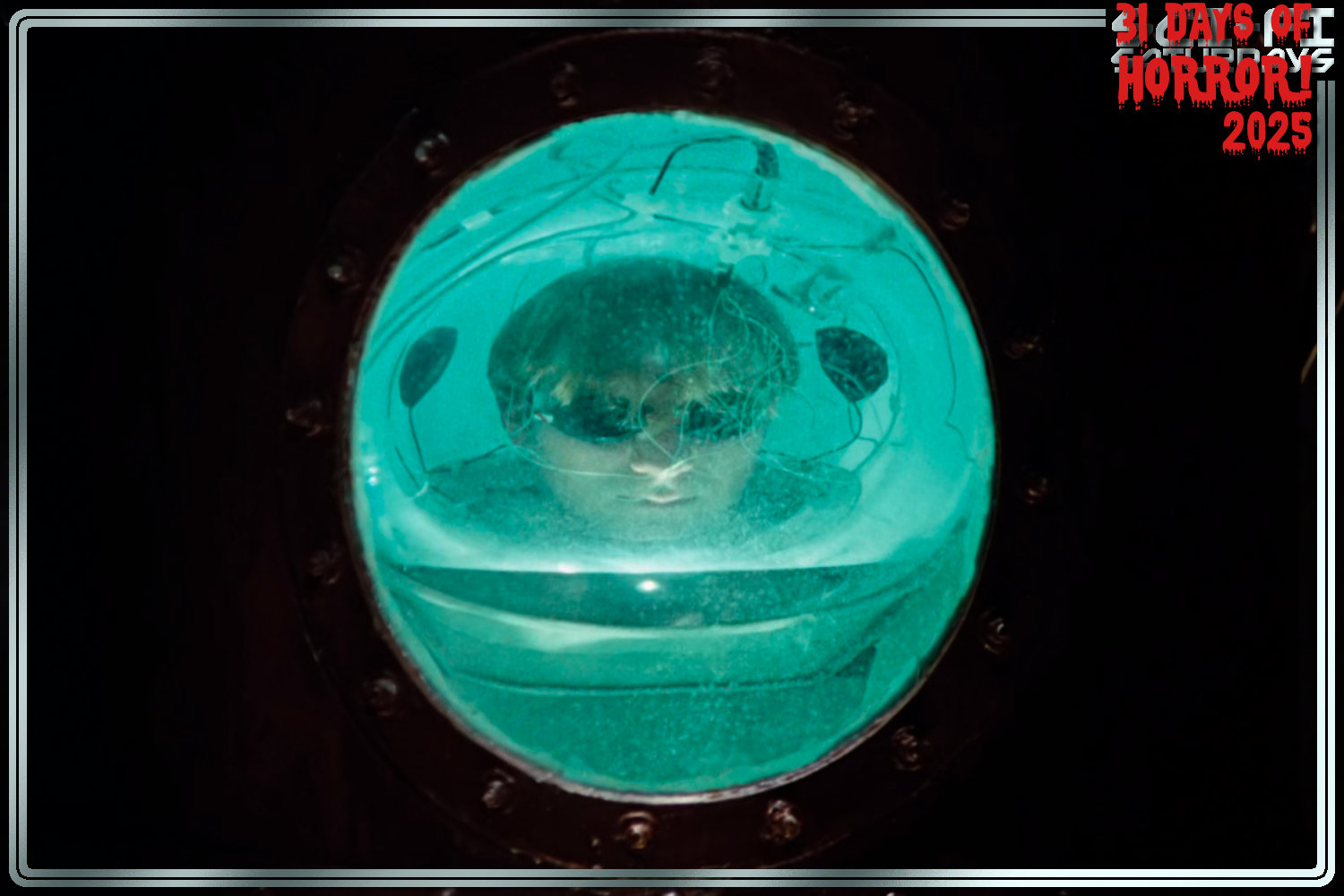
Unable to wait, Eddie goes back into the tank by himself and devolves into a simian-like primal man (Miguel Godreau), who escapes from the tank and kills a campus security guard. The creature runs through the streets of Boston, ending up in the city zoo, where he kills and eats an antelope. A short while later, a naked Eddie is discovered in an animal pen and arrested. Mason and Emily come to bail him out. Emily reviews Eddie’s notes, tapes, and x-rays, and begs with him to stop before any permanent genetic damage can be done. Eddie decides to go back into the tank with Arthur, Mason, and Emily there as witnesses. A bright light emanates from the windowless tank, erupting in a burst of energy, destroying the tank and injuring the men. Emily enters the flooded tank room and pulls a protoplasmic Eddie from a swirling whirlpool of phantasmagoric lights.
They return Eddie to his house, where Emily admits to Mason that she can’t get him out of her mind. She loves him so much that she is unable to move on to other relationships. Arthur is excited by the possibilities of what he’s witnessed, but Mason is still skeptical of the implications. Eddie realizes that he has answered his questions about the final truth, realizing that God doesn’t exist and only humanity is real. He thanks Emily for being his anchor and saving him before he devolved into the nothingness of creation. Suddenly, Eddie reverts into his protoplasmic state, “infecting” Emily with a mass of energy as she reaches out for him. Using his willpower, Eddie pounds on the walls of the hallway to transform himself back to his human state, and cradles Emily, reverting her back as well. They huddle on the floor, hugging each other.
“The final truth of all things is that there is no final truth.” – Eddie

Emily meets Eddie and they immediately hit it off.
History in the Making
Altered States is a heady film about the biggest questions of the universe as told via one man’s exploration of the human psyche. It’s a cutting-edge film that blends science, science-fiction, and horror with counter-culture ideology concerning the expansion of one’s consciousness. This was the first horror film directed by Ken Russell (The Devils, Tommy) and based on a novel by screenwriter and playwright, Paddy Chayefsky (Marty, Network). But you will not find Chayesky’s name credited on the film; rather, Sidney Aaron is the credited screenwriter. This is due to a reported feud between Russell and the author, who felt that once filming started, there could only be one director on the picture. And Russell definitely put his stamp on the film, especially in finding a way to present the bizarre hallucinations that Eddie experiences as a way of pushing the boundaries of cinema at the time. Unfortunately, some of the visual effects are probably the biggest limitation of the film. By current standards, they appear rough and contrived, yet they still manage to get across the idea of Eddie’s psychedelic hallucinations, especially in the later sequences.
At its heart, Altered States is a modern adaptation of Robert Louis Stevenson’s Strange Case of Dr. Jekyll and Mr. Hyde. It’s completely coincidental that last night’s 31 Days of Horror film, The Substance, was also compared to Jekyll and Hyde. This film is much more exact in its representation, featuring a mad scientist (of sorts) who transitions into various other creatures. Instead of an elixir, Eddie makes use of a psychotropic drug, which, in conjunction with the sensory deprivation, allows his body to devolve. Not many films have dealt with anything like this subject matter. There have certainly been films about altered states, just check out any Cheech and Chong film, but connecting it to horror and sci-fi is rare. The pharmacological aspect of the film, with the shaman-like magic, feels similar to elements in The Serpent and the Rainbow (1988), which deals with zombies (Haitian Hougan zombies, not the brain-eating walking dead). Altered States also shares some traits with Eraserhead and Videodrome in terms of body horror and altered consciousness. This film falls into the group of films begun in the 70s that involved the exploration of mystical and paranormal phenomena using science. Horror films such as The Asphyx, Prince of Darkness, and The Exorcist attempt to puzzle out mysteries of life, death, God, and the Devil using modern science and its belief system. Altered States goes the extra yard by declaring that God is truly dead (Time Magazine also said so, in 1966), with science having unlocked the keys to the human condition by uncovering the true and original First Self.

Eccheverria and Eddie meet with the Brujo, an Indian witch doctor.
Genre-fication
Altered States is an important film in the genre of body horror, being one of the first true examples of existential body horror. The definition of the genre didn’t even exist at the time when this film was released, having been coined three years later by Phillip Brophy in his article “Horrality: The Textuality of the Contemporary Horror Film.” But Altered States served as one of the films that defined that term, along with varied titles such as An American Werewolf in London, The Thing, and Videodrome. Body horror is defined by the mutilation and mutation of a body, but in ways different from typical murder or slasher films. The trauma is often caused by experimentation, infection, or primordial regression. The works of David Cronenberg are replete with examples of the genre, such as Scanners, The Fly, and Dead Ringers. Stuart Gordon (Re-Animator) is another popular example. But body horror has existed in various ways since the 1950s. The Blob and Invasion of the Body Snatchers are two early examples of the genre, which can also manifest itself in human experimentation flicks like Sssssss and The Island of Dr. Moreau, or alien infection films like The Incredible Melting Man and Alien. Altered States takes the idea that everyone has the genetic memory of their primordial self locked within the atoms in their body. That beast, or primordial ooze, can be extracted and returned to the present through the use of hallucinogens and the induction of a trance-like state.
This is where the science-fiction aspects of the film come from. These transformations are not brought about with some random elixir that separates the id from the ego. As with Cronenberg’s The Fly, a scientific process is being followed that introduces unexpected consequences. Seth Brundle’s scientist is working on a means for teleportation, when a small housefly inadvertently gets jumbled into the matrix, resulting in a human/fly hybrid. Here, Eddie Jessup is researching cures for schizophrenia, as well as trying to explain the religious allegory experienced by many schizophrenics. His experiments take him on a real trip lined with the mystical nature of ancient hallucinogens. Eddie’s visions invoke elements of Dante’s Inferno, as well as the phantasmagoric stargate from 2001: A Space Odyssey. Russell treats the entire process as an unethical dissertation done by grad students rather than a fantastical or unknowable connection. It’s again a manifesto about the death of God by the scientific community, which can answer all our questions about creation and divinity.

Primal Man equals primal fear as Eddie reverts to a proto-humanoid.
Societal Commentary
While Altered States presents a fantastical story about Eddie’s continuing experimentation within the sensory deprivation tank, it makes good use of his colleagues, Arthur and Mason, as sounding boards for the audience. Arthur, who has worked with Eddie since the beginning, is very enthusiastic about the prospects of their research. After the final transformation, which destroyed the lab, forced Emily to extract Eddie from a primordial state, and rendered Arthur unconscious, Arthur says how excited he is by the research. “I don’t expect to go to sleep for a year.” He’s always been eager to continue this wild and reckless research conducted by Eddie. He’s the true believer in this situation, a real Fox Mulder. On the other side of the fence is Mason. He is a complete skeptic and has never had any faith in what Eddie is doing. He calls Eddie a flake for being so cavalier in his experiments. He doesn’t believe any of Arthur’s explanations for what Eddie has experienced in the tank, and lists his credentials as if somehow reminding everyone that he is a renowned Endocrinologist somehow changes things. But his skepticism only goes so far. Mason seems scared to realize that his scientific belief system may have been shaken. After Eddie’s first experience in the tank, when he comes out with blood on his mouth, the first thing Mason does afterwards is burn the rag that he used to clean up Eddie. He’s not excited to get new information, choosing to destroy any proof that would contradict his beliefs. When he takes the X-ray to the Radiologist, he disbelieves Eddie’s assertion that he has somehow morphed into something else. He is again unprepared for the answer. The doctor shatters Eddie’s worldview by confirming that “this guy is a f***ing gorilla.” Mason still chooses to work with Eddie and may do so for the same reasons Emily comes back later; he’s in love with Eddie.
Now, Mason is probably not sharing the same sexual attraction of love for Eddie that Emily is, but instead looking at him with the respect and admiration of a great mind. Emily, on the other hand, is drawn to Eddie for his weirdness, but also for reasons she cannot easily explain. At this point, Altered States is a love story about two people who complete each other. Emily admits to trying to forget Eddie with other men and one-night stands, but she can’t. She’s drawn back to him. Meanwhile, she thinks that all Eddie can love is his work. After the great cataclysm towards the end of the film, when Emily saves Eddie’s life, she believes she has lost him for good. She thinks he’s in love with God now and that he has consummated his relationship with the deity. But Eddie surprises her by revealing that she is the thing that was able to bring him back to the present. He says that there is no God, and it was Emily who redeemed him, bringing him back from the edge of the pit. When Eddie has his final outburst, and the energy of his being threatens to consume him and infect Emily, it’s his love for her that saves him and protects her. The final words of the film are the one thing Eddie has never said before, “I love you, Emily.”
The one area in which the film tries to pique some interest is in the religious iconography of the hallucinations. Eddie tells stories about how he would see or hear God as a young child until the death of his father. Hearing that his father’s last word was “terrible” destroyed Eddie’s sense of wonder about God. Eddie explains to Emily that his interest in studying schizophrenia is because of the religious visions patients experience due to the disease. His former passions inform his present course of study. Then, when he begins hallucinating under the Hinchi mixture, Eddie begins seeing horrible visions from Revelations and of demonic goat heads. These visions seem to indicate his reconnection to God, but are just a fleeting discovery as he goes even deeper into the hallucinogenic state. A state that erases all mythology of a deity and connects him to the origins of life and the universe within a framework of science.

Eddie loses himself in the darkness, as he slowly loses his grip on reality.
The Science in The Fiction
Altered States implies that the act of depriving oneself of sensory input while under the influence of psychedelic drugs is a gateway to finding one’s true self. While scientific experiments have been performed with both of these things, there has never been any conclusive data released that anyone has reverted to a primitive state. The use of sensory deprivation tanks is a way to isolate an individual from extraneous stimulation, whether that’s auditory, visual, or tactile, and was first used by the public as early as 1972. As shown in the film, these tanks can be vertical or horizontal, as they are filled with fluid, which creates a sense of weightlessness. These tanks have been used for various types of studies, including addiction cessation, hallucinogenic studies, and the effects of sensory deprivation on schizophrenics.
Altered States takes many liberties with the scientific method, including Eddie’s repeated usage of himself as a guinea pig (especially without supervision). His cavalier and often unethical experiments look good on film, but would not fly in the real world. The film does provide some interesting, though probably non-scientific, theories about the evolution of the species. Eddie claims that the atoms in the human body are six million years old, which leads to the “physiological pathway to our earlier consciousnesses.” This is considered genetic memory and is defined as some innate memory that is present without any associated sensory input. For the film, the idea constitutes the ability of the cells within the body to exhibit long-lost traits when properly accessed. This is how Eddie was able to devolve to a lesser humanoid, complete with additional digits on his feet, an altered laryngeal structure, and a primitive fight or flight response. Until William Hurt transforms into another creature, much of this idea of his “other self” appears to have been part of his hallucination. While there’s nothing scientifically that could physically alter a human’s body back to such a state, the idea makes for a wonderfully chilling movie.

“You feel phenomenal acceleration, like you’re being shot out over millions, billions of years.”
The Final Frontier
Eddie’s trip in this film feels a bit like the reverse progression of astronaut Dave Bowman in 2001: A Space Odyssey. In that film, humanity is shown evolving from apes to space-faring men, to Dave evolving further to some sort of Star Child. Here, Eddie regresses backwards as his body changes back to Neanderthal, a protozoan, and eventually some creature of energy. To truly understand what is going on in the film can be difficult to parse in one sitting. The actors often give overlapping dialogue and rattle off lots of scientific jargon rapidly. The timeline moves along quickly, with many time jumps occurring via edits without a substantial realization that we are now years later. But Russell’s imagery provides what audiences will want from this film on first viewing. It’s an unsettling look at the horror of the unknown and the loss of self. The weird hallucinations and startling imagery of Eddie’s primal self are enough to satisfy the curious audience member. This concludes the final 31 Days of Horror/Sci-Fi Saturdays mashup for October. Stay tuned for more horror reviews for the rest of the month, and join us next week as Sci-Fi Saturdays resumes its normally scheduled reviews from the year 2014.
Coming Next


Having grown up on comics, television and film, “Jovial” Jay feels destined to host podcasts and write blogs related to the union of these nerdy pursuits. Among his other pursuits he administrates and edits stories at the two largest Star Wars fan sites on the ‘net (Rebelscum.com, TheForce.net), and co-hosts the Jedi Journals podcast over at the ForceCast network.