
This girl is more human than human!
Alita: Battle Angel adapts a popular Japanese manga telling a futuristic tale of mystery and desire. And for fans of science-fiction, it’s got cyborgs, nanotechnology, and a deadly bloodsport called motorball.
First Impressions
The trailer depicts a post-apocalyptic future where a scientist discovers the head of a robotic girl with her cybernetic brain still intact. He assembles her, treating her as his own daughter, but something draws her towards a sunken vessel. Inside is a different body made of battle armor, which she wears, giving her great strength. This catches the ire of some other person who has three evil cybernetic fighters that get sent after the young girl. It’s a manga-looking live-action film starring Alita: Battle Angel.
Presented below is the trailer for the film.


Alita: Battle Angel title card.
The Fiction of The Film
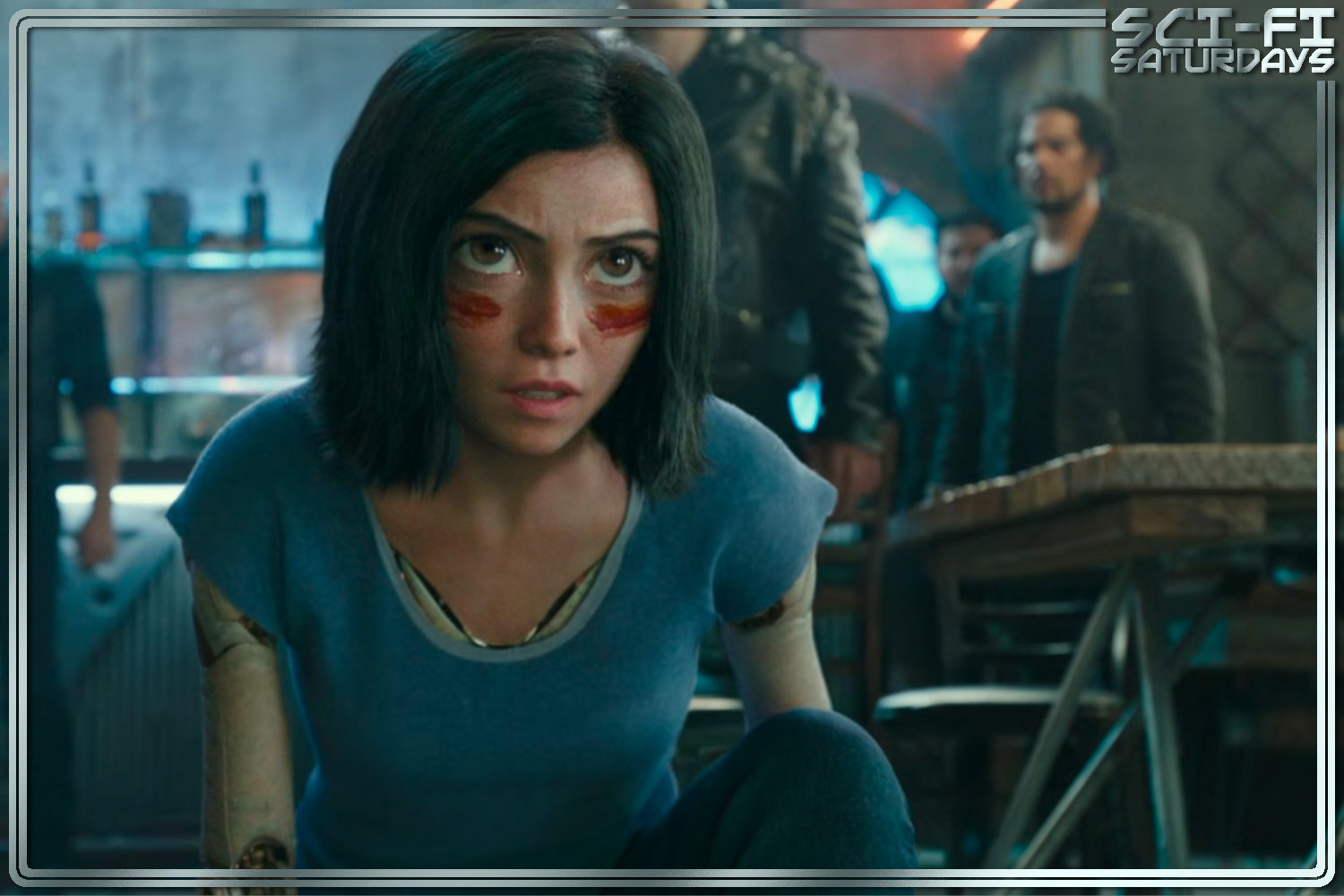
The year is 2563, three hundred years after The Fall, which is the conclusion to the battle between Earth and the United Republic of Mars (URM), when all of the sky cities except Zalem fell to the Earth. Dr. Dyson Ido (Christoph Waltz) wanders through the ejected garbage underneath Zalem and finds a female cybernetic head with an intact human brain inside. Back at his workshop in Iron City, he repairs the cyborg with a body designed for his deceased daughter. The girl awakens with no previous memories and is told her name is Alita (Rosa Salazar), and Ido is her father. She is amazed by the world, experiencing everything for the first time. While wandering through the local area of Iron City, she meets Hugo (Keean Johnson), a boy her age, when he saves her from being run over by a rolling tank-like robot called a Centurion.
Hugo invites Alita to scrimmage a game of motorball, an aggressive skate-based sport involving multiple players and a ball. She takes to it readily, being adept at very physically challenging acts. Ido’s ex-wife, Dr. Chiren (Jennifer Connelly), sees Alita in the street and is taken aback by her body, which she immediately recognizes as that of her deceased daughter. Ido warns Alita not to venture out at night due to a killer on the prowl, cannibalizing cyborg bodies. Could it be Ido Alita wonders, when she sees him return one evening with a wound on his arm. She follows him the next night, but he is not the killer she expects. He is a hunter-warrior, a bounty hunter, trying to stop the rogue cyborgs from preying on weaker ones. Ido is confronted in a trap by three killer cyborgs, but Alita springs into action with unbeknownst combat skills, killing two–Romo (Derek Mears) and Nyssiana (Eiza González)–and injuring a third, the hulking Grewishka (Jackie Earle Haley).
Ido lets her know that her skills were linked to the URM soldiers from over 300 years ago. Alita continues her interest in motorball, attending a match with Hugo. Meanwhile, Grewishka gets his repairs courtesy of Vector (Mahershala Ali) and Chiren. They all work for Nova (uncredited cameo by Edward Norton), who can hijack Vector and Grewishka’s bodies at will and communicate through them. He promises Chiren that she will get what she desires, the ability to return to Zalem. Hugo also works for Nova, via Vector, hijacking cyborgs and stealing their parts for the black market with his crew, which includes Hugo’s friend, Tanji (Jorge Lendeborg Jr.). Hugo takes Alita outside Iron City into the foliage surrounding the city to show her a crashed URM battleship. Feeling a calling, she immediately dives into the water surrounding it and makes her way to the bridge, where the computers respond to her actions. She retrieves a silver cyborg body, called a Berserker, taking it back home and asking Ido to put it on her.

Dr Ido finds some cybernetic parts in a junk pile, beginning the entire story of Alita.
When Ido refuses to upgrade Alita into the most “advanced cyborg weapon ever created,” she rebels and signs up to be a hunter-warrior against his wishes. She then solicits help from other bounty hunters at the local bar, Kansas, to help stop Grewishka. Zapan (Ed Skrein), a seasoned hunter, teases her for her inexperience and youthful demeanor. Alita knocks him down, impressing others. No one will help her because there is no official bounty on the killer. Just then, Grewishka appears, complete with an upgrade (made possible by Hugo’s nighttime work) and attacks Alita. He slices her body up, but is prevented from the killing blow by Ido and McTeague (Jeff Fahey), another bounty hunter with a pack of robodogs. Ido realizes he cannot stop Alita from seeking conflict, but he can help protect her, and installs the Berserker body on her, which adapts itself instantly to Alita’s self-image.
Alita is eager to help Hugo attain the rest of the money he needs to pay Vector for passage to Zalem, not realizing that no one ever returns to the sky city after they have left. She tries out for motorball with her new body. Vector, at Nova’s behest, has set up a $500,000 bounty on Alita, leading to multiple killers playing against her at her tryout. Alita easily handles most of them, but gets a call from Hugo during the event saying that he’s in trouble. Zapan, discovering that Hugo is in love with Alita, has framed the young man for murder and is chasing him down. Alita intervenes, and Zapan tries to turn Alita on Hugo by inducing the hunter-warrior bounty code and stabs the boy to speed things along. Alita drags a wounded Hugo into a nearby church, expressing her love for him. Chiren overhears this and, feeling sorry for her part in the events, helps Alita decapitate Hugo, hooking his head up to Alita’s circulatory system. On her way out, she cuts Zapan’s face off with his sword.
Back at Ido’s workshop, the doctor puts Hugo’s head on a new body. He also reveals, once and for all, that the only way to get into Zalem is to become the motorball Final Champion. And he should know, as he was once from the sky city. Alita confronts Vector, who is taken over by Nova. She tells the architect that she’s coming for him, killing his pawns, Grewishka and Vector, to make her point. Alita finds Hugo missing from Ido’s and discovers him climbing a massive cable to reach Zalem. She begs him to come back with her, as it doesn’t matter where they go, as long as they’re together. He says he can’t let her run from the bad guys for him, just before a massive rotating blade slides down the cable, slicing Hugo into parts. Alita grabs his hand, but he falls to the ground before she can save him. With vengeance in her heart and the skills to back it up, time passes, and Alita (known as the Battle Angel, for “the face of an angel and a body built for battle”) rises to the top of the motorball league. The movie ends with her staring up at the hovering Zalem, pointing her sword at it, letting Nova know she’s coming for him next.
“This is just a body. It’s not bad or good. That part’s up to you.” – Dr. Dyson Ido

Alita and Hugo wonder what it must be like in the sky city of Zalem.
History in the Making
The providence of Alita: Battle Angel is a long story. It began as a cyberpunk manga published between 1990 and 1995 by Japanese writer/artist Yukito Kishiro, and known as Battle Angel Alita. This primary work was eventually followed by two other chapters, Battle Angel Alita: Last Order (2000-2014) and Battle Angel Alita: Mars Chronicle (2015-2025), all of which tell the story of Alita, an amnesiac cyborg in a dystopian future. The manga caught the interest of filmmaker Guillermo Del Toro, who shared it with filmmaker James Cameron. Cameron was interested in the project, going so far as to model the lead character in the early 2000s television series he produced, Dark Angel, after Alita. By 2003, Cameron had announced that the film, now entitled Alita: Battle Angel (partially due to all of Cameron’s films beginning with either the letter ‘T’ or ‘A’. Look it up!), was being prepared along with another trilogy he was working on. That other trilogy became known as Avatar, and everyone knows what happened with that. The work on Avatar superceded that of Alita, pushing the manga-adaptation further back on the slate–even though Cameron and his producing partner Jon Landau said it was eventually coming. By 2015, filmmaker Robert Rodriguez (El Mariachi, From Dusk Till Dawn, Sin City) was brought in to direct the film, leading to the early 2019 release date.
Like other prominent sci-fi films, Alita: Battle Angel has a strong core of devoted followers. And it’s easy to see why. It’s a complex and detailed film of a young girl’s call to adventure, complete with dozens of world-building elements to spark viewers’ imaginations. It uses elements of sci-fi dystopias, fuses them with cyberpunk themes, and sets up a potential sequel, which, unfortunately, has yet to materialize. It has the feeling of some of James Cameron’s other sci-fi work, with detailed worlds and cultures that are only hinted at and glimpsed in the finished film. These teasers of a bigger story are a great way to encourage fans to seek out the original manga or other similar stories to satiate their appetite. Alita also has a lot of Robert Rodriguez’s style infused into it. He is a director who can work on low-budget films, filling them with the feel of a larger-budget picture. He is equally comfortable with character development and visual effects, generating both for this film. Finally, Rodriguez, a Mexican-American, often works with other Hispanics as the leads in his films. Actors like Danny Trejo, Jessica Alba, and Antonio Banderas. Here, he casts Rosa Salazar and Keean Johnson in primary roles, giving the film a different multicultural look than might be fitting of a manga adaptation.

Hugo, and his friends, take Alita on to see a crashed spaceship from a 300 year old battle.
Genre-fication
Alita: Battle Angel draws on decades of sci-fi elements (and some other more traditional genres) to make the world of Iron City look like a lived-in futuristic world. It’s one of the few futuristic dystopias that does not appear as a bleak, washed-out, or dark technocratic nightmare. Instead, it’s often sunny, brightly lit, and peopled with genuinely happy people (at least when they’re not being preyed on by the lords of Zalem). While Iron City can be a harsh place with robotic Centurions racing through the streets, the sun is often shining, and youngsters are allowed to play mock games of motorball in the courtyards. With the people that Hugo knows, he’s able to take trips outside of the city, which holds many wonders. Trees and plants abound along with a lovely river and lake, which holds the crashed URM ship that Alita finds. It doesn’t seem like a horrible place to live. It’s not the wastelands of Mad Max, or the oppressive post-apocalyptic nightmare of The Matrix. The opening piles of garbage are even reminiscent of the lighthearted WALL-E. Only the nighttime seems to hold dangers for the citizens, as cybernetic killers stalk their victims.
Cybernetic implants seem to be, to this future world, what smartphones are to the early 21st Century. Everybody, and every body, seems to have some sort of augmentation, from replacement limbs to fully synthetic bodies, with only the smallest amount of an organic being left. The URM agents, of which Alita is one, are fully synthetic and adaptable cyborgs with the brain of a human. This is different than classical cyborgs, which have either been mostly human (as with Cyborg and Universal Soldier) or fully robotic and synthetic (like the Replicants in Blade Runner). Every robotic-looking character, with the presumed exception of the Centurions, has at least some factor of humanity left within their shells. There’s even a hint of the fairy tale story Pinocchio within the film, as Alita wants to be more than what she is, at least for her “father,” Ido.
Alita: Battle Angel also adapts a version of the violent bloodsport film Rollerball (and its 2002 remake), with its version of motorball. This is a game where mayhem and death are encouraged and rewarded. Unlike Rollerball, which is played by humans, there’s no way an ordinary flesh-and-blood human would survive more than a few moments in the arena with some of the monstrous creations that play the game. It’s more Running Man in that regard, as contests seem to get violently removed every match. The lure that the winner of the motorball championship will get a free pass to Zalem seduces players into getting radical body modifications to compete in the show. Parts such as wheels grafted onto their feet, or whip-like protuberances that are eventually stolen by Hugo and his team and regrafted onto Grewishka.

Alita battle Grewishka, who has recently upgraded his body.
Societal Commentary
The film deals with some basic and very common themes about dichotomy: good and evil, haves and have-nots, heaven and hell, human and more than human. Basic, but not simple. Much of the story’s themes derive from the original manga, but Rodriguez really sells the contrast. There’s the young Alita, who has no real memory of where she came from, continuing her mission to stop the injustice of Zalem. As an ex-resistance fighter from the URM, her goal was to stop people like Vector and Nova. Even though she cannot remember her past, she seems compelled to continue the work. This is also the battle between the rich utopia of Zalem and the urban dystopia of Iron City. Even though life is not constantly oppressive in Iron City, everything that happens to these people is controlled, in some form or another, by Nova and Zalem. Whether that’s via the predominance of motorball in the area or the control over the cyborg killers when Nova was able to take over their bodies, that omnipresent feeling is always there.
Then there are the obvious parallels of Heaven and Hell. The title of the film is alluded to by the motorball announcer, who says that Alita has “the face of an angel with a body built for battle,” hence, battle angel. She is a character who has fallen from Zalem, literally, after being cut down in battle. Zalem is identified as heaven, not just in its vertical space above Iron City, but also by Vector, who says he would choose to “rule in Hell that serve in Heaven.” The parallels seem quite overt, to the allegory with characters dreaming of ascension towards Zalem, and other characters (like Ido and Chiren) being thrust out–exiled–for whatever reason. Extending the metaphor, Nova would then be God, which is an apt title for a character who appears to have omnipotent powers and the ability to control others at will. Yet, no one gets what they want in this film. Nova wants to snuff out the last URM soldier in Alita. Chiren and Hugo want to make it to Zalem. Ido wants his daughter back. And Alita, she wants to be happy and spend her life with Hugo. It’s a tragic tale that reminds viewers what it means to be alive.
Alita: Battle Angel also pursues the common cyberpunk themes of what it means to be human. This is a common theme in several manga, including the Ghost in the Shell series (and its live-action remake). Both concern female cyborgs who have lost the ability to know their origins. They struggle with existing in the real world and finding their place amongst other humans. Alita finds herself attracted to Hugo, but also ashamed at the thought that she may be so different from him that he finds her repulsive. Surprise, he doesn’t. It’s the Hero’s Journey for Alita, with her coming of age and understanding her origins and her place in society. As a hybrid of the best of humanity and superior technology, she exemplifies the one person who can do things that nobody else can, such as return to Zalem. Any sequel to this film seems like it would be about her bringing the fight to Nova and liberating society from its oppression. At one time or another, every person dreams that they can be the one to create big change, and sci-fi stories like this are the ones that provide that wish fulfillment.

Alita and Hugo share a tender kiss, showing that love is blind to its surroundings.
The Science in The Fiction
The science of Alita: Battle Angel is much more advanced than our present cybernetic abilities. Many characters are only minimally human, with the majority of their bodies having been replaced by mechanical parts. But this is similar to many other stories, whether it’s the Cylons of Battlestar Galactica or the Replicants of Blade Runner. What seems the most intriguing, and is never answered in this particular story, is how the URM developed such superior technology, yet still lost the wars against the sky cities. Alita finds the downed URM craft with the advanced Berserker body, which she eventually is grafted onto. This body has nanotechnology and other fancy pseudo-scientific properties that allow it to alter itself to reflect the mind inside it. This body provides Alita with extraordinary power and abilities, greater than those of the other cyborgs, making her unstoppable. If the URM had this technology, how did it lose the war? The rich backstory of the film, which is only touched on, creates a desire to read the source material to get answers to many of these questions.

Zapan tries to spur Alita into killing her boyfriend, Hugo.
The Final Frontier
While Alita: Battle Angel might feel somewhat simplistic in terms of its story, it’s a film with so much else going for it. The visuals are stunning, with a lot of world-building going on. It seems like a bigger scope of a film than it is, with lots of smaller segments stitched together, probably in a similar way to the chapters of the manga. Prior to watching the film, all I knew was that it was based on a Japanese comic and that the main character had amazingly huge eyes. This element does take a little getting used to. There is a bit of the Uncanny Valley in Alita’s appearance, which was done as an homage to her origins from the manga, and also to set her apart from the various other cyborg characters in the film. At some point, that realization no longer matters, and the audience becomes wrapped up in her adventure as she discovers her purpose and grows as a character. A sequel would be a welcome adventure, but has yet to materialize. But not to worry. If recent films have taught us anything, a franchise can continue successfully after many years of being dormant. Just like Alita in the scrap pile of Iron City.
Coming Next


Having grown up on comics, television and film, “Jovial” Jay feels destined to host podcasts and write blogs related to the union of these nerdy pursuits. Among his other pursuits he administrates and edits stories at the two largest Star Wars fan sites on the ‘net (Rebelscum.com, TheForce.net), and co-hosts the Jedi Journals podcast over at the ForceCast network.