
God, a red nugget, a fat egg under a dog. Go hang a salami, I’m a lasagna hog.
Strap in, hold on, and get ready for the weirdest film from Christopher Nolan since Inception. Tenet serves as the final entry in the current incarnation of Sci-Fi Saturdays. It’s a film that looks forward to look back, creating a time loop of infinite complexity, and blending the genres of science-fiction and spy dramas into an instant classic.
First Impressions
The trailer for Christopher Nolan’s newest film starts like some spy drama, with a man sneaking into a building, getting captured and killed, only to be “resurrected” by a man in a suit – presumably working for him now. There’s mystery and intrigue as the man investigates something that will prevent World War III. There are also some strange shots that appear to be played back in reverse motion. As with many Nolan films, it’s an intriguing trailer, with just a one-word title: Tenet.
Presented below is the trailer for the film.


Tenet title card.
The Fiction of The Film
On “the 14th,” a CIA operative, known only as the Protagonist (John David Washington), takes part in a rescue operation at the Opera house in Kyiv, disguised as a Ukrainian police operative. He retrieves an odd-looking device before being captured and interrogated. The Protagonist opts for a suicide pill, but wakes up in a hospital under the watchful eye of Fay (Martin Donovan), his boss, who introduces him to a gesture of interlaced fingers and the matching code word “Tenet.” This grants the Protagonist entry into an organization of the same name, where Barbara (Clémence Poésy), a scientist within the organization, is studying the inverted entropy of bullets and other objects. She demonstrates how these objects appear to travel backwards, such as a bullet “being caught” by the gun that fires it, or a cog suddenly leaping from a table into someone’s hand who has “dropped it.”
The Protagonist travels to Mumbai, meeting with his contact, Neil (Robert Pattinson), and preparing for an introduction to Sanjay Singh (Denzil Smith), an arms dealer specializing in inverted ordinance. However, he is just a cover for the true dealer, his wife, Priya (Dimple Kapadia), who also works within Tenet. She provides him with the name of Andrei Sator (Kenneth Branagh), a Russian oligarch who smuggles inverted weapons by communicating with unknown individuals in the future. The Protagonist’s next stop is with Sir Michael Crosby (Sir Michael Caine), a British Intelligence officer, who informs the agent that his best chance to meet Sator is via the man’s estranged wife, Kat Barton (Elizabeth Debicki). Kat explains to the Protagonist that Sator bought a forged Goya painting that she falsely authenticated, and is using it to blackmail her. She recounts an argument she had with Sator a week before in Vietnam, where she later saw another woman diving off his boat. The Protagonist offers to steal the painting from the freeport at the Oslo airport in exchange for an introduction to Sator.
Neil dictates a plan to crash a 747 jet into the Oslo freeport, distracting the authorities, while he and the Protagonist steal the painting from an intricate vault built by Rotas Construction. During the heist, the Protagonist and Neil discover two small rooms, separated by a window and linked by a rotating “turnstile.” A divided rotating bin activates, and two masked individuals exit, one on Neil’s side, who moves through time normally, and one on the Protagonists’ side, who is inverted. A fight ensues, but both men escape. Priya explains that this device is future tech, which is yet to be invented, and is a way to invert humans within the world. She suggests baiting a trap with a cache of plutonium-241 to draw Sator out. Meeting with Sator and Kat on the Amalfi Coast of Italy, the Protagonist proves his loyalty to Sator and is hired to steal a briefcase of Pu-241 from a carrier in Tallinn.

The Protagonist’s boss offers him a simple gesture, and a name, “Tenet,” as part of his new mission.
The Protagonist wants Kat’s help in the handoff of the material, trusting her not to help Sator. A complex and sometimes confusing highway chase yields the orange case containing the Pu-241. Opening the case, the Protagonist realizes it’s another device, similar to the one he found in Kyiv, instead of the radioactive isotope. During a chase involving inverted vehicles, the Protagonist is forced to give the device to Sator to free Kat, who the oligarch is holding hostage. The Protagonist manages to save Kat, but both are taken to Sator’s nearby warehouse, where an inverted Sator threatens them both before shooting Kat with an inverted bullet. Neil, along with a Tenet military team led by Ives (Aaron Taylor-Johnson), arrives as Sator and his men depart. Seeing that the only way to save Kat from the wound is to invert her for it to heal, the Protagonist, Neil, and Kat enter Sator’s warehouse turnstile and travel backwards a week, exiting at the freeport in Oslo.
During the Protagonist’s reversion, it’s revealed that he was the masked Antagonist who fought Neil and himself a week before in the freeport. Priya reveals that she used the Protagonist to draw out Sator, who now has all nine pieces to the “algorithm,” a device he plans to use to reverse the entropy of the world, potentially destroying everything. Tenet plans to steal the algorithm when Sator brings all nine pieces together. The Protagonist takes Neil, Ives, and others onto an inverted boat, traveling back several weeks to “the 14th” where they plan to steal the algorithm and prevent Sator from knowing that time has changed, lest his future masters get word and alter the past. While the Protagonist and others exit the turnstiles, Kat goes back a little further, hoping to confront Sator on his boat in Vietnam and ensure that he does not use his planned dead man’s switch to trigger the algorithm prematurely.
The Protagonist listens to Ives describing the temporal pincer movement they plan. Ives and the Red Team, which includes the Protagonist, will move forward in time, while the Blue Team, including Neil, runs backwards. They plan to make it appear that the algorithm was destroyed at the Stalsk-12 hypocenter, when in reality they have taken it at the last minute. Ives and the Protagonist take off into an underground mine to retrieve the algorithm while normal and inverted forces fight in a chaotic battle above. In Vietnam, Kat kills Sator when she receives the word that the device has been retrieved, and dives off the boat, realizing she was the other woman her past self saw. An inverted Neil sees a trap and tries to warn the Protagonist, but must revert in order to do so. Within the mine, the Protagonist recognizes an orange string with a washer on a dead operative’s backpack–it’s the same one that saved him from getting shot in Kyiv on “the 14th.” The dead inverted body arises, revealing it’s Neil from some future moment. Blue Team Neil saves Ives and the Protagonist, who all agree to separate the algorithm and hide the components. Neil reveals that he has been working for the Protagonist the whole time, as he was originally the man who recruited Neil. The Protagonist kills Priya, protecting Kat and her son from being murdered by Tenet, and takes over the operation for future missions.
“We live in a twilight world…And there are no friends at dusk” – The Protagonist & Well-Dressed Man

Neil and the Protagonist plan the first big action set piece of the film…
History in the Making
Welcome to the final article in the current run of Sci-Fi Saturdays, which now features 330 essays spanning 71 years of science-fiction cinema. From Rocketship X-M (1950) through today’s article on the 2020 sci-fi/action headscratcher, Tenet. Tenet, not to be confused with the Roman Polanski film, The Tenant, is Christopher Nolan’s 11th film and truly one of his most inspired. That’s saying something, coming from a filmmaker who has redefined genres in almost every film. Memento changed the audience’s relationship to non-linear storytelling. Inception messed with the nature of reality and time. Interstellar redefined the sci-fi space odyssey for the 21st Century. And Tenet challenged the perceptions of time in a big-budget action/spy film. As a film, Tenet did something that no other type of media could accomplish by mixing footage shot both forwards and backwards to tell its story. According to Looking at the World in a New Way: The Making of Tenet, the way that Nolan conceived the fight scenes was immensely complex. In a sequence of two people fighting, the fight was conceived normally, but then one of the performers was asked to watch the fight backwards and learn how to do those moves going forward. Then, when the film is reversed, the same fight scene will exist, but with one actor performing the stunts forward, and the other going backwards. It’s a challenge to put an exact finger on which shots are projected forward and which are backwards, as they get mixed together in the edit. This, of course, is also key to the thematic elements of Tenet as well.
A tenet is defined as “a principle, belief, or doctrine generally held to be true.” The word is also a palindrome, which is a word that can be read the same forward as backwards. Both these elements are core concepts within Tenet, the film. It’s a film that takes what the audience takes as truth about the way films are made and watched, and completely shatters that belief. In a film, which opens with a CIA operative uncovering lies perpetrated on lies and discovering the existence of a previously unknown global organization keeping the world safe, it’s quickly learned to take nothing at face value (which is also a safe way to watch any film by Nolan). The beliefs of all the main characters are put to the test as truth becomes lies, and the impossible becomes truth. Tenet also plays with cinematic time. Rather than having a standard chronological unfolding of the events of the film, it’s a mix of non-linear elements, flashbacks, and time running in reverse–even as the characters progress forward. It is the only film that starts and ends on the same date, in two different locations, with characters who have progressed through full arcs. Tenet becomes the spiritual and physical successor to Nolan’s Memento, which starts and ends at the same moment, but arrives there via time travel and other physical impossibilities rather than through a non-linear editing style.

…which is crashing a full size jet airplane into a building!
Genre-fication
While Tenet is a science-fiction film, that’s only a small fraction of its genre. First and foremost, it’s an action and spy film in the vein of Mission: Impossible or James Bond, but with more eccentric gadgets and physics-bending technology. This type of genre has its own term applied to it called spy-fi, a portmanteau of sci-fi and spy genres. Tenet may be the most extreme of this particular genre, which leans from classic spy thrillers like the ones mentioned above, with their technologically advanced gadgetry and situations, to more recent and extreme examples such as Men in Black, and the television series Alias and Agents of SHIELD. Interestingly, Agents of SHIELD is the only other entry to include time travel as part of its storyline, making it the most similar to Tenet even if tangentially. Removing time travel as an essential element of the story, Tenet has everything else to make it seem like a classic spy-fi film. It has a powerful multinational organization tasked with protecting the world, attempting to take down a maniacal oligarch who threatens the safety of others, as seen in numerous Bond films. There is a mysterious device that can provide whichever side wields it great power, similar to the Rambaldi device in Alias. Speaking of mysterious, how much more mystery can be found in a main character whose name is never spoken? All press material surrounding the film only refers to Washington’s character as ‘the Protagonist,’ which he certainly is. It’s both on the nose, and intriguingly obtuse at the same time. Tenet also uses the travelogue-style of location shooting seen in many big-budget spy thrillers. Denmark, Estonia, India, and Italy all feature heavily in the finished film. And in these exotic and beautiful locations, Nolan includes amazingly intricate stunts and breathtaking photography to create a grand scope to the finished film. It really is an homage to the modern spy thriller with an inspired Nolan twist to it.
The science-fiction aspect of Tenet is what really sets the film apart from everything else. Nolan creates a time travel device that feels more real and potentially boring than anything to date. There’s no giant plasma sphere that drops a naked time traveler into the past, nor a silver DeLorean that leaves flaming tire tracks when it reaches 88 miles per hour. In Tenet, if the characters want to travel into the past, it takes them just as long going backwards as it did going forwards. For the main temporal pincer move, where the Protagonist, Neil, and Kat all travel backwards in time, it takes them two weeks to go two weeks into the past. This could be an extremely boring type of time travel, but Nolan spices things up by including backward-traveling characters fighting forward-traveling characters. In fact, the palindromic nature of the film, with the ending at Stalsk-12 taking place at the same time as the Kyiv Opera House attack from the opening, creates a new and fun way for audiences to understand the film. As with the Russian nesting doll structure of Nolan’s Inception or the paradoxical nature of Interstellar, Tenet is a self-contained story elegantly presented, which works either forward or backwards. It even has a brief allusion to one of the top five greatest films of all time, Casablanca. At the end of the film, as the Protagonist and Neil part ways (with the audience knowing Neil will soon go back in time to sacrifice himself for the Protagonist), Neil says “I think this is the end of a beautiful friendship,” mimicking the words of Humphrey Bogart’s Rick who says, “Louis, I think this is the beginning of a beautiful friendship.” And while it is the end, at this time, maybe at some point in the future, our future, these two will reteam for another exciting adventure.

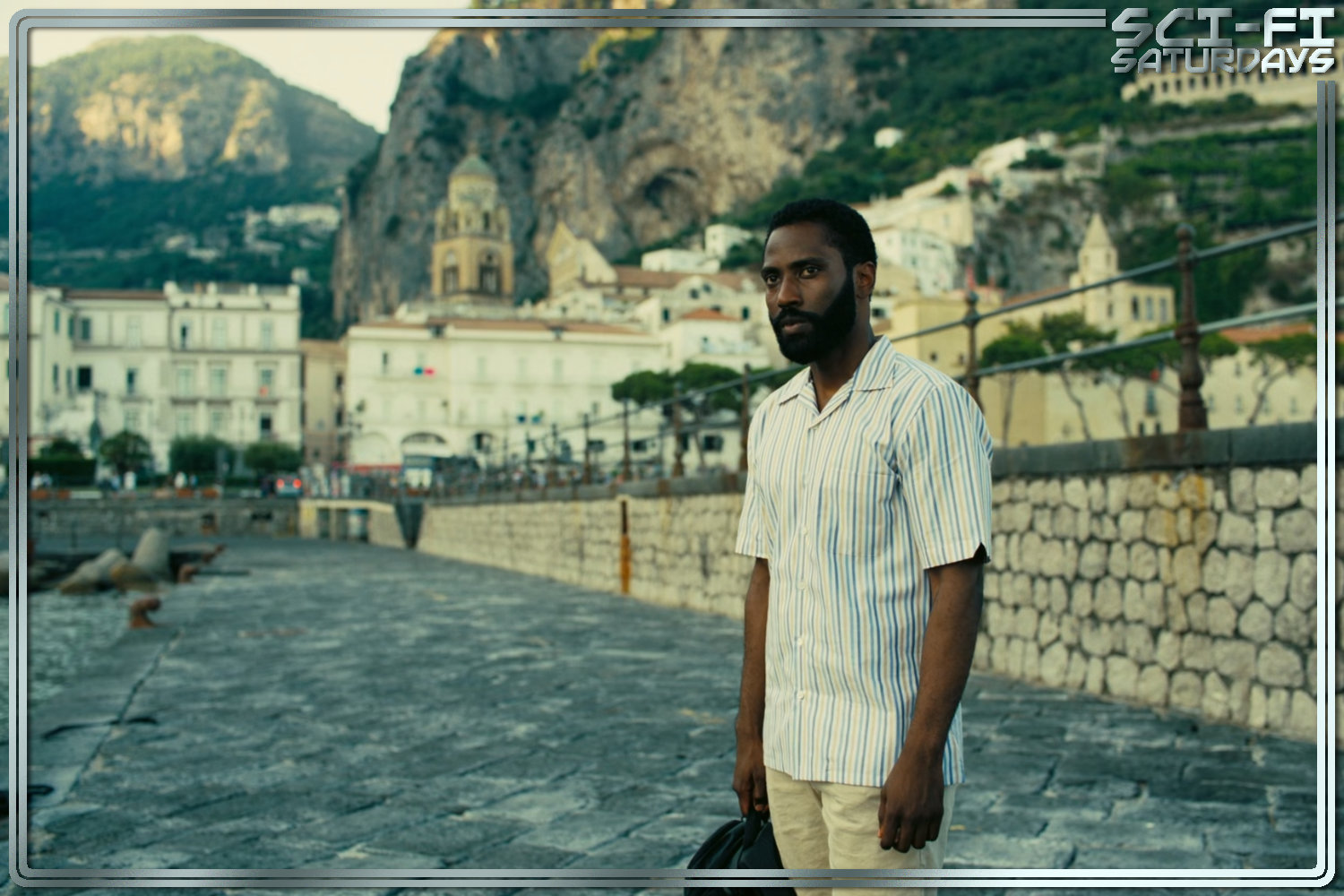
Kat and the Protagonist on the Amalfi Coast, one of the many stunning locations from the film.
Societal Commentary
The world of Tenet, like any good spy film, exists in a world outside our own. This is confirmed by the code phrase used between the CIA and their compatriots, quoted above. The spies live in a “twilight world” where there are no friends at “dusk.” It’s an engaging metaphor for how they work in the shadows in an ever-darkening world. Their twilight world reflects the setting sun (of freedom or democracy), harkening the real twilight, which is the fading of light before full darkness and night. Dusk is the point marking the end of the light, just before darkness, where no friends exist, leaving the operatives on their own. It’s a time when anything can happen, and things are not what they appear. That’s why the series The Twilight Zone chose a name from the same time of day to tell stories of strange and fantastical events.
Tenet also deals with the issue of trust, as does any good spy film. The Protagonist is introduced to the fact that things are not what they seem early in the film when the suicide pill he takes turns out not to be what he thought it was. It doesn’t actually kill him, but his old persona dies, as he has now been recruited into a new depth of espionage within the Tenet organization. He is introduced to Neil, who appears as an affable and charismatic character, but loses faith and trust in the man after the loss of the algorithm in Tallinn. Not having the full picture yet, he believes that Neil is a mole for Sator within Tenet, when in fact the inversion of events provides Sator with everything he needs. Throughout all of this, the Protagonist never stops his empathetic and moral compass from pointing him in the correct direction. He agrees to crash a plane into the Oslo freeport as long as no one is unnecessarily injured. He plays spy games, but refuses to sacrifice people, like Kat, just to achieve the upper hand. The Protagonist trusts Kat to do the right thing, not because he has some deep insight, but because he knows how much she hates Sator, motivating her actions in a way he can foresee. And even by the end of the film, the Protagonist speaks with Priya and says that he’s taking her on her word not to kill Kat or her son. After everything he’s seen, he still wants to believe and operate on the trust of others. While some might be led to cynicism, he carries on with the belief that others are doing the right thing, at least until they prove to him otherwise.
Finally, as with any film about time travel, the elements of fate versus free will are debated. While some time travel films, like Edge of Tomorrow, argue some amount of free will within a larger pattern of predeterminism, Tenet comes down firmly on the side of “what happened, happened.” If the actions of every character were not set in stone, whether motivated internally or by some external force, how would the elements of inversion work as they do? Things must work out as they always have in order for the elements of the film to unfold as they do. Neil must save the Protagonist in the opera house in Kyiv. The Protagonist must lose the piece of the algorithm in Tallinn. And Kat must always see another woman diving off of Sator’s yacht. These things happened, and they will always happen again, no matter how many times the events are revisited. It’s a great metaphor for film. Every time Tenet, or any film, is watched, the events of the movie are not altered. B always follows A, and scene 2 follows scene 1. Tenet just adds an extra layer of inversion, showing that there may have been people moving backwards through events that were already depicted, thus influencing the outcome in varied, but always set, ways.

Sator would make for an iconic, and formidable, villain in any spy franchise.
The Science in The Fiction
Tenet’s main precept is that entropy (the loss of energy to the system) can be reversed. An explosion in our world releases a large amount of destructive energy. If somehow physics were to allow that to happen in reverse, a concussive blast would be collected (not released) into a single location. The best example of this is during the siege at Stalsk-12, where the Blue and Red teams blast a derelict building with RPGs at the same time, one from the normal flow of time and one from an inverted timeline. The resulting event appears to reconstruct and then demolish the building. The Protagonist is instructed on the precautions to take within an inverted timeline, such as wearing his special breathing mask, since his inverted lungs can’t process oxygen the same way as in the normal flow of time, and be aware of fire because the reversed entropy of the flame would give him hypothermia. It’s safe to say that inverted physics are tricky, and the film is not meant to really explain why things happen like they do (even if Nolan did consult with physicist Kip Thorne on what may or may not be possible). At the end of the day, the conceit that when inverted, the wind would feel as if it were pushing someone along while running (rather than blowing in one’s face) just makes for a cool premise, which is all that Nolan wants to put on film.
The other fun tidbit of Tenet is the use of the elements from the Sator Square. This is a clay tablet found in the ruins of Pompeii that contains five palindromic words: SATOR, AREPO, TENET, OPERA, ROTAS. It has been the subject of much research and debate. Is it some ancient mystical chant, or just some Romans having a good time with word play? Maybe it was just an early code used to identify people within some secret society? Nolan was taken with the idea, which fits into the palindrome themes of the film. He uses each word in the square as an element in the film. Obviously, Tenet is the title of the film and the secret organization that the Protagonist works for. Sator is the antagonist of the film, while Rotas is the name of the company he used to build the inversion turnstiles. Arepo is the name of the forger who created the Goya painting for Kat that got her in hot water with her husband, with Opera simply being an actual opera house at the beginning of the film. The Sator Square becomes another fun bit of the real world placed into one of Nolan’s films as a way of suspending disbelief in whatever strangeness is happening. It’s akin to the appearance of real-life inventor and scientist Nikola Tesla being included in The Prestige. Because if this real thing can exist in this bizarre world, maybe these weird things are possible in some way.

Priya thinks the Protagonist is unready to accept what Tenet has to offer. Unfortunately, he’s already in control.
The Final Frontier
Tenet continues Christopher Nolan’s groundbreaking cinematic streak. He uses cinematic film to play with the notion of time, showing audiences things that they would be unable to see with their naked eyes. And even though other films have used slow motion or reverse motion as effects in the past, Nolan puts them together in a new way, using clever editing to hide the method from the audience. In the end, he creates a new language in the filmic medium. He also teases his next film within Tenet. When Priya and the Protagonist are discussing where the algorithm has come from, she compares the scientist who created it to Robert Oppenheimer, the man behind the atomic bomb. Three years after the release of Tenet, Nolan released his biographical epic on none other than Oppenheimer. An interesting tease, and probably more than just a coincidence. As a filmmaker, Nolan picks projects of varied backgrounds that he feels passionate about to produce. Regardless of their subject matter, they all have something to say about the human condition and the modern world in which we live. And, if we’re lucky, they also spark a chord with the audience watching them. Tenet continues to awe and inspire audiences who look for deeper meanings in its sequences. I wonder if watching it backwards while listening to Pink Floyd’s Dark Side of the Moon would mean anything?
This concludes the current run of Sci-Fi Saturdays. The series began over seven years ago, in 2019, with the goal of looking at iconic, fun, and genre-defining science-fiction films. The articles started with movies from 1950 and have progressed chronologically through the years, finally reaching a culmination in 2020. Seventy-one years of space adventures, dystopian futures, killer cyborgs, and other weird events. The series is ending now, five years behind the present-day films, because it’s difficult to see the impact that an individual film might have on the genre without a little breathing room. There will still be more sci-fi articles coming in my 31 Days of Horror series this October for fans who enjoy sci-fi/horror mash-ups. A huge thank you to Joe Tavano at Retrozap.com for believing in me and my idea for this series. And thanks also to everyone who has read, shared, and commented on my 330 articles over the last seven and a half years. It‘s been a fun ride. So long, and thanks for all the fish.
Coming Next


Having grown up on comics, television and film, “Jovial” Jay feels destined to host podcasts and write blogs related to the union of these nerdy pursuits. Among his other pursuits he administrates and edits stories at the two largest Star Wars fan sites on the ‘net (Rebelscum.com, TheForce.net), and co-hosts the Jedi Journals podcast over at the ForceCast network.