
Let’s see if we can get you into something a little bit smaller.
Downsizing seems to reinforce the phrase, think globally, act locally. It’s about a man trying everything he can to make himself happy by trying the newest fad, only to discover that what he needed was already within himself. That, and it’s got some cool shrinking technology.
First Impressions
This trailer reveals that the world is faced with overpopulation, but one scientist has devised a way to shrink people to take up less space and consume less food. A man and his wife attend a seminar about the procedure and decide to invest in this new world, where everything is a fraction of the size of normal. They are able to live in special communities where everything seems like it is for regular-sized people. It’s quirky and a bit goofy-looking. A Talking Heads song asks, “How did I get here?” Well, you signed up for Downsizing, man.
Presented below is the trailer for the film.


Downsizing title card.
The Fiction of The Film
At the Edvardsen Institute in Bergen, Norway, Dr. Jørgen Asbjørnsen (Rolf Lassgård) makes a stunning discovery. Five years later, at a Human Scale and Sustainability talk, his partner, Dr. Andreas Jacobsen (Søren Pilmark), reveals the newest solution to the overpopulation problem, shrinking individuals. Jørgen, his wife Anne-Helene, and 36 other volunteers went through the irreversible process 4 years ago and live in a community in Norway. Their total output of garbage in four years is about half a trash bag. Ten years later, downsizing, the colloquial name for the shrinking process, is common, and downsized communities have sprung up around the world. Paul Safranek (Matt Damon) and his wife Audrey (Kristen Wiig) are eking out a meager existence in Omaha, but yearn for more.
At a high school reunion, Dave & Carol Johnson (Jason Sudeikis & Maribeth Monroe) show up, shrunken, much to the amazement of the guests. Paul gets more information about downsizing from Dave, and he and Audrey decide to move into Tony Dale’s Leisureland in New Mexico. Meeting with their sales rep, they discover that their $152,000 of equity buys them $12.5 million in downsized dollars. Paul is taken back for the process before Audrey and is readied for the procedure. He is sedated, all his hair shaved off, and any dental implants removed. After the procedure, he awakens in a recovery room, where he gets a call from Audrey, who admits she chickened out at the last minute. Upset, Paul has no choice but to continue with the check-in process, moving into a giant mansion by himself. He watches a news story on television about the dangers of downsizing, with the newscaster fearing immigrants or terrorists sneaking into the country. The story tells of a TV box full of dead Vietnamese dissidents who escaped to America after being miniaturized for their crimes by the government. The lone survivor was Ngoc Lan Tran (Hong Chau).
A year later, Paul finalizes his divorce from Audrey, has moved into a modest apartment complex, and works at a call center for Land’s End. He has attempted dating a single mom (Kerri Kenney), but broke up with her. His upstairs neighbor, Dusan (Christoph Waltz), a profiteer, throws wild parties, which Paul attends one night. At the party, he hangs out with the downsized nouveau rich and famous, like Little Ronni (Cameron Geddes), the first downsized baby born (not a young adult), and Konrad (Udo Kier), a flamboyant yachtsman. The next morning, he recognizes one of the female cleaning crew as Ngoc Lan. She appears to be having trouble with her prosthetic leg, which she received after her trip to America. Paul, a former occupational therapist, offers to help her fix her leg. She takes him up on the offer and immediately brings him back to her apartment, in a slum outside the walls of Leisureland. Paul accidentally breaks her leg while trying to repair it.

Jørgen reveals his shrinking technology to the world.
Feeling guilty, Paul begins helping Ngoc Lan out with her cleaning duties until her leg can be fixed. He finds out that she was jailed in Vietnam for protesting the flooding of her village when the government erected a dam. She fled the country for a better life. Paul also assists her in bringing leftover food to the neighbors of the slums where she lives from the homes they clean and local Leisureland restaurants. After two weeks of performing these duties with her, they returned to clean Dusan’s house. The profiteer informs them that they need to leave the next day for the original Norwegian colony, and Paul needs to come with them. Ngoc Lan invites herself, claiming she has always had a standing invitation to visit with Jørgen, but never has. In Norway, Jørgen expresses his sadness at his process being used on people, like Ngoc Lan, against her will. He also tells the group that recent methane leaks in the Arctic signal the end of human civilization.
It’s not happening right away, but it’s an inevitable extinction event, as concluded by himself and other Nobel Prize winners. Downsizing came too late, as only 3% of the population has used the process. On Konrad’s boat, named Louise–which he has shipped wherever he goes, Paul and Ngoc Lan get closer and eventually make love one night. The next day at the colony, Jørgen reveals that the colony will be moved into a vault 1.6 kilometers underground, where the group and their progeny will live for 8,000 years until it’s safe to come back out. Paul is stunned by the news but is eager to accept the invitation from Jørgen and the colony to join them.
Ngoc Lan is sad that Paul is deciding to stay, as she needs to get back home to help her neighbors. Paul tells her that the people back home don’t stand a chance. He thinks the vault is the best way to help and that it’s fate that has brought him here at this moment, after being downsized and meeting everyone. Dusan calls the colonists a cult and says that they will all go insane and kill each other long before the human race dies out. Paul and the others spend time celebrating with the colony and watching the final sunset. He enters the vault, but begins to have second thoughts. He changes his mind and leaves Norway with Ngoc Lan, Dusan, and Konrad. Back in New Mexico, Paul and Ngoc Lan move into his apartment and spend their days enjoying the satisfaction of bringing meals to the poor neighbors of the slums.
“The world has already seen five major extinctions, and now there will be another.” – Jørgen Asbjørnsen

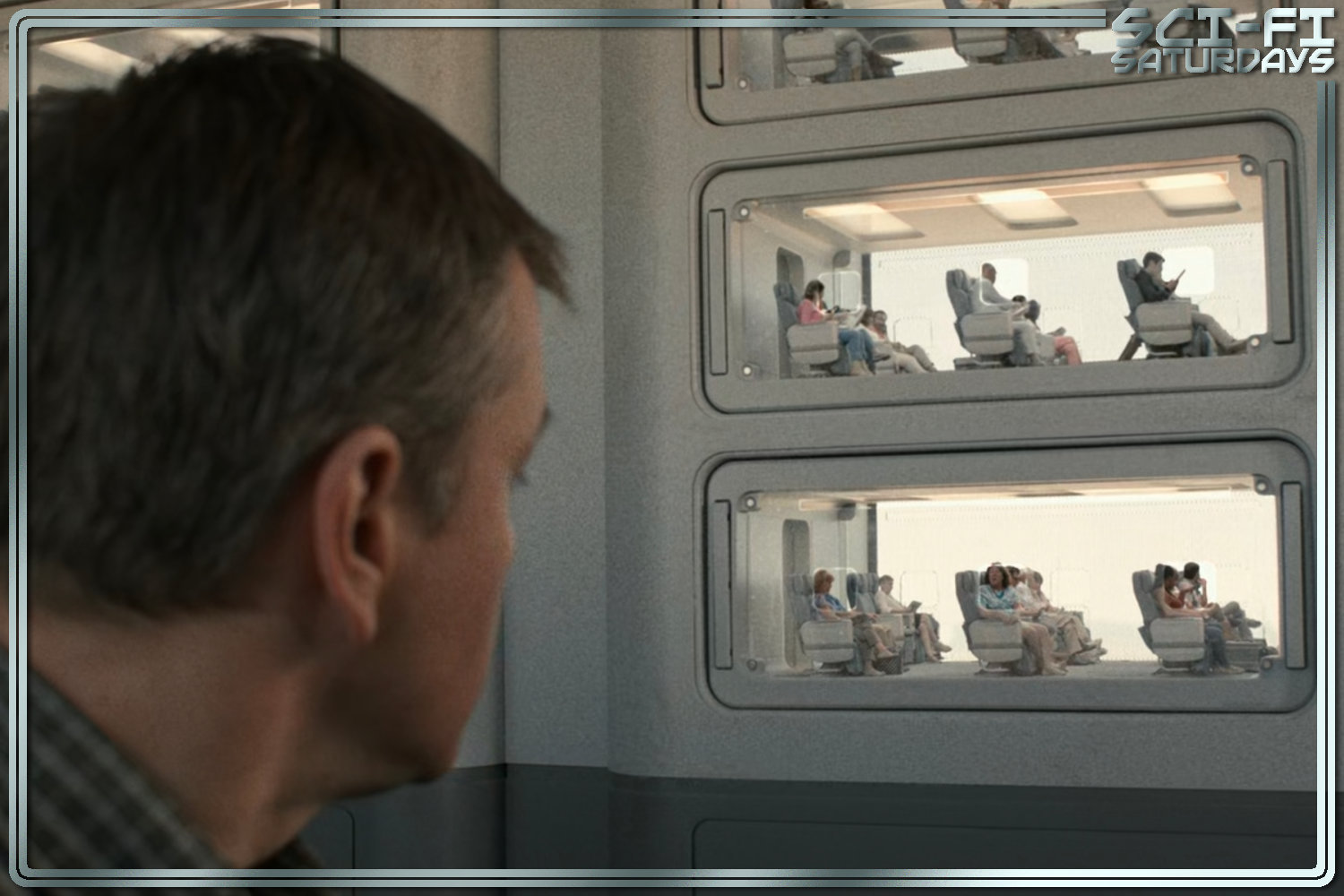
Paul and Audrey are impressed with the shrinking technology and seriously consider trying it out themselves.
History in the Making
Downsizing is a 2017 film by Alexander Payne, the writer and director behind such hits as Election, About Schmidt, and Sideways. It appears to be an abrupt departure from his normal work due to the science-fiction aspects present in it. But after watching the film, it’s very much evident that it’s less sci-fi and more aligned with Payne’s previous work about interpersonal encounters and characters navigating the modern world. Even though the film starred Matt Damon, who was readily promoted, it was considered a box office flop, with poor reviews putting off many from attending. Part of this backlash probably comes from the incongruent marketing for the film. The trailer is very upbeat, with a Talking Heads song playing over slightly comical moments showing comedic actors like Kristen Wiig and Jason Sudeikis. It also shows Matt Damon waking up from his downsizing procedure and checking to make sure his manhood was intact. While the film does have humorous moments, it is far from a comedy. I recall the first time I saw it, and came out feeling flat due to my expectations not being met. This is not a slight on what the film is really about, just that audiences may have been expecting something other than what they got.
One of the main draws of the film is the variety of actors in major and cameo roles. Audience members who are familiar with character actors will recognize many bit roles in the film. Matt Damon is obviously the draw, and makes his fourth sci-fi film after The Adjustment Bureau, Elysium, Interstellar, and The Martian (also featuring Kristen Wiig). Christoph Waltz, famous for No Time to Die and Inglorious Basterds, appears in his second sci-fi film (after The Zero Theorem). He will also appear in Alita: Battle Angel in 2019. Udo Kier is a famous German actor who has appeared in a multitude of films, including Iron Sky, Armageddon, and Johnny Mnemonic. Hong Chou was less known at the time, but has since become more famous for her roles in the Watchmen TV series and her nomination for Best Supporting Actress in The Whale. Jason Sudeikis, famous for his roles on Saturday Night Live (also with Wiig), makes his second, and final (to date) appearance in a sci-fi film after the previous year’s Colossal. In smaller roles look for Joaquim de Almeida as the Conference Director; the late James Van Der Beek as an anesthesiologist and former-classmate of Paul’s; Neil Patrick Harris (Starship Troopers) and Laura Dern (The Last Jedi) as Jeff and Laura, a couple who gives a presentation for Leisureland; Niecy Nash as a Leisureland salesperson and Kerri Kenney-Silver as Kristen, two Reno-911 alums; Margo Martindale as a small woman on a shuttle bus, and Don Lake as Matt, the Leisureland guide who shows Paul to his home.

Paul finds out that Dusan is not such a bad guy.
Genre-fication
Downsizing is part of a long line of size change films, dating back to the 1957 The Incredible Shrinking Man. Creating a small person in a normal environment (or a giant person in a normal environment) has always been a fun and interesting visual in film and television. It was a popular genre for a while, from television series like Land of the Giants and Dr. Shrinker, to movies like Fantastic Voyage and Innerspace. But the last major sci-fi film to be about shrunken people (outside of the superhero films with Ant-Man) was Honey, I Shrunk The Kids in 1989. Normally, shrinking is a plot device used to alter the characters for a specific purpose, only to return them to their normal size by the end of the film. Downsizing uses the process as a means to an end, creating an irreversible process by which the characters stay small. And unlike other films of this type, the shrinking process is a well-thought-out scientific process that talks about mass reduction, and pays attention to things like implants and non-organic objects in the body. The sci-fi elements are just the tip of the iceberg, as the film ends up going much deeper.

Paul discovers that even in the idyllic downsized community, there are still slums and poverty.
Societal Commentary
In the current parlance, the word downsizing is about reducing one’s footprint in the world. Moving into a smaller, more modest home from a McMansion, for example. In this film, it’s the term coined for people shrinking down to a five-inch size. Downsizing uses the guise of sci-fi to pull audiences in, expecting to get a Damon/Wiig comedic film, but delivering a more somber social satire instead. It’s a bait-and-switch technique that the film uses to great effect. Many of the elements of the film are characters being sold on a bill of goods that are not what they seem. While the downsizing process has been created to help the people of the world survive, it’s been co-opted by corporations as a way to sell their goods. Paul believes that he will become happier when he has more money, which he can do by downsizing. His net worth multiplies by a factor of ten, but that, of course, doesn’t make him any happier. He is later sold on another path, one that will help the human race further down the road (by at least 8,000 years). He buys into that cult-like idea as well. Though Paul does quickly decide that he would rather stay in the here and now with Ngoc Lan.
Downsizing ends up being a competent social satire about finding what’s really important in life. Is it doing the right thing for the planet? Or doing the right thing for yourself? It’s clearly not about following fads and trends, or trying to keep up with the guys next door. It’s not about doing what’s expected of you either, because that is not the path to happiness. For people like Jørgen, it is definitely about helping the planet. Creating the shrinking technology was done for noble purposes, as many scientific achievements are. Unfortunately, the technology was used for other purposes, which Jørgen feels absolutely horrible about. He had never considered that corrupt governments would use the process to shrink dissidents and ship them off to foreign countries. It’s certainly a way to silence the loudest voices, or at least make them seemingly disappear. But for people like Paul, the shrinking technology was about finding the right path for himself. While he was always looking for the best way to move forward, he got off to several bad starts. He was smart enough to realize that his choices (or fate) brought him to the Norwegian colony, but still believed that it was to make the choice to enter the vault with him. It wasn’t until Paul really listened to himself and what he wanted that he was able to make the right choice for himself. It’s not the right choice for everyone, but for him it was the answer to his dilemma.
The film also does a good job showing how nothing is ever a quick and easy fix. Getting downsized seems like it solves all the problems. You’re doing something good for the planet. Your money goes farther. And you can live an opulent lifestyle. Except that in the downsized community, there’s still a division of classes. A slum exists outside the walls. And many people are still suffering. It all loops back to Paul’s initial conversation with his mother. She complains of her suffering and that there’s no cure for her fibromyalgia, but scientists are wasting time with shrinking technology. “And all this fuss about the environment as though the world’s going to end tomorrow. I’m in pain. I can’t breathe! Doesn’t that matter?” Paul’s simple response is that “Lots of people are in pain, Mom, in all sorts of ways.” It’s a difficult process to expand your circle of caring beyond a certain number of people. Lots of people focus on themselves or their immediate core group, while a few individuals can extend that number to an even greater group. Downsizing makes a case for doing the best you can to take care of the world, but in the end, one should choose to focus on their immediate locale, where they can make the most impact. Paul finds satisfaction in helping Mr. Cardenas, rather than becoming a key to the survival of the human race. It’s the benefit of helping yourself by helping others.

Paul admires Ngoc Lon’s resilience and faith.
The Science in The Fiction
As far as size-change films go, Downsizing seems to have put the most thought into how the process actually works. Unlike films that have characters growing large, like Attack of the 50 Foot Woman, this film tries to account for the change in size and mass. Characters getting bigger is not scientifically accurate due to the fact that their new size must come from somewhere. What makes up their mass? If there’s no mass gain, the giant character would really just be a large vapor that resembles their former self. For characters who shrink, if mass is not removed, then they’d be small action figure-sized people that weigh as much as they did full-sized. The science here is that each cell is (somehow) reduced to .0364% it’s former size, thus reducing the overall mass and volume of the individual. Okay, well, it at least seems more scientific. Obviously, if each cell reduces at the same ratio to every other cell, the people would be deformed. Some thought is taken into the fact that people with implants won’t be able to take part, and those with fillings and dental work need to have them removed and reinserted. Since it’s only organic material that this works on, the body must be shaved first and the bowels evacuated. But what of the eyelashes, the hair in the nose, the hairs in the inner ear? As I said, it plays as a much more scientific process, but as with so many of these types of films, it can be shot full of holes relatively easily.

Ngoc Lon, Paul, Ana-Helene and Jørgen sail on a miniature boat along a Norwegian river.
The Final Frontier
Downsizing also makes a point about how humanity will always create a new scapegoat or citizen to hate. If we were to eliminate racism or sexism, the society would inevitably discover a new group that can be blamed for others’ ills. In this film, it’s the small people. As the bar patron drunkenly points out, they don’t deserve to vote anymore (or maybe only get one-fifth of a vote) because by shrinking themselves, they’re choosing to no longer participate in society. They’re removing money from the standard world economy; their homes lie dormant, affecting the prices of their neighbors, and they are taking jobs from normal-sized people that could be doing things like the call center we see Paul in. While some of these reasons do ring true, the downsized people are definitely still participating in society. In fact, Paul discovers that all downsized people are not created alike, and that the social spectrum still exists. There are still people like Dusan who prey on the needs of others, smuggling in high-value items for a fee. It seems to be the equilibrium of society to eventually spread out, with some people on top and others filling in the necessary menial tasks, according to the film.
Downsizing is a film that definitely makes you think about what’s worthwhile. It actually could have gotten a lot deeper into the social satire, but spent a lot of time with the journey of Paul getting shrunk and the procedures associated with that. From the standpoint of the trailer, it does feel like a different film was sold to audiences, with the trailer being the one they wanted to see, and the actual film being the one they needed to see. It’s hard not to want a little more from this film, especially with such a surprisingly long film that still ends up being a little short on enjoyment.
Coming Next


Having grown up on comics, television and film, “Jovial” Jay feels destined to host podcasts and write blogs related to the union of these nerdy pursuits. Among his other pursuits he administrates and edits stories at the two largest Star Wars fan sites on the ‘net (Rebelscum.com, TheForce.net), and co-hosts the Jedi Journals podcast over at the ForceCast network.