
Everyone needs a little Joi in their life!
Blade Runner 2049 was released thirty-five years after the original film, allowing audiences to reenter the cyberpunk world of a futuristic Los Angeles. This film continues many of the themes of the original, going even deeper into the ideas about what makes an individual a person, along with the nature of memory and what constitutes a soul.
First Impressions
Even before the title comes up in this trailer, fans will immediately recognize the world of Blade Runner. A new, younger cop is now on the beat, and he must visit with Rick Deckard to get some help on the case he’s working on. There’s little to go on, other than the visually stunning future with its wet, neon, cyberpunk aesthetic and lots of action. It’s thirty years later, and the future is here in Blade Runner 2049.
Presented below is the trailer for the film.


Blade Runner 2049 title card.
The Fiction of The Film
In the thirty years since the events of the original film, a 10-day power blackout destroyed most of the digital records, violent replicant rebellions led to the bankruptcy of the Tyrell corporation and retirement of all models, including the Nexus 8, and industrialist Niander Wallace (Jared Leto) created a new form of synthetic farming that averted global famine. Wallace also created a new line of replicants that obeyed orders, unlike previous models. Officer KD6-3.7 (Ryan Gosling), a Nexus 9 known as K, investigates a protein farm run by a rogue Nexus 8, Sapper Morton (Dave Bautista). Sapper refuses to cooperate, mentioning his adherence to a miracle, so K retires him. Scanning a dead tree outside the property leads to the discovery of a box filled with human bones and some hair. It appears to be the remains of a female Nexus 7 replicant who died thirty years ago during childbirth, something that should be impossible.
K’s commander, Lieutenant Joshi (Robin Wright), tells him in no uncertain terms that he must make this go away, lest a revolution occur. A serial number on the bones leads K to the Wallace Corporation to check their archives. Wallace’s replicant assistant, Luv (Sylvia Hoeks), is alerted to the search and takes K into the old portion of the archives, where they find the body belongs to Tyrell’s replicant “niece”, Rachel. After K leaves, Wallace impresses the importance of discovering more about the child who was born of a replicant. Of all the work he has done, he has never been able to solve this problem. K returns to Sapper’s house and finds a baby sock hidden in the piano and the date “6-10-21” etched into the roots of the tree. He torches the farm, destroying any other evidence. Luv enters the LAPD facility and steals the bones and other evidence, killing forensic specialist Coco (David Dastmalchian) in the process.
K, with the help of his digital assistant and girlfriend Joi (Ana de Armas), investigates the DNArchives. He discovers two identical sets of DNA for a boy and a girl, both born 30 years ago, and sent to an orphanage. Joi points out that he hasn’t shared the full story on the date he found, as it matches the date on a toy horse from an implanted memory of his. He thinks that he may be the son of the female replicant. K proceeds to the orphanage to investigate, demanding to see the paperwork from the caretaker, Mister Cotton (Lennie James). The pages for the year 2019 are missing, but the location sparks a memory in K, who investigates the furnace, finding the same toy horse from his memory, complete with a date inscribed on it. He visits with Dr. Ana Stelline (Carla Juri), a maker of memories, to get more details. She says it’s illegal to use real memories in replicants, but looking into K’s memory, she confirms that someone lived that memory.

Agent K wonders why he found a date one a tree that means something special to him.
At the station, K submits for his baseline check and is found to be far off from normal. Joshi puts him on a two-day suspension to get back on track. When K returns home, he finds Joi has hired a sex worker, a replicant named Mariette (Mackenzie Davis), to act as a sex surrogate for her. The next morning, Mariette hides a tracking device in K’s coat. Needing more information, K tracks down the origin of the wooden horse, which comes from the irradiated town of Las Vegas. Joi wants to come with him, but needs to be deleted from the home console so her data cannot be used against K if she’s discovered. The deletion of the Wallace-designed technology alerts Luv, who visits and kills Lt. Joshi for K’s whereabouts. In Las Vegas, K enters a derelict casino and finds an aged Rick Deckard (Harrison Ford) living in isolation. Deckard doesn’t trust the young replicant, but after a brief scuffle, the two decide to sit down for a drink.
Rick confirms that it was Rachel who died during childbirth, and that he was the father. He helped scramble the records of the birth and placement of the child, and then left, not knowing what happened or who the baby was. A group of spinners from the Wallace Corporation enters town, landing at the casino and capturing Rick. K is beaten by Luv and left to die, but members of the Replicant Freedom Movement arrive and bring K back to Los Angeles. Mariette patches up K’s wounds, and he is brought before Freysa (Hiam Abbass), their leader. She reveals that a revolution is coming, and that many individuals have part of the puzzle. The baby was a she, which disappoints K, who believed he was part of something bigger. With Deckard captured by Wallace, it’s only a matter of time before the trail points to Freysa and her group. She asks K to kill Rick.
Wallace meets with Deckard, wanting further information about the child. In exchange, he is prepared to offer the former Blade Runner a reconstituted Rachel (CGI likeness of young Sean Young) in all her beauty. Rick rejects her outright, telling the blind Wallace that her eyes were green and not brown. Wallace instructs Luv to ship Deckard off-world. On the way to the airport, K crashes his spinner into the Wallace airship, bringing it down into the ocean surf. As water begins to fill the cabin, K fights with Luv. She injures K several times, but he manages to get the upper hand and drown her. Instead of killing Rick, he saves him, claiming that he must have died in the crash. K tells Deckard that he’s now free to see his daughter and takes him to Stelline Labs. Yes, Dr. Stelline is Rick and Rachel’s real daughter. As Rick enters the building, a wounded and exhausted K slumps on the steps outside.
“Dying for the right cause is the most human thing we can do.” – Freysa

K, with the help of his digital assistant Joi, tracks down the missing child.
History in the Making
After the Star Wars prequel trilogy, Blade Runner 2049 may have been the most anticipated sequel to a classic film. And with that anticipation comes many precarious elements. The original 1982 Blade Runner is not just a cult film for sci-fi enthusiasts. It was Ridley Scott’s second directorial job ever, ushering in an amazing career as an auteur director, as well as being a watershed film for the cyberpunk movement. Its influences were felt across all media, from television and film to comics, books, and computer games.
This film marked Denis Villeneuve’s second sci-fi film in as many years. Primarily known for his dramas and action films (Prisoners, Enemy, Sicario), he created an incredible and moody science-fiction film in 2016 called Arrival. That marked his entrance into the genre world, which he has been working in ever since. His follow-up films to Blade Runner 2049 include the Dune trilogy, with Part Three planned for a release later in 2026. It also marked the return of Harrison Ford to one of his three most iconic roles. He had already revisited Star Wars as Han Solo in 2015s The Force Awakens, and would return as Indiana Jones (the man in the hat) in 2023s Indiana Jones and the Dial of Destiny.
To prepare audiences for the world of 2049, three short films were produced and released online to provide some context for what has occurred in the 30 years between the 2019 of Blade Runner and Blade Runner 2049. The first was a 20-minute anime short called Blade Runner Black Out 2022. directed by Shinichirō Watanabe. This was the longest of the shorts and told of a small group of replicants who instituted an EMP pulse, causing the blackout. The next chronological entry was 2036: Nexus Dawn, directed by Luke Scott. In this one, a group of lawmakers hears from Niander Wallace about his desire to restart the replicant process. They are stunned when he orders his replicant assistant to violently kill himself in front of everyone. The final film, 2048: Nowhere to Run, also directed by Scott, involves Sapper Morton trying to make a living by selling his goods at market. There, he intervenes to stop a young girl from being beaten and is outed as a replicant. Four years later, Blade Runner: Black Lotus (2021), an anime TV series, was released. It takes place in Los Angeles, 20232, and focuses on a female Replicant protagonist. All of these other stories help in fleshing out the world of the future, each providing its own take on the themes and ideas of the franchise.

K’s search takes him to meet Dr Ana Stelline, a creator of replicant memories.
Genre-fication
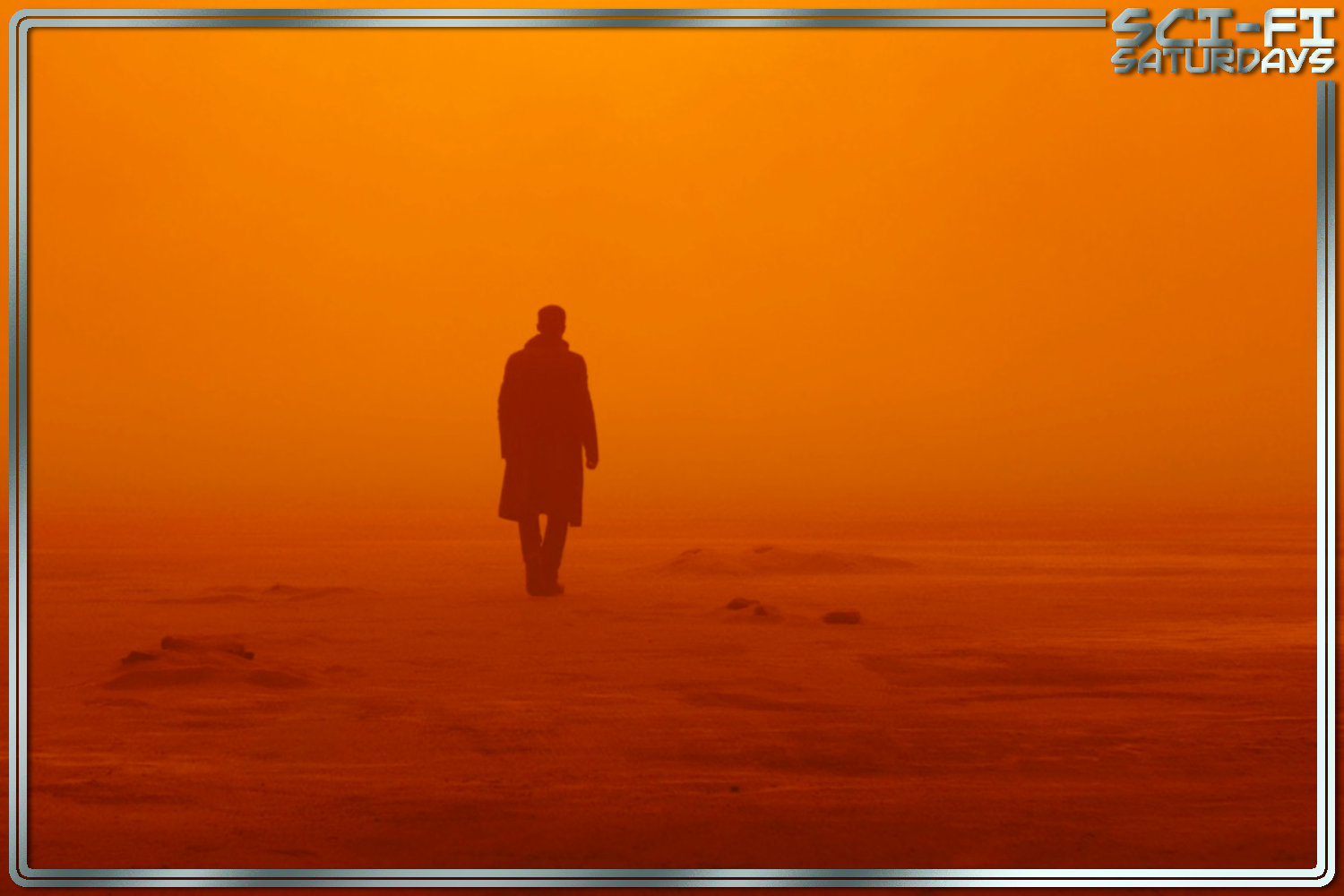
Blade Runner 2049 follows in the footsteps of its predecessor, as it mixes science-fiction with a hard-boiled noir detective story. Writer Hampton Fancher returns to the universe, co-writing the film with Michael Green (Logan & Alien: Covenant), to create a darker and more intricate mystery. The setting for the film is 30 years after the events of the previous film, taking place along the Southern California coast, from the dark and overpopulated Los Angeles, to the municipal waste processing district of San Diego. A brief change of scenery takes the characters to an irradiated Las Vegas, which has the burnt sienna look of Rum Wadi, Jordan. The bleak futurism continues as streets remain dark and dingy, the air is thick with haze, and neon-lit distractions attempt to console the burdened populace. With the original film having been such an inspiration to the ideals of the cyberpunk genre, Blade Runner 2049 continues the trend, introducing new information about synthetic humanoids, artificially intelligent holographic assistants, and the dismally dystopian future that looks back as much as it looks forward. Where else can you find flying cars paired with scavengers who use harpoon guns to bring them down? The artfully futuristic design of replicant memories contrasts with the Oliver Twist-like orphanage where hundreds of underage workers repair obsolete circuit boards. As with other classic sci-fi films, the Blade Runner series works best when it’s creating incredible and contrasting visuals in service of the story.
While protagonists in both films are Blade Runners (police officers who ‘retire’ replicants) who investigate and play detective, K is definitely a replicant himself, while Deckard might be a replicant depending on which version of the original film the audience watches. Instead of the hunt for the rogue replicants, who are able to hide in plain sight amongst humans, K must solve a greater mystery as he searches for the child who is an offspring of a human and a replicant. Could the baby in question be K himself? That possibility creates a more intricate enigma that keeps the audience guessing as well. Even knowing the outcome, through multiple viewings, the film still manages to create a pitiable version of K, the character who just wants to belong to something. As a replicant himself, K is an outsider to everyone. The people of the police department don’t respect (or trust) him due to his replicant status. Other replicants don’t seem to respect him, even Nexus 9’s, due to his turning on his own kind. It’s the perfect setup of the outsider detective who must adhere to the truth at every turn as all sides attempt to sway him to their agenda.

Eventually, K meets up with Rick Deckard–an ex-Blade Runner, and father to the hybrid child.
Societal Commentary
Blade Runner asked the question about what makes a person a person. Was it really being alive (or human), or was it something else? From this point onwards, the assumption will be that Deckard is a human, as it was never conclusively determined that he is anything else from either the original theatrical film or from any scene of this one. With Blade Runner 2049, instead of an outsider investigating replicants, the protagonist is himself a replicant. K shares so many traits with the people he hunts, with the exception of his overall freedom. A character like Sapper Morton does what he wants, when he wants. He is free to come and go, as long as he doesn’t raise any red flags with anyone. As a Nexus-8 replicant, Sapper is part of a hunted species. K, on the other hand, is part of Wallace’s new line of replicants. Ones that are unable to harm humans but are treated as slaves to their masters. While K has the freedom to do what he wants on his own time (having his own digital assistant in Joi), he is unable to do little more than accomplish his job. He pursues the path throughout the film because those are the instructions of his superior. And with that invisible leash, there’s a bit of sadness about his actions, too.
K’s depression stems either from his discovery that he is not a special person, being born from a woman, or also due to the fact that he’s being forced to hunt people whose sole transgression is being different. The backstory for the film, taken from the short films discussed earlier, reveals that groups of Nexus-8 replicants fought on both sides of the war in the colonies, off-planet. That was the purpose they were created for. Sapper returns to Earth wanting to live out the rest of his life, but is unable to do so because of what he is. He is a fantastic piece of hardware, different from a human only in his synthetic nature and a serial number on his right eyeball. Yet, his life is worth so much less than “real” humans. The film makes a case that these replicants, like any other living organisms on the planet, have the ability to evolve and change. They are not just their programming. They can do more with their lives. Sapper was created as a soldier, but now he runs a protein farm. Freysa and others led a movement to win equal rights for their kind. And the biggest change is the fact that Rachel was able to conceive and birth a child. None of the replicants in this series seems to follow their programming. Rather, they live their lives, which are defined by their actions and choices instead of what anyone else seems to think they should be.
The film also refutes the nature of reality, exploring how memories are as important as the real events. Replicants were never children, and as such, have no memories of being a child. Early on, it was determined that by implanting false memories of a childhood into them, they would become better-adjusted individuals. These memories shape the identity of the replicants, giving them a back story on which to build. Whether they understand that the memories are fake or not doesn’t seem to matter. K knows what he is, and that his memories aren’t really his, but that doesn’t change the fact that he begins to believe that he may be the child that he’s searching for. What a strange coincidence that the memory of Rachel’s daughter was used to create K, and in turn, he’s the one tasked with finding Dr. Stelline. Maybe this was done on purpose. Yet either way, his memory ends up driving him further on the quest for the truth.

The uncanny valley cometh.
The Science in The Fiction
One of audiences biggest questions after seeing this film might be, how can there be a baby if the replicant is a machine? Replicants are not that kind of machine, at least not in the same way that the Terminator is. They bleed and function much like humans do, but are produced in a fully adult form instead of growing from a child. Humans are also machines, extremely complex ones. The replicants, for all their artifice, must also be extremely complex machines. As far as Rachel is concerned, she was always special. Tyrell made her as a one-off version, and who knows what he did to make her so that she had viable ova within her. Something about her reproductive system was able to interact with Deckard’s sperm in a way very much as a human female’s reproductive system would. Maybe it really is more akin to a miracle, like the way that Sapper sees it. Maybe it’s like the quote from Jurassic Park, that life just finds a way.
Blade Runner 2049 also delves into the world of bio-ethicism and elements of transhumanism. As a minority and subservient class, the replicants are fighting for their rights to exist. Parallels to real-world minorities and their struggles are quite obvious in the subtext. As Joshi points out, if word about a live birth from a replicant were to get out into the world, a revolution would happen. It becomes the driving factor for the Replicant Freedom Movement to circle around, knowing that they can leverage the event for their own purposes. Wallace, on the other hand, wants to harness the ability to provide all replicants with the ability to conceive and birth their own offspring. Not for any social relevance or altruistic motive, but for power. He already has a God complex, holding ultimate authority over the replicants he produces and the ones he chooses to kill. Creating the next wave of beings would single-handedly place him in a higher position above humans and in an even greater creator role for the replicants he produces. They would be more human than human, able to replicate like humans, but without being subject to the same pitfalls, like aging and disease. The perfect slave race on which to build a new empire.

Deckard and K part ways at the conclusion of the case.
The Final Frontier
Blade Runner 2049 is a beautifully evocative film, full of atmosphere and mood. It makes good use of what has come before and creates a new storyline as one of the next logical steps for the technology and society. Ryan Gosling is fun to see as the reluctant detective, turning over every rock, because he has to, yet wondering if he might be uncovering his own roots in the process. Certainly, some viewers may have taken umbrage at this storyline when it didn’t pan out. It could feel like a lot of wasted investment in the character, for nothing to come from it. It was also nice to see Ford return in a non-Lucasfilm role. The tragedy of his character is highlighted even more in this film, as he was forced into a 30-year exile due to whom he decided to love. Interestingly, this was Gosling’s first sci-fi film to date. His second sci-fi entry is coming later this month in the adaptation of Andy Weir’s Project Hail Mary. Ford is, of course, known for his work in the Star Wars franchise, returning one last time, two years later, in Episode 9: The Rise of Skywalker, but he also appeared in Cowboys & Aliens and Ender’s Game.
The worst aspect for the returning cast may be the use of a digitally de-aged Sean Young as Rachel. While Young is credited in the part, Loren Peta was a stand-in body double for the character. The visual effects wizards at Moving Picture Company (MPC) then added a digital head of Young (circa 1982) to Peta’s body. The progression of the de-aged facial features of an extremely recognizable actor has come a long way in the seven years since TRON: Legacy. Jeff Bridges’ younger face looks good in stills, but still lacks something in the moving image. The same can be said for Carrie Fisher’s younger head from Star Wars: Rogue One (2016). Young’s head looks very good, but still contains a small amount of the uncanny valley in the performance. With Rachel’s look being so glammed up, it’s unclear why a photo double, made up to look like Rachel, wasn’t used. They could have touched up the imagery with visual effects, rather than trying to recreate a near-realistic visage.
Fans of the franchise may also be excited to know that the world of replicants and their hunters will return later in 2026 with an Amazon Prime series entitled Blade Runner 2099. It stars Michelle Yeoh as an older replicant near the end of her life, but other than that, not much else is known. It’s certainly a franchise that can keep evolving and changing with the times, keeping well ahead of the real-world technology as it does what all great sci-fi stories do: exploring the nature of humanity and existence.
Coming Next


Having grown up on comics, television and film, “Jovial” Jay feels destined to host podcasts and write blogs related to the union of these nerdy pursuits. Among his other pursuits he administrates and edits stories at the two largest Star Wars fan sites on the ‘net (Rebelscum.com, TheForce.net), and co-hosts the Jedi Journals podcast over at the ForceCast network.