
It’s kind of a big deal.
This may be the weirdest sci-fi film of the year. Colossal is an atypical genre picture that might seem more at home as an indie melodrama. It’s more of a character piece that chooses sci-fi elements to highlight the very real human issues rather than use them as the backdrop or as spectacle. The title highlights the magnitude of the film, from the size of the monsters to the size of the characters’ failures. It ends up being, “come for the kaiju, stay for the codependence.”
First Impressions
The trailer for this film shows a woman coming back home after a stressful breakup. She appears to be quite a mess. She and her male friend see a clip on television of a giant monster attacking a city in Japan. Suddenly, the woman realizes that somehow she is controlling the monster as it makes the same hand gestures she does. How is this possible? And how can she control something so Colossal?
Presented below is the trailer for the film.


Colossal title card.
The Fiction of The Film
Sometime in the early 1990s, a young Korean girl searching for her lost doll in a park is startled by the appearance of a giant Kaiju. Twenty-five years later, Gloria (Anne Hathaway) returns to her apartment after a drinking binge, claiming to her boyfriend Tim (Dan Stevens) extenuating circumstances. He is tired of her excuses and tells her that her clothes are packed, and it’s best she not be there when he gets back from work. Gloria moves into her parents’ old house in New Hampshire with her two suitcases, and that’s it. On her way back home from buying an air mattress, she is surprised to see her childhood friend Oscar (Jason Sudeikis).
Oscar takes her to work with him so they can catch up. He is the proprietor of the local bar, which presents some concern for Gloria, but she takes free drinks offered to her. She hangs out with Oscar’s friends Joel (Austin Stowell) and Garth (Tim Blake Nelson) all night. Joel makes an awkward pass at her, which seems to upset Oscar. On her way back home, early the next morning, she takes a shortcut through a playground. She is awoken mid-morning by a call from her sister about a monster attack in Seoul, South Korea. She tries to contact Tim, but he’s very dismissive about her continued drinking binges.
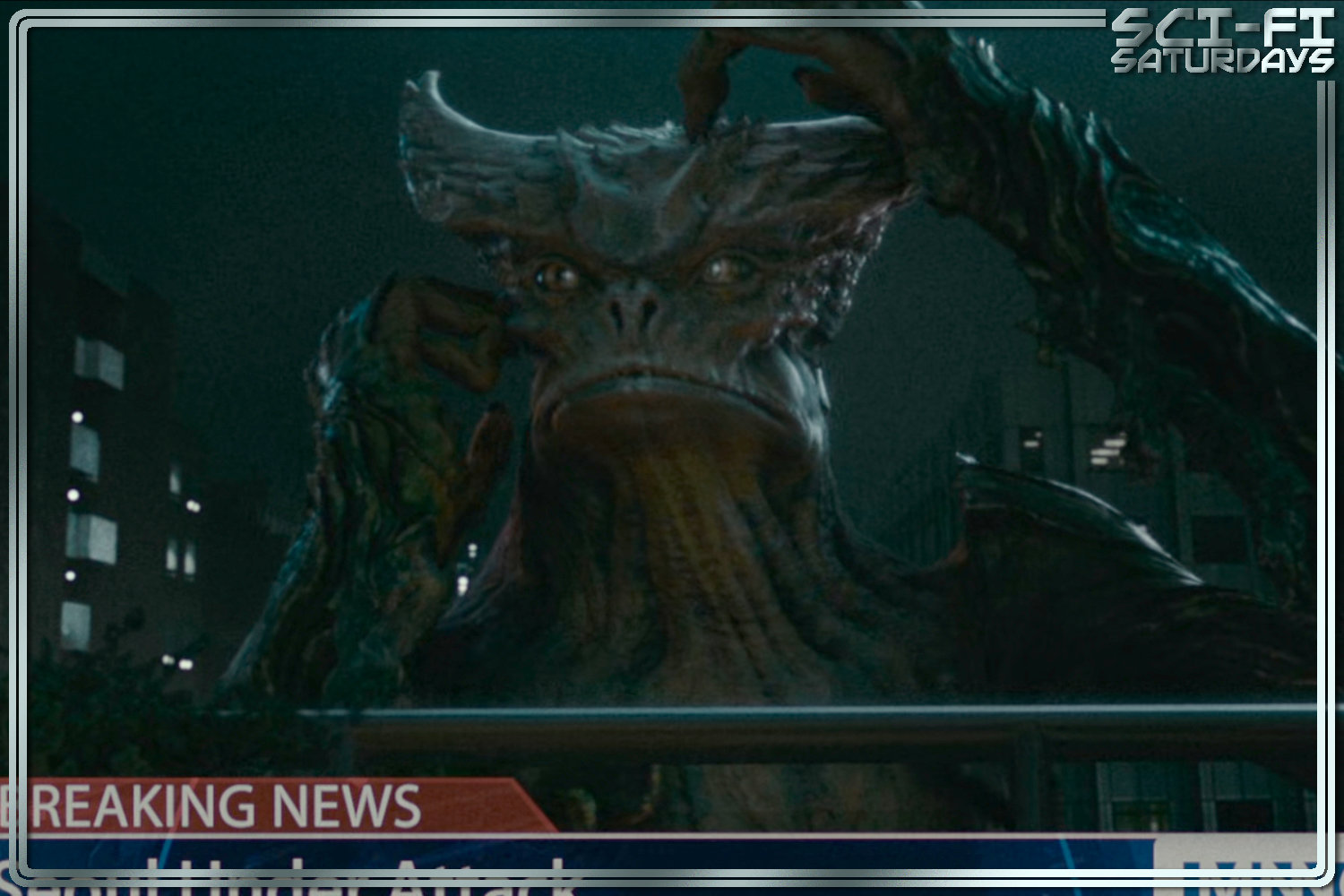
Oscar brings her a television set, seeing as she has no furniture. She doesn’t recall that he offered her a job the previous night, but she still accepts it. At the bar, she sees a news report on the monster in Seoul and notices it scratching its head just like she does. Putting several ideas together, she deduces that the playground somehow represents Seoul, and when she walks through it, the monster appears and mimics her behavior. She tells Oscar, Garth, and Joel, demonstrating one morning. She makes the monster do funny hand gestures while they watch a live camera in Seoul. Gloria becomes upset, realizing that she accidentally killed hundreds of people that first night.

Gloria’s opening and closing looks for the film.
Oscar comforts her, and Garth realizes that a giant robot is now next to the monster in Seoul. Somehow, Oscar being in the playground manifests as a large mecha. With Oscar’s help, Gloria gets a handwritten note in Korean that says “I’m sorry,” and writes the epitaph on the playground/and in Seoul. Having atoned, she follows Joel home and spends the night with him. The next morning, they see a news report that a giant robot is taunting the business district. A drunk Oscar is standing in the playground being a jerk, so Gloria slaps him, telling him to leave. Oscar becomes jealous after realizing Joel and Gloria slept together, and abuses everyone around him.
Gloria has sobered up, not wanting to repeat the accident of walking through the playground while drunk. Meanwhile, Oscar taunts her with alcohol and threatens to walk through the playground if she doesn’t drink. He attempts to live up to his threats, but Gloria fights him at the playground, and he sulks off. She later visits his house, and he apologizes, ashamed of his behavior. Tim arrives in town for a “client meeting,” but is really checking up on Gloria. He asks her to return to New York with him. Oscar, once again jealous of Gloria’s relationship, does the “most irresponsible” thing and sets off a giant firework in his bar. Oscar then threatens Gloria again. If she leaves town, he’ll do damage in the playground every day until she returns.
Gloria has a flashback to a gusty morning 25 years ago, when on her way to school, her diorama of Seoul, Korea, gets blown into a nearby woods. Young Oscar jumps the fence, appearing to help retrieve it, but instead, he stomps on it, destroying the presentation. Lightning strikes the two of them at the same time, and they collapse; Gloria drops a monster action figure, while Oscar drops a robot figure. Gloria doesn’t know what to do to stop Oscar, who is drunk both on alcohol and power. She hops on a flight, but instead of returning to New York, she travels to Seoul. Gloria realizes that she can manifest as the kaiju in the playground as well. When Oscar comes to the playground that morning to do some damage in Seoul, the kaiju appears above Oscar. It grabs him and flings him off into the distance, saving the city of Seoul once and for all. Gloria enters a local bar crying. She asks the bartender if she wants to hear an amazing story. The bartender says yes and offers Gloria a drink. Gloria grunts, annoyed.
“Please know that I’m only being this pushy because deep down, I know you want it.” – Oscar

Oscar discovers Gloria is back in town and invites her to hang out with him.
History in the Making
There needs to be more original genre films like Colossal. It often seems like everything coming out of Hollywood is part of a larger series, a remake, or culled from someplace else. Half of the last ten films reviewed on Sci-Fi Saturdays are original stories (non-adaptations and not based on an existing franchise), which seems far too few. This film was written and directed by Nacho Vigalondo, a Spanish filmmaker known for Timecrimes, Extraterrestrial, and segments from the anthologies The ABCs of Death and VHS: Viral. Vigalondo’s style is unique and contains elements of traditional dramatic films and genre films (mainly sci-fi and horror), peppered with comedic elements. Colossal comes off as a completely different sci-fi film from this era. It’s a mash-up of genre styles, but presents much of the story as a dramatic tale about alcoholism and abusive relationships, only adding the science-fiction elements as an apparent afterthought. Yet those genre elements make the story much more compelling and troublesome, crafting an interesting parable about the dangers of unchecked power.
This was the second and last sci-fi film for Anne Hathaway (for now). It’s light-years from her previous role as Amelia in Interstellar, both in terms of character and in tone. Her role as Gloria is certainly one in which the character is not in control, nor even likable. It’s also an interesting choice for Hathaway, who shows her versatility at many different types of characters, from comedic to dramatic to superheroic. Colossal marks the first sci-fi film for Jason Sudeikis, who, at this time, was primarily known for his role on Saturday Night Live and comedic films such as We’re the Millers and Horrible Bosses. Presently, he’s more known for his breakout character Ted Lasso. Sudeikis would go on to co-star in an upcoming sci-fi film, Downsizing (on the list to be reviewed next month), but tends towards less genre-driven fare. Given the types of roles he portrays and is known for, it’s extremely difficult to watch him in this role as the antagonistic and abusive Oscar.

Gloria’s strange tic, created by a scar on her scalp, replicates itself with the kaiju.
Genre-fication
It’s hard to describe what Colossal is. It’s a kaiju movie without really being a kaiju movie. It’s a drama. Maybe it’s a fantasy parable. The trailer teases the fact that a giant monster will appear in Asia, but follows a different path from conventional kaiju films, even though it follows many conventions of the kaiju genre. Typical modern kaiju films, such as Godzilla (2014) or Pacific Rim, feature the monsters (and sometimes giant mecha) as the primary antagonists. There’s always a human story in the film, too, but that is usually subservient to the tale of the monsters appearing. The kaiju fight, sometimes to protect the humans, and other times despite the humans. In the end, the human story concludes by realizing that people are lucky to have survived these unpredictable acts of destruction. For Colossal, and from the standpoint of characters in Seoul, Korea, this is what occurs. A giant kaiju appears from nowhere, destroying a portion of the city. It returns, randomly, causing anxiety and panic, but soon reveals itself to be a good creature, not meaning any harm. It is followed by a giant mecha that fights the kaiju and threatens the city in its own way (a reversal of the normal behavior of mechas being protectors). In the end, a mysterious invisible force dispatches the robot, while the kaiju deals with the antagonist abroad. But the story that the audience follows is very different.
The audience watching the film is following the story of Gloria and, eventually, Oscar. Theirs is not a kaiju story or even a science-fiction tale, but an indie drama. It’s the story of two troubled individuals who reunite after 25 years apart and realize that their lives are a mess. Gloria is introduced as a woman with a drinking problem. So much so that she fails to see the problem and the problem it causes with her uptight boyfriend, Tim. She returns to her childhood home, like so many characters in other films of the era, including Charlize Theron in Young Adult, who also has a drinking problem. She meets up with Oscar, a friend (as far as the audience realizes) from elementary school. This appears to be the meet-cute (if it were a rom-com) as Oscar seems to be smitten with Gloria and jealous of her attentions towards Joel. As the film progresses and the backstory becomes clear that Oscar was Gloria’s bully in school, the tone changes. Oscar isn’t smitten with her in the normal romantic way. He’s kind of obsessed with Gloria for making it out and becoming a successful writer. It highlights his depression and the fact that he has remained stuck in this little town, working in a bar and amounting to nothing. The emergence of the fact that Gloria can become a kaiju and Oscar, a mecha, while standing in the park allows the film to show Oscar’s lust for power and control in a way that complements the abusive sequences at the bar with his friends.

Gloria and the kaiju dance the same moves at the same time, showing they are somehow linked.
Societal Commentary
On its face, Colossal creates a story about the dangers of alcoholism and characters absorbed in self-loathing and self-destruction. This is made all the more potent by the casting of Sudeikis in the role of Oscar. He plays against his normal jovial type, exposing a truly despicable character. The alcoholic story beats begin with Gloria and her behavior. She is introduced coming home in the morning after spending all night out drinking. This is her core behavior, and within minutes, audiences understand that it’s a problem. She, too, understands it’s an issue, but appears to make poor choices in the moment. She retreats out of the city to a small town, where she can focus on herself. But the first thing she does is go with her friend to a bar (which he owns) and spend the night out drinking. As Oscar begins to show her kindness (bringing her a television or a futon) and she spends time away from Tim, Gloria starts to develop some self-worth and respect. Even though she is working at a bar, she decides to stop drinking and get her life together. Not just because she knows it’s the right thing to do, but because she realizes she has accidentally killed hundreds of people after her bender. Awakening mid-day, Gloria hears the news of the kaiju attack, and after watching footage, realizes that she was somehow controlling the monster and responsible for its damage.
As Gloria begins to sober up, Oscar begins to spiral out of control. While Gloria’s discovery that she can manifest the form of a giant monster helped her to see her faults, Oscar’s realization that he can become a giant mecha opens his desire for control. As a man whose life is a mess, the ability to wield power over others provides him with a thrill that he has never experienced. Audiences learn that he’s disappointed with his life and career, and the one scene at his house shows that he has additional problems with hoarding. If we believe that Oscar’s initial interest in Gloria is based on his perception that she’s a successful woman, then the realization that she’s as messed up as him throws him for a loop. Discovering that he has the power to hold the lives of people he will never know in his hands gives him such a rush. His drinking binge that evening includes lambasting Garth about a possible drug habit and threatening Gloria, blackmailing her to drink–even though he knows she’s trying to stay sober. But instead of threatening Gloria physically (though there are elements of that), he threatens to destroy part of Seoul instead. He becomes abusive and controlling while drinking, wanting to stay in that state of control. Unlike a drama about alcoholism, Colossal changes the outcome of the drinking binges from personal destruction and the characters destroying lives locally (such as with drunk driving accidents, or beating of their spouses), to a global catastrophe on the level of a disaster flick.

Gloria takes a stand and tells Oscar to leave.
The Science in The Fiction
The third act of the film reveals the backstory that is only slightly hinted at throughout the film. Gloria has flashbacks of some moments from her childhood that she is unable or incapable of remembering. Perhaps it’s due to the age of the memory, but seemingly it’s related to her drinking. As she begins to sober up and take responsibility, more of the past comes into focus. The connection between her and Oscar and the city of Seoul is shown as a strange, magical lightning strike that connects the three elements, utilizing two toys that they each carried. The release of the monster is not due to scientific experimentation in this case, but some higher power connecting the location in New Hampshire to Seoul, and choosing Gloria and Oliver to be guardians or antagonists as they deem fit.
A lightning storm strikes the two children in the woods (the location of where the playground will be 25 years later), giving them the power to materialize as giant avatars in a city halfway around the world. What would do this to the people of Seoul? It seems tied to the fact that Oscar was destroying Gloria’s Korean diorama, but was this event meant as punishment for the city? Is it a mystical coincidence that plays out the cruelty that Oscar exhibits in the real world? It is the weirdest trick of fate that innocent people are put into the path of danger by these two emotionally damaged Americans. Luckily, Gloria realizes that if she can stand in the park in New Hampshire and affect Seoul, then she should be able to stand in Seoul and affect the park in New Hampshire. From a sci-fi perspective, this Earth contains a limited wormhole that connects two points on the planet, but instead of allowing a person to travel from one location to the other, their avatar (transmitted like television waves around the globe) manifests in their place.

The kaiju cometh!
The Final Frontier
Seeing Jason Sudeikis as the character of Oscar is troubling. He’s a great actor and really gets into the role in a way that audiences will not expect. He begins as a seemingly nice guy, but soon becomes a very evil antagonist. It begins with him goofing around and being somewhat inconsiderate to those around him, but soon graduates to extreme emotional abuse. It’s a sad moment, both for the character and the audience, realizing that this is not the same happy-go-lucky character they expect.
I often recommend Colossal to friends who like genre films or the actors herein. Partially because it’s a good film, but a director who truly has a vision he wants to share. But also partially because of the whiplash present when trying to align the expectation of the film with the final product. It’s a film that requires a little more focus, not because there’s a lot of techno-babble and jargon to understand, but due to the union of two disparate genres that are not normally combined. Ultimately, it uses the metaphor of the giant monster in the streets to explain the dangers of the demon within the bottle, courtesy of the local bar.
Coming Next


Having grown up on comics, television and film, “Jovial” Jay feels destined to host podcasts and write blogs related to the union of these nerdy pursuits. Among his other pursuits he administrates and edits stories at the two largest Star Wars fan sites on the ‘net (Rebelscum.com, TheForce.net), and co-hosts the Jedi Journals podcast over at the ForceCast network.