
It’s a new world of gods and monsters!
Ex Machina creates an amazing parable about the dangers of artificial intelligence in this thoughtful and intricate film. Never before has AI been explored as thoroughly as it is here, creating a springboard for all future discussions on the subject.
First Impressions
The trailer provides ominous tones as a young man meets his employer at an overly large estate, which is more than just a house, but a research facility. The employer is creating robotic women that look and act just like real people, other than the fact that much of the skin on the body is missing, ruining the illusion that it’s a real woman. The young man has been brought to test the robot, Ava, but she offers him a warning about his boss: Don’t trust him. She asks the young man to help her as she gets out of the training facility and charges towards the boss menacingly.
Presented below is the trailer for the film.


Ex Machina title card.
The Fiction of The Film
Computer programmer Caleb (Domhnall Gleeson), who works at the search engine Blue Book, wins a staff lottery that gives him a trip to the owner’s massive estate. He gets delivered by helicopter into a field in the middle of nowhere, with no cellular signal, and discovers a small modern house near the river. Inside, he meets Nathan (Oscar Isaac), CEO of Blue Book and a genius inventor, who tells Caleb that he was brought here to share in a research project. But first, Caleb must sign a non-disclosure agreement. Nathan tells Caleb he’s here to administer the Turing Test to a gynoid named Ava (Alicia Vikander). Caleb is escorted into an underground workspace and living quarters, where he can interview Ava through a plexiglass partition. She has a synthetic body, except for her feet, hands, and face, which are covered with what appears to be skin.
The first session has Caleb asking Ava to talk about herself, while Nathan watches on a remote CCTV monitor. Caleb is curious about the test, which is to prove if the subject has consciousness equivalent to a human. He asks why show her as robotic? Nathan feels that if he can show her robotic elements, and Caleb still feels she’s human, then it’s a success. Nathan asks Caleb to stop being analytical about what he’s seen and asks him to simply state how he feels about Ava. Caleb explains that she’s amazing! That night, Caleb can’t sleep and turns on the television in his sparse room. On the monitor are images from the CCTV cameras showing Ava and her room. He is transfixed until a power outage occurs. He is locked in his room for a few moments until the power is restored.
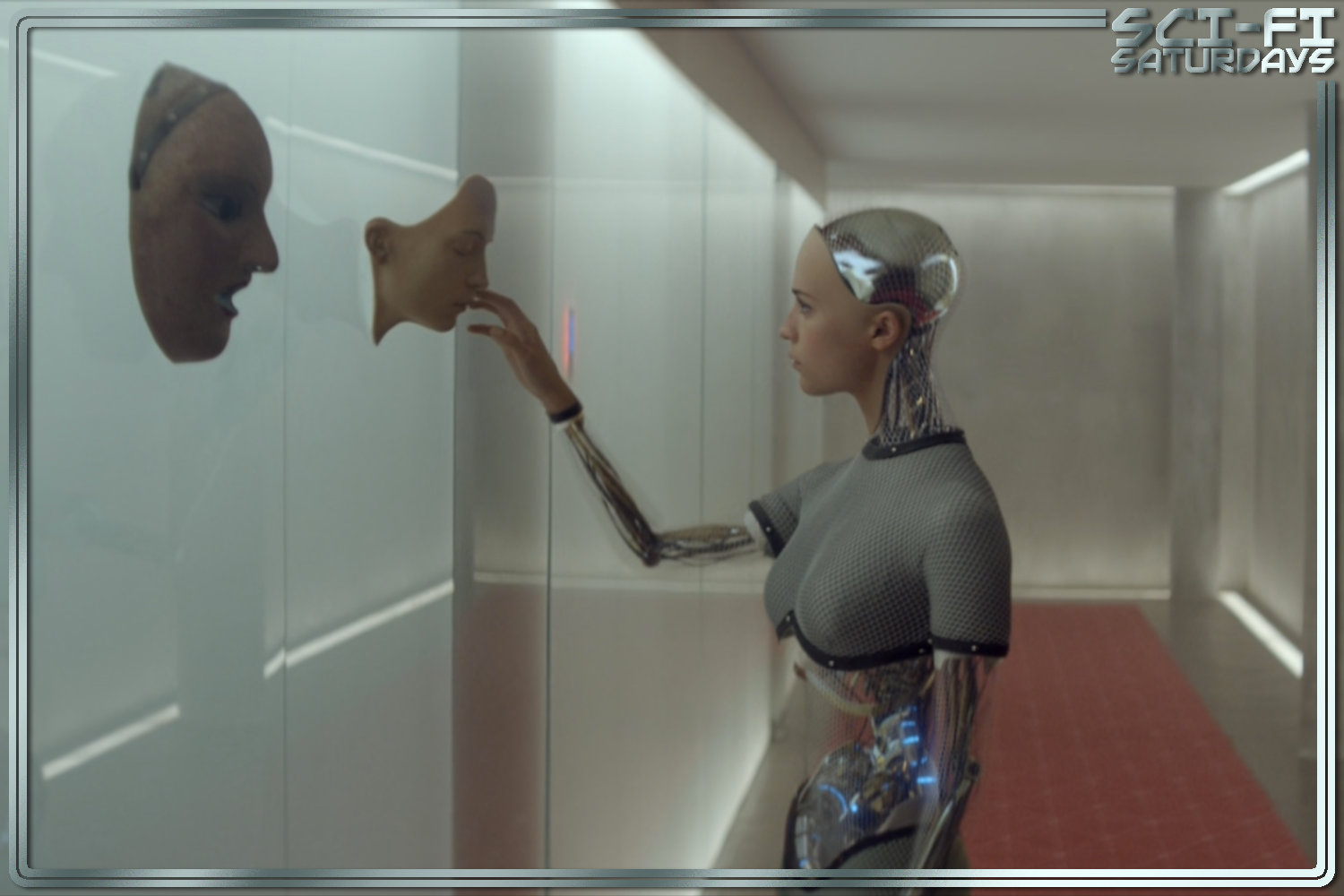
Caleb wanders a hallway, finding a chronology of facial masks, ending in one that looks very much like Ava. In a darkened room nearby, Caleb is startled by a drunk Nathan. In the morning, Caleb is again startled when a new woman, Kyoko (Sonoya Mizuno), brings him breakfast, believing that he and Nathan were the only two here. The question for today’s session is asking Ava how she feels about Caleb. She asks for more details about Caleb, and he describes a car crash that killed his parents and left him scarred and in the hospital for a year. During another power outage, which also cuts the CCTV Nathan observes them with, Ava tells Caleb not to trust Nathan. At dinner, Nathan berates Kyoko, who doesn’t speak English and has spilled a glass of wine. When he asks Caleb about any discussion during the outage, Caleb lies.

Nathan observes Caleb as he enters Ava’s room for their first session.
The next day, Nathan answers some of Caleb’s questions about the project, like using his search engine to provide the core elements of the AI, along with hacking the world’s cell phones to gather biometric data from individuals. At the third session, Ava admits she’s never been outside the room and then picks out a dress and wig to wear, hoping to impress Caleb on a “date” they may be having. Caleb questions Nathan’s use of sexuality in Ava, but the creator argues that all sentient creatures exist with a sexual dimension. During the next session, Caleb learns that Ava has been controlling the power outages, looking for an exploit to escape. That night, Caleb imagines kissing Ava while Nathan has intercourse with Kyoko in his room.
Caleb observes Nathan talking to Ava via the CCTV monitor and sees him tearing up a drawing she made of Nathan. In the common room, Nathan doesn’t want to answer questions about tearing up the picture, deciding to tear up the dance floor with Kyoko instead. He later passes out drunk. During session five, Ava administers a “lie detector” test to Caleb, eventually asking him if he wants to be with her. Nathan reveals that Ava is version 9.6 of his experiment, and that he may need to upgrade again, which would wipe out the existence of “Ava.” That afternoon, Caleb encourages Nathan’s drinking and, when he passes out, steals his keycard, accessing his private files. He finds a video of three other prototype gynoids. In Nathan’s room, he finds their bodily remnants in the closets along with a naked Kyoko, who peels back part of her skin, revealing that she, too, is a robot.
On the final day, Caleb plans to get Nathan drunk again, reset the security protocols, and escape with Ava. But Nathan reveals he installed a battery-powered camera and heard the entire plan. He explains that Ava is a rat in a maze and is using Caleb as the exit. He was not chosen by happenstance, but based on his search engine inputs and his likelihood to connect with the visage of Ava. Another power outage occurs, but Caleb has already reset the protocols, meaning that Ava is now able to get free. Nathan tries to stop her by shattering her arm, but Kyoko sneaks up behind him and stabs him with a knife. He smashed her face with a pipe as Ava stabs him again. As Nathan bleeds out on the hallway floor, Ava enters Nathan’s room, finding the earlier prototypes. She replaces her arm and, using skin from one of the gynoids, covers the remainder of her anatomy. Caleb is locked in Ava’s room, screaming for her to let him out. She puts on her clothes and flies away with the helicopter meant for Caleb. She finds a busy intersection in town, as she had always dreamed about, mingling with the pedestrians before disappearing into the crowd.
“The computer is Mary in the black and white room. The human is when she walks out.” – Caleb

During a power outage, Ava tells Caleb not to trust Nathan.
History in the Making
Though only 10 years old at this point, Ex Machina should be considered the gold standard for films discussing artificial intelligence, as both a starting point and an end goal. It provides an unflinching look at the perils and pitfalls of artificial intelligence two years before the debut of current large-language models of AI. It was one of several films from the 2010s that examined the development and evolution of AI systems, including last week’s look at Chappie, Her, and Tron Legacy. It was the first directorial film for writer/director Alex Garland, who would also go on to direct Annihilation, Men, and Civil War, but it was not his first foray into film. He was the author behind 28 Days Later, Sunshine, and Dredd, plus others. Garland was nominated for Best Original Screenplay at the Academy Awards for his efforts, while the film won an Oscar for Best Visual Effects for its subtle, yet haunting, visions.
The cast of Ex Machina is impressive, but was less well-known than they are now when the film was originally released. Domhnall Gleeson, son of Irish actor Brendan Gleeson (Edge of Tomorrow, A.I. Artificial Intelligence, In Bruges), stars as Caleb the programmer. In 2015, he was primarily known to fantasy and sci-fi fans for his small roles in the final two Harry Potter films, The Deathly Hallows Part 1 and Part 2, and Dredd. His first starring role was in the time travel/romcom About Time, and he garnered even further exposure in the debut Season 2 episode of Black Mirror, “Be Right Back” (where he coincidentally plays an artificially intelligent clone of a woman’s dead boyfriend). Oscar Isaac was also not a household name at the time, having had a small role in Sucker Punch and playing the wicked King John in the Russell Crowe/Ridley Scott version of Robin Hood. He received a starring role in the Coen Brothers’ melancholy period piece Inside Llewyn Davis, before becoming the charming and dark Nathan. Both he and Gleeson would become much better known to audiences at the end of 2015 as the two starred in Star Wars: The Force Awakens, where Gleeson played the evil General Hux, while Isaac played the heroic Poe Dameron. Rounding out the cast, Alicia Vikander had only done dramatic roles, in films like Anna Karenina (also with Gleeson) and as Vera Brittain in Testament of Youth, before stepping into the role of Ava. She has since become known for action films like Man from UNCLE and Tomb Raider.

Nathan explains how Ava’s brain works, and also about the slightly unethical research he did to design it.
Genre-fication
There would be no Ex Machina without a slew of other films and TV shows from the past 60 years to stand on. The film also owes much to two classic stories, one of which is science-fiction (but often thought of as horror), while the other is a Shakespearean classic. Many viewers of this film probably recognize its similarities to the classic Mary Shelly story Frankenstein, adapted originally in 1931 (and most recently, again, this month with Oscar Isaac as the mad doctor). One might argue that Ex Machina is more likely The Bride of Frankenstein, as man creates woman. But either way, the parallels are the same: a troubled genius creates life with unexpected consequences. The 21st-century version just includes non-organic elements. The other story that Ex Machina draws from might not be as obvious. It’s William Shakespeare’s The Tempest, about a wizard (Prospero) who lives on an island with his daughter (Miranda), a servant (Caliban), and an air spirit (Ariel). Sci-fi fans might know this tale better by its 1956 title, Forbidden Planet. It was also retold, in a way, with Jerome Bixby’s 1969 episode of Star Trek, “Requiem for Methuselah.” Nathan is Prospero, a magician of the technical kind. Ava is both Miranda and Ariel due to her subservience towards Nathan, but also her “powers,” akin to spiritual magic. Caleb is Caliban, the only inhabitant of the island who is forced to serve Prospero. These stories form the basis of Ex Machina’s foundation, which also includes ideas from elsewhere.
Since HAL 9000 went rogue and insane in Stanley Kubrick’s 2001: A Space Odyssey, the portrayal of intelligent robots and computers has often revolved around the link to their humanity and the dangers associated with providing them too much autonomy. Colossus: The Forbin Project, Westworld, Saturn 3, and others derive their conflict from humanity versus an intelligent machine. The Matrix would move to new depths with an artificially intelligent mechanical species controlling humanity as a power source for its survival. A.I. Artificial Intelligence brings a story focused more on the search for humanity by the humanoid robots. Many of these stories also make way for, or present, the technological singularity (often referred to only as The Singularity), which is a hypothetical event where technology grows beyond human control, often producing unpredictable changes. Ex Machina does just that, inciting a near-perfect copy of a human being, and releases that machine into the realm of the social ecosystem.
This film also delves deeper into the idea of artificial intelligence than almost every other film on the subject, which is why it’s recommended for watching. It introduces a creator who understands the engineering and business model for the creation of Ava, but doesn’t seem to understand the connections that she can foster with others. He is her father, her creator, and looks upon her as a tool, much as one might look at a car they’ve built from scratch. You might take good care of it, keeping it clean and protected, but you’re not going to worry about leaving it alone in the garage, or think it will get jealous when using another vehicle. Nathan misses what he’s actually created specifically because he’s too close to Ava. Caleb, on the other hand, initially sees her as a robot, which fascinates his intellectual curiosity. But it’s his emotional relationship with her that the crux of the film hangs on. Until Ex Machina, artificial intelligence was infrequently seen outside of a computer shell, let alone in the body of Alicia Vikander. The film doesn’t shy away from the sexuality of Nathan’s creations either. Ava was “fully equipped,” as were Kyoko and the others. The following year, the reboot of Westworld would dive deeper into these themes, and others, but Ex Machina was numero uno.

Nathan tears it up on the dance floor with Kyoko, one of the most memorable scenes in the film.
Societal Commentary
The title of the film derives from the Latin phrase deus ex machina, meaning the God (or sometimes the Ghost) in/from the machine. It was a phrase that references the tropes presented in ancient theater, where a God would intervene in the final act, correcting everything that was wrong with a sweep of his hand. The removal of the ‘deus’ in the phrase leaves the title as ‘the machine,’ referring to Ava’s character. Early in the film, when Nathan explains to Caleb what he’s about to see, the young programmer says, “If you’ve created a conscious machine, it’s not the history of man. That’s the history of gods.” Nathan later misquotes the man by asking how Caleb’s quote went. “I’m not a man, I’m God,” says Nathan, completely reimagining the line by putting himself on the highest pedestal imaginable. The filmmakers removed God from their title, but Nathan makes sure to reinstate it. If there’s any doubt that one of the themes of the film is the danger of creation, look no further than this.
As with last week’s film, Chappie, Ex Machina also deals with the notion of consciousness and what it means to be alive. Caleb is very excited to discuss the nuances of Ava’s programming and her large language module, but Nathan is uninterested in that. He’d rather have a beer and a discussion, asking Caleb how he feels about Ava. Caleb begins to relate to Ava as he would a person, forgetting that the exposed skull and midsection of a robot exist. He begins to lose sight of his true purpose, becoming emotionally entangled by Ava’s charming subroutines. The film works on the level of empathy in regard to the obvious robot in the room. And it makes both Caleb and the audience second-guess their instincts. What if Caleb is a robot too? If something that is clearly a robot can act with such feeling and emotion, maybe Caleb is not what he seems. He tells a story about how his parents were killed in a car accident. He has strange scars on his back. Perhaps these memories aren’t real, and Caleb was also built by Nathan to work at his company. The way that Garland plays with the audience’s expectations of the genre to create new and exciting moments is one of the best elements of the film.
Some viewers may ask, What was Nathan attempting to do by having Caleb come to the house? It begins as a fiction that Caleb has won an employee contest to visit Nathan’s compound. That turns into a request to perform interviews with his new AI/fembot, which makes Caleb eventually realize that the whole thing has been a performative setup. He wasn’t picked; he was specifically chosen, via his search history and psychological profile. Ava was even tailored to look like the women in Caleb’s porn profile. So what was Nathan’s plan? He certainly wanted to show off his creation to someone. Presumably, his life was one of isolation on his estate, building gynoids for his own edification and pleasure, but also to see if he could. He wanted to bring in someone who could appreciate his accomplishment. But he also wanted someone who would provoke and test Ava in ways that he was unable to do. Through her manipulation, her sexuality, and her perceived innocence, she manipulates Caleb into releasing her from her prison. It doesn’t seem like Nathan ever conceived of that happening, especially with the security measures he put in place. But his hubris and ego blinded him to the possibilities of things going awry. That, and perhaps his blackout binges of alcohol. Like the greatest mad scientists in fiction, Nathan thought he was the god, but he was actually the monster.

Caleb discusses the next steps in the project with Nathan when he realizes he actually has feelings for Ava.
The Science in The Fiction
Ex Machina satisfies the science element in science-fiction, too. It is extremely thoughtful and caring about representing several aspects of philosophy and computer science, along with its semi-futuristic exploration of sentient artificial intelligence. The most prevalent scientific theory regards the Turing Test, and is more well-known because of this film. Created by British mathematician Alan Turing, the test supposes (as the film states) that a human speaks with another via some interface, possibly a keyboard/screen or even vocally. On the other end of the line will be either another human or a robot/AI. If the human is unable to tell the difference, the test is passed. This is different from the Uncanny Valley, which is the ability for a digitally synthesized human being to be believably perceived as a real person, or if there are certain aspects of the performance that appear unreal. The Turing Test also assumes that the one conducting the test has certain traits that would allow them to interpret their interactions in a meaningful way, such as empathy, cognition, and a suitable intelligence. This is not the same thing as asking your favorite digital assistant to tell a joke or order Chinese food. It would be examples as presented in the film, such as letting the AI choose what to draw or the response it gives to contradictory stimuli. Audiences may find the Voight-Kampf test from Blade Runner as being similar to Turing’s test. But instead of working on logical boundaries, the VK test works on empathy, something the Replicants of that story lacked.
Another aspect of the testing involves the knowledge argument, represented in the film as “Mary in the Black and White Room.” This experiment asks about Mary, a scientist working in a wholly black and white room. She studies optics and understands everything there is to know about color, even though she doesn’t experience it. The question being, if Mary were let outside, would she learn anything new by being exposed to a colorful world? Caleb argues that she would. Mary would feel what it’s like to actually experience color. He argues that the computer is Mary in the black and white room, and the human is when she walks outside. That is, the artificial intelligence can understand everything there is to know about humans, but until it experiences being a human, that’s the point where it gains new understanding or feeling. It’s not accidental that Ava is kept inside, in a single room, during the film. Nathan has never let her experience the wonders of nature all around his compound. But the climax of the film occurs when she finally gets to leave the compound and fulfills her fantasy of visiting a traffic intersection where she can experience people. She graduates from being a computer that understands without experience, to becoming a human for all intents and purposes.
This final sequence also touches on another important philosophical notion. As Ava enters the real world, the camera focuses on her shadow intertwined with the shadows of other busy individuals making their way along the sidewalk. We understand that these are representations of people, but their proportions are skewed due to the setting sun. This is Plato’s Allegory of the Cave. In his tale, Plato relates a notion about men chained to the wall of a cave who experience reality by observing the shadows on the wall of the cave. From their perspective, these shadows represent reality. But to the outside observer, the shadows are only muddy versions of the true reality that exists outside, or in the higher plain. The Matrix used this allegory to ask the audience what is real. Ex Machina uses the idea to show Ava’s transcendence. She was once locked in the cave, but now she is free–both physically and philosophically.

Ava and Kyoko are about to go full Terminator and attack their creator.
The Final Frontier
There is so much going on in Ex Machina that it requires multiple rewatches to see everything. Garland depicts Nathan as both a creator and a destroyer through his misattributed quotes. The misappropriation of the term God is mentioned above, and occurs in one of the first discussions between Nathan and Caleb, after the time Caleb discovers what Nathan has made. It’s an exciting moment where Caleb also quotes Lewis Carroll’s Alice in Wonderland. The other quote comes after Caleb has decided to get Nathan drunk and change the security codes. Caleb is shocked by the revelations he’s seen and quotes Robert Oppenheimer, “I am become Death, the destroyer of worlds,” itself a quote from the Bhagavad Gita. As Nathan lies, drunk on the couch, he mutters, “The good deeds a man has done before defend him,” which is another section of the Gita quoted by Oppenheimer. The connection is that Nathan realizes that he, too, has created a device that is now out of his control and one that potentially can destroy humanity. He follows this by saying, “It’s Promethean, man.” Prometheus being the man who stole fire from the gods, a gift that is very much a blessing and a curse. Whether Nathan understood what he was doing prior to this is up to the viewer’s interpretation of the events of the film.
Garland also uses plenty of non-verbal cues to craft the themes of the film. One primary visual is the use of mirrors and other reflective surfaces. A reflection is often considered a sign of duality, and the character seen reflected the most is, you guessed it, Ava. Her reflection not only relates to the truthfulness of her statements, but her humanity as well. Lying would probably not be a default state for a computer, but a learned experience. We often lie to cover shame and guilt, to avoid getting in trouble, or to exert power. Ava appears to be exhibiting these very human traits as well, exceeding her mandates and Nathan’s dreams. The scenes of her technological superiority are contrasted (or perhaps, reflected) by Garland’s use of nature scenes as transitional elements. Visuals of the woods or the river underscore both how different Ava is from the natural world, but also depict the beauty that she has never seen, but yearns to. It’s a beautifully poetic tone poem of footage that allows the audience a respite from the intensity of other scenes.
Ex Machina is such a wonderful film. It has influenced many other stories about artificial intelligence in the decade since it was released. Stories such as Westworld (the TV series), Blade Runner 2049, M3gan, and The Creator have continued to explore different aspects of AI. Coincidentally, there were several other films in 2015 that dealt with AI, but not as thoughtfully or successfully, including the continuation of The Terminator franchise, Terminator: Genisys, and Avengers: Age of Ultron. Ex Machina remains the best example of a human story about the technological world, as it reminds viewers exactly what is important about being human. It presents an artificial woman, having more humanity than a man who is human, and asks the question: Does it matter?
Coming Next


Having grown up on comics, television and film, “Jovial” Jay feels destined to host podcasts and write blogs related to the union of these nerdy pursuits. Among his other pursuits he administrates and edits stories at the two largest Star Wars fan sites on the ‘net (Rebelscum.com, TheForce.net), and co-hosts the Jedi Journals podcast over at the ForceCast network.