
When death comes to town, I’m gonna jump that train. When death comes to town, I’m gonna catch that plane.
Final Destination was one of a series of films that reinvigorated the genre in the late 1990s and early 2000s. It didn’t stray too far from the norm as it sought to reframe the ideas around classical slasher-type narratives, but did create an interesting take on the killer-stalking-teens formula that has proved its longevity.
Before Viewing
This trailer starts with a young man freaking out on an airplane, claiming that it will explode, causing himself and several others to be thrown off. It does, and he has now saved his friends’ lives. Unfortunately, strange things begin happening as his friends begin dying in the same order they would have died on the plane. How can you cheat death when you’re already at your Final Destination?
Presented below is the trailer for the film.


Final Destination title card.
After Viewing
Alex Browning (Devon Sawa) and his classmates from Mount Abraham, New York, arrive at JFK airport for a school trip to Paris. He is nervous and notices lots of small details, like the departure board showing the word “terminal.” The students board the plane, and Blake (Christine Chatelain) asks Alex if he would switch places with Christa (Lisa Marie Caruk), which he does, ending up sitting next to his friend Tod (Chad Donella). The plane experiences massive turbulence on takeoff, ripping a hole in the side before exploding. Alex startles awake, sweating, only to see Blake and Christa waiting for his answer to their question. He panics and gets off the plane, followed by Carter (Kerr Smith) and his girlfriend Terry (Amanda Detmer), Tod, Clear (Ali Larter), teacher Val Lewton (Kristen Cloke), and Billy (Seann William Scott).
Alex and Carter are detained for fighting, and the captain says no one else is allowed back on. The plane departs without them and explodes moments later, putting everyone into shock. FBI Agents Weine (Daniel Roebuck) and Schreck (Roger Guenveur Smith) interview the survivors before their parents come to pick them up. A little over a month later, a memorial is dedicated to those killed in the accident. Carter is angry with Alex, telling him he owes him nothing for saving his life. Many think that Alex holds some kind of supernatural power. That evening, a mysterious shadow appears behind Tod while he is shaving in the bathroom. He slips on the water-soaked tile, falling into the shower where a clothesline wraps around his neck, killing him. The water mysteriously recedes to the source afterwards.
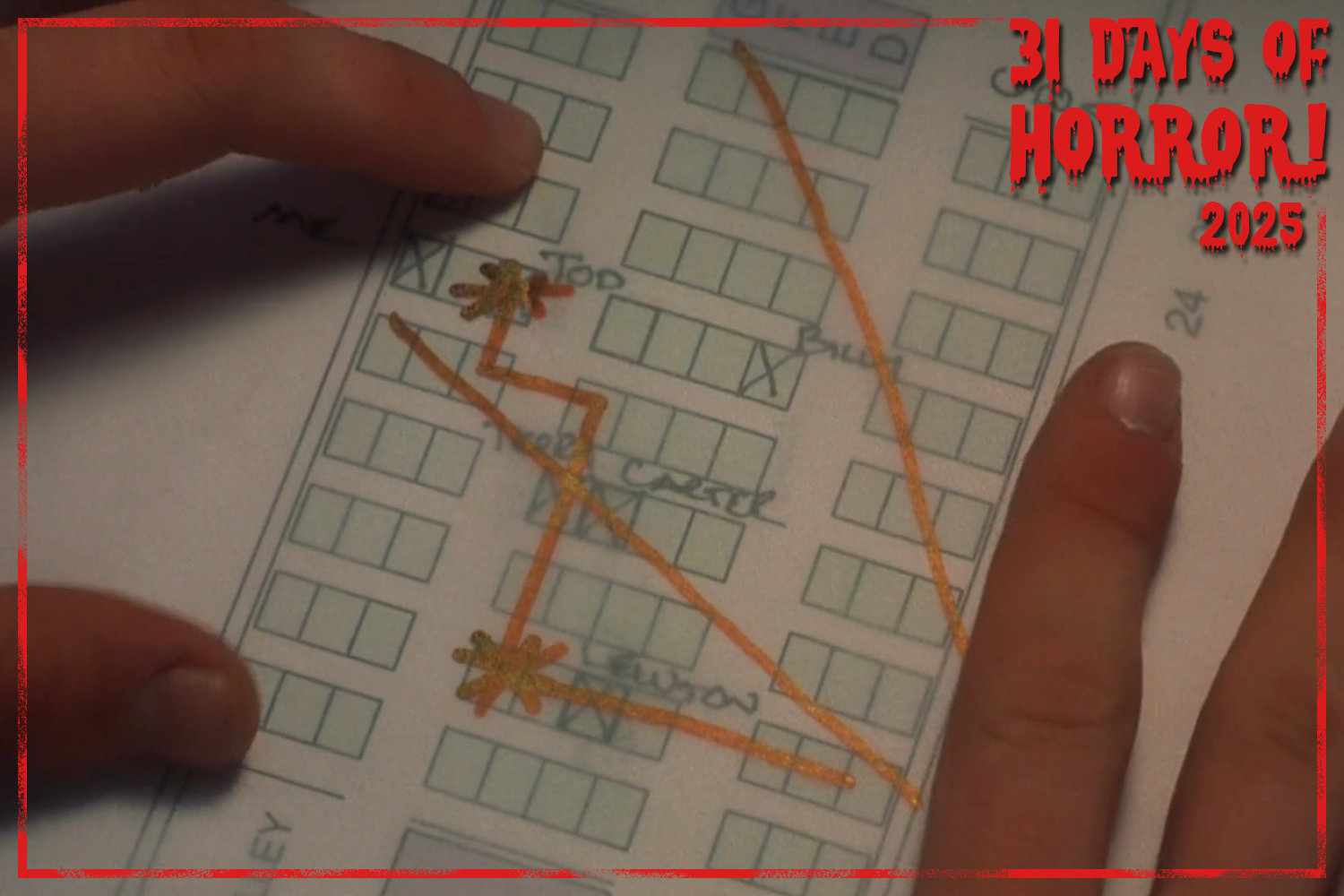
Tod’s dad (Larry Gilman) blames Alex for his son’s apparent suicide. Alex visits Clear at her house. Neither she nor Alex believes it was a suicide, and they break into the mortuary to see his body. They encounter the creepy mortician, Bludworth (Tony Todd), who tells them about Death’s design and how Alex has interrupted the plan. All the survivors coincidentally arrive at the same street corner the next day. Terry has had it with Carter’s angry treatment of others and says she is moving on with her life, just before she dies by stepping in front of a speeding bus. Alex tries to explain the design, but no one is listening. The FBI continues to keep tabs on the kids, especially Alex. He does some investigation on his own into the cause of the explosion, finding that a fuel line ruptured. The path of the explosion was traced through the seats of the survivors, and they’ve been dying in order of how they would have died on the plane.

The seven survivors of Flight 180 take stock of their lives.
Alex stops by Val’s house to check on the safety of her car tires, when the FBI agents pick him up. Inside, Miss Lewton is already on edge as she packs up to move. She plays a John Denver album and makes a cup of tea. She changes her mind and pours out the tea, replacing it with chilled vodka, which cracks the mug, leaking flammable fluid. The vodka drips into the back of her computer monitor, which explodes, sending a chunk of glass into her neck. A fire starts, burning a trail back into the kitchen. Crawling along the floor, Val reaches for a towel on the counter and accidentally pulls off a knife that impales her chest. Alex returns, having been released by the Agents, and tries to save this teacher. He leaves his finger and shoe prints before escaping as the house explodes.
Clear, Carter, and Billy find Alex and decide to take him to a cabin in the woods owned by Clear’s family. On the way, Carter becomes suicidal, claiming that he controls his own destiny. He stops the car on a train track as a freight train approaches. Deciding he doesn’t really want to die, he tries to get out but can’t. Alex saves Carter, but Billy dies instead, decapitated by debris from the mangled car. They realize that by saving Carter, Death skipped over him and took the next person. Alex “death-proofs” the cabin, but soon realizes that he’s not the next to die, as he thought. Since he had not actually switched seats before getting off the plane, Clear would be next. Alex runs to her house, finding her trapped in a car with sparking electrical wires around her.
Alex tells Clear that he’ll force Death to skip her by grabbing the wires himself. Then it will all be over. Clear escapes the car, and Alex is blown into the garage by the electrical explosion. The FBI agents arrive and perform CPR on Alex. Six months later, Carter, Clear, and a healthy Alex arrive in Paris for a much-needed vacation. At a cafe, Alex explains the design, but is confused why he survived. Clear has a premonition and calls Alex’s name to stop him from stepping in front of a bus. The bus bumps a pole, which smashes into a giant hanging sign, which falls towards Alex. Carter saves Alex, telling him that he’s safe. But Alex points out that Death has now skipped him, as the sign swings backwards, impaling Carter.
“It’s all part of death’s sadistic design, leading to the grave.” – Bludworth

Billy, Clear, and Alex attempt to warn Carter about the oncoming train.
Final Destination was the newest destination for horror movies, spawning from the late 20th-century wave of self-aware slasher thrillers, beginning with Scream and continuing with I Know What You Did Last Summer and Urban Legend. Each of these films worked to create a new franchise within the horror genre to freshen an otherwise stale marketplace. Scream created a series of films with characters who were aware of the tropes in slasher movies while suddenly becoming thrust inside one. I Know What You Did Last Summer followed suit with the killer stalking a group of young friends in what appeared to be a feature-length telling of an oft-told urban legend. Urban Legend decided that if it was good enough for I Know What You Did, then it would create a serial killer that only killed people via urban legends. Final Destination broke further conventions and did away with a killer entirely. In this film, the personification of Death itself is seeking retribution on the students for somehow having squirmed their way out of its master plan.
The story originated as an idea by writer Jeffrey Reddick for The X-Files television series. He was convinced to turn it into a feature-length script instead, which caught the eye of X-Files writers and producers Glen Morgan & James Wong. The duo reworked the script together with Morgan producing the film and Wong directing. It also owes a tip-of-the-hat to another tale, though one that is never directly mentioned: The Twilight Zone episode “Twenty-Two.” As mentioned in the article earlier this month for Dead of Night, “Twenty-Two” is based on a story from that film, about a woman who has recurring dreams while hospitalized of being taken to room 22, the morgue. Once she is released, she books a flight, which turns out to be number 22, but refuses to get on. The denouement is that the plane explodes shortly after take-off, with her dreams having been premonitions about the crash. Certainly, Reddick had most likely seen that episode of The Twilight Zone at some point, which percolated through all coincidences featured in the film. Final Destination freshens up the plot, using a group of high school teens on their way to Paris for a class trip when one of their number suddenly has a premonition of their death. Seven characters deplane, surviving what would have been a fiery death above the Hudson River.
Wong builds the tension to this moment, which occurs 15 minutes into the film, by showing Alex’s distracted nature. He hypervigilantly notices minute details about the airport. The Hare Krishna provides Alex with a flyer, which says, “Death is not the end.” He focuses on the words “departed” and “terminal” of the giant automated Departures board. A close-up of a photo of a wrecked car (specifically Princess Diana’s vehicle) is shown. All the while, a menacing lightning storm approaches the airport. Unless audiences have seen the trailer and know that an accident is about to happen with the plane, the tension of these moments definitely lets them know that something is about to happen. Once the revelation that the explosion was only Alex’s premonition, the film kicks into high gear, amping up the suspense. The survivors are all hunted by the personification of Death. No killer or spectre is ever shown, but there are subtle shadows that cross behind characters before their imminent death. One passes across the background behind Tod, and another near Val, before they get killed in elaborate Rube Goldberg-like ways.

Alex decides to risk his safety to save Clear from becoming the next victim to Death’s design.
The death sequences, like many horror franchises concerning serial killers, are the main attraction for the audience. Once it’s been established that Death is coming for the survivors, it does so in the most complicated ways, as if trying to hide its hand by creating the most contrived series of coincidences possible. The death sequences are the way for the filmmakers to create new and exciting visuals of characters dying. For example, Tod is grooming himself in the bathroom when water begins to leak from the toilet tank, flowing across the floor in a predetermined pattern. It’s not just pooling, but heading towards Tod’s bare feet. He slips in the water, but doesn’t just hit his head. He falls into the shower, knocking the clothes drying line loose, which wraps around his neck and suffocates him. The water then mysteriously recedes, leaving no trace of this as an accident, and incriminating Tod in suicide. Val’s death is even more contrived as her cracked mug leaks vodka, which becomes an accelerant in a fire ignited by a shower of sparks from an exploding computer monitor that also blasted a shard of glass into her neck. The flames lead back to the vodka bottle, causing a massive explosion that throws her to the floor. As she reaches for a towel to staunch the blood from her neck, she pulls a butcher’s knife off the counter, which impales her in the sternum. Alex arrives, believing she can be saved, when a second explosion blows the oven door open, knocking over a chair, which lands squarely on the knife, driving it all the way in. Both exciting, from a causal perspective (the amount of foreshadowing in these scenes is excessive), and horrific, from a genre perspective (as is expected).
Alex becomes convinced that he can change things, as each time someone is saved from dying, the “countdown timer” on that person’s death is reset and bypassed. As if Death were taking customers at the deli counter, and anyone “surviving” just had to return to the end of the line to wait until their next turn. Final Destination takes the adage that you can’t cheat death and turns it into an absolute. Outsmarting the Grim Reaper at his own game only makes him more vengeful and subject to accelerating your timeline. Alex pontificates that maybe sitting and drinking coffee, or crossing the street, might be the thing that sets the events in motion that will one day lead to their death. He’s correct, but not in as dramatic a fashion. Everything each one of us does every day is leading, somehow, to our death. It is, of course, the final destination. As soon as we’re born, we begin dying, though this is not something usually dwelt on by teenagers. As Tod reads in his recitation at the memorial, “we imagine that the hour is placed in an obscure and distant future.” The tragedy for the characters in this film is that their time is up, and apparently, nothing they can do will abate the spectre of death. In the end, Carter saves Alex from being killed by the sign only to be killed himself (presumably, since the screen cuts to black at the moment of impact). What then happens to Alex and Clear? Are they vigilantly trying to save each other in a merry-go-round of near-death experiences until they eventually tire and succumb to the Design? Does Death take a break from killing others to correct its design and kill those who missed out? If so, Alex has messed things up for Mr. Death until he can get things back on track.
Final Destination is an interesting new premise to an old-style of horror film. Instead of a masked killer hiding around every corner, characters in this film need to be wary of almost anything, from the most mundane tasks to the bizarre one-in-a-million accidents. If there’s any criticism about this film, it’s got to be the toxic masculinity of Carter. He is constantly lashing out at people, and targets Alex…for what? Claiming that the airplane is going to explode? His anger at everyone is never explained, and he’s so quick to fly off the handle that he becomes a caricature of the High School bully, rather than someone involved in a bizarre situation. For those who enjoy this type of film, there have been five sequels, with the most recent, Bloodlines, having been released earlier this year.

Clear, Alex, and Carter celebrate beating death, by having a drink in Paris.
Assorted Musings
- The surnames of many characters are all homages to horror directors and actors.
- Alex Browning and Tod Waggner are named after director Tod Browning (Dracula), but also director George Waggoner (The Wolf Man)
- Billy Hitchcock is named after director Alfred Hitchcock (Psycho)
- Valerie Lewton references producer Val Lewton (Cat People)
- Larry Murnau refers to director FW Murnau (Nosferatu)
- Agent Schreck recalls actor Max Schreck (Nosferatu)
- Agent Weine certainly refers to director Robert Wiene (The Cabinet of Dr. Caligari)
- Blake Dreyer references director Carl Theodor Dreyer (Vampyr)
- Terry Chaney infers the actor Lon Chaney (The Phantom of the Opera)
- Christa Marsh might be a stretch, but could reference actor Fredric March (Dr. Jekyll and Mr. Hyde)
- James Wong returned six years later to write and direct the third film in the franchise, Final Destination 3.
- The film contains multiple occurrences of the John Denver song “Rocky Mountain High.” Denver famously died in a plane crash in 1997.

Having grown up on comics, television and film, “Jovial” Jay feels destined to host podcasts and write blogs related to the union of these nerdy pursuits. Among his other pursuits he administrates and edits stories at the two largest Star Wars fan sites on the ‘net (Rebelscum.com, TheForce.net), and co-hosts the Jedi Journals podcast over at the ForceCast network.