
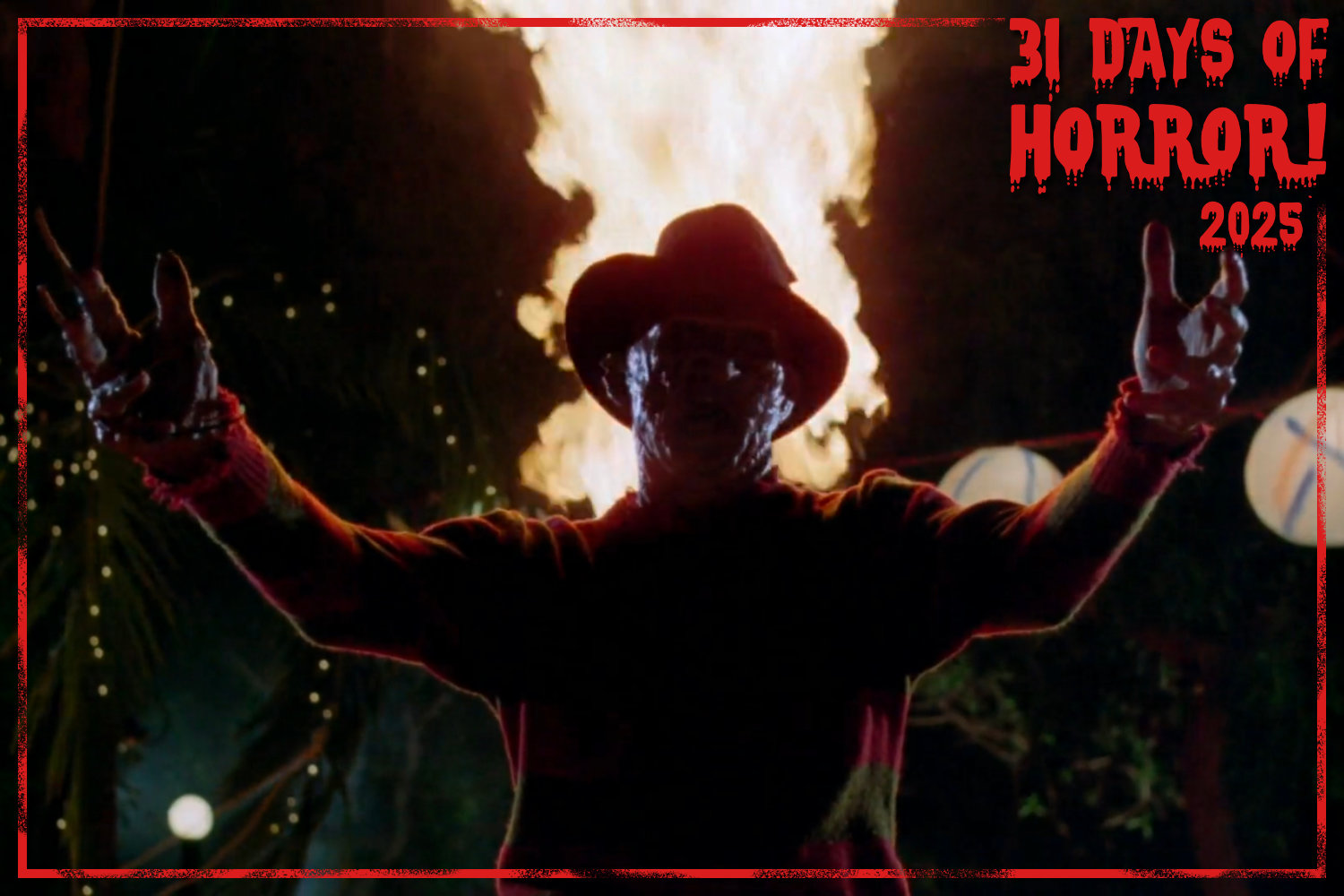
The Nightmare continues, but in a much more ludicrous way than anticipated.
For the second film in its franchise, A Nightmare on Elm Street 2: Freddy’s Revenge is a very campy departure from all the things that made the original film groundbreaking. Freddy’s power has been diminished in some fundamental ways that make this film seem almost like a spoof of a horror film, rather than the terrifying nightmare that fans were looking for.
Before Viewing
This trailer mentions the most important thing, which is Freddy’s back. He’s not welcome or wanted, but he’s coming back anyway. Someone has an eyeball in their mouth as Freddy crashes a pool party, locking (and electrocuting) the gate on the poor teenagers. He’s pissed and back for Freddy’s Revenge.
Presented below is the trailer for the film.


A Nightmare on Elm Street 2: Freddy’s Revenge title card.
After Viewing
In Springwood, California, a school bus drops off all of its students except for three: two girls and Jesse Walsh (Mark Patton). Suddenly, it lurches off the road and into a hellscape of a desert. The ground falls away, leaving the bus balanced on a rocky spire as Freddy Krueger (Robert Englund) comes for the kids. In Jesse’s kitchen, his parents hear him wake up, screaming. At school, Jesse gets into a scuffle with jock Ron Grady (Robert Rusler) during a softball game. Coach Schneider (Marshall Bell) makes them do pushups for detention. Ron tells Jesse that people were killed in his house five years ago. The Walsh’s have recently moved into the house, which Mr. Walsh (Clu Gulager) got at a great discount.
Jesse has trouble sleeping due to his room being hot all the time. That night, he wanders outside and sees a figure through the basement window by the ignited boiler. Investigating, he runs into Freddy, who wants to use his body. Jesse wakes up screaming, again. He drifts off in class and startles awake, believing a snake is on him. A snake has actually crawled on him in the biology class. Jesse makes plans to visit with his girlfriend, Lisa (Kim Myers), but is told he can’t until he finishes unpacking his room. Lisa walks in on him during an erotic dance and helps him finish unpacking. She finds a diary in his closet that belonged to Nancy Thompson, the previous owner.
Jesse and Lisa read part of the diary, finding out that Nancy had dreams about a strange, disfigured man with a razor-glove. That night, Jesse finds Freddy’s glove in his basement. The next day, the Walsh house is 97 degrees, causing the parakeets to freak out and explode. Mr Walsh angrily blames Jesse for the odd behavior, denying that there’s anything wrong. During a rainstorm that night, Jesse can’t sleep and wanders the streets into town, finding Don’s Place, a fetish bar. Inside, he sees Coach Schneider in a leather outfit. The coach makes him run laps in the gym. When the coach goes to shower, he is killed by Freddy. Jesse screams, finding himself naked, in the shower, wearing Freddy’s glove.

Lisa and Jesse discover a hidden diary detailing the murders in Jesse’s house.
The cops bring Jesse home, where Mr. Walsh accuses him of being on drugs. Mr Walsh admits to his wife that he knew about the killings in the area and this house, but it was such a great deal. Lisa takes Jesse to an old power plant where Freddy used to work and gives the nightmare killer’s full backstory. That night, Jesse wakes up in his young sister Angela’s (Christie Clark) room, wearing Freddy’s glove. He takes Sta-Up pills and chugs a Coke to stay awake. Lisa hosts a pool party where all the kids from school attend, except Ron. Jesse thinks he’s going crazy, but Lisa tells him she really wants to help. They start to make out, but Freddy’s long tongue comes out of Jesse’s mouth, and he runs off, embarrassed.
Jesse bursts into Ron’s room (at his house) and confesses that he killed the Coach. Ron wants to know what he can do to help. Jesse tells him to watch him sleep and if anything weird happens to wake him up. Ron falls asleep, and Freddy crawls out of Jesse’s stomach, killing the other boy with his razor-sharp claw. Jesse runs back to Lisa’s house, where she tells him to fight back. Freddy takes over and begins killing teenagers at the pool before disappearing. Lisa drives to the old power plant, where she avoids two guard dogs with human faces.
Inside, Freddy tries to scare her off, but she continues to talk to Jesse, pleading with him to fight. She kisses Freddy, and a fire breaks out, which surrounds Freddy, subduing him. When the flames cease, Jesse crawls out of the burned husk of the killer. Jesse and Lisa leave together. The following day is sunny and bright as Jesse gets on the bus for school. Jesse screams at the bus driver for going too fast, but it’s just his imagination running away with him. Lisa’s friend, Kerry (Sydney Walsh), says that it’s all over–as Freddy’s gloved hand erupts from her stomach. The bus lurches off the road, into a hellscape of a desert, just as it had in the opening of the film.
“Something is trying to get inside my body.”
“Yeah, she’s female, she’s waiting for you in the cabana. And you wanna sleep with me.” – Jesse and Ron

Always wear a glove before you make love.
A Nightmare on Elm Street 2: Freddy’s Revenge takes all the innovation and goodwill created by A Nightmare on Elm Street, released the previous year, and flushes it down the toilet. It was still a successful enough film that another sequel was released 16 months later, in 1987, but anyone who’s seen this film probably would not be surprised if this was the end of Freddy. Everything that’s great about the original film feels like it’s problematic with this one. The original film was iconic for several reasons, including its interesting take on the slasher formula, the inclusion of a character who attacks teenagers in their dreams with all the Freudian implications that go along with that, and the killer himself, Freddy Krueger. In that film, Freddy is not just an average slasher killer in the way that Leatherface, Michael, or Jason had been up to that point. He spoke, he joked, he had a strong personality, along with all the horrific attributes that make him scary, such as his glove and scarred visage. A Nightmare on Elm Street did for sleeping what Psycho did for showers; it made people afraid again by having Freddy stalk these teenagers and kill them in various ways that defied rational or logical expectations. His form emerged as an outline through a solid wall. He chased a teenager down an alley, having grown ludicrously long arms to allow his knives to scrape on the fence. His glove emerged perilously between the heroine’s legs while she fell asleep in a bathtub. Freddy was dangerous, and when a character fell asleep, the audience knew that Freddy would be able to finally get them.
Freddy’s Revenge follows a lot of the same formula as the original film. It opens with a dream in which the main protagonist is heading for school but ends up taking a bizarre turn as the bus ends up in a hellscape, putting the audience immediately on the defensive. It also ends with a fake-out happy ending, which also ends up as a dream (as in the first film) with Freddy coming, once again, for the main characters. In between, there are some of the same types of strange murders with Freddy taunting the protagonist, but less of the cat-and-mouse interactions from the first film. In A Nightmare on Elm Street, Freddy is like the shark in Jaws. His presence is felt by his voice or his claws, but the film keeps his full form hidden for a while as it builds the suspense. In Freddy’s Revenge, it seems like the filmmakers understood that the audience knew about Freddy, so there was less teasing of the villain. What they chose to do instead was create a story about a boy who was being possessed by the spirit of Freddy (even though they tried to make the audience think it could just be that Jesse is going crazy for the early parts of the film). The question was whether or not he was going to be able to resist the temptation.
Looking at the film from the final body count, it is the most death-filled Nightmare on Elm Street film by far. But here’s the problem with those deaths: most of them come from unnamed students at Lisa’s pool party, six in fact. These are characters that audiences don’t care about. One gets a decent death with a disemboweling, but two are thrown off-screen into the pool (which burns with hellfire once Freddy arrives), one is stabbed by Freddy (we only see the characters back) and then thrown through the grill (which explodes), with the final person being trampled to death by the escaping teens, and technically not being killed by Freddy. Freddy still gets some great screen time, but much of this was an afterthought, according to accounts on the making of the film. It was believed that a stuntman in Freddy makeup could be used instead of bringing Englund back for the part. It’s unclear how many of the interactions may have been afterthoughts. Freddy is less seen in the film and less crucial, because every time Jesse is on screen, he becomes the stand-in for Freddy. The scarred killer is manifesting himself within and through Jesse, so the fear becomes that Jesse may actually kill someone. That’s not ever shown, even though the death of Coach Schneider implies that it was Jesse who made the killing blow. Jesse awakening in his sister’s bedroom with Freddy’s glove on his hand also makes the stakes a little higher. The idea from the final act is that Freddy has emerged from Jesse (literally, in Ron’s room), while the youth is trapped inside of Freddy. The killer’s death by fire leaves a charred husk, which Jesse is able to crawl out of, reversing the metaphor.

Homoerotic subtext, or overhyped analysis? You decide!
Freddy’s Revenge plays with the tangibility of reality throughout, making dreams seem like the real world and the real world seem like dreams. How do viewers account for some of these moments? A scene that appears to start in reality has Jesse leaving the house and walking into town, but slowly devolves into a much weirder setting. He finds the Coach at a fetish bar, which suddenly transitions to the high school, where the Coach makes Jesse run laps. During this punishment sequence, Coach Schneider chooses to take a shower, where he is killed by the invisible killer using a jump rope. It begins in the real world, but soon fades into what feels like a stress dream where Freddy was able to kill Schneider in his sleep. Or perhaps it’s via Jesse in the real world. Or something like that. That’s some of the charm of the film, but also where the logic of the film becomes befuddled. If Jesse is able to manifest Freddy within himself, then this would allow Krueger to enter back into the mortal plane, no longer restricted to the dreamworld. But some scenes, and especially the death of Schneider, have a more dreamlike stream-of-consciousness state that defies logic. Additionally, smart viewers may ask, What is Freddy taking revenge upon? Nancy, the only surviving teen from the first film, doesn’t appear here–even though her diary is the link between the stories. As far as anyone knows, Freddy only wants to take over Jesse, but the reason why is unknown. Of course, being back in the real world would allow him to continue his killing spree. But just what Freddy really wants is never touched on. In fact, the word “revenge” is never uttered in the film itself. Does it really matter? Not at all, as logic in the dreamworld does not have to make sense.
The final aspect of A Nightmare on Elm Street 2, and the one that may be the most talked about aspect of the film, is the homoerotic subtext present throughout. This has to do with audiences perceiving homosexual themes and coding in the scenes surrounding Jesse. Watching the film from the context of 2025, it’s very clear that the character of Jesse is portrayed as a closeted gay man who is uncertain about what he’s feeling during his confusing adolescence. To be clear, the character is never considered gay in the film. He is depicted with a girlfriend with whom he makes out, but everything about him is a little more flamboyant. When these ideas were brought up originally (in the 80s and 90s), director Jack Sholder and writer David Chaskin denied putting in anything overt. Chaskin even chalked it up to the actor Mark Patton (at the time a closeted gay man in real life) as playing it “too gay.” Anyone who knows about how films are created probably finds this ludicrous. The scenes that include this homoeroticism didn’t just manifest themselves. They were planned and executed as they were conceived. The 80s were a different time, when homosexuality was not as openly discussed, but how could the major players in the film (the writer, director, or editor) be oblivious to some of these moments? Just looking at some examples provides all the evidence needed. A fight ensues between Jess and Ron on the baseball diamond, which rapidly devolves into a wrestling match. Ron says that Coach hangs around a “queer S&M joint,” which Jesse later discovers. Jesse is depicted shirtless and sweaty (due to a malfunctioning thermostat). Later in the film, Jesse retreats to Ron’s house, bursting into his room to admit to killing the coach and questioning his sanity. Ron says the quote listed above, saying that flat out, Jesse wants to sleep with him. These are not coincidences, but premeditated choices about the dialogue, the settings, and the characters. For 25 years, Chaskin denied anything of the sort, deflecting that people were reading too much into the film, or shifting any “blame” to Patton. Eventually, he revealed the truth that, yes, he had written it with Jesse (a non-gender-specific name) as gay, claiming that he wanted to play into the homophobia of the male audience members to make them more uncomfortable. In essence, Jesse became the first male “final girl” of a horror movie, ever.
From a modern context, Freddy’s Revenge is difficult to watch because so much of it is the angsty Jesse being placed in the position of disbelief, mostly by his father. His father thinks he’s on drugs after he’s found naked in the school showers after hours. He’s also blamed for the exploding death of the parakeets, also by his father, one night. In fact, the father is a character who readily admits that nothing weird is going on seconds before the toaster bursts into flames. If anyone is in denial in the film about Jesse’s sexuality or his penchant for being a serial killer, it’s the father. These scenes feel so forced and disingenuous that they keep the film from achieving its fullest potential as a horror film where a killer stalks hormonal teenagers in their dreams. Luckily, the series returns more to form in the following film, Dream Warriors.

The film literally puts blood on Jesse’s hands.
Assorted Musings
- Robert Englund has a quick, uncredited cameo (outside of his Freddy makeup) as the driver of the bus in the opening scene.
- Another element of the film that doesn’t age well is the cereal on the family’s breakfast table: “Fu Man Chews.” It features a characterized stereotype of a Chinese person, with the toy surprise inside being Fu Man Fingers, five long red nails, which sister Angela wears, letting Jesse remember his dream about Freddy’s long knives.

Having grown up on comics, television and film, “Jovial” Jay feels destined to host podcasts and write blogs related to the union of these nerdy pursuits. Among his other pursuits he administrates and edits stories at the two largest Star Wars fan sites on the ‘net (Rebelscum.com, TheForce.net), and co-hosts the Jedi Journals podcast over at the ForceCast network.