
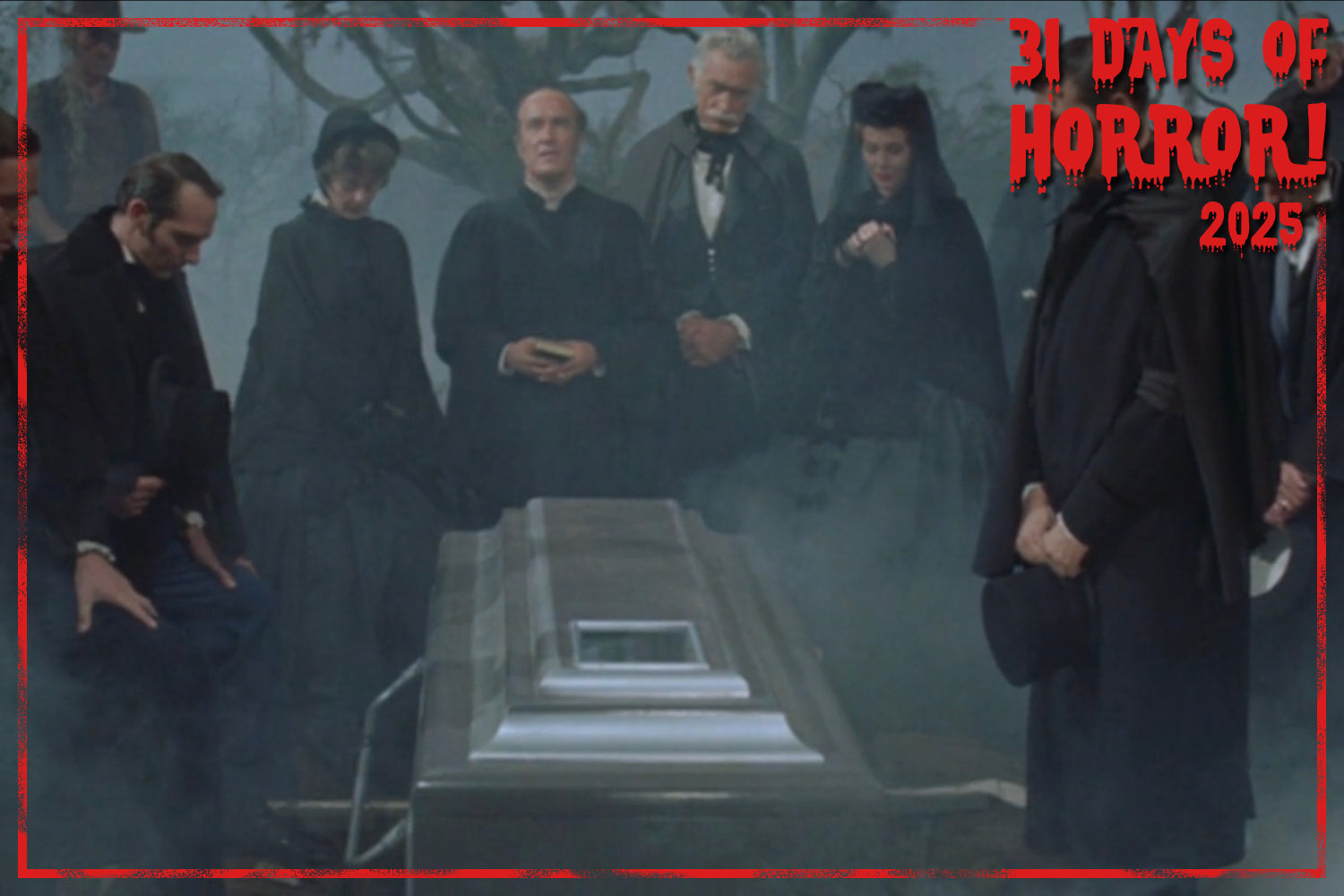
You will suffer as I have suffered. Buried alive…buried alive!
Roger Corman returns with another gothic tale inspired by the master of the macabre, Edgar Allan Poe. With a title like The Premature Burial, it’s almost a foregone conclusion that at least one character will get buried alive in this claustrophobic chiller.
Before Viewing
This trailer tells audiences everything they need to know. And maybe too much! Academy Award-winning actor Ray Milland is starring in a new film based on an Edgar Allan Poe book about a man who believes he will be buried alive. The man appears haunted and paranoid as he expresses his concerns to those closest to him. The trailer ends with him, apparently, being part of a Premature Burial, which hopefully is not the full arc of the film.
Presented below is the trailer for the film.


The Premature Burial title card.
After Viewing
On the moors of England, Guy Carrell (Ray Milland) attends an exhumation of a body that shows signs of a struggle after burial, disturbing him. His girlfriend, Emily Gault (Hazel Court), arrives at his castle, but both his sister, Kate (Heather Angel), and he attempt to turn her away. She professes her love, as Guy explains his reasoning for keeping her away. His family suffers from catalepsy, and they have all met violent deaths. He believes he will be buried alive, and so Guy wants to spare her the trauma. Emily doesn’t care, and the two wed on a dark and stormy night, much to Kate’s chagrin.
At the reception in Guy’s parlor, Guy’s colleague, Miles Archer (Richard Ney), compliments Emily on her piano playing. Her song, “Molly Malone,” causes Guy to recall the gravediggers he watched exhume the body, making him fear for his life again. That night, he hears a scream and finds Kate outside with his dog King, who is dead, hit by lightning presumably. As he formulates a plan to bury the canine companion, the dog wakes up, only stunned. This further pushes Guy’s paranoia about being prematurely buried.
Emily tells Miles that Guy is ill, as he has been building a mausoleum that contains many devices that would allow him to escape and survive being mistakenly interred. Should all other hidden passageways and communication devices fail, he has a goblet of poison for the final escape. Miles tells Emily he fears that Guy’s paranoia may bring the catalepsy to the forefront, as a case of mind over matter. Kate overhears Emily mentioning that she wishes Miles would stay at the castle with them. Emily’s father, Dr. Gault (Alan Napier), takes up his experimental residency in the house, which includes electroshock experiments on dead frogs.

Emily tries to soothe Guy’s jangled nerves, but he just wants to be left alone.
Guy hears someone whistling on the moors, but Emily says she hears nothing and that no one is there. He discovers the two gravediggers, Sweeney (John Dierkes) and Mole (Dick Miller), and passes out from fright. Guy has a nightmarish vision of being buried alive and having none of his escape methods work, including the poison. After waking up, Kate tries to tell him that their father never had the disease, and it’s all in Guy’s head. After spending all his time in his tomb, ignoring his wife, Emily gives him two choices: come back to her, or remain in the living death he’s already in.
Guy blows up his tomb, feeling much better, but has a relapse when he discovers their cat stuck in the wall–technically entombed alive. Miles believes that the only way to convince Guy of the truth is to enter his father’s crypt to prove he wasn’t buried alive. Guy finds the key to the door missing and forces the crypt open, where his father’s skeleton falls onto him. He passes out, and after Miles and Dr. Gault examine him, they conclude he’s had a heart attack and is dead. He is buried, but per his fears, he awakens enough to see, but not move. His voice-over shouts for someone to look closer at him, but to no avail, and he is put six feet under.
The two grave diggers exhume his body at the request of Dr. Gault, presumably to use in an experiment. Guy climbs out of the coffin, alive, but insane from his ordeal. He kills both Sweeney and Mole, returning to his castle. He then murders Dr. Gault. Emily admits to Miles that she made a mistake in marrying Guy when his apparently reanimated corpse enters the room. She faints, and Guy takes her body to his grave, covering her with dirt. Miles struggles to stop Guy and free Emily when Kate arrives and kills her brother. Miles discovers that Emily has died as well. Kate points out the crypt key on Emily’s necklace, noting she was behind the desecration of the body and for creating other signs that Guy was going mad, such as hiring the gravediggers to scare him and putting the cat in the wall. Kate regrets that she was too late to explain it all to her brother.
“For years, I’ve lived in dread of being buried alive. Can you possibly conceive it?” – Guy Carrell

Guy demonstrates his amazing new invention, a coffin with escape tools.
The Premature Burial is the third film in director Roger Corman’s Edgar Allan Poe cycle, and the first not written by Richard Matheson. Instead, this film was written by Charles Beaumont and Ray Russell. Beaumont would return for two other Corman/Poe adaptations, The Haunted Palace and The Masque of the Red Death, but may be best known for his more than 20 teleplays for The Twilight Zone television series. The film adapts the 1844 short story, first appearing in The Philadelphia Dollar Newspaper, and containing the bare bones of the story seen in this film. As with Corman’s previous Poe film, The Pit and the Pendulum, the bulk of the film was created anew to supplement the short story format. As with many of Poe’s works, the story is told from an unnamed first-person perspective that discusses, in depth, his fear of his catalepsy and being buried alive. His phobia grows so great that he creates devices in order to alert his friends should he ever be entombed prior to his death. He eventually awakens in a small, dark, confined space, which he believes to be a grave, but it turns out that it’s a boat berth. This shocks him out of his obsessions over any type of premature burial. It’s quite a different story overall than the events in the film, which finds intent in creating Guy’s paranoia with his then-wife, which eventually leads to both Guy’s and Emily’s death.
The idea of being prematurely buried is a common theme in Poe’s work, having popped up in The Pit and the Pendulum as well as in The Tomb of Ligeia. It wasn’t just his fascination, but a grander Victorian notion that one might find themselves in such a deep slumber that they would be mistaken for dead. Guy’s morbid fascination with setting up bells, secret passageways, and other escape methods from his tomb, as well as making sure it was stocked with food (and poison), was again based on real things that people would do to prevent accidentally being trapped. The film takes Guy’s mania to ludicrous heights, including the dynamite he can use to blow a hole in the tomb, which also happens to fail in his dream. Corman creates a mood and atmosphere that mimics the claustrophobia that Guy feels. The exteriors of the castle, the moors, are always hemmed in with spindly, dead trees, and the ground covered in a thick fog, which envelops the frame like a blanket. Inside the castle, the rooms are often small, and Corman keeps the camera close to the actors, especially Milland, not giving the audience any room to breathe. This gets exacerbated by the sequence where Guy passes out and believes himself to be trapped in the coffin. The camera is squeezed into the grave with him as colorful filters pulsate in blues, greens, and purples. It creates the feeling of anxiety in the viewer, mirroring Guy’s own spiraling.
With the other characters being an addition to the film’s plot, Guy’s mania seems like it could be being triggered by one particular person, his sister. Kate is the one that the filmmakers put the burden of suspicion on. The film opens with her telling Emily that Guy doesn’t want to see her, without even asking him first. She again tries to shoo her away after stepping into another room, but Emily stands by her need to “hear that from Guy himself.” A short while later, Kate interrupts Guy with his medicine, which she says is laudanum, but both Emily and the audience are suspicious. Kate often torpedoes Guy’s stories that he heard his father crying out after he was buried. She says that is not so, and that Guy was suffering a hallucination. That his own anxiety is feeding itself. Is she lying, or is Guy really fooling himself? At that point in the movie, there’s little reason for audiences to doubt Guy, but as things play out, it’s obvious he’s a few ravens short of a murder. Audiences may believe in a murderous sister up until the very end when Kate notices the crypt key around Emily’s neck. Audiences have seen the chain, but never what is attached to it. So when she provides the final answer of who was responsible, it all falls into place. But unlike the manipulations from other Corman/Poe films, this was not about adultery or trying to trick a spouse into madness for money. So why did Emily go to all this trouble to drive Guy mad? “I made a mistake,” she tells Miles. That’s right. She married Guy, but she realizes that she’s really in love with Miles. So, she tries to make Guy kill himself so she can move on with her life.

Emily and Guy listen to Miles’ encouragement, as Kate listens in incredulously.
Emily’s idea comes early on when Miles describes how the body and the mind are linked together. It’s possible to fixate on an idea so much that it physically begins to manifest itself within the body. There’s no real explanation as to what triggers Guy’s paranoia. Perhaps it was just the fear of death and believing that his father had died too early. Or maybe some other childhood memory overtook him. Either way, he believed that when his father passed on, he could hear his screams, and that he was buried prematurely. This constant fixation on the notion that his father was cataleptic and that he had inherited it created so much anxiety in Guy that it began to manifest physically. Slowly at first, but as Emily kept working on connecting his paranoia with death (with the gravediggers whispering, and then putting the cat in the wall), he became so overcome with the idea that his brain convinces his body that he was dying and couldn’t move. The catalepsy created itself because of his fears of it.
The Premature Burial is Corman’s only Poe film without Vincent Price in the lead, which is a shame. Ray Milland is a good actor (having won an Academy Award for The Lost Weekend), but the level of mania and paranoia he possesses is only a small amount of what Price might have been able to bring. But it’s best not to dwell on what never was. Based on the trailer and the title, a premature burial was bound to be part of the film. But the question was, would it be the finale or just a step towards the end? Having Guy come back “from the dead” as a maniacal killer was inspired. Just like with Price’s character in The Pit and the Pendulum, when the protagonist is pushed too far, he takes a deep dive into the depths of the psyche and comes out a changed person, usually for the worse. Having seen over half of Corman’s Edgar Allan Poe films, The Premature Burial is good, but when compared to the remainder of the films, it falls short of the true dread and hysteria that the series is capable of.

Returning from the grave can make anyone grumpy, as Guy proves to everyone.
Assorted Musings
- The film was shot by Floyd Crosby, father to musician David Crosby, who had shot High Noon as well as several other Corman films, including House of Usher, The Pit and the Pendulum, and X: The Man with the X-Ray Eyes.
- Character actor Dick Miller (Mole) has worked with Roger Corman several times, including Not of This Earth (1957), A Bucket of Blood (1959), and The Little Shop of Horrors (1960). His credits also contain bit parts in other popular genre films, including Piranha (1978), The Howling (1981), Gremlins (1984), Chopping Mall, and Night of the Creeps (both 1986).

Having grown up on comics, television and film, “Jovial” Jay feels destined to host podcasts and write blogs related to the union of these nerdy pursuits. Among his other pursuits he administrates and edits stories at the two largest Star Wars fan sites on the ‘net (Rebelscum.com, TheForce.net), and co-hosts the Jedi Journals podcast over at the ForceCast network.