
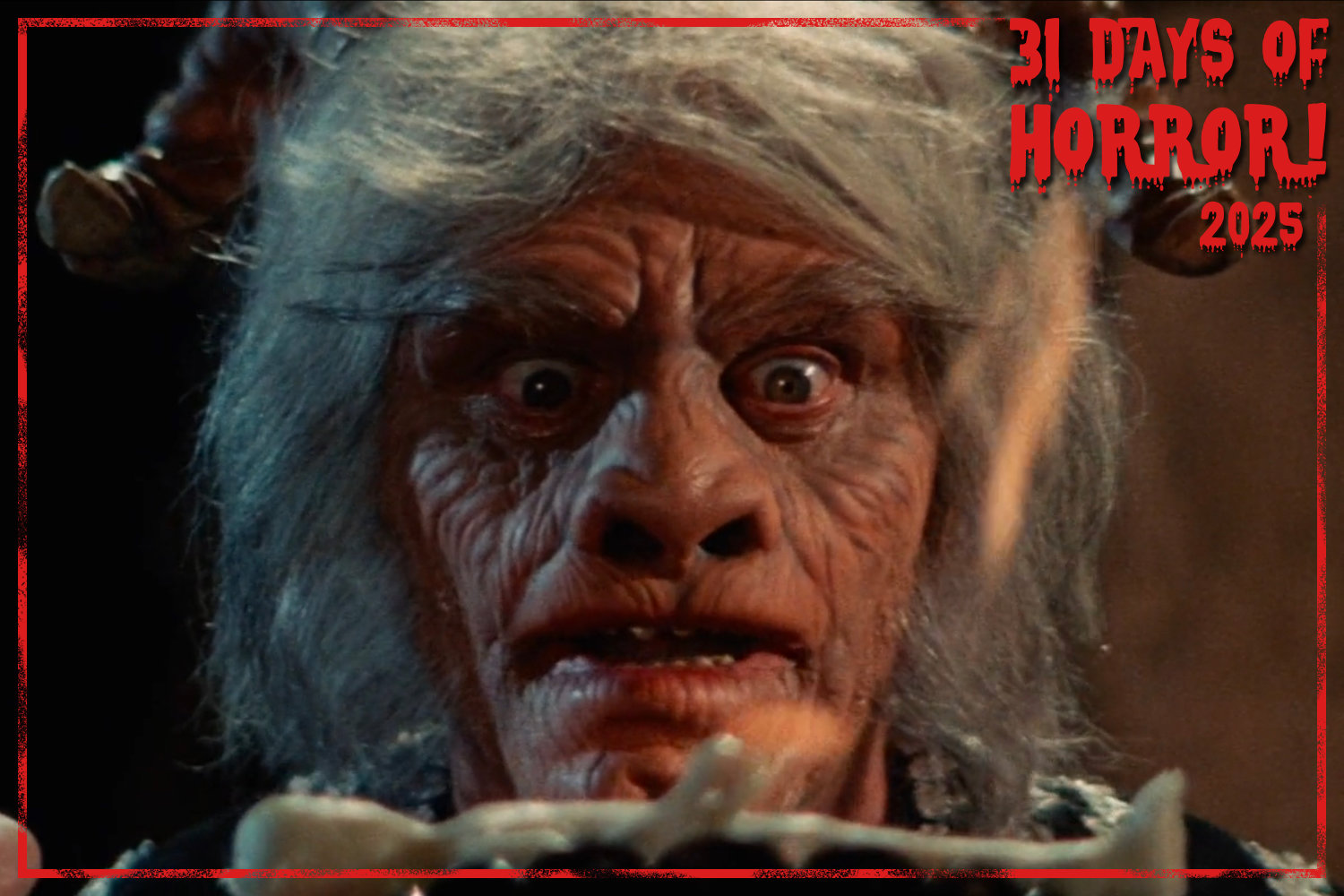
Only Hell can make it rain, rain o’er me.
Tonight, celebrate the 50th Anniversary of a devilishly odd film, The Devil’s Rain. It may not be extremely well known, but it has a lot of weirdness and eerie moments to recommend itself. That, and some memorable performances (for good or ill) from stars of the day, including Ernest Borgnine and William Shatner.
Before Viewing
The narrator of this trailer reminds audiences that there have been a lot of disaster films about earthquakes, airplane disasters, and infernos, but nothing like this rain, cue exploding church. Footage of a goat-man in robes, in what looks like a church, tortures another man with some kind of voodoo doll. Eyeless, robed figures attack people as mayhem breaks out with fires, gunshots, and car crashes. The cast is revealed along with special participation from Anton LaVey, “high priest of the Church of Satan.” Then comes The Devil’s Rain, which causes the goat-man and his followers to melt into a goo!
Presented below is the trailer for the film.


The Devil’s Rain title card.
After Viewing
On a rainy night outside Redstone, Texas, Mark Preston (William Shatner) arrives home to his nervous mother, Emma (Ida Lupino), and family friend John (Woodrow Chambliss). He states he was unsuccessful in finding his father. Emma fears it’s all like her dream. The dogs bark, and Steve Preston (George Sawaya) arrives, missing his eyes and warns them that Corbis is in the desert and he wants the book back, before dissolving in the rain into a pile of waxy goo. Checking that the book is still safely hidden beneath the floorboards, Emma gives Mark an amulet to protect him from the “devil’s man.” Steve’s pickup shows up outside, but when Mark investigates, there’s no one there, only a small waxen figure pinned to the steering wheel. Returning inside, he finds his mother missing and John beaten and strung upside down.
The next morning, Mark drives to the desolate and abandoned town of Redstone to confront Jonathan Corbis (Ernest Borgnine), the man he feels is responsible for his missing parents. Corbis, a strong and hearty older man, welcomes Mark, inviting him into the local church where a ceremony is about to begin. Testing his faith against Corbis, Mark sees dozens of other robed and eyeless satanists, including now his mother. Corbis, now in red habit, casts a spell urging the spirit of Martin Fife to enter Mark’s body, but the amulet protects him. The satanists chase Mark from the church, where Corbis uses a spell to make the amulet appear to be a snake so Mark will remove it. They surround him as Corbis tells him that the name of Preston will be no more.
Elsewhere, in a science classroom, Tom Preston (Tom Skerritt) and his wife, Julie (Joan Prather), are conducting an experiment led by Sam Richards (Eddie Albert). They have Julie hooked up to a machine, allowing her to isolate the brain waves responsible for ESP and project her consciousness into the future, where she sees danger. Receiving a note that something has happened to his family, Tom and Julie visit the house and speak to Sheriff Owens (Keenan Wynn), who cannot be bothered to look for a lost family while he’s helping clean up from the previous night’s storm. They decide to head to Redstone themselves and investigate. While looking inside the church, their car explodes, followed by Mark’s car attempting to run them over. They follow someone into the hotel, where Tom is attacked, and then incapacitates the eyeless man.

Mark confronts Corbis, believing that he can threaten the older man to return his family.
While staring into the man’s orbital pits, Julie experiences a flashback to 1680, where Jonathan Corbis and his followers are being persecuted by Preacher Blithe (Claudio Brook) after a confession by Aaronessa Fife (Erika Carlsson), wife of Martin (also played by Shatner). She stole Corbis’s book of names pledged to Satan to save her husband. As Corbis burns, he vows revenge on all of the Fife descendants. Tom returns to town, while Julie goes for help in Mark’s car. She crashes into a tree when a cultist rises up from the back seat, startling her. Mark disguises himself in a robe and follows the other satanists into the desert, where they prepare Mark for a ceremony. Corbis calls for “his Lord” and transforms into a goat-man, who performs a ritual that replaces Mark’s soul with Martin Fife’s. Tom is discovered and fights his way from the cultists, returning to town.
The next day, Tom meets with Sam, who explains the provenance of the book that’s been in the Preston family for centuries. It contains the names of the people Corbis has pledged to Satan and includes a note from Aaronessa about keeping the tome safe. As long as the book is kept from Corbis, he cannot deliver the souls to Satan. It also mentions something called the Devil’s Rain, which is a vessel that holds the spirits of the damned in torment until they can be delivered. Tom sees Mark’s name in the book now. Tom and Sam return to the town and discover an egg-shaped jar in a pit under the floor of the church, which contains the swirling souls of the damned. They hide when the cultists arrive with Julie, who has been prepared for a ritual.
After Tom is grabbed by Corbis’s men, Sam threatens to destroy the Devil’s Rain unless Julie and Tom go free, but is stopped when Mark grabs the vessel. Sam begs Mark to destroy the vessel, which he does, allowing the spirits to go free, and in doing so, torrential rain falls on the town. Any satanist hit by the water begins to melt into a waxy puddle. Tom fights with Corbis, once again in the guise of a goat-man, but the cult leader also melts into goo and is pitched into the pit where the Devil’s Rain was held. Tom and Sam grab Julie and get out of the church just as it explodes. Tom hugs Julie in relief, and as the camera dollies around the two of them, Julie changes into a laughing Corbis, unseen by Tom. The spirit of Julie is shown trapped in a new Devil’s Rain, screaming to be released.
“Let me show you what I’ve put my faith in.” – Corbis

Tom and Julie check in with family-friend John to find out what’s happened.
While a holistic review of The Devil’s Rain might present the story as uneven, there’s no doubt that certain moments in the film are terrifying, burning the visuals into one’s brain for eternity. Directed by Robert Fuest, who was responsible for a pair of Vincent Price films in the early 70s, The Abominable Dr. Phibes and Dr. Phibes Rises Again, the film is a mish-mash of incomprehensible scenes, interesting visuals, and gaping plot holes that somehow manage to create an unsettling vibe over the entire production. And even though the film is not going to make any Top Ten lists for horror films, it’s often remembered for reasons outside its production.
The Devil’s Rain was one of several films from the mid-70s that dealt with Satan, satanism, and cults. Unlike films from the previous decade, which were often period dramas dealing with consorts of the devil, like Black Sunday or The Devil Rides Out, contemporary films often dealt with devil cults seducing innocents for power or to bring about the end of the world. While many of these titles were lurid, low-budget pandering (Daughters of Satan, They’re Coming to Get You!, or The Pyx), several higher-profile, higher-budget films helped capture the attention of filmgoers. Rosemary’s Baby (1968) was the first mainstream film to focus on witches/covens/satanists attempting to bring the devil back to the material world. The 70s would expand on the role of the Devil and dark forces, testing humanity’s faith in films like The Exorcist (1973), The Omen (1976), and Suspiria (1977). The title of The Devil’s Rain is certainly a play on the phrase “the Devil’s reign,” as a notion that the devil is attempting to rule the world in control of our souls. All of this cinematic paranoia about dark forces controlling our fate was inspired by a variety of ills that befell America during the time, including political fallout over Watergate and the Vietnam War, social fears spurned by the Manson and Son of Sam killings, and the Zodiac murders, plus the changing family unit as a result of the rise of the counterculture.
The rise of the counter culture in the mid-1960s and the unpopular political climate of Vietnam and Watergate (among others) altered the way that films portrayed elements of society. For horror films, that meant creating offshoots of society that meant it harm, or at least disrupted the status quo. Corbis’s cult definitely fits that mold, having disrupted New England in the 17th Century and cropping up again in Texas to do the same thing. However, the random acts of violence that populated the late 60s and early 70s were more of an influence on The Devil’s Rain. With the media popularizing the sudden and unthinkable rise of Charles Manson and his group, having reported ties to Satanism and the killing of apparently random people, it’s no wonder that America was on edge. Add to that the random and still unsolved Zodiac murders, and the spate of killings by the Son of Sam, a man whose demon-possessed dog (Sam) told him to do so, it’s easy to see where a 200-year-old satanic cult might have been dreamed up.
The film opens with an eerie set of surrealist imagery depicting buildings on fire, humans contorted in painful ways, imps and demons, and even human ears holding a knife. These images are from the Dutch painter Hieronymus Bosch, who was known for his religious allegories depicted, often in triptychs, with surrealistic imagery. The footage, played under the opening credits, depicts at least four of Bosch’s paintings from the early 16th Century. In order, they are “The Lost Judgment,” “The Garden of Earthly Delights,” “The Temptation of St. Anthony,” and “The Haywain Triptych.” The closeups of the paintings, underscored by eerie music, set the tone for the film, tying into the torment felt by the individuals trapped in the Devil’s Rain. While it doesn’t always come across in every sequence, there’s enough shocking imagery to make The Devil’s Rain memorable. Some of these moments include the first look of Mark’s eyeless father as he melts in the rain and Ernest Borgnine’s solid performance in ram makeup, looking like an outcast from The Island of Dr. Moreau. The closing scenes are just as creepy, as Tom leads Julie away from nearly becoming another member of the satanic cult, only to reveal that Corbis has somehow placed his soul inside her body, trapping Julie inside a new Devil’s Rain. Regardless of whether audiences understand the why of how that happened (as it’s not really explained), the image of Julie in her white gown pounding on wet glass as the credits roll is chilling. Her final stare out into the audience indicates that the evil has not been contained, as one might hope.

Sam and Tom view the souls trapped within the Devil’s Rain with disbelief.
Outside of the content of The Devil’s Rain, two other things stand out. The first is the credited use of Anton Szandor LaVey, the High Priest of the Church of Satan, as a technical advisor on the film. This was noted in both the trailer and in the opening credits to the film and surely drew curious individuals to the movie. LaVey founded the Church in the mid-60s as a counter-cultural way to oppose other forms of ritualistic theism. While there is no belief in or worship of the Devil in the Church, many Christian groups attempt to portray the members of the Church as devil-worshippers and cultists. Certainly, LeVey’s bald head and thick goatee, as well as his flair for the theatrical, helped create the image of the demonic, giving detractors an obvious opponent. It’s unclear in what way LeVey advised on the film, but it probably surrounded the ritualistic markings and performance of the black mass. He even had a small part in the film as one of the non-eyeless assistants to Corbis, who wears a gold helmet. On the flip side are the stories of Joan Prather and her connections to Scientology. She reportedly met actor John Travolta on set (he was one of the eyeless minions, and seen ever so briefly) and provided him with the introduction to the teachings and philosophy of L. Ron Hubbard’s “religion,” to which he became a great proponent. To paraphrase film reviewer Michael Adams, The Devil’s Rain is about a cult, has a cult following, was devised with input from a cult leader, and saw a future superstar indoctrinated into a cult he’d help popularize. What bizarre story!
The Devil’s Rain has both good and bad things about it. It tries hard to pull audiences in with its cast, plugging both Shatner and Lupino in the trailer (and pushing Travolta in post Saturday Night Fever airings). Shatner is his standard overblown self, coming off as very manic and upset. Ernest Borgnine gives the best performance as the hundreds-year-old cult leader. He’s enigmatic and friendly, yet also dangerous and menacing. And while the makeup effects for the eyeless masks worn by the cast may seem dated today, it’s a convincing enough job for the mid-70s. Other effects, especially the souls in the Devil’s Rain jar, are incredible. It’s unclear how that was accomplished, whether through some sort of Pepper’s Ghost illusion or projecting a 16mm image into the jar, but it feels authentic. The one detraction is the nearly 10-minute sequence of the cultists melting into goo. Yes, the rains come and melt them (presumably because rain falls from Heaven, harming the minions of Hell), but did they have to show the death of every single member? I’m sure they spent a lot of money on that gag and wanted to make sure it was seen by the audience, but it’s really too much!
While not the best film of 1975 or that decade, there’s still enough weirdness in the film to make it enjoyable. After viewing, there are certainly scenes that are hard to forget, either because they’re so good or they’re so bad. This film marks the second anniversary film this week, following last night’s The Phantom of the Opera. Stay tuned for films celebrating anniversaries from their Fortieth through their Tenth during the rest of the week on 31 Days of Horror.

Corbis summons his power from Hell, changing into a goat-man, in order to battle Tom.
Assorted Musings
- Once William Shatner loses his eyes, notice how similar his face looks to the mask worn by Michael Myers in Halloween. This is because the film ended up using a William Shatner Captain Kirk mask as the basis for Michaels.
- The film contains a lot of pseudo-scientific mumbo jumbo in one scene to act as a counterpoint to the satanism. Dr Richards claims that “there’s nothing in the subconscious that cannot be raised to the conscious level,” indicating that ESP and telepathy are completely safe. Apparently, Julie’s abilities are there to provide her to tell the backstory of the cult to her husband, and sense her ultimate fate. Or perhaps give a clue as to how Corbis was able to sneak inside her body.

Having grown up on comics, television and film, “Jovial” Jay feels destined to host podcasts and write blogs related to the union of these nerdy pursuits. Among his other pursuits he administrates and edits stories at the two largest Star Wars fan sites on the ‘net (Rebelscum.com, TheForce.net), and co-hosts the Jedi Journals podcast over at the ForceCast network.