
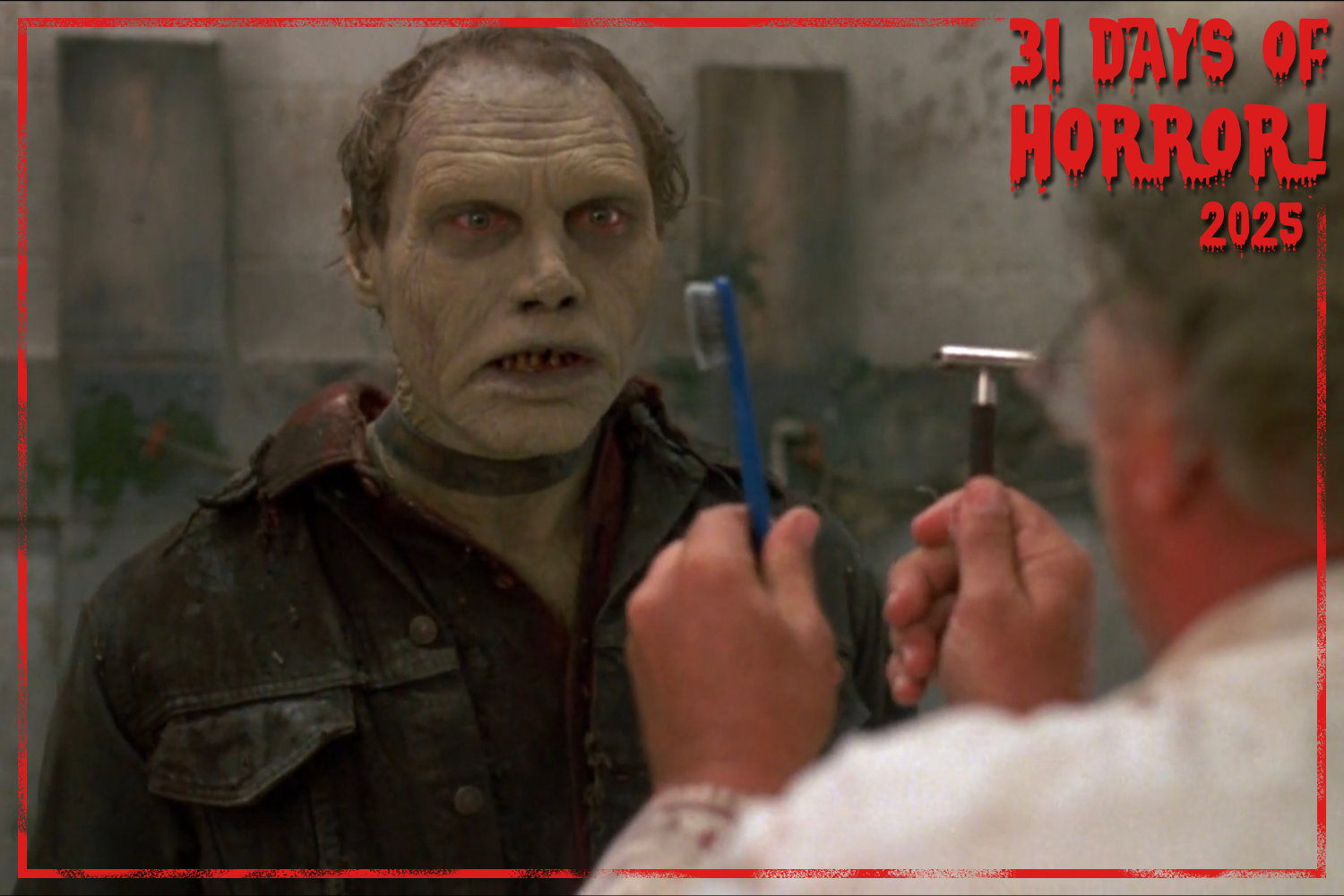
The dead shall have their day.
Welcome, boys and ghouls, to the 8th annual 31 Days of Horror series on Retrozap. This year will see another month full of scary and exciting horror films spanning over 100 years. There are even a couple of theme weeks planned for your continued entertainment. Everything starts with the 1985 conclusion to George Romero’s Living Dead trilogy, Day of the Dead.
Before Viewing
The trailer for this film makes it immediately known that this is the third part in George Romero’s Living Dead series. A group of scientists, working with the military, is fabricating a cure to the plague using a captive zombie named Bub. A male scientist is trying to learn all he can about how the creature works, while a General maintains strict discipline. Of course, something goes horribly wrong during the Day of the Dead.
Presented below is the trailer for the film.


Day of the Dead title card.
After Viewing
After a jump scare dream moment, Sarah (Lori Cardille), a scientist, awakens on a helicopter setting down in a deserted city street on the Gulf Coast of Florida. She and Miguel (Anthony Dileo), an army private, search for survivors but only find hordes of undead shambling in the streets. They return ot their base, an underground bunker which stores government records, films, and vehicles. Privates Steel (G. Howard Klar) and Rickles (Ralph Marrero) demand help from Miguel in wrangling two more “dumb f**ks”, which Sarah assists with instead. After the recent death of Major Cooper, the cruel Captain Rhodes (Joe Pilato) is now in charge. The military is providing support to a small group of scientists researching the zombie outbreak.
Sarah checks in with Doctor Logan (Richard Liberty), the head scientist who has been conducting disturbing experiments with the zombie corpses (including the deceased Major Cooper). He is known as “Frankenstein” by the soldiers. At a meeting of everyone in the mess hall, including helicopter pilot John (Terry Alexander) and radio operator Bill (Jarlath Conroy), Rhodes pulls rank and threatens to have Sarah shot if she doesn’t fall in line with his plans. He plans to kill the zombies, as they should have done in the beginning, rather than let the scientists continue their work.
Logan explains that he is getting results and gets a few more weeks from Rhodes to prove his theories. John warns Sarah and Ted (John Amplas), a lab assistant, to watch their backs as they are the most disposable people on base. Bill takes Sarah back to the trailer where he and John live relatively stress-free. She complains that they do little to assist with anything. John points out that the work is futile, and all of this is bullshit. Doctor Logan believes that the zombies are a less-than-perfect version of themselves, and he is working to train them to obey rudimentary orders. He introduces Ted and Sarah to Bub (Sherman Howard), a zombie he keeps chained to a wall in his lab. Rhodes discovers this experiment and becomes enraged by the “progress” being made.

Miguel, John, Bill, and Sarah prepare to re-enter their underground bunker.
While trying to corral two more zombies for Logan’s experiment, Miguel’s catch-pole malfunctions, and a zombie kills Private Miller (Phillip G. Kellams), who accidentally shoots Private Johnson (Greg Nicotero). Miguel is bitten on the arm, but Sarah manages to amputate it before the infection can spread (presumably). She takes him to John’s trailer to recuperate. Rhodes discovers that Logan is feeding dead soldiers to Bub and shoots the older man. He then kills Tim to help “convince” John to fly the soldiers elsewhere, after trapping Bill and Sarah in the zombie pen. Miguel awakens enough to move and, knowing his time is limited, takes the elevator topside.
Meanwhile, Bub discovers how to unlock his chain from the wall. John knocks out Rhodes and steals his guns, going to help Sarah and Bill. Miguel commits suicide by opening the chain link gate around the facility and letting the zombies in, descending with them into the base as he gets eaten. Rhodes abandons his remaining three soldiers, Steel, Rickles, and Torrez (Taso N. Stavrakis), locking the door behind him. Bub wanders the hall and discovers the dead body of Doctor Logan, becoming upset.
The zombie horde overtakes Rickles and Torrez, tearing them apart and eating them. Steel shoots several zombies, but is soon overwhelmed, choosing to take his own life instead. Bub finds a pistol and picks it up, firing it at Rhodes, who he hits twice. Rhodes attempts to escape through a doorway, but the horde of zombies grab him as Bub shoots him one last time. Bub salutes the dying Captain as the zombies roam free over the base. John catches up to Sarah and Bill, and the three make it up a ladder to the helicopter. The next day, the three of them relax on a private beach, far away from the zombie outbreak.
“Knowing what they are, we can begin to approach them properly, condition them, control them.” – Doctor Logan

Captain Rhodes explains, in no uncertain terms, that he’s in charge.
Day of the Dead is the third film in director George Romero’s Living Dead series which started famously in 1968 with Night of the Living Dead and continued a decade later with Dawn of the Dead. Each film tells the story of survivors of a zombie outbreak in various settings with different social commentary and different perspectives on what’s happening. The first film dealt with individuals struggling to understand what was happening as everyone was mostly out for themselves. The undertones dealt with race relations as the black lead squared off against an overbearing white husband. Romero expanded the ideas and concepts into the second film where the scope increased as the main leads decreased. In that film the zombie apocalypse was a backdrop for social subtext on capitalism and consumerism. For this conclusion to the first trilogy of Living Dead films, Romero takes a swing at the different approaches used to quell the outbreak between the military and scientific communities. He also works in his first leading zombie character, Bub, which is something that hadn’t been seen before.
By the mid-80s, when this film was released, horror sequels were in full swing. As one of the franchises that helped usher in horror sequels fans were eager to revisit Romero’s universe of the undead, but the popularity of the genre meant an oversaturation in the market. There were five films already in the Friday the 13th series, the Omen trilogy had run its course, there were three Halloween’s, Jaws films, and Amityville Horrors, plus a smattering of sequel that would turn into larger franchises including Psycho, A Nightmare on Elm Street, and The Hills Have Eyes. This made the job for Day of the Dead much more difficult as it had to not only compete with original horror films like Fright Night and Re-Animator, but a glut of other horror sequels and franchises that had sprung up like rotting corpses in the past seven years.
Audiences attend horror films to be scared, but they had also become more accustomed to coming for the strange, gory, and interesting ways that characters would be killed by the monsters (and sometimes the monster’s deaths too). At a running time of 100 minutes, the first zombie sighting occurs only a few moments in, but the first human to get attacked by a zombie takes nearly a full hour to materialize (Miller is bitten in the throat at around 58 minutes). That’s quite a bit of waiting to get into some of the more horrific aspects of the film. From there the tension mounts as the next zombie attack appears imminent. On this outing the special effects are provided by Tom Savini with two-thirds of the crew that would be known as KNB Effects, Greg Nicotero and Howard Berger. Their gags include zombie entrails falling out of an exposed gut, both a headless body and bodiless head, plus Torrez and Rhodes being literally pulled apart by zombies while still alive. The level of blood and carnage in Day of the Dead was less than seen in Dawn of the Dead, and other films in the space between, but the death of Captain Rhodes as he’s destroyed by the walking dead makes up for a bit of that. It’s up to personal taste if it’s enough horror to satisfy the tastes of the audience.

Doctor Logan explains how his experiments with zombies should make them trainable.
The makeup of the characters in this film is also very different than before. While interpersonal struggles occur in Romero’s previous Living Dead films, each film has escalated the conflict. Night of the Living Dead was a few average people in a farm house with Ben and Harry being on both sides of the argument on how to survive. Dawn of the Dead has the main characters coming from the city (two television station employees and two SWAT members) and getting along for the most part. The interpersonal turmoil in that film is caused by a group of bikers who prefer to keep things chaotic. The third film pits a small group of scientists and support personnel against six military men (technically seven, but one is sleeping with a scientist–so they’re on good terms for the most part). This brain versus brawn aspect is the culmination of decades of arguments and counterarguments in film. Sci-fi films often place the military versus the scientists as a battle of ideologies, and depending on the era the film was made indicates which side will win. It wasn’t until the late 60s and early 70s that scientists were seen as anything except problematic doomsayers, often instigating the problem themselves (see movies like Frankenstein, X: The Man With The X-Ray Eyes, or Them!). Here, Romero creates cruel and harsh soldiers that see the only way forward as their military training: shoot to kill. They fail to understand that the “fancy terms” the scientists are providing may hold a solution. But on the flip side, the scientific solutions are not necessarily of sound mind either. Logan’s work has gone off the rails (as has he), and him having the nickname ‘Frankenstein’ is no accident. The gulf between his work (train the zombies to not kill humans) and Sarah’s work (eradicate the virus) is monumental considering the limited resources and time they have. Only John’s solution makes sense at this time. As the helicopter pilot, and a character with a laidback Jamaican accent, he suggests heading to an island, relaxing, and making babies–ensuring that they never return ot the mainland. That’s the solution that works in the film and where the characters end up at the end of this trilogy, because what else is there to do?
For many viewers, Bub is the stand out character in the film. He is the first zombie character, outside some miscellaneous background extras in the original films, that is capable of using tools and containing a hint of understanding. Logan’s work attempts to socialize the undead in an attempt to allow humanity to coexist with them. However, nothing from the film suggests that his experiments created Bub. This particular zombie seems to be an outlier who maintains a bit of his past life, presumably as a military man. He understands how to use a gun and what it’s supposed to do, as well as remembers the act of saluting which appears as a sarcastic act to the dying Rhodes. He is the only singular zombie that maintains these traits, though Dawn of the Dead had a group of zombies that gravitated toward the Mall, remembering their daily wanderings of that place. Along with the Tarman zombie from The Return of the Living Dead, also from 1985, the undead were getting some of the character spotlight which provides additional fun moments.
As mentioned above, another undead film debuted this year, The Return of the Living Dead. This is technically another sequel to the Night of the Living Dead created by Romero’s partner on that film, John Russo. That series is lighter in tone with more pop culture references. It ran for a total of five films between 1985 and 2005, which is when Romero returned with a second trilogy of undead films. Land of the Dead (2005), Diary of the Dead (2007) and Survival of the Dead (2009) making up the second act of Romero’s Living Dead cycle with a potential seventh film, Twilight of the Dead, still in the works. These films take place decades later as the last remnants of humanity have learned how to recreate small city-states, but still unable to get along. Out of the original three Romero films, Day of the Dead may be the least entertaining. It feels like “just another” horror sequel for a lot of the film, with predictable characters and situations. Yet, there are still some great moments; the opening jump scare/dream gets things moving at a great pace, and Bub provides a fun counterpoint to the sadistic Captain Rhodes. Either way, it’s a good warm-up for the 2025 31 Days of Horror series. Stop back every night for a new horror film review, plus other surprises.

Captain Rhodes is through with the scientists BS. Either he gets results or they get fed to the zombies.
Assorted Musings
- The actor who played Bub went on to play Lex Luthor in The Adventures of Superboy, with Gerard Christopher.
- This is the first of Romero’s Dead films not to take place in Pennsylvania, though all of the underground bunker sequences were shot there.
- The first episode of the third season of Stranger Things, “Suzie, Do You Copy?”, features the kids watching Day of the Dead at the Starcourt Cinema.
- Best Zombie Death: In the tunnels of the zombie pen, John puts a shovel through the mouth of a zombie, rending its upper head from its jaw. He flips the head across the cavern, which lands upside down, with the eyes continuing to dart about.

Having grown up on comics, television and film, “Jovial” Jay feels destined to host podcasts and write blogs related to the union of these nerdy pursuits. Among his other pursuits he administrates and edits stories at the two largest Star Wars fan sites on the ‘net (Rebelscum.com, TheForce.net), and co-hosts the Jedi Journals podcast over at the ForceCast network.