
Science and emotion collide in a masterpiece of the early 21st Century.
Christopher Nolan’s Interstellar is no simple film. He tackles some very big themes on humanity and exploration while creating an engrossing and exciting sci-fi film for the modern era. It features strong ideas on the perseverance of humanity, as it challenges ideas on what people are capable of. It also stands on the shoulders of some of the greatest sci-fi films that came before it, elevating itself into cinema history.
First Impressions
In this trailer, a man meets with school administrators who tell him that even though he’s educated and an engineer, the world doesn’t need more engineers. A dusty and burning farm shows what they mean. The world has run out of food. The man’s older professor friend tells him they’re not going to save the world, they’re going to leave it–as the engines from a giant rocket are shown. He blasts off with other astronauts as a voice-over says we need to start thinking of ourselves as a species rather than individuals. Humanity is ready for Interstellar travel this week on Sci-Fi Saturdays.
Presented below is the trailer for the film.


Interstellar title card.
The Fiction of The Film
In the mid-21st Century, ex-astronaut and test pilot, Cooper (Matthew McConaughey), lives with his two children, Tom (Timothée Chalamet) and Murph (Mackenzie Foy), and his father-in-law, Donald (John Lithgow), at a corn farm in the center of America. The area is prone to dust storms as a blight has begun killing crops each year, meaning people are slowly running out of food. Cooper attends a parent/teacher conference at Murph’s school, where he learns she is disruptive, especially in light of the teachers’ focusing on negative propaganda about the space program and pushing an agriculture-based curriculum. Murph believes she has a ghost living in her room, as books occasionally fall off the shelves. A dust storm highlights a strange gravitational anomaly in her room that creates lines of dirt on the floor.
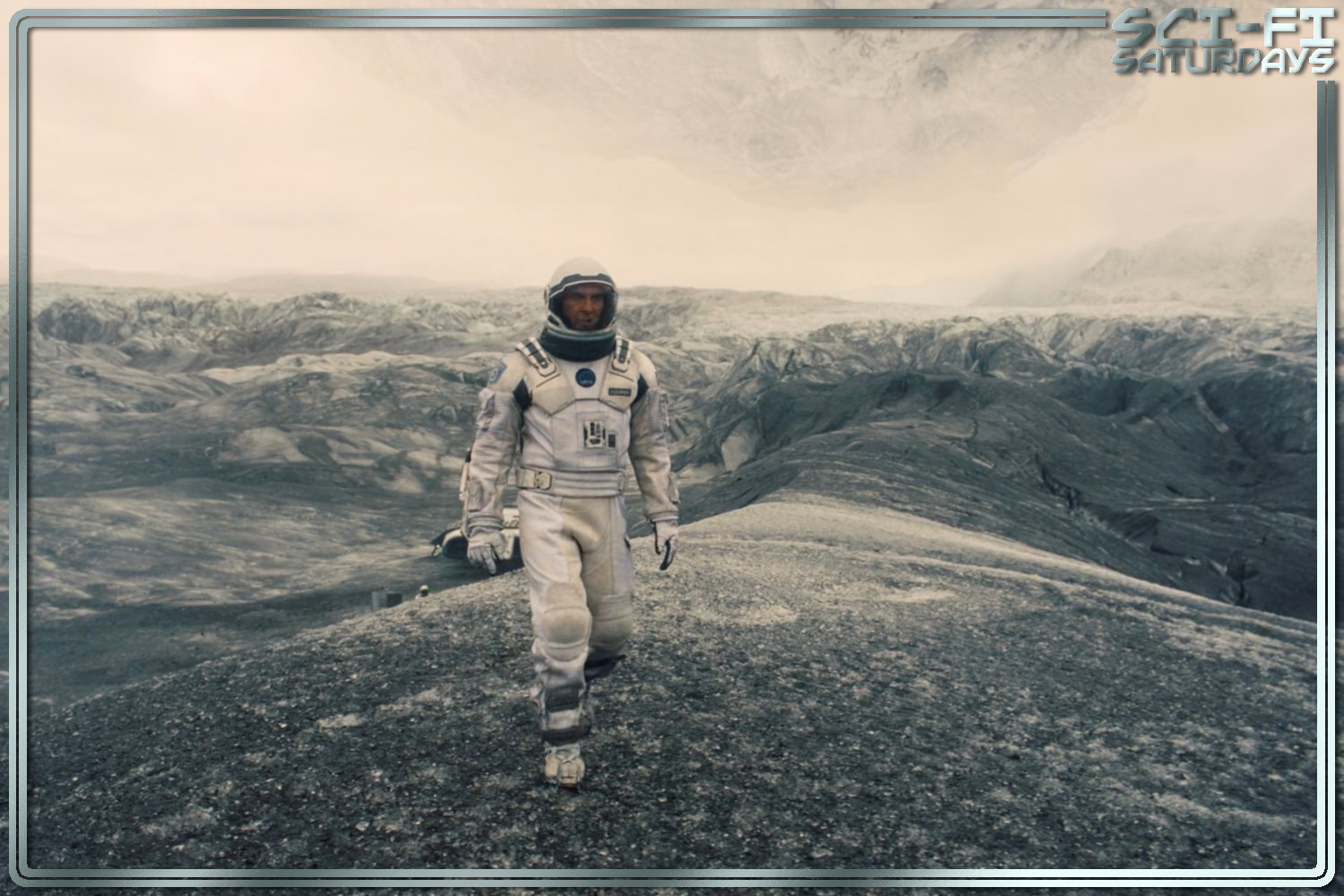
Coop and Murph discover the lines are coordinates in a binary code, leading them to an old NORAD facility, where they are arrested for trespassing. However, they have nothing to worry about as this is what’s left of NASA, run by an old colleague of Cooper’s, Professor Brand (Michael Caine), along with his daughter Amelia (Anne Hathaway). They have been secretly managing a space mission called Lazarus, which has launched a dozen ships through a recently discovered wormhole (believed to have been placed by an alien intelligence) near Saturn, looking for a new hospitable planet to move humanity towards. Plan A is a space station that will get people of the Earth to colonize one of the three potential planets. Plan B is a freezer of 5,000 embryos to rebuild humanity from scratch. Cooper is asked to pilot Endurance, which will check out the possible planets. He leaves his watch with Murph, who is extremely upset that her father is leaving, potentially forever.
On board Endurance, Cooper, Amelia, Romilly (David Gyasi), and Doyle (Wes Bentley) make the two-year trip to Saturn in hypersleep, a cryogenic slowing of their metabolism. They prep for travel through a wormhole that bridges our solar system to another galaxy with 12 different planets. Its prominent feature is Gargantua, a black hole (or gentle singularity as they call it) very near Miller’s Planet. Checking that planet will be precarious due to the strong gravitational pull, meaning that one hour on the planet equates to seven years on Earth. Landing on the planet reveals a shallow water-bound world with mile-high tidal waves. Doyle is killed as their Ranger attempts to take off, and Cooper and Amelia become temporarily stranded as the engines become waterlogged. By the time they return to Endurance, over 23 years have passed for Romilly. They catch up with their messages from Earth, which includes one from a now adult Murphy (Jessica Chastain), who is working with Professor Brand to solve a gravity equation that would allow the Plan A to work.

Cooper exams the bookshelf in his daughter’s room; the place that will connect the two of them throughout theirs lives.
The three astronauts debate heading to Mann’s Planet (the closest, but less favorable) or Edmund’s Planet (further, but more hospitable), since they only have enough fuel for one trip. Amelia admits that she is in love with Edmund, but that doesn’t change her scientific opinion that his planet is the better choice. She receives a message from Murph that her father has died, and is asked if she was aware that Professor Brand perpetrated the lie about Plan A being feasible. He never intended for Endurance to return, as the only way to solve the gravity equation was to gather data from inside a black hole. Devastated, the Endurance travels to Mann’s Planet, where Dr. Mann (Matt Damon) is woken from cryosleep and shares his data about this frozen, inhospitable world. Unfortunately, he has lied about all his data as well, having suffered a mental collapse from the isolation. A booby trap placed on Mann’s robot kills Romilly. Mann attempts to kill and maroon Cooper and Amelia. Returning to the Endurance in a stolen Ranger goes poorly, and Mann crashes into the craft, depressurizing his vehicle and severely damaging Endurance.
Amelia, Cooper, and the robots TARS (voice of Bill Irwin) and CASE (voice of Josh Stewart) make a plan to slingshot around Gargantua, using up an additional 51 years of time, to help slingshot the Endurance toward Edmund’s Planet. TARS will use the Ranger to drop into the black hole and transmit as much data as it can about what’s inside so they can hopefully transmit the answers back to Earth before humanity suffocates and starves. The plan is successful, except that Cooper has failed to tell Amelia the rest of it. He, too, needs to eject from Endurance to provide the necessary boost. After a tearful goodbye, he drops into the black hole and falls into a three-dimensional representation of the alien’s fifth-dimensional reality that is made up of infinite moments in time, all of which appear as Murphy’s childhood bedroom. Suddenly, Cooper realizes he’s the ghost in Murphy’s bedroom, able to affect gravity through time.
Cooper asks TARS to send the data on the gravity equation to him in binary. Using his love for his daughter, he finds the one moment in time where he can communicate with her. Cooper uses the tessaract model to transmit the data to Murphy using the second hand of the watch he left for her. She takes that information back to NASA and fills in the missing parts of the equation, knowing that it was her father who was able to communicate with her. With the mission completed, the aliens dismantle the tesseract, and Cooper appears floating in orbit around Saturn. Cooper awakens on Cooper Station, named after his daughter, ninety-some years after he left. He looks the same as he did when he left, but Murphy is now an old woman (Ellen Burstyn) on her deathbed. They have a heartfelt reunion as she tells him not to waste his time with her, and to get out there and find Amelia, who is waiting in Edmunds Planet, the new home of the human race.
“We used to look up in the sky and wonder at our place in the stars. Now we just look down and worry about our place in the dirt.” – Cooper

Cooper hugs Murph before he leaves to go on his decades long space mission to save the planet.
History in the Making
At the time of its release, Interstellar was Christopher Nolan’s most important and popular film. It was his third sci-fi film (after The Prestige and Inception), following his immensely popular reimagining of Batman in his Dark Knight trilogy, and a film that reunified science and fiction into an epic tale of humanity reaching for the stars. He created a film which embodied the human spirit as well as celebrating the men and women who go into space for a living. And as with all good sci-fi films, it focuses on the lives of individuals, using them as stand-ins for humanity. It asks big questions about who we are and why we are here, but also questions whether we should be staying on Earth. Cooper states that “Mankind was born on Earth; it was never meant to die here,” proposing a tactic of human colonization that has never been explored in film. Certainly, humans in sci-fi films have been shown exploring the galaxies and colonizing other worlds (Star Trek made three seasons about that), but having to choose between dying on Earth and leaving the planet is a new concept.
The film also reintroduced the realism of true science-fiction back into the genre. Interstellar takes great pains to create documentary-styled imagery from the space-faring elements of the film, creating new and more scientifically accurate accounts of rocketry and stellar phenomena. Black holes, fifth-dimensional analogues, tesseracts, and time dilation are all on display in new and exciting ways. Add to that a very grounded cast, not known for their work in sci-fi (for the most part), which makes the story seem more realistic. Matthew McConaughey had only been in one previous sci-fi film, which was the 1997 Robert Zemeckis film Contact, where he played the man of faith to Jodie Foster’s woman of science. Here, McConaughey portrays the brilliant pilot and engineer who finds it easier to control a spaceship through a wormhole than to speak with his daughter. Anne Hathaway makes her first (of two, the other being Colossal) sci-fi appearance as the brilliant, yet slightly clueless, daughter of Professor Brand. She doesn’t quite have the believability of an astronaut, but still provides a foil to Cooper’s character, becoming the heart of the mission. Jessica Chastain also makes her first (of two, the other being The Martian) sci-fi appearance as Cooper’s intellectually superior daughter, all grown up. Her ability to persevere, even after discovering Brand’s lie about being able to save humanity, shows that she is her father’s daughter. Finally, Matt Damon makes a surprise cameo as Dr. Mann, mentioned by Amelia as being “the best of us,” due to his leadership and charisma. This follows The Adjustment Bureau and Elysium, and would be followed in the next year by The Martian, another scientifically realistic astronaut film.

Miller’s Planet, as shown orbiting the black hole, Gargantua. This depiction of black holes set a new benchmark for film visuals of these phenomena.
Genre-fication
Interstellar attempts to create an in-depth and modern science-fiction film in the model of classics such as 2001: A Space Odyssey, Contact, and Sunshine. It hangs the crux of the plot on the willingness of mankind to reach out beyond our boundaries as we explore the galaxy (and other galaxies) for a new home for the species. Both 2001 and Contact featured similar stories, as peaceful alien cultures reach out to humanity, and specifically, individual explorers to aid them in moving the species forward. The idea that there are beings out there that are rooting for humans to transcend to another plane of consciousness (as with 2001) or that they just want to see us succeed and survive (as with Contact) is a very heartening idea. Interstellar takes the alien caretaking to another level because they are both helping us explore and find a new world, but they are also looking to protect and save the species. Nolan uses imagery that harkens back to these films, specifically 2001. It may be a shot of the exterior of the Ranger docking with the Endurance that transitions from a scene with sound to the quietness of space or Cooper falling into a black hole as light stretches out in a stargate-like plane in front of him, mirroring Bowman’s descent into the Monolith.
The film also likens itself to Sunshine, which contains no aliens, but contains ideas of a small group of humans sacrificing themselves to save the planet. The crew of Icarus and Icarus II (in Sunshine) must travel to the Sun and restart the dying star before the population of the Earth freezes to death. Interstellar has a less cosmic issue with the planet, but one where the outcome will be the same–the death of the population. Blight and pestilence have rendered the planet incapable of growing the crops needed to support life. Mankind has ignored the warning signs and now finds itself at a precipice. Their only hope for the species lies in getting off-planet, an issue that may not be accomplished within a single person’s lifetime. Most sci-fi stories, at least in film, tend to shy away from such scope. Creating a story that spans generations may not be as engaging to audiences and requires a large cast to portray the various characters. But when has Christopher Nolan ever shied away from difficult filmmaking?
Genre-wise, it adds references to other sci-fi films as well as blazing new trails for other filmmakers to follow. One fun pull is the explanation of how the wormhole works. Romilly uses a piece of paper, marking two distant dots, one describing where they are and the other where they wish to go. He folds the paper in half so the two dots touch and pushes a pen through the sheets, explaining this is how a fourth-dimensional wormhole works. Who would believe that the seventeen year old sci-fi horror film Event Horizon would contain the most concise and repeated (Thor: Love and Thunder also used this model), description of interstellar travel. Deja Vu also makes a similar claim, showing nearly the same explanation, minus the pen piercing the pages. But Interstellar’s claim to fame is its reaffirmation of science in the fiction. Regardless of what dozens of other films and TV shows tell audiences, there is no sound in space, faster-than-light travel is not possible, and all energy must be conserved in the interactions between objects as explained by Newton’s Third Law. Nolan proves that these realities should not be seen as limitations. He makes each piece of his film exciting while keeping true to the realities of science (for the most part). The visuals of Gargantua, the giant black hole in the other galaxy, have redefined the ways that filmmakers depict similar celestial objects. Compare that imagery to the 1980 version of The Black Hole, and see how cooler things appear now versus then.

Amelia, Cooper, and Romilly converse with Doctor Mann about why his world is the best prospect for humanity to colonize.
Societal Commentary
An epic sci-fi film like Interstellar can’t survive without large themes, and Nolan brings some of the biggest: the perseverance of humanity, the strength of love, and the bonds of family. While many of the films reviewed here on Sci-Fi Saturdays often feature strong themes of human perseverance and questioning mankind’s place in the universe, Interstellar takes them to new heights. With the humans of Earth on the verge of dying, a dozen secret space launches, codenamed Lazarus after the biblical character who rose from the dead, are sent out to find a suitable planet to colonize. The person in charge of these missions is Dr. Mann, who is mentioned several times as being the best of us. While it seems obvious, and quite a bit on the nose, Mann is a proxy for mankind (maybe his first name is Hugh). While he might be a representative of the best of society, he also turns into a representative of the worst of us. Unable to cope with the isolation and enormity of his sacrifice, Mann attempts to destroy the entire project by stealing a Ranger and attempting to hijack Endurance. Damon’s surprise casting as the character plays as the antithesis of the character he would play the following year in The Martian.
The film also deals with the power of love. This emotional storyline balances out and acts as a counterpoint to the strong scientific talk and themes. Nolan presents love in two different ways. The first is the love for the human race. Professor Brand and his team at NASA have a love for the human race, which pushes them towards figuring out a way to save the species. This feeling ranges from a respect and desire to do the right thing, all the way to Amelia having a relationship with Edmunds (one of the other explorers) and wanting to see him again. She claims that her emotional feelings for this man aren’t affecting her scientific reasoning for choosing his planet to explore next. And while it may not be, to Cooper (at that time) it seemed suspect. What she was feeling, and what Cooper discovers when he enters the black hole, is that love is a strange attractor, stronger than magnetism or gravity. The idea that Nolan puts forth is that love can guide people towards one another as a tangible element, a signpost pointing the way. Amelia was probably feeling her connection to Edmunds resonating within her as a beacon towards his planet, the same way that Cooper was able to navigate the interiors of the tesseract to find the one moment in time where he would be able to talk with Murph. Cooper’s love for Murphy and his whole family is also displayed by his choice to sacrifice himself to save them–and humanity in the process.
Cooper tells Murphy that her mother used to remind him that, “Once you’re a parent, you’re the ghost of your children’s future.” This is a way of saying that your time, no matter what else you do, will always be remembered by your children as their parent. One way of looking at the story of Interstellar is that Cooper seems to take this to heart. He has an opportunity to return to doing what he loves–or what he was born to do, but also a responsibility to join with NASA so he can save the planet for his children. He becomes a ghost to Murphy, leaving her at a formative time, returning as a literal ghost, aiding her in the salvation of mankind. Cooper doesn’t really want to leave and regrets doing so later when he finds out his decision was based on a lie, but he knows he’s the best person for the job. His love for Tom and Murphy, and millions of other people he’s not even met, drives him forward to find a way to save these people. Even when his father-in-law, Donald, tries to guilt him into staying, he chooses to shun the one person he’s closest to, to save the species. It resonates the maxim from Star Trek II: The Wrath of Khan, that the needs of the many outweigh the needs of the one.

Cooper finds himself stuck inside a tesseract, a 3D vision of a fifth dimensional space.
The Science in The Fiction
Nolan’s approach to Interstellar was to use scientific conceits as much as possible rather than fictional ideas on how the universe works. He hired Kip Thorne, a theoretical physicist and Nobel Laureate, to assist in fact-checking the script, providing alternate ideas, and helping visualize the looks of the wormhole and the black hole. To date, wormholes in sci-fi often looked like funnels in space. Star Trek: Deep Space Nine was a television show that depicted wormholes every week, given that the celestial object was located right outside the station, allowing for excursions into the unknown. Interstellar presents the look of the wormhole as a spherical object, replete with stars. This is the distorted view of the other galaxy as seen through the lens of gravity. To date, it’s a unique look for this type of phenomenon, and one that appears to be the way such an object may actually present itself.
The black hole in the film was also a unique depiction at the time. It was not just a hole in space, but a giant black sphere with an aura and halo of starlight. Thorne helped the visual effects team at DNEG create the look for Gargantua by providing them with actual physics equations that they could input into their CGI software to simulate the black hole. Reportedly, it took up to 100 hours to render individual frames of the sequence, which is astronomical when talking about some of the longer scenes in the film. This new look for what black holes probably appear like has shown up in other films, most recently in the 2025 summer blockbuster Superman.
The final element of Interstellar that pushes the boundaries of science in fiction is the depiction of the robots TARS and CASE (and also poor KIPP). Having a robot as an associate on the mission is immediately a throwback to HAL 9000 from 2001: A Space Odyssey. The intonations of the voice may give audiences a similar vibe to that of the psychotic AI computer. But unlike HAL, these robots have various settings that allow them to avoid the issues that drove HAL insane (he was given conflicting orders, and that drove his circuitry mad). Cooper can change the trust, humor, and honesty settings for the robots to better interface with the humans and make them more comfortable. As TARS mentions, “Absolute honesty isn’t always the most diplomatic, nor the safest form of communication with emotional beings.” Cooper keeps the honesty at 90% for this reason. He also agrees with Amelia that a 90% honesty level would be good for them as well (Cooper changes this setting at the end of the film to 95%, given all that he and TARS have gone through). The other aspect of these robots is that they are mobile. They initially appear as large monolithic slabs, but can recalibrate portions of their anatomy to create arms, legs, and other appendages to assist in their workflow. They aren’t human analogues, like so many space-faring robots before them, which is probably for the best, since the human form may not be the best configuration for exploring new planets.

When Cooper finally returns to Earth he finds that his daughter is now older than him due to the time dilalation effects of relativity.
The Final Frontier
Interstellar has been praised as one of Nolan’s best films, and rightly so. There are a lot of amazing things happening in the film, including strong themes, great performances to satisfy many audience members. However, the film still has some issues that prevent it from being a phenomenal film. Your mileage may vary on these criticisms. For the amount of thought and energy that went into the apparent scientific accuracy, having the ending of the film reveal that the aliens helping mankind move into new realms are both a future version of Cooper and a distantly-future evolved version of humankind seems both paradoxical and a little too deus ex machina for such a serious film. The ghost in Murphy’s room provides her and Cooper with the coordinates used to find the hidden NASA facility. But later, the audience learns that the ghost is actually Murphy providing the coordinates after the fact. Effect precedes cause in this temporal paradox, where Cooper provides himself with the data to start his journey, but without that data, he would have never been on the journey in the first place. It has no beginning and no ending, existing as a causal loop for eternity.
The film offers so much more depth to itself in smaller ways. Lines of dialogue that are mentioned early on in the film return later with new meaning, such as the discussion of a ghost in Murphy’s room, ending up being Cooper, who talked about being the ghost of his child’s future. Young Murphy asks her father why they named her after something bad (ie, Murphy’s Law). He corrects her that it’s not always something bad. Murphy’s law says that whatever can happen, will happen, and in this case, whatever did happen will happen again in the future (causality). Cooper complains to the school principal that Tom should be able to attend college, and that he pays his taxes, which should help with that. The principal says they don’t see any of that, meaning that the money goes elsewhere. It’s soon revealed that the government is funding a reborn NASA, and that’s where Cooper’s tax money is being spent. Also, the idea that textbooks in the future will be rewritten explaining that the Apollo missions to the moon were propaganda to bankrupt the Soviets is interesting. It serves the need to drive the younger generation to become farmers rather than dreaming of going to the stars, when, of course, that’s exactly what is needed.
Interstellar feels like part documentary and part epic sci-fi film. It has ties to The Right Stuff and Apollo 13, both films about real space missions, presented sometimes in a documentary way. There are also clips from a real documentary by Ken Burns called The Dust Bowl included in Interstellar. With the exception of Old Murph, all the interviews about the blight and dust storms come from this other film about the environmental disasters of the 1930s. By starting the film with this grounded nature, Nolan and team create a story that is very real, even though it ventures into the theoretical realms of science-fiction. It’s a film that continues to state that no matter how tough things get, the human urge to explore, to thrive, and to survive is strong. The strongest message that the film sends is that while we may have been born on Earth, we were never meant to die here. Interstellar stands as a love letter to the human spirit, and a piece of encouragement to return to that explorer spirit that gripped the world in the 1960s and 70s. It reminds us that the best of us can help the rest of us into a new era.
Coming Next


Having grown up on comics, television and film, “Jovial” Jay feels destined to host podcasts and write blogs related to the union of these nerdy pursuits. Among his other pursuits he administrates and edits stories at the two largest Star Wars fan sites on the ‘net (Rebelscum.com, TheForce.net), and co-hosts the Jedi Journals podcast over at the ForceCast network.