
Turn off your mind, relax, and float downstream. It is not dying.
Tom Cruise returns in another exciting and action-packed thriller. This time, he’s a man who can’t do anything correctly, at least the first time. His character must learn and grow from a spineless officer into a gregarious gentleman as he battles a horde of alien invaders.
First Impressions
The trailer opens with Tom Cruise’s voiceover explaining that things may sound strange, but the longer he talks, the more rational things will appear. The woman he’s with asks how many times they’ve been in this situation. Scenes of a battle with explosions and some kind of creature punctuate a new voiceover, as Cruise awakens in the same location again and again. In fact, he cannot die, having to “live, die, repeat” the whole day. This does not look like a typical Tom Cruise adventure film as he lives on the Edge of Tomorrow.
Presented below is the trailer for the film.


Edge of Tomorrow title card.
The Fiction of The Film
News reports tell of an alien invasion near Hamburg, Germany, the spreading alien menace, the deaths of millions, and finally the invention of a new robotic exoskeleton battle suit, called The Jacket. Major William Cage (Tom Cruise), a public relations officer in the military, is ordered to cover the coming offensive battle from the front line in France by General Bingham (Brendan Gleeson). Cage attempts to back out of the duty, but is arrested, demoted to private, and relocated to the staging area for the invasion at Heathrow Airport. He attempts to get out of this situation with Master Sergeant Farell (Bill Paxton), but the acerbic drill instructor knows the score and places Cage with J-Squad, a misfit unit heading to the front lines in the morning.
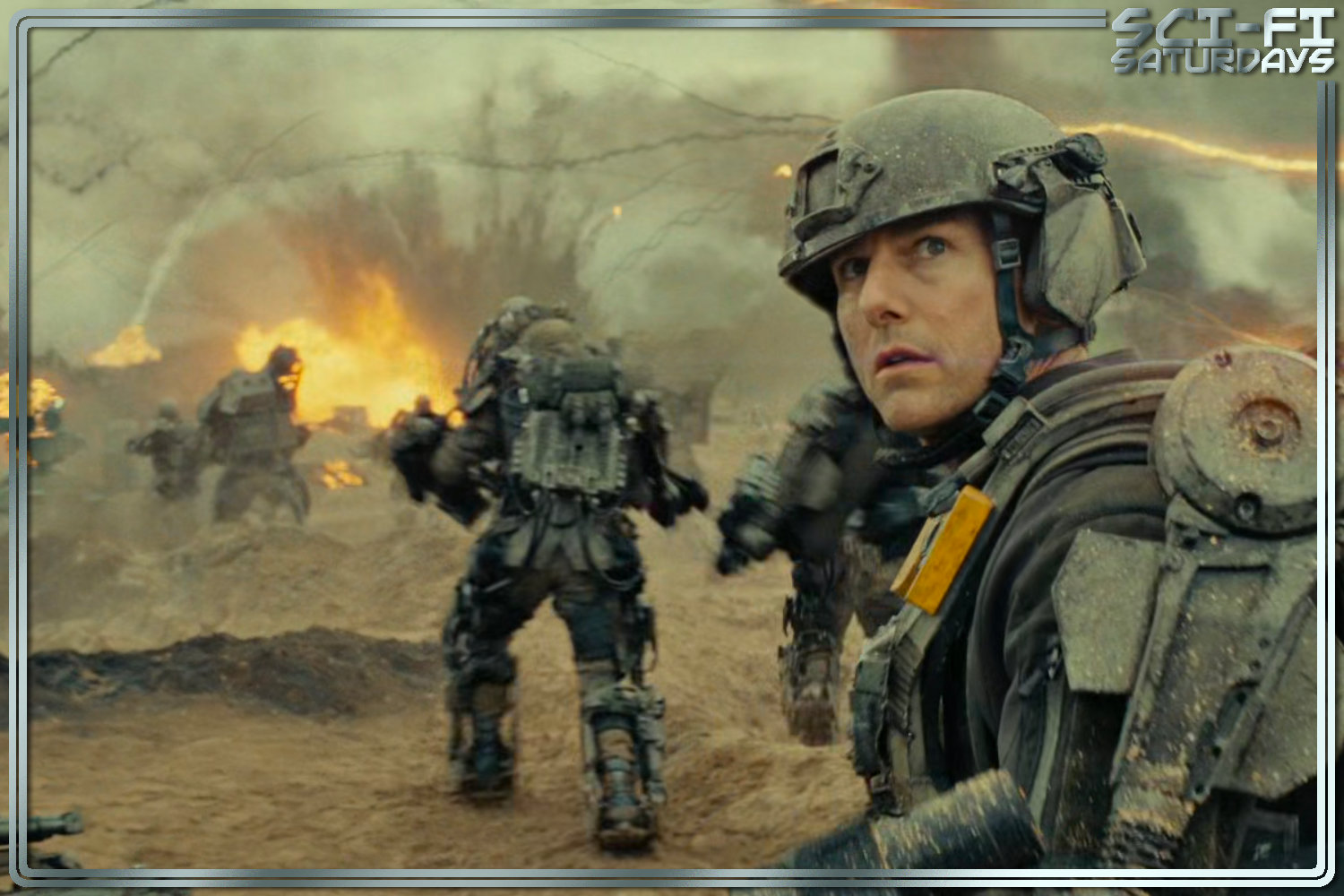
As the inexperienced Cage, outfitted in an exoskeleton, approaches the beach with the others, his airship is shot down, and many die. He and other J-Squad members luckily make it to the ground, but many quickly die when confronted by the enemy known as Mimics. These tentacled creatures erupt from the sand, slaughtering hundreds of soldiers, including the Angel of Verdun, Rita Vrataski (Emily Blunt). A larger Mimic, later identified as an Alpha, lunges for Cage, who detonates a claymore mine, killing both of them. Cage awakens back on the base, confused, as he re-experiences the entire day and a half again. He realizes that every time he dies, he respawns at the base, getting a second chance to work through the day.
After several unsuccessful attempts to fight through the beach, Cage seeks out Rita, who eventually confides in him that she, too, experienced this power once after being bathed in the blood of an Alpha. It’s how she was able to win the Battle of Verdun. She introduces Cage to Dr. Carter (Noah Taylor), a particle physicist, who has been demoted for his crazy talk about time loops and the Mimics. She tells Cage that eventually he will get a vision of the Mimic leader, the Omega, when the creatures are close to finding him. She wants a chance to join him to kill it. Every time Cage dies, he trains further with Rita, creating a strategy that eventually gets them off the beach.

Bill Paxton makes an excellent foil to Tom Cruise as Master Sergeant Farell.
Cage and Rita manage to steal a minivan and make their way to a small farmhouse with a helicopter. Cage confesses to her that they have made it to this place dozens of times, but nothing he can do saves Rita. He’s not ready to proceed without her, having fallen in love with her over and over in his hundreds of times through the loop. On his next reset, he decides he can’t involve Rita, stealing the helicopter and making his way to a dam in Germany, where he’s had visions of the Omega. But when he enters the structure he discovers it’s a trap devised by the Mimics. He tells Carter and Rita that they need an alternate idea. Carter suggests his prototype transponder, a device that can tap into the wavelengths used by the Alphas to communicate with the Omega. Only they don’t need an Alpha, because Cage has the same power.
Rita takes Cage to the last known place of the transponder, General Bingham’s office. After several tries, they manage to get the device, but are always chased by the military. Cage uses the device, seeing the Mimic General under the Louvre in Paris. They get into a car accident, and when Cage reawakens, his blood has been transfused, losing the power to reset the day. From here on out, it’s one shot at saving the world. With only hours left until dawn and the attack on the beach, they decide to get the help of J-Squad and head to Paris. The location is heavily defended, and all of J-Squad dies as they approach.
As they attempt to make their way into the flooded tunnels under the museum, Rita tells Cage that neither of them will make it out. An Alpha kills Rita and heads for Cage, who is swimming into a shaft towards the Omega. He gets stabbed by the Mimic, but reveals he has pulled all the pins from his grenades, which blow up the giant Mimic boss, bathing him in its blood. Cage awakens two days in the past, on the helicopter landing outside Bingham’s offices. The news reports that a series of pre-dawn explosions in Paris has wiped out the Mimics, and Bingham says they will soon be able to mop up the remainder. Cage finds Rita, who has no idea who he is since the reset, which causes him to chuckle.
“Through readiness and discipline, we are masters of our fate.” – J-Squad

Rita tells Cage that when he wakes up he needs to find her so they can stop the alien invasion.
History in the Making
Edge of Tomorrow is not the standard Tom Cruise action film from this era. Not necessarily in terms of plot, but more so in terms of character. Cruise was no stranger to science-fiction films, having previously appeared in Oblivion, the remake of War of the Worlds, and Minority Report. He had established the Mission: Impossible franchise as another viable action series, having released its fourth film in 2011. His modus operandi was strong, likable characters in a non-stop action film where Cruise was definitely the star. However, in this film, Cruise plays an unlikeable character (as unlikeable as Tom Cruise can be on screen) who must overcome several character flaws to complete the mission. This is a minimal issue, and barely worth mentioning, since audiences are already on his side when the film opens. They probably agree with Cage’s character, believing that they wouldn’t want to be sent to the front lines either. It’s worth mentioning due to the fact that Cruise’s characters are rarely seen in an unfavorable light. They may have character flaws, but they are always the lead hero.
The film was written by Christopher McQuarrie, a writer commonly associated with Bryan Singer projects such as The Usual Suspects and Valkyrie (also starring Cruise). McQuarrie worked previously with Cruise on Jack Reacher, which he both wrote and directed two years before Edge of Tomorrow. Their collaborations continued with McQuarrie having uncredited rewrites for the 4th M:I film, Ghost Protocol, with him then being brought in to write and direct the final four installments of that franchise, Rogue Nation, Fallout, Dead Reckoning, and The Final Reckoning. McQuarrie was the eighth writer to tackle the screenplay for this adaptation of the Hiroshi Sakurazaka manga All You Need Is Kill. He is the primary credited screenwriter, sharing co-credit with Jez and John-Henry Butterworth, who were hired when Doug Liman was brought on board as director. Liman may not be a familiar name, but audiences would be familiar with his action films, including The Bourne Identity and Mr & Mrs Smith. Sci-Fi Saturdays looked at his previous science-fiction film, Jumper, last year. Liman would work again with Cruise on American Made, before making another sci-fi film, Chaos Walking, and the Road House remake. He does an amazing job of keeping the audience from getting confused in a film that could easily do so.

When Cage eventually finds Rita, he must gain her trust, over and over again.
Genre-fication
Edge of Tomorrow deals with one of the more popular sub-genres of science fiction, time travel. But it’s not just any kind of time travel, as it specifically deals with time loops. While time travel films have been around since the 1950s, time loop films didn’t come into popularity until the 1990s. 12:01 (1993) is one of the first, but audiences may be more familiar with Groundhog Day, which came out the same year. What’s interesting about time loop stories in film is that they don’t necessarily need to be science-fiction tales to work. Groundhog Day is not sci-fi. It’s more fantasy than anything else, and why it wasn’t included in these articles. Neither is Palm Springs, which is also fantastical, even though it includes scientific principles in its resolution. Happy Death Day (and its sequel) and The Final Girls are both horror films, showing that other genres can play with the same tropes. But since time travel is so closely identified with sci-fi, that’s where most time loop films fit as well, including this one, Frequently Asked Questions About Time Travel, and Source Code.
Edge of Tomorrow embraces many of the common tropes about science-fiction films, including alien invasions and advanced technology. The aliens have not come in peace and threaten to exterminate humankind via their ability to travel through time, resetting events, giving the Mimics preternatural abilities. It’s a much more dangerous and terrifying version of War of the Worlds. Cage and the members of J-Squad all wear battle suits for their deployment. These aren’t full armors like Iron Man uses or those worn by the Stormtroopers of the Galactic Empire. These are exoskeletons that amplify the strength of the wearer and contain additional weaponry. This is the second film within a year to feature robotic exoskeletons after the previous years Elysium. It’s also the first film to really give a movie audience the feel of what it’s like to play a video game.
Anyone who has played a video game in the last 40 years knows exactly what Cage is going through. As players navigate their way through levels of their favorite video game, memorizing patterns and maps to avoid bad guys and other pitfalls, they will inevitably fail at some point. At that time, their character is respawned, hopefully at the last save point, but in the old days, it may have been at the beginning of the game, forcing the player to insert more money and start all over again. While the film doesn’t show everything every time, it does a good job of revealing the shortcuts and muscle memory that Tom Cruise’s character must build to navigate the day and a half that he keeps reliving. I’m sure that he is at a place where he knows multiple branches of the day’s events so that he can move quickly to the important aspects, like getting Rita on his side. It’s too bad that he doesn’t have a special button that allows him to skip the cut scenes.

Dr. Carter explains what is currently known about Mimics, hoping to discover a way to defeat them.
Societal Commentary
The theme of Edge of Tomorrow is clearly summed up in the words of wisdom of Master Sergeant Farell, recited by J-Squad, and quoted above. We are all masters of our own fate, which is the main lesson learned by Major Cage. When it comes to films regarding time travel, indeterminism is one of the two major philosophical choices, along with fatalism. For films that want to carry a grim message, they usually fall on the fatalistic side, believing that events are out of control of the protagonist. This is the time travel model of whatever happened, happened. Nothing the time traveler does is able to change the course of the major events in the story. If someone has died, they will always die, even if the character is able to alter the events surrounding this death. Death will find them in another way. This is the message delivered at the beginning of the 2002 remake of The Time Machine. Regardless of what Alexander does, his girlfriend continues to die, yielding an angry young man trying to defeat the will of the universe.
However, films that want to uplift the audience usually choose to go the route of free will. While the notion can sometimes be dizzying and overwhelming, it provides the idea that every decision we make leads to the outcome of our lives. There’s no ethereal deity controlling the lives of the humans on Earth. Just billions of decisions that intersect and rebound off one another, leading people along their lives. That’s why human interest stories of individuals “beating the odds” are so inspirational, because they provide the idea that anything is possible given determination and effort. Major Cage is the personification of this. Endowed with extraordinary powers, he is able to repeat the events of a single day, exploring the various avenues available to him, until he gets them correct. He battles alien creatures looking for a way off the beach, eventually realizing that the perceived way forward is actually a dead end. He shuns the fight, choosing to drink in a pub instead. This inaction leads to the same outcome of the world being overrun by Mimics. Eventually, he finds the third option, which is an experimental device that allows Rita and him direct access to the Omega Mimic and a win.
The film shows that sometimes the proper course of action is not the initial or easy path (though none of this appears easy). If not for the ability to explore every possible outcome, would Cage have been able to discover the small path that led him to defeat the aliens? His journey is a metaphor for humans who choose to follow the same path, over and over again in life, hoping that the outcome will change. It’s part of the blind optimism that humans share, believing that they can eventually win at Blackjack and beat the house, even after losing more times than they win. Cage demonstrates outside-the-box thinking, which is crucial to attacking important and apparently insurmountable problems. If at first you don’t succeed, try, try again–but also look for different ways to try. This is where the video game metaphor intersects with reality. If you die every time you take the right-hand path, stop taking the right-hand path.

Cage realizes that some avenues end up being dead ends, even though they may seem advantageous.
The Science in The Fiction
It’s fun to explore time travel films to find the reasons behind the time travel. Some films, like Back to the Future, explain the entirety of the process–even if the science behind it makes no sense. In other films, like Looper, there’s just a process that works, which audiences must choose to accept. Edge of Tomorrow is an outlier in that its notion of time travel is both explained and not explained. The characters in the film understand that the Alpha and Omega mimic have the ability to travel through time. Actually, it’s not even full-time travel as we may understand it from other films. They are really resetting the day. The Mimics don’t seem to have the ability to go anywhere they want. They are able to go back as far as their last moment of unconsciousness (ie, sleep) to start again. That’s the known aspect of time travel. What’s unknown is how they accomplish this. As with kaiju that have the ability to release an EMP blast (Pacific Rim, Godzilla), these creatures have evolved in a way that was evolutionarily advantageous by gaining this power. They would be able to become the top of any food chain by having the ability to learn from their mistakes and conquer any other creature. How would this happen? It’s anyone’s guess. These are aliens from an unknown location, so anything is possible.
Edge of Tomorrow also makes use of some fantastic hardware in its Jacket robotic exoskeleton battle suit. These are straight out of video games like Ghost Recon: Future Soldier and Call of Duty: Advanced Warfare. The device, which is a smaller and more militarized version of the power loader from Aliens, augments the wearer’s strength and stamina, allowing them to lift more weight, jump further, and run faster. It features multiple automatic weapons and a computerized interface that may not be the easiest thing to use (at least going by Cage’s troubles getting it to work). Yet these battlesuits don’t make characters invulnerable. They can still be shot, blown up, or crushed by the crashing assault craft. For much of the original timeline, Rita chooses not to use a Jacket. This is probably due to her experience with the Mimic’s power and the realization that the exosuit will run out of ammunition at the most inopportune time. She chooses to use a giant anime-style sword. Eagle-eyed viewers will note that this sword appears to have been crafted from the blade of a helicopter, sharpened for battle. It’s the best explanation of how a comically large sword (which is very much a staple in the manga that inspired this film) would be available during this battle.

Rita and Cage eventually gain what they need from General Bingham, but at what cost?
The Final Frontier
As always, Tom Cruise creates a likable character that audiences want to see succeed. Cage’s personal growth is one of the highlights of the film as he slowly changes from a self-serving egoist to a truly altruistic soldier doing his best to protect others around him. Emily Blunt returns in her third sci-fi action film, having the most agency of any of her characters. In The Adjustment Bureau, she was the impetus for Matt Damon’s avoidance of his fated life-path. In Looper, she created a strong character who stood up to Joseph Gordon-Levitt’s killer-for-hire. But here, she is immediately characterized as a bad-ass, even before the audience meets her. She’s the Angel of Verdun, the Full Metal Bitch, and she lives up to every aspect of that backstory. The supporting cast of the film is great as well. Brenda Gleeson, as the no-nonsense General, plays a great authority figure that the audiences love to hate. Bill Paxton builds on his jerk-like characters, channeling Chet from Weird Science, if he were to have been put in R. Lee Ermey’s role in Full Metal Jacket. And finally, the members of J-Squad, who are comically used as cannon fodder throughout the entire film, but get their chance to be redeemed in the final act. They include Tony Way (High Rise) as the overweight Kimmell, Jonas Armstrong as the psychotic Skinner, Franz Dremah (Attack the Block) as the young Ford, and Charlotte Riley (the upcoming Masters of the Universe) as the battle-hardened Nance.
Talk of a sequel for this film has been circulating for the last decade, and there’s still a chance that one might appear. With Tom Cruise having finished up his Mission: Impossible films, there’s a window in which something might appear. The question comes down to the story that they choose to tell. What would make sense for a sequel? Did Cage receive a stronger power from the Omega Mimic that allows him to time-travel greater distances? Or is the reset at the end of the film a one-off situation? Without a proper story, any sequel may feel like a retread of the same story, over and over again. That said, the repetition in Edge of Tomorrow never feels cumbersome or boring. The story moves at a breakneck pace after familiarizing the audience with what’s happening with Cage. It exudes fun and adventure, while also creating strong characters and themes about living one’s best life.
Coming Next


Having grown up on comics, television and film, “Jovial” Jay feels destined to host podcasts and write blogs related to the union of these nerdy pursuits. Among his other pursuits he administrates and edits stories at the two largest Star Wars fan sites on the ‘net (Rebelscum.com, TheForce.net), and co-hosts the Jedi Journals podcast over at the ForceCast network.