
For a guy who’s 60 years old, he looks pretty good!
The most recent film, entitled simply Godzilla, provides a much-needed boost to the legendary kaiju. Summoning elements from the original 1954 film, this version provides an easy and exciting entry point into the world of giant monsters battling each other as they destroy the cities around them. It also showcases the human element by focusing on the trauma faced by one family who keep getting involved with these destructive creatures.
First Impressions
In this trailer, a man’s voice-over indicates he believes someone else is hiding something, a cover-up. Footage of refugees streaming along roads and collapsing buildings accompanies this conspiracy theory. Another man claims that something was awakened in 1954 during nuclear tests in the South Pacific. The military is called in, but they begin to encounter something much bigger than they expected as planes begin dropping out of the sky. Why does the Golden Gate Bridge always get beat up in these films? It’s the return of Godzilla, and he doesn’t look happy.
Presented below is the trailer for the film.


Godzilla (2014) title card.
The Fiction of The Film
The opening credits present archival footage of nuclear bomb tests from the 1950s and the advent of an apparent government program called Project Monarch. In 1999, Dr Serizawa (Ken Watanabe) arrives at a mine collapse in the Philippines to investigate. He notices something massive has emerged from a fossil and crawled into the ocean, all the while the radiation levels are growing stronger. In Japan, Joe Brody (Bryan Cranston), a lead engineer at a nuclear power plant, gets reports of seismic activity in the area and sends his wife, Sandra (Juliette Binoche), to investigate the lower level of the plant. When the reactor breaches due to an earthquake, Joe must seal the door, trapping Sandra and her team in the reactor, where she dies.
Fifteen years later, Joe’s son Ford (Aaron Taylor-Johnson), a bomb disposal expert in the Navy, returns home after his tour to his wife, Elle (Elizabeth Olsen), and son Sam (Carson Bolde). He is immediately called to fly to Japan, where Joe has been arrested, again, for trespassing on the quarantine zone near the nuclear reactor. Joe spouts wild conspiracy theories that there is a cover-up and that no earthquake caused the plant collapse. After releasing him from the local police, Ford follows Joe, yet again, into the Q-zone to pick up files at their old house. They discover, to Ford’s surprise, that his father is right and there’s no radiation.
Dr. Serizawa and his assistant, Dr. Graham (Sally Hawkins), are on site as part of Monarch, investigating similar seismic readings from 15 years ago, when a giant insectoid creature hatches, flying away from the site. In the destruction, Joe is injured and dies a short while later. The news media reports this as another earthquake, as Serizawa explains that this MUTO (Massive Unidentified Terrestrial Organism) uses an EMP attack to disable machinery and feeds off the radiation from nuclear power. He believes that a similar creature, discovered in 1954 and named Gojira, is the only way to restore balance. Ford heads home via Hawaii, while military teams discover the MUTO and a Russian nuclear sub in the jungles of Oahu. Godzilla appears and fights the MUTO at the Honolulu airport, causing much destruction.

Joe and his son Ford return to the quarantine zone finding it habitable and radiation free.
Admiral Stenz (David Strathairn) wants to know how to stop these creatures, unable to be certain if Godzilla is really a “good guy.” Another MUTO, a larger female version of the same beast, escapes from Yucca Mountain, Nevada, a nuclear containment facility, and wreaks havoc in Las Vegas. The smaller, winged male MUTO is headed to meet its mate in San Francisco, followed by Godzilla. Ford manages to get back stateside and volunteers on a military train convoy designed to lead the MUTO to San Francisco with a nuclear warhead, where they will continue leading it out to sea and destroy it. Since the MUTOs use EMP technology, Ford has helped retrofit an analog timer onto the warhead.
As the first MUTO makes landfall, Godzilla follows, damaging the Golden Gate Bridge in the process. The female MUTO has stolen the warhead and created a nest in downtown San Francisco, where she lays her eggs. Elle, a nurse at a local hospital, puts Sam on an evacuation bus and stays in town, waiting for Ford to return. Ford and another military team perform a HALO jump into San Francisco so they can dismantle or retrieve the warhead before it detonates. They find the bomb covered in MUTO eggs and manage to extract it and get it to the wharf and onto a boat, while Ford burns the nest using a crashed gasoline tanker as an explosive. Godzilla fights the MUTOs in town, causing much destruction. He uses his atomic breath on the male, killing it. The female kills the military team as she heads for the warhead.
Ford gets into the boat and sets a course for 20 miles out while Godzilla, already exhausted, fights the large female MUTO. Knowing he has set the course, Ford collapses on the boat. Godzilla kills the female and collapses at the same time. A helicopter team extracts Ford from the boat as it travels out to sea. The bomb detonates safely outside the city. The next morning, Ford finds Sam at a shelter in Giants Stadium. They watch as new sets of refugees arrive, finally spotting Elle, whom they both run to and embrace. Dr. Serizawa marvels at the collapsed body of Godzilla in the rubble. He is startled when the giant kaiju awakens and slowly lumbers off into the sea until the next time he is needed to restore balance.
“The arrogance of men is thinking nature is in our control and not the other way around.” – Dr. Serizawa

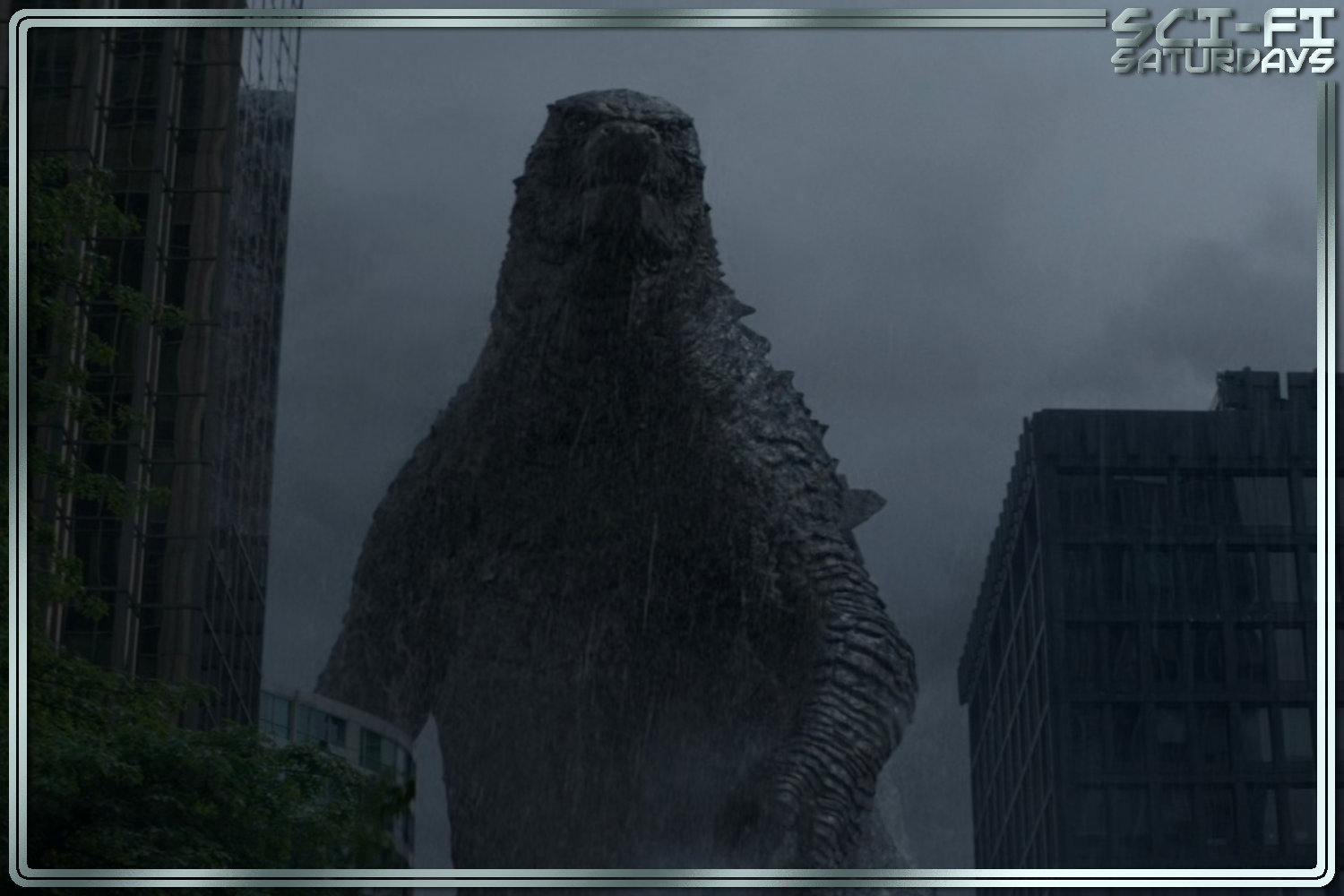
The first appearance of Godzilla as he stomps through Honolulu airport.
History in the Making
Godzilla is a special film for kaiju fans. Not only is it the first film in the Legendary “monsterverse” series, but it is also the first Godzilla film in ten years since Godzilla: Final Wars, the last film in the Millennium Era series. It celebrates the 60th anniversary of the kaiju’s creation by returning to the roots of the character. It’s also not exactly a remake, but more of a soft reboot of the series. Fans will be interested in the updated take on the character, but viewers who have never seen a Godzilla film before have nothing to worry about. The film is the beginning of a new storyline and new continuity for the kaiju, and provides everything you need to know in this film.
This is the second time that Hollywood has solely produced a Godzilla film outside of Japan, the first being the 1998 Godzilla film with Matthew Broderick. British filmmaker Gareth Edwards was picked to direct this film based on his previous (and debut) film entitled Monsters, which owes a lot to kaiju films in general. The cast is an eclectic mix of multinational actors. Big name Bryan Cranston, who chose this role after the conclusion of his successful run on Breaking Bad. Ken Watanabe had a successful career in Japan before breaking into Hollywood films such as Batman Begins and Inception. The young leads were portrayed by Aaron Taylor-Johnson, known for his work in the Kick-Ass series, and Elizabeth Olsen, who had previously appeared in the Spike Lee remake of Oldboy. These two would play brother and sister the following year in Avengers: Age of Ultron, with Olsen gaining new stardom for her portrayal of the Scarlet Witch for Marvel Studios.
This version of a Godzilla film looks backward as much as it does forward. While it’s not a sequel to the original 1954 Godzilla film, it does make reference to the original in several key ways. The first is referencing the arrival of Godzilla in 1954. You know all those nuclear bomb tests on atolls in the South Pacific during this era? They were really attempts to kill Godzilla using a cover story of military testing. The film uses this ruse to set up the covert organization Monarch, which will show up further in subsequent Monsterverse films and TV series. The other main reference is the name of Dr. Ishirō Serizawa. His first name comes from Japanese director Ishirō Honda, while his surname is from a character in the original 1954 film, Dr. Daisuke Serizawa. His character also becomes the main character to impart the themes of the movie to the audience, seeing Godzilla as a part of the natural world, or a force of nature, rather than a creature that can be destroyed.

Ford works with a military advisor to get back home to San Francisco, to his wife and son.
Genre-fication
Since it’s been ten years since the last official Godzilla film, and this film is much more of a reboot of the franchise, it’s difficult to compare them. That’s actually untrue, since in essence, kaiju films all rely on the same basic premise: humans plus giant monster equals entertaining films. While Godzilla: Final Wars hits all the elements of the Godzilla franchise that have made it popular (it was made for the 50th anniversary of the franchise), Godzilla returns to the most basic level for this genre of film. It focuses more on the human element rather than trying to cram a bunch of references to previous films into itself.
Kaiju films are also disaster pictures on a large scale. While some Godzilla films get away from this premise, perhaps having multiple monsters fighting on a deserted island, the original film features Tokyo getting the brunt of the monster’s wrath. Substitute the kaiju with earthquakes, tornadoes, or meteor showers, and you get a very similar film focused on humans trying to survive. Godzilla actually owes much to a series of other, recent disaster films (some of which involve kaiju) from the previous decade. The first is a remake that deals with giant creatures, though not kaiju. It’s the 2005 Steven Spielberg adaptation of War of the Worlds. Both films focus on the main character (Ford and Ray, respectively) avoiding the surrounding destruction as they try to reunite with their families. While many critics may lament the lack of Godzilla scenes in this film, Edwards chooses to use the human characters as the focal point of the film, such as during a kaiju fight in San Francisco, as the doors to the shelter close with Elle inside, blocking the audience’s view of the melee. This type of action and destruction is also similar to the Matt Reeves film Cloverfield, which also focuses on the human characters and is a film completely filmed by them (within the found footage genre). Other influences can be found in Pacific Rim, which itself is an homage to the kaiju films from Toho Studios, featuring giant robots fighting giant interdimensional monsters. Pacific Rim introduces the idea of biological creatures being able to generate an EMP blast, a story element that is repeated here in the new generation of Godzilla films.

Millions flee from the MUTO threat only to encounter an infrastructure unable to support them.
Societal Commentary
As with the 1954 version of the film, Godzilla also deals with the danger and horror of nuclear weapons. The creature’s origins are surrounded by nuclear power, as Dr. Serizawa relates the story of Godzilla’s discovery. In 1954, when the USS Nautilus, a nuclear-powered submarine, descended to its deepest depth, it awoke Godzilla and other creatures. The nuclear blast tests that were performed throughout the 50s were not specifically tests, but attempts to destroy the creature. Nuclear radiation attracts the creatures, and while Godzilla is never shown directly consuming radiation, Serizawa makes it known that these creatures feed on this energy.
The MUTOs, on the other hand, are specifically seen destroying nuclear facilities and vessels. The winged male creature heads straight for the Japanese power plant when awoken, feeding off its radiation and causing a seismic event mistaken for an earthquake. The female MUTO survived by feeding off the nuclear waste, where her dormant body was disposed of. She follows the radiation signature of the warhead back to the California Coast, where she lays her eggs along the missile, providing nutrients for her babies. Dr. Serizawa is the one character continuously reminding others that the dangers of the creatures come from nuclear energy, as well as counseling that Godzilla may not be the bad guy. When Admiral Stenz continues with his plan of detonating a warhead in or near San Francisco, Serizawa shows him a watch, which is stopped at 8:15. Stenz finds this amusing until he realizes that it was stopped on August 6, 1945, when Hiroshima was bombed. This is the only (and hopefully the last) time that atomic weapons have been used against humans, hitting home the key theme that there is no good time to use a nuclear weapon.
The other strong theme in the film is family, specifically the story of the Brody family. Even more specifically, the generational trauma in the Brody family. Sidenote, there’s also generational trauma with Dr. Serizawa losing his father at the bombing of Hiroshima, and inheriting his watch as a reminder of that dreadful moment in history. The film opens with young Ford being unable to wish his father Happy Birthday properly before Joe and Sandra have to rush off to work. After Sandra’s death, Ford seems to have become estranged from Joe for two reasons. The first reason is Joe’s continuing lawbreaking stunts and conspiracy theory talk in what Ford believes is a way to avoid the responsibility of Sandra’s death. Secondly, Ford still blames Joe for his mother’s death and the lack of proper parenting he provided the boy. For all of this grief, Ford then becomes a person who puts some of the same amount of trauma on his own son. Ford realizes that everything his father had been telling him was true and uses his military connections and skill to do his part to make his family safe, while also putting himself directly in harm’s way. The film doesn’t show a lot of Sam’s trauma, but he’s clearly scared and worries about his father.

Elle decides what to do with her son Sam as the city evacuates from the threat of kaiju attack.
The Science in The Fiction
Godzilla’s explanation of how Godzilla and the MUTOs receive energy goes back to the original film. The kaiju was attracted to the atomic power plants of Tokyo, which led to his destruction of the city. The “radiation equals energy” component of Godzilla films has always been there, but has never really been explained, other than it helps to power his atomic breath. Dr. Serizawa hypothesizes that in prehistoric times, radiation levels were greater, and these MUTO creatures lived above ground, consuming this radiation as a food source. How or why? They don’t get into that. But what is shown with the two insectoid MUTO creatures demonstrates that having a radioactive warhead (inside some casing, and presumably safe enough for military personnel to operate around) is enough of a food source to have mama MUTO lay her eggs all over it.
If viewers are going to argue about radiation and how the creatures metabolize that into something that gives them the energy they need to live (perhaps the kaiju mitochondria are actually the nuclear powerhouses of their cells), that may distract purists from questioning how a 355-foot creature, and its kin, can live on our world. A recent episode of Ask Hank Anything with Brian David Gilbert on YouTube discloses that a Titan like Godzilla could never get this large due to its weight, the density and strength of its bones, and, of course, Earth’s gravity. But why bring reality into a series as fun as Godzilla?

Dr’s Graham and Serizawa marvel at the scale of the massive Godzilla.
The Final Frontier
This version of Godzilla kicked off a new slate of films called the Monsterverse, which has reached five films (a sixth, Godzilla x Kong: Supernova, is coming in 2027), plus two television shows. At the same time, a new era of Japanese Godzilla films has also begun. The Reiwa Era of kaiju films began in 2016 with Shin Godzilla and, as of 2023, has reached five films with the most recent being the amazingly popular Godzilla Minus One. The follow-up to Godzilla was Kong: Skull Island, establishing at some point that these two Titans must meet and battle each other. And that they did, in 2021s Godzilla vs Kong. The films have had varying levels of quality, but have all provided the same level of fun that audiences seek from this genre. An animated television series surrounding Skull Island has come and gone, while the live-action Monarch: Legacy of Monsters was renewed for a second, and unaired as of yet, season.
Godzilla returns to claim the throne as King of Monsters after a 10-year absence from movie screens. The film’s thematic elements remain in line with many of the original Godzilla stories, allowing a new generation of moviegoers to appreciate the complexity and history of this character. It also allowed a new era of kaiju films to grow and flourish, knowing that Godzilla is still in charge.
Coming Next


Having grown up on comics, television and film, “Jovial” Jay feels destined to host podcasts and write blogs related to the union of these nerdy pursuits. Among his other pursuits he administrates and edits stories at the two largest Star Wars fan sites on the ‘net (Rebelscum.com, TheForce.net), and co-hosts the Jedi Journals podcast over at the ForceCast network.