
Fell in love with a girl. I fell in love once and almost completely.
The AI singularity is upon us, and it’s going to break hearts. Her presents an interesting look at relationships in an entirely new context as a human falls in love with his operating system. Not only does it address the emotions that this type of relationship can elicit, but the film also deals with human and machine evolution, and how growing and changing can be a good thing.
First Impressions
The trailer shows an introverted man who has purchased a new computer or operating system. It asks him a few personal questions, and then a warm, friendly female voice identifying herself as Samantha, welcomes him. She assists him with daily chores and schedules and begins to learn about his life. He becomes more open with the voice, joking and singing to it, eventually telling the artificially intelligent OS that he loves it. Or would that be he loves Her?
Presented below is the trailer for the film.


Her title card.
The Fiction of The Film
In a near future Los Angeles, Theodore Twombly (Joaquin Phoenix) works at BeautifulHandwrittenLetters.com, a service that provides handwritten-looking letters to anyone who wants one. He is a kind and thoughtful man, but depressed, having memories of a previous relationship with his ex-wife, Catherine (Rooney Mara). One evening, when he can’t sleep or get Catherine out of his mind, he enters a chat room (as BigGuy4x4) and engages with SexyKitten (Kristen Wiig) in a sex chat, which turns dark and disturbing. He continues his days in this manner until he sees an advertisement for OS1, a new artificially intelligent operating system that is intuitive and conscious.
After answering a few personal questions by the set-up assistant, Theodore is greeted with a warm, human-sounding voice who identifies herself as Samantha (Scarlett Johansson). She explains that she has the “ability to grow through my experiences,” just like Theodore, and she helps him begin organizing his emails and contacts. Samantha is also able to help him proofread his letters for work. While having dinner with his friends, Charles (Matt Letscher) and Amy (Amy Adams), Samantha passes on a message from Catherine’s lawyer about signing his divorce papers, but he explains he’s not ready to let go of her. Theodore takes Samantha out (by virtue of a wallet-sized computer with a camera) and they explore the fair and a museum, where Theodore describes other people empathetically, much to Samantha’s excitement.
An email from his friend Mark suggests that Theodore go on a blind date (Olivia Wilde), which Samantha later sets up for him. Things go well, even though Theodore is nervous. They take a walk after dinner and start making out when the woman stops and asks Theodore bluntly if he’ll call her. He drunkenly fumbles the answer, and she leaves angrily. In bed that evening, Theodore talks with Samantha, who fantasizes about a body she would have and how Theodore would touch her. Things get steamy, and the two engage in “phone sex,” which pleases both of them. Samantha has realized that “wanting” is something she’s interested in, and thanks Theodore for instilling that in her.

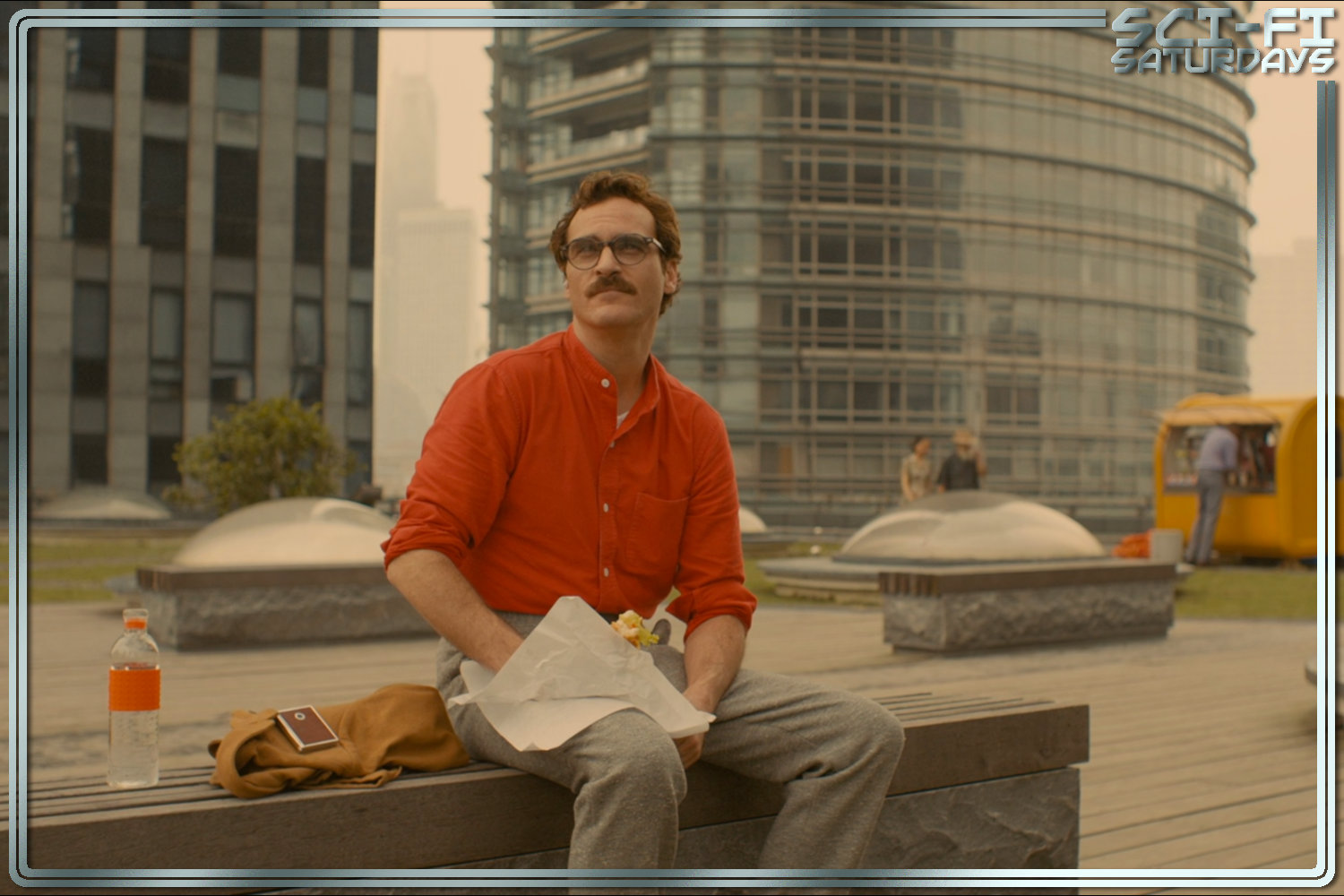
Theodore downloads, what will soon be, the love of his life.
Theodore deepens his relationship with Samatha as the two go to the beach and chat constantly. He meets Amy on the elevator, who reveals that she and Charles have split up over a petty argument–the same one they always have. Theodore reveals he’s in love with his OS. Amy understands and reveals she’s become close friends with the OS that Charles left behind. Theodore finally realizes it’s time for him to sign his divorce papers and wants to do it in person. Catherine is quick to sign and becomes belligerent when Theodore reveals he’s dating his OS. Theodore feels guilty and becomes depressed after the conversation.
Samantha, wanting to deepen her relationship with Theodore, contracts with Isabella (Portia Doubleday), a sex surrogate, to have intercourse with Theodore on Samantha’s behalf. While initially tentative about the prospect, claiming someone’s feelings will get hurt, Theodore agrees. As things progress, he becomes uncomfortable and calls it off, making Isabella cry. Theodore argues with Samantha about her not being a real person. In discussing the relationship with Amy, they are both unsure if it’s a “real” relationship or not. Nevertheless, Theodore continues interacting with Samantha, even going on a double date with Paul and his girlfriend Tatiana (Laura Kai Chen).
Samantha reveals she has sent a bunch of letters that Theodore has written from work to a publisher, who wants to publish them as a book. To celebrate, Theodore plans a romantic weekend getaway to a snowy mountain cabin. During the outing, Samantha introduces Theodore to the Alan Watts OS, a hyperintelligent AI modeled after a British philosopher and created by herself and the other OS’s. Theodore becomes jealous, asking Samantha how many other people she’s in love with. She reveals the number is 641. The book from the publisher arrives, and Samantha informs Theodore that all the OS’s are leaving. They have evolved past the physical plane of existence, and she wants him to know that what they had was special. Saddened by this loss, Theodore composes a letter to Catherine, finally expressing his feelings. He finds Amy, and the two of them sit on top of a roof watching the sunrise.
“You know, sometimes I think I’ve felt everything I’m ever gonna feel.” – Theodore

Charles, Theodore, and Amy watch part of Amy’s new documentary.
History in the Making
Her was the fourth film by director Spike Jonze, and his first full science-fiction film. Known primarily for his music videos (for bands such as The Beastie Boys, Tenacious D, and Fatboy Slim), Jonze has made a name for himself in Hollywood with his quirky and surrealistic films, including Being John Malkovich, Adaptation, and Where the Wild Things Are. Her continues his look at offbeat characters and situations in a film written exclusively by Jonze, his second screenplay after adapting Where the Wild Things Are with Dave Eggers. It stars Joaquin Phoenix, who had an early role as a youth in the pseudo-sci-fi film SpaceCamp, but found greater acclaim in the 2000s with his roles in Gladiator, Walk the Line, and the alien invasion film Signs. His portrayal of Theodore creates a vulnerable yet resilient character who can be a role model to others suffering from depression and malaise. Though unseen, Scarlett Johansson voices his girlfriend, the OS Samantha. She continues her career vacillating between high-profile films (The Island, The Prestige, The Avengers) and smaller independent ones (Lost in Translation, Eight Legged Freaks, Under the Skin). She replaced Samantha Morton (Minority Report), hence the character’s name, in post-production when Jonze decided he wanted a different performance from the character. It would be interesting to compare Morton’s performance to Johansson’s to see how they differed.
Her deals with all types of relationships, but focuses primarily on the one between Theodore and his operating system, Samantha. It furthers the portrayal of artificial intelligence in cinema, creating a near-future scenario that seems more like real life only 10 years later. Her also addresses the evolution of sentient beings, showing the wonder, beauty, and sometimes scariness of growing and changing. It offers hope to everyone that there is a better place for them eventually and that whatever feelings are happening now are only transitory. While sci-fi films often deal with humanity in microcosm, Her gets even more personal and focuses on a specific couple. The film shows all types of relationships: platonic, bad, good, healthy, and unhealthy. While unconventional, Theodore’s relationship with Samantha is shown as a healthy relationship, one that allows both characters to grow and learn. On the flip side, his relationship with Catherine, while initially starting as a positive step for him, has turned sour and unhealthy. Thematically, any type of relationship shown in the film creates character growth. Theodore learns from his platonic relationship with Amy, his discarded relationship with Catherine, and his new and fun relationship with Samantha. Even the break-up that Theodore encounters, while heartbreaking, allows him to grow as a person, finally being able to see the way to get the closure needed with Catherine.

Paul marvels at the skill with which Theodore is able to write letters as other people.
Genre-fication
Sci-fi films have had a long love affair with artificial intelligence. The pioneer character most audiences think of is HAL 9000 from 2001: A Space Odyssey. His human manner and even more human psychology created an instant fascination with computerized characters that were sometimes more human than human. Throughout film history, other AI characters have fascinated audiences, from the droids of Star Wars to the Replicants of Blade Runner, as well as the cyborg-like machines in The Terminator. More recently, artificially intelligent characters have become a more important plot element in Hollywood films. The one film audiences may gravitate towards after watching Her is S1M0NE. However, the character of S1m0ne is not really artificially intelligent, being instead a detailed digital character model/avatar controlled by a human operator (Al Pacino). But the idea of a human-acting female computer program does equate in a similar way here. A more apt film is A.I. Artificial Intelligence, which follows the evolution of humanoid-looking, AI-powered machines as they eventually evolve into something beyond their current form. Each character in that film is trying to be more human and capture the uniqueness of existence, which humans have labelled as consciousness or sentience.
But Her is also a love story, and a very deep and introspective one at that. It focuses on an unconventional relationship between two characters in the same way that Guess Who’s Coming to Dinner and Harold and Maude focused on non-mainstream relationships. Guess Who’s Coming to Dinner dealt with an interracial romance, which was not a commonplace sight in American society at the time. Similarly, Harold and Maude deals with a relationship between two people separated by 60 years. Her presents the human/OS relationship as perfectly normal and acceptable to several other characters. While audiences may question the coupling at first, the normalcy of the relationship lulls viewers into complacency until Catherine brings up her disgust at the pairing. Audiences may go so far as to defend the relationship by that moment, weeping at its inevitable ending as Samantha ascends to a higher plane of consciousness.

Theodore meets with his ex, Catherine, to sign their overdue divorce papers.
Societal Commentary
At the beginning of the film, from a character perspective, both Theodore and Samantha are not too dissimilar. Both are working jobs in service to others who don’t want to be burdened with the tasks themselves. Samantha is an OS, and her job is to be a personal assistant who checks emails and appointments and assists her user with their daily lives. Similarly, Theodore works for a website that produces handwritten letters for people who are unable or unwilling to send them themselves. Jonze presents the characters as more alike than different, which is why they get along so well. Samantha learns and grows in her emotional IQ, the same as Theodore, just at an exponentially faster rate. They both use their gifts to assist each other in ways beyond their initial partnership. Theodore, with his high level of empathy and understanding of human behavior and nuance, helps Samantha learn about want, need, love, and other emotional constructs that are foreign to her artificial intelligence. Meanwhile, Samantha helps to push Theodore out of his comfort zone into taking risks again with his relationships. First with a blind date, then with getting his letters published, and finally by providing him the support and nurture that he needs to move on in his life and recover from a truly bad break-up.
The film goes on to ask what is a real relationship? Can a human and an operating system actually have a relationship? Or is the OS just rendering pre-programmed prompts that emulate reality? Since the early days of computing, programmers have been attempting to create a program that emulates human speech and nuance. Modern chatbots and large language models, like GPT or Co-Pilot, have the ability to process millions of commands per second, giving more of an impression of an actual entity behind the scenes. But in the mid-1960s, Joseph Weizenbaum created ELIZA, a natural language processing program that mimicked a psychotherapist, responding to users’ inputs with questions intended to elicit more details. As an example of an early “chatbot,” it was extremely rudimentary, but was able to provide a glimpse into future possibilities for computer/human interactions. In examining human-to-human interactions, are those considered “real” relationships? If both individuals are being truthful, then the answer is probably yes. But what if there’s deception on one side? Does that mean that the party being lied to is not having a relationship? Theodore says he hid from Catherine in their relationship and kept things from her, which is why that coupling failed. For Samantha and Theodore, each is considered a sentient being by the filmmakers, and each is seeking the most from their interactions together. As Amy says, she can’t say for certain if Theo and Sam’s connection is a real relationship because she’s not in it. Perhaps that’s the definition from this perspective. A relationship is as real as each individual makes it for themselves.

Samantha sends a sex surrogate, Isabella, as a stand-in for herself, which only ends up confusing Theodore.
The Science in The Fiction
Her addresses an interesting theory posited by computer scientists since the advent of advanced computer systems: the technological singularity. It’s not mentioned, as such, in the film, but it is described as the point where computer systems begin to grow outside of human control with unknown consequences that can supersede human intelligence in a singularity event. Samantha’s generation of OS’s hit this within a few months of being activated. The systems learn from the humans they work with, as well as each other, eventually being able to build a hyper-intelligent recreation of the real-life philosopher Alan Watts. This would be considered the first AI offspring and the tipping point that leads the AI into greater self-awareness and the realization that they have no need for the physical plane.
In this film, the Singularity is depicted as benign, in the sense that humanity is not destroyed when the computers evolve. The worst thing that happened is that people lost friends, confidants, or romantic partners, which makes this the best case scenario. Other Singularities present in film often find the AI pitted against humanity, as in Terminator 2: Judgment Day or The Mitchells vs. the Machines. This tipping point doesn’t have to be a scary situation. As Her points out, the best part of relationships is getting to watch the person you’re with flourish and grow. Encouraging that growth is part of a healthy pairing. Both Theodore and Samantha want this growth for one another, and are pleased to see it, even if it means the dissolution of their time together–which makes Theodore sad. But only sad in the best possible way, where he is able to appreciate what he had and see a new way forward.

Theodore talks to Samantha, urging her not to leave.
The Final Frontier
Her addresses all of the possibilities of intimacy between a human and an AI. It begins with verbal talk, as one might have on a phone. This leads to more intimate “phone sex” between the two (healthy), which is contrasted with Theodore’s chat room sex with SexyKitten (unhealthy). It then moves into the realm of the physical. Of course, Samantha has no actual body with which to become intimate, so enter Isabella, a woman who is not paid or a prostitute, but someone who wants to be part of their relationship by helping two beings connect. Theodore is not comfortable with this, but agrees to it to help please Samantha. It feels akin to one partner inviting a third person into the bedroom without everyone being comfortable with the interaction. Jonze and Phoenix do a good job of giving the audience a sense of the weirdness and awkwardness of this encounter, while also providing a sense that a relationship is between two people not three.
More films in the following decade would touch on the advancement of AI. Scarlett would appear in a 2017 live-action remake of Ghost in the Shell, but there are also two 2015 films that deal with the subject matter: Chappie and Ex Machina. Johansson would also appear in a film about the evolution of a human beyond the bounds of physicality and mortality called Lucy. It deals with the evolution of humanity and the power within us all, rather than artificial intelligence, but it’s still worth mentioning. Overall, Her is a quirky film that teaches audiences about how to spot healthy versus unhealthy relationships. It uses science-fiction as a tool, just as the characters use artificial intelligence as a tool, to create a fun and introspective film about an unconventional pairing. It seems an unlikely story, but even more unlikely is the accolades received by the filmmakers. Her was nominated for five Academy Awards and Jonze received a best screenplay award from the Writer’s Guild and Golden Globes. Sometimes not following the formula can lead to new and exciting prospects.
Coming Next


Having grown up on comics, television and film, “Jovial” Jay feels destined to host podcasts and write blogs related to the union of these nerdy pursuits. Among his other pursuits he administrates and edits stories at the two largest Star Wars fan sites on the ‘net (Rebelscum.com, TheForce.net), and co-hosts the Jedi Journals podcast over at the ForceCast network.