
In actuality, this movie is really about Tim.
As more of a romantic comedy, About Time takes the conventions of the time travel genre and intertwines them extraordinarily with the tropes of a couple’s drama. The sci-fi aspects inform the relationships of the characters to create a unique take on both genres.
First Impressions
Rachel McAdams appears in another rom-com dealing with time travel in this quirky trailer. A young man’s father tells him that the men in their family can travel through time and engineer the perfect day. At first, he doesn’t believe it, but once he tries it, he’s hooked. He meets the aforementioned Rachel McAdams and rewinds his life until he sounds less like a geek. The trailer also tells audiences this film is by the creator of Notting Hill and Love Actually. What is this about? It’s About Time.
Presented below is the trailer for the film.


About Time title card.
The Fiction of The Film
Tim Lake (Domhnall Gleeson) is an average yet awkward teenager. After a New Year’s Eve party, where he shakes hands with a girl, his father, James (Bill Nighy), tells him the family secret: all the men in the family can time travel backwards in their lifetimes by stepping into a darkened room, clenching their fists, and concentrating. Unbelieving, Tim tries it and is back at the party the night before. He changes some minor things, choosing to kiss the girl this time. Back in the present, he asks his Dad what he’s used it for. Reading books is the answer. James also warns him to be careful and use it wisely. Money destroyed Tim’s grandfather.
The following summer, Tim is infatuated with a friend of his sister Kit Kat (Lydia Wilson), named Charlotte (Margot Robbie), who is staying the summer. After several awkward encounters and time traveling to fix them, he realizes he can’t make someone fall in love with him. Tim moves to London to start his job as a lawyer. He moves in with a playwright friend of his father’s, Harry (Tom Hollander). One evening, Tim and his co-worker Rory (Joshua McGuire) have dinner at a restaurant that is staffed by blind waiters and set in the dark. They meet two women, Joanna (Vanessa Kirby) and Mary (Rachel McAdams). Tim is instantly smitten and gets Mary’s phone number.
Tim finds that Harry’s new play had a disastrous opening and uses time travel to fix it, but in doing so, he never met Mary and no longer has her phone number. Remembering Mary enjoys Kate Moss, Tim begins hanging out at a photography exhibit, hoping to see her again. He finds out that she has a boyfriend now, so he time travels to ensure he is there before she meets Rupert (Harry Hadden-Paton). Tim uses her words about Kate Moss to woo her, and they end up having dinner and going back to her place. He time travels twice after having sex with her to ensure that it’s a better “first” impression on her. They move in together and begin doing all sorts of things together.

Having been told about the family secret, Tim shuts himself into a dark wardrobe to see if it works.
Tim takes Rory to the theater and runs into Charlotte again, who is visiting London. She and Tim go to dinner, where she attempts to kindle a romance. He ends up leaving her and returning to his apartment, where he asks Mary to marry him. Tim takes Mary home to meet his Mom (Lydia Wilson) and Dad. Kit Kat is there also, having had a rough go with her boyfriend recently. They announce that they’re engaged and also have a baby on the way. The wedding is in the middle of a thunderstorm, but instead of correcting the weather, Tim time travels to replace his best man (3 times) with his Dad. James reminds everyone to look for relationships that are kind.
One year after the birth of their daughter Posy, Kat has a car accident after a fight with her boyfriend Jimmy (Tom Hughes). Tim decides he needs to help, so he reveals the family secret to Kat, takes her back to the New Year’s Eve party, and ensures she doesn’t meet Jimmy. When they return to the present, Jimmy is no longer in the picture, and Kat is dating Tim’s friend Jay (Will Merrick). Unfortunately, when Tim returns home, he finds that Posy is now a young boy, having been altered by time traveling prior to her birth. Tim re-reverses the intervention, ensuring the accident takes place, but he and Mary stay in the hospital with Kat to help her sober up and ensure she leaves Jimmy. She eventually ends up with Jay.
Things are going well for Tim, and he and Mary have a second child. A call comes from his mom, revealing his Dad has cancer. With only weeks left to live, and no way to alter the disease without changing his children, James is resigned to the end. He reveals a bigger secret to Tim, a formula for happiness. Live each day twice, enjoying it the second time for all the things you missed the first time. With a third baby about to be born, Tim goes back one final time to hug his Dad and tell him he will never see him again. James suggests they take a quick trip, which won’t break anything if they don’t make any changes. He takes Tim to a day when Tim was young and playing at the ocean with his father. Tim shares one final piece of wisdom with the audience, having given up time travel. Live your life deliberately and to its fullest extent every day, as if it were the last day of your life.
“The men in this family can travel in time.” – James Lake

Tim meets Mary for the first time, hitting it off without having to time travel.
History in the Making
The funny thing about About Time is that it is not really a science-fiction film. There are no special effects, no fancy models, no dystopian fascists ruling over the world. It’s a simple film about love, happiness, and self-acceptance. Yet at its core, the main character uses time travel as a tool to learn more about his life and his world. The other funny thing about it is that it’s written and directed by Richard Curtis. For those that are unfamiliar with Curtis, his oeuvre is the British romantic comedy. And he’s extremely good at it. This is only the third (and last, as of 2025) film that he directed, the first two being Love Actually and The Boat That Rocked (aka Pirate Radio). But he has written many more, including Four Weddings and a Funeral, Notting Hill, Bridget Jones’s Diary (and its sequel, Bridget Jones: The Edge of Reason), as well as two movies with Mr. Bean and Mamma Mia! Here We Go Again. When I heard he was involved with a film about time travel, I was incredulous.
About Time is also the third film starring Rachel McAdams that involves time travel, which is also very weird. When thinking of the types of films she has made (Mean Girls, The Notebook, Wedding Crashers, Sherlock Holmes), knowing that three of them, released between 2009 and 2013, were about time travel is bizarre. She made nine films in those four years, so 33% of them were sci-fi related. The first was The Time Traveler’s Wife, which was covered on Sci-Fi Saturdays at the beginning of this year. It deals with a man who meets McAdams’s character, from her perspective, as a young girl, returning every so often. She falls madly in love with this mysterious man, who is leaping through his life in random sequence, and they eventually get married. The second is Midnight in Paris, which is an equally unnatural film and not as much sci-fi as it is a Woody Allen drama. In this story, a screenwriter travels back to 1920s Paris at midnight to meet with famous people. This is even less focused on time travel than either of her other two time-related films.

Accidents happen, and Tim must meet Mary again for the first time.
Genre-fication
Since an argument can be made that About Time is both a science-fiction film and not a science-fiction film (talk about time paradoxes, or is it Schrödinger’s film?), I will be explaining how it adheres to the genre. An opponent of the film as a sci-fi movie may point out that time travel without the use of a machine (time machine, tardis, DeLorean) is not really a sci-fi film. Yet, there are many time-travel films where characters travel to different eras by sheer use of their will, or perhaps by something unknown and unexplained. One of the most famous is Somewhere in Time, where the protagonist concentrates on a photograph of a woman and can transport himself into the early 20th Century. Other examples include The Butterfly Effect, La Jetée, and The Time Traveler’s Wife. Some time loop films also feature mysterious or non-mechanical devices to transport the protagonist through time, such as Groundhog Day or Edge of Tomorrow, neither of which gives control to the character. At least Tim has control of his power, willing himself to any memory that he can dredge up, just by clenching his fists and concentrating on it.
Films about time travel also deal with metaphors about modern living, regret, and the choices we make daily. This time travel conceit allows the character to undo a bad decision or reverse some catastrophic wrong. Back to the Future deals with a young man understanding that his parents are not much different from himself. Looper is about a man trying to alter his destiny and create the life he should have. About Time has these same types of themes. Tim uses his powers to control his destiny, in an abundance of free will. And fortunately, it appears to be paradox-free, even though there may be some fine print on the exact rules.
But primarily, About Time is a romantic comedy. A Rom-Com made by the pre-eminent maker of rom-coms in the early 21st Century. If Curtis had decided to opt out of the time travel aspect, this film would be no different from a lot of other films about dating and relationships of twenty-somethings. Instead of giving Tim multiple sexual partners to learn how to be a better lover, this film allows him to time travel repeatedly, allowing Mary to experience her first time with him multiple times. It progresses through many of the same relationship milestones that even The Time Traveler’s Wife does, but in a more humorous fashion. There’s the courtship, the moving in together, the wedding, followed quickly by the baby. The one rom-com situation it lacks is the fear of a breakup or some other rough patch in their relationship. Tim is smart enough not to be seduced by Charlotte, and his and Mary’s relationship is very grounded. The trauma of the film comes with Kit Kat’s accident and troubled relationship with Jimmy, along with the death of his Dad. In that way, the film is much more centered on Tim than on the relationship between him and Mary.

Upon meeting Mary’s parents, Tim assures them there’s no oral sex going on.
Societal Commentary
I will admit, the first time I saw this film, I felt that the manipulation by Tim of getting Mary to go out with him felt a little creepy. He runs into Mary a second time (and her first time) at the Kate Moss photo exhibit, where he lies and says he, too, loves the model. She presents a take on why Kate Moss is so popular, which he agrees with, not really understanding what it means. Later, when he has traveled back in time before this encounter, in an attempt to meet Mary before she meets her boyfriend, he spouts the same line about Kate Moss back to her. She is flabbergasted because that’s exactly what she thinks. It seems like a dishonest way to get a girl to like you. Ask her a bunch of questions about herself, travel back in time, and tell her about all these things that you’re into, that she will find so coincidental, she’ll have to go out with you. If this were any other actor than Domhnall Gleeson, it could have played a lot differently.
The main theme of About Time is to recognize the little moments in daily life that bring joy and celebrate them. Tim’s father has created a process with his ability to live the day twice. He deals with the mundane everyday tasks for the first time, and then repeats the day, now familiar with what’s coming, to enjoy the things he missed the first time. Tim tries this but eventually realizes that he can do the same thing as “normal” people do, and live each day once. He learns to appreciate everything the first time, which is all anyone in the real world can do, and live each day as if it’s his last. We never know when the last time we’ll see our parents is, so why not make each moment worthwhile? That idea can be tough in a busy world, where so many demands are being placed on us by others, and sometimes by ourselves, too. For a time travel film to push happiness and forethought over regret and hindsight makes for a wonderfully beautiful, and surprisingly tear-jerker of a movie.

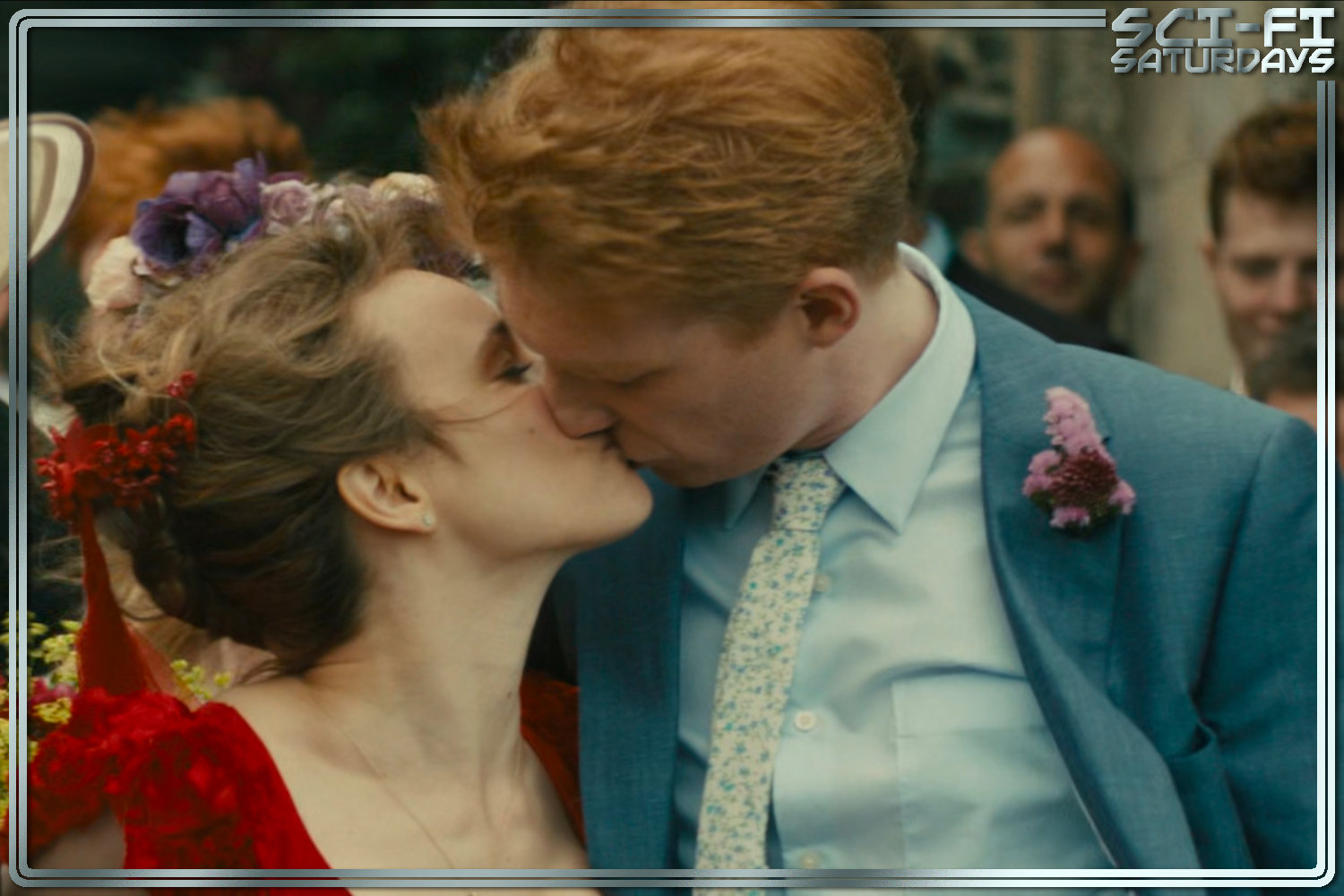
Tim and Mary celebrate their wedding day, stormy as it was, as a perfect moment.
The Science in The Fiction
In the history of sci-fi time travel films, this is the first time that time travel is depicted as being able to alter the sex of a child after conception. It’s a minor point in the film, but this one rule, which was not originally mentioned by Tim’s dad, is that traveling back in time across the birth of your child will probably alter the baby that you have. It’s such a great conceit, since there are so many things that make up the place where you now exist. Thousands of small decisions, and some large ones, define you in this moment. So why wouldn’t altering the past also change what you did up until the point a child was conceived? It only takes one sperm to meet an egg, but who’s to say how different sperm A is from sperm B?
Another question arises from watching About Time, which is not important in the long run, but exists as a curiosity. When Tim travels back in time, such as when he travels back to the night of the New Year’s Eve party, what happens to his younger self? In this case, it appears that he inhabits the same body or at least replaces the younger self in the timeline. The scene where he originally spills drinks all over some kids plays again, but this time he avoids bumping the table. There’s definitely no other version of him lurking about. This means that at the end of the film, when he and his Dad travel back to Tim’s youth and “don’t change a thing,” both Tim and his father are inhabiting their younger selves as they play along the beach. What a wonderful ability to be able to recapture moments in time such as this.

Tim hugs his father one last time before he passes away.
The Final Frontier
One very funny moment, of which there are several, is an homage to Curtis’s first film, Love Actually. Even if people have not seen the film, they are probably aware of its most iconic scene where Andrew Lincoln stands outside Keira Knightley’s front door with cue cards professing his love for her. It’s the 2003 equivalent of the John Cusack boombox scene in Say Anything. Well, Curtis’s has a laugh at his expense in About Time as Tim helps Richard Grant as an actor who has forgotten his lines on stage. Tim stands in the wings with the lines for Grant’s character written on scraps of pizza boxes. It’s funny, but doubly so when seen in relation to the previous scene it homages.
About Time is a wonderful film that everyone should see. If it doesn’t make you at least smile or cry a bit, then there’s something broken inside of you. It’s such an honest and uncynical portrayal of relationships, love, and family that, after a bit, the fact that Tim is time-traveling becomes forgotten, and audiences can just enjoy the wholesome celebration of being together.
Coming Next


Having grown up on comics, television and film, “Jovial” Jay feels destined to host podcasts and write blogs related to the union of these nerdy pursuits. Among his other pursuits he administrates and edits stories at the two largest Star Wars fan sites on the ‘net (Rebelscum.com, TheForce.net), and co-hosts the Jedi Journals podcast over at the ForceCast network.